
General Principles of Juristic Acts: Mistake, Fraud, Invalidity, and Exercise of Rights
Based on 160 consultation cases · Updated · Translated from the Korean original.
To cancel a contract or claim that it is void, you must consider requirements such as whether the mistake was material, whether the motive for contracting was disclosed to the other party, and the extent of any deception. The outcome may depend on the wording of the contract, the circumstances in which it was made, and the parties’ respective interests. It is therefore difficult to determine the contract’s terms or whether it can be canceled based on advertising or explanations alone.
At a glance
Key points
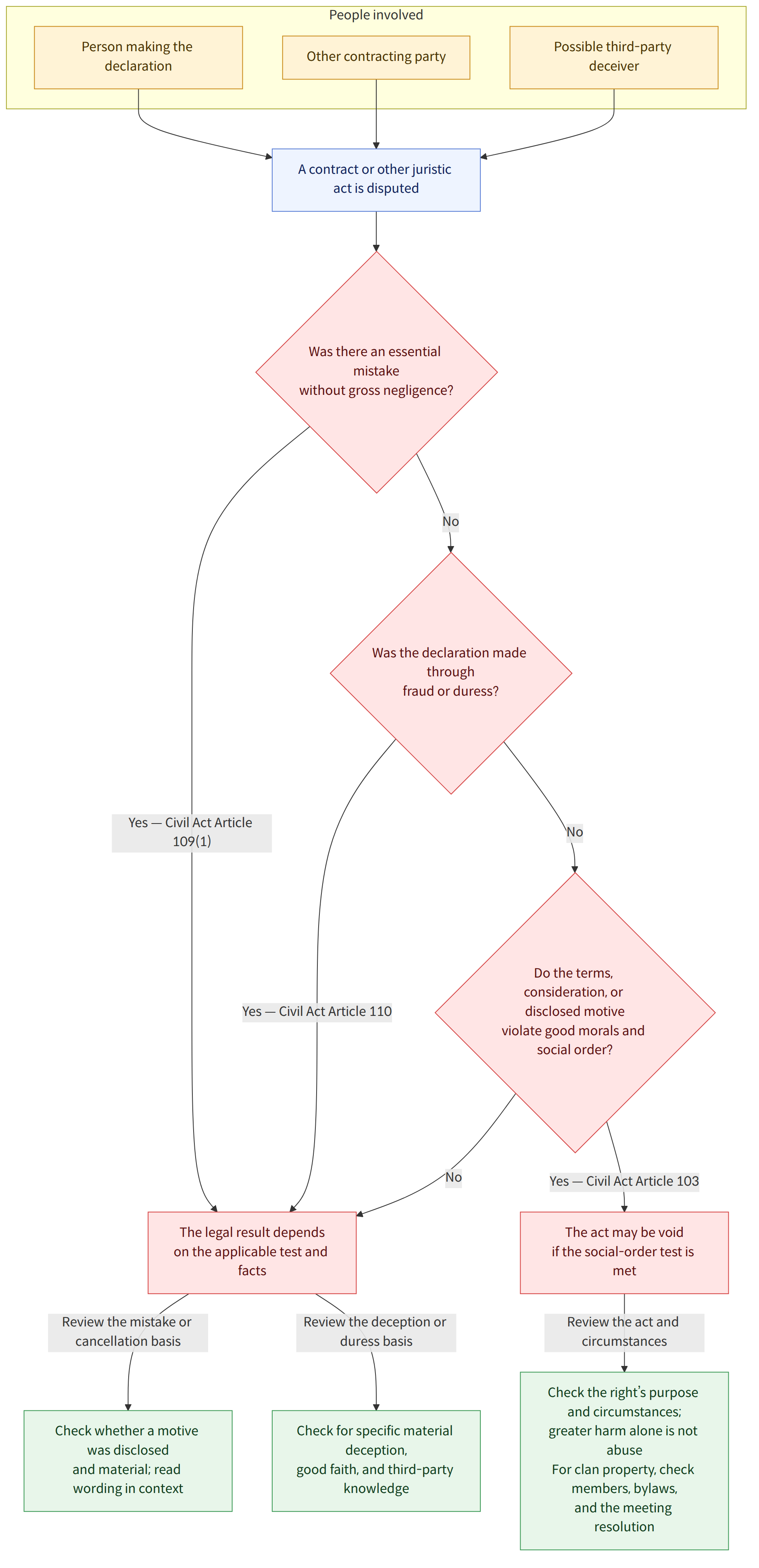
- A juristic act may be canceled if there was a mistake concerning an essential part of its terms, but it cannot be canceled if the person making the declaration was grossly negligent (Civil Act, Article 109(1) (민법 제109조 제1항)).
- Being mistaken about real estate market prices is generally only a mistake concerning the motive for entering into the contract. It is necessary to consider whether the motive can be interpreted as having formed part of the contract and whether the mistake was material (Cases 1 and 7).
- A declaration of intention made through fraud or duress may be canceled. If a third party committed the fraud or duress, it is also necessary to consider whether the other party knew or could have known of it (Civil Act, Article 110 (민법 제110조)).
- A contract cannot be canceled merely because an advertisement contains exaggerations or falsehoods. It is important to determine whether specific false information about a material aspect of the transaction was provided to an extent contrary to the principle of good faith (Cases 3 and 18).
- If the meaning of the wording is unclear, it is interpreted objectively by considering not only the text but also the motive and circumstances of the contract, its purpose, and customary practices (Case 23).
- A juristic act may be void if its terms, conditions, or consideration—or a motive that was stated or disclosed to the other party—violates good morals and social order (Civil Act, Article 103 (민법 제103조)).
- Whether the exercise of a right constitutes an abuse of rights is determined in the specific circumstances, including the purpose of exercising the right and whether it violates social order. The fact that the other party would suffer greater harm does not, by itself, amount to an abuse of rights (Civil Act, Article 2(2) (민법 제2조 제2항); Cases 11 and 25).
- The distribution or management of a clan association’s property, and the appointment of its representative, require consideration of the association’s members and bylaws, as well as the substance and procedure of the general meeting’s resolution. The fact that a resolution is void does not automatically entitle an individual to claim a distribution in an amount of their own choosing (Cases 4, 8, 12, and 17).
Frequently asked questions
Q. Can I cancel a contract because I bought real estate for more than its market value?
Being mistaken about the market value is generally a mistake concerning the motive for entering into the contract, so it is difficult to cancel the contract on that basis alone. However, it is necessary to consider whether the motive can be regarded as having been expressed as part of the contract and whether the mistake was important enough to determine whether the contract would be made.
Q. Can I cancel a document I signed because I misunderstood the type of guarantee?
If you thought you were signing a personal guarantee document without checking its contents, but in fact signed a joint and several guarantee document, this may constitute a mistake in the declaration. Whether it can be canceled depends on whether the mistake concerned an essential part of the document and whether the person who signed it was grossly negligent.
Q. Can I cancel a contract if the area or projected returns in a sales advertisement differ from reality?
A contract cannot be canceled merely because an advertisement contains some exaggeration or falsehood. It is necessary to consider whether specific facts concerning a material aspect of the transaction were falsely represented to an extent contrary to the principle of good faith, and whether the advertised information became part of the actual contract.
Q. If a contract says “I will make every effort,” does that mean I must repay the other party’s debt?
That wording alone does not establish that you intended to assume a legal obligation or guarantee the debt. The objective meaning of the wording, the circumstances in which the contract was made, and its purpose must all be considered to determine whether a guarantee agreement was actually formed.
Q. What can I do if the seller resells the property to someone else after I bought it first?
The second sale is not void merely because the second buyer knew that the seller was acting in breach of trust; it is important to determine whether the second buyer actively participated, for example by inducing or instigating that conduct. If the first buyer has not yet acquired ownership, they cannot directly seek cancellation of the registration from the second buyer. Other options, such as exercising the seller’s rights on the seller’s behalf, may be relevant.
Q. Can I demand performance of a promise made in exchange for testifying in a lawsuit?
If the consideration for testifying goes beyond compensating for losses incurred by appearing in court, the agreement may be void as contrary to social order. In that situation, it may be difficult to legally demand performance of the promise, such as delivery of a car or payment of money.
Q. If a resolution to distribute a clan association’s property is void, can I immediately claim my share?
As a rule, a clan association’s property is distributed in accordance with its bylaws or a resolution of its general meeting. Case law holds that even if an existing distribution resolution is void, a member cannot immediately claim a distribution amount of their own choosing without a new resolution.
Q. Is it always an abuse of rights for the State to invoke the expiration of the statute of limitations?
The fact that the State invokes the statute of limitations does not, by itself, constitute an abuse of rights. It is necessary to consider whether special circumstances exist, such as the State having made it difficult to exercise the right before the limitation period expired or having led the claimant to believe that it would not invoke the limitation period.
Relevant laws
- Civil Act, Article 2(2) (민법 제2조 제2항)
- Civil Act, Article 103 (민법 제103조)
- Civil Act, Article 104 (민법 제104조)
- Civil Act, Article 109(1) (민법 제109조 제1항)
- Civil Act, Article 110(1) and (2) (민법 제110조 제1항·제2항)
- Civil Act, Article 186 (민법 제186조)
- Civil Act, Article 619 (민법 제619조)
- Civil Act, Article 837(1) and (5) (민법 제837조 제1항·제5항)
- Criminal Act, Article 228(1) (형법 제228조 제1항)
- Criminal Act, Article 355(1) (형법 제355조 제1항)
- Civil Procedure Act, Article 1 (민사소송법 제1조)
- Civil Procedure Act, Article 41(1) (민사소송법 제41조 제1호)
- Civil Procedure Act, Article 52 (민사소송법 제52조)
- Civil Execution Act, Article 48(1) (민사집행법 제48조 제1항)
- Farmland Act, Article 6(1) and (2) (농지법 제6조 제1항·제2항)
Watch out for
- To claim a mistake concerning the motive for entering into a contract, you should specifically determine whether the motive was disclosed to the other party, whether it can be regarded as part of the contract, and whether the mistake was material.
- Whether advertising or oral explanations form part of a contract may depend on the wording of the contract and the circumstances in which it was made.
- When considering the distribution of a clan association’s property or the appointment of its representative, you should also check membership eligibility, the bylaws, the procedures for calling and holding a general meeting and passing resolutions, and the substance of the resolution.
- Whether the exercise of a right constitutes an abuse of rights, or whether a statute-of-limitations defense is effective, depends on the specific circumstances. Do not reach a conclusion based solely on the harm to the other party or the difficulty of exercising the right.
Related articles
Source cases
This guide was compiled by AI from the following Korea Legal Aid Corporation consultation cases (in Korean).
- 부동산 시가에 대한 착오를 이유로 계약을 취소할 수 있는지
- 제3자의 기망행위로 신원보증으로 속아 연대보증서류에 날인한 경우
- 연립주택분양광고에서 평형이 과장된 경우 계약을 취소할 수 있는지
- 종원의 자격을 제한하거나 확장한 종중규약의 효력
- 법률행위일반 - 도달주의
- 종중 총회 결의에 대한 무효확인 청구의 소의 담당 판사가 당해 종중의 구성원인 경우 당해 재판 관여 가능 여부
- 매수대상 토지의 30%가 도로로 편입된 때 계약취소 가능한지
- 종중 재산을 분배함에 있어 단순히 성별의 구분에 따라 그 분배 비율 등에 차이를 두는 경우 그 효력
- 농업 경영에 이용하지 않는 농지소유를 금지하고 그 예외에 종중을 포함시키지 않은 농지법(2009. 6. 9. 법률 제9758호...
- 명의신탁된 종중 재산을 타인에게 임의로 처분한 경우 형사적 책임 여부
- 10년 전부터 농지 위에 불법 설치된 송전선의 철거청구 가능한지
- 여성종원이 배분 제외된 종중재산수용보상금을 분배받는 방법
- 민법 제103조에 의하여 무효로 되는 반사회질서 행위의 내용
- 종중원의 자격을 성년남자로만 제한하는 경우 성년여자의 지위확인
- 명의신탁된 종중 재산에 대해 강제집행이 개시된 경우 종중 소유임을 주장하면서 제3자 이의의 소를 제기할 수 있는지 여부
- 종중 명의의 부동산등기를 함에 있어 허위의 종중 대표자 기재를 한 경우 형사처벌을 받는지 여부
- 종중이 종중총회의 결의 없이 부동산중개업자와 체결한 중개수수료 지급약정의 효력
- 상가 분양광고의 과장된 수익성보장을 이유로 계약 취소할 수 있는지
- 근로자에 대한 전보처분이 권리남용에 해당하는지 여부
- 공동 선조 두 명의 후손들로 구성된 종중이 소송의 주체가 될 수 있는지
- 종중의 부동산등기용등록번호부여신청 절차상 대표자로 된 자의 자격
- 부동산 이중매매의 경우 최초매수자의 부동산소유권 취득여부
- 회사와 법인 대표의 관계
- 민사소송절차에서 증언을 조건으로 대가를 받기로 한 약정의 효력
- 국가의 소멸시효 완성 주장이 권리남용에 해당하는지
This guide is general legal information about Korean law, not legal advice for your situation. For a specific case, consult a lawyer or the Korea Legal Aid Corporation (call 132 in Korea).