
Guide to the Allocation and Recovery of Costs in Civil Litigation
Based on 38 consultation cases · Updated · Translated from the Korean original.
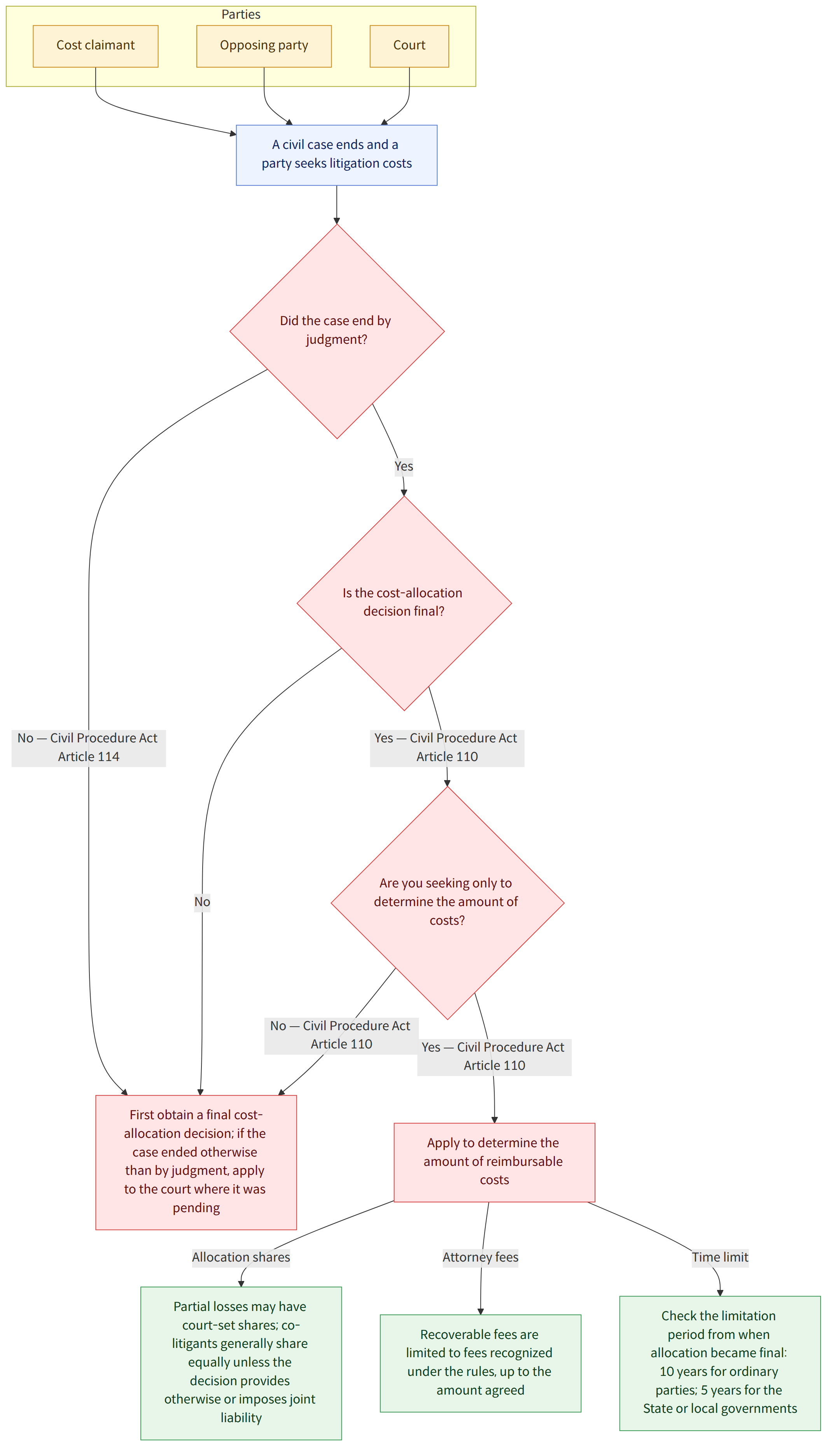
As a general rule, the losing party bears the litigation costs, but the court may allocate them differently in cases such as partial losses or co-litigation. Once the decision allocating the costs becomes final, the specific amount to be reimbursed is determined through the procedure for determining the amount of litigation costs. As a general rule, that procedure cannot be used to dispute anew the reimbursement obligation itself once it has been established.
At a glance
Key points
- As a general rule, the losing party bears the litigation costs. In cases of partial loss, the court may determine the proportions in which the costs are to be borne without having to match them exactly to the ratio between the amount claimed and the amount awarded (Civil Procedure Act, Articles 98 and 101 (민사소송법 제98조, 제101조)).
- If all co-litigants lose and the judgment does not specify a different allocation or impose joint and several liability, the co-litigants generally bear the costs equally as against the opposing party (Civil Procedure Act, Article 102 (민사소송법 제102조)).
- If co-litigants retain an attorney together, attorney fees are generally calculated by combining the amount in controversy for each party. However, where separate cases are consolidated later, the fees may be calculated separately based on the amount in controversy in each case before consolidation and then added together (Cases 1 and 18).
- The attorney fees recoverable from the opposing party are not necessarily all the fees actually paid. They are the fees recognized as litigation costs under the applicable rules, within the amount provided for in the fee agreement (Civil Procedure Act, Article 109 (민사소송법 제109조); Rules on Inclusion of Attorney Fees in Litigation Costs, Article 3 (변호사보수의 소송비용 산입에 관한 규칙 제3조)).
- Expenses incurred to conduct litigation, such as medical-examination costs incurred under a court order, should generally be claimed for reimbursement through the procedure for determining the amount of litigation costs, rather than through a separate damages claim (Case 7).
- If a lawsuit ends other than by judgment, you must apply for a decision allocating litigation costs to the court in which the case was pending when it ended. This cannot be replaced by filing only an application to determine the amount of litigation costs with the court of first instance (Civil Procedure Act, Article 114 (민사소송법 제114조)).
- The procedure for determining the amount of litigation costs determines the amount of costs to be reimbursed; it is not a procedure for reconsidering whether the reimbursement obligation established by the final decision allocating the costs exists (Civil Procedure Act, Article 110 (민사소송법 제110조)).
- Claims for reimbursement of litigation costs are subject to a limitation period. The case explains that the period is 10 years for ordinary parties’ claims and 5 years for claims held by the State or local governments, beginning on the date the decision allocating the costs becomes final (Case 16).
Frequently asked questions
Q. If I win the lawsuit, can I recover all the attorney fees I actually paid?
No. Attorney fees recognized as litigation costs are calculated under the applicable rules, up to the amount of fees actually paid or payable. You cannot automatically claim from the opposing party attorney fees exceeding the amount included under the rules.
Q. How are attorney fees calculated when several people retain an attorney together?
Under the principle described in the case, unless special circumstances exist, the amounts in controversy of co-litigants who retain the same attorney are combined when calculating attorney fees. However, the method of calculation may differ where special circumstances exist, such as co-litigation in which the claims are substantively only weakly related, or where separate cases are later consolidated.
Q. All of the co-defendants lost, but the judgment does not specify the proportions in which they must bear the costs. What happens?
If the judgment merely states that the co-litigants are to bear the costs, without specifying each co-litigant’s share or imposing joint and several liability, they generally bear the costs in equal shares as against the opposing party. The allocation among the co-litigants themselves must be resolved under a separate agreement or substantive law.
Q. Can I claim expenses I paid directly for a medical or land-survey expert examination as damages in a separate action?
Expenses such as examination costs incurred pursuant to a court order for expert examination may be included in litigation costs as expert-examination expenses even if they were paid directly without going through the advance-payment procedure. Rather than seeking these expenses through a separate damages claim, you should seek reimbursement through the procedure for determining the amount of litigation costs.
Q. Where do I apply for litigation costs if I withdraw an appeal or the lawsuit ends before judgment?
If a lawsuit ends without a judicial decision, you must apply for a judicial decision on the allocation of litigation costs to the court in which the case was pending when it ended. After that court determines who bears the costs and in what amount, you can seek reimbursement.
Q. Can I apply later for costs I left out of my application to determine the amount of litigation costs?
If you omit some costs from your application and obtain a final determination without stating that you are claiming only part of the costs, the determination’s res judicata effect may extend to the total litigation costs, and a further application may not be allowed. It is important to check that you have included all relevant costs when applying.
Q. Can I argue in the procedure for determining the amount of litigation costs that I am not liable to bear the costs?
As a general rule, no. The procedure for determining the amount of litigation costs determines the amount of costs to be reimbursed under the judicial decision allocating those costs; it does not rehear and determine whether the reimbursement obligation itself exists.
Q. Can I claim litigation costs from the opposing party long after the amount has been determined?
Claims for reimbursement of litigation costs are subject to a limitation period. The case explains that the period is 10 years for ordinary parties’ claims and 5 years for claims held by the State or a local government. The period is stated to begin on the date the judicial decision allocating litigation costs becomes final, so you should check the applicable limitation period.
Relevant laws
- Civil Procedure Act, Article 66 (민사소송법 제66조)
- Civil Procedure Act, Article 98 (민사소송법 제98조)
- Civil Procedure Act, Article 99 (민사소송법 제99조)
- Civil Procedure Act, Article 101 (민사소송법 제101조)
- Civil Procedure Act, Article 102 (민사소송법 제102조)
- Civil Procedure Act, Article 104 (민사소송법 제104조)
- Civil Procedure Act, Article 105 (민사소송법 제105조)
- Civil Procedure Act, Article 107(2) (민사소송법 제107조 제2항)
- Civil Procedure Act, Article 108 (민사소송법 제108조)
- Civil Procedure Act, Article 109 (민사소송법 제109조)
- Civil Procedure Act, Article 110 (민사소송법 제110조)
- Civil Procedure Act, Article 114 (민사소송법 제114조)
- Civil Procedure Act, Article 117 (민사소송법 제117조)
- Civil Procedure Act, Article 118 (민사소송법 제118조)
- Civil Procedure Act, Article 121 (민사소송법 제121조)
Watch out for
- In the procedure for determining the amount of litigation costs, you may dispute the types and amounts of costs, but it is difficult to dispute anew the reimbursement obligation itself under a final decision allocating the costs.
- If you omit items from your application for litigation costs, a later application for those items may be barred unless you stated that your application was for only part of the costs. Check all of your expenses before applying.
- If the lawsuit ends other than by judgment, or if part of a claim is withdrawn or reduced, the procedure may differ from the standard application to determine the amount of litigation costs. Depending on the circumstances, you may need to apply separately for a decision allocating the costs to the court where the case was pending when it ended.
Source cases
This guide was compiled by AI from the following Korea Legal Aid Corporation consultation cases (in Korean).
- 수인이 공동으로 변호사선임한 때 변호사보수의 소송비용산입 관계
- 수인을 공동피고로 한 사건의 상대방 부담 변호사보수의 산정
- 소송이 재판에 의하지 않고 완결된 경우 소송비용상환방법
- 채권자가 지출한 소송비용 중 채무자 부담 부분의 확정시기
- 파기환송사건을 다시 상고 시 변호사보수의 소송비용산입 관계
- 패소한 자에 대하여 변호사선임비용을 청구할 수 있는지
- 예납금 이외에 직접 지출한 신체감정비용은 어떻게 받아야 하는지
- 변호사보수에 부과되는 부가가치세가 소송비용에 포함되는지
- 소송비용과 기판력
- 부당제소로 인한 소송비용 지출
- 선정자에 대한 소송비용부담재판
- 항소 범위 감축 시 변호사 보수 산정 기준
- 소송비용확정절차에서 소송비용 상환의무의 존부를 다툴 수 있는지
- 상소심에서 소송비용에 대한 담보제공 신청을 할 수 있는 경우
- 비용 부담을 명받은 무권대리인의 항고기간
- 소송비용액과 소멸시효
- 직권에 의한 소송비용 담보제공 재판에 불복하는 방법
- 일방 당사자가 지출한 변호사보수 중 상대방 공동소송인들이 부담할 변호사보수를 소송비용에 산입할 때 변호사보수액의 산정방법
- 선정당사자에 대한 소송비용 확정 결정
- 일부패소의 경우 소송비용부담의 결정방법
- 소송구조결정의 ‘변호사 보수’에 담보제공명령의 대상인 각 심급별 변호사 보수도 포함되는지
- 소송절차 후 패소한 자의 변호사선임비용 지급 범위
- 파산절차에서 무권대리인의 소송비용 부담 규정이 준용되는지
- 민사소송법 제117조 제1항의 담보제공신청권 행사 자격
- 무권대리인과 소송비용
This guide is general legal information about Korean law, not legal advice for your situation. For a specific case, consult a lawyer or the Korea Legal Aid Corporation (call 132 in Korea).