
Evidence in Civil Litigation: What to Submit and How
Based on 17 consultation cases · Updated · Translated from the Korean original.
In a civil lawsuit, you must submit evidence to support the facts you allege. The court decides whether to admit the evidence and how much weight to give it. The procedure for submitting evidence and the matters that must be proved vary depending on the type of evidence, such as documents, recordings, videos, or expert appraisals.
At a glance
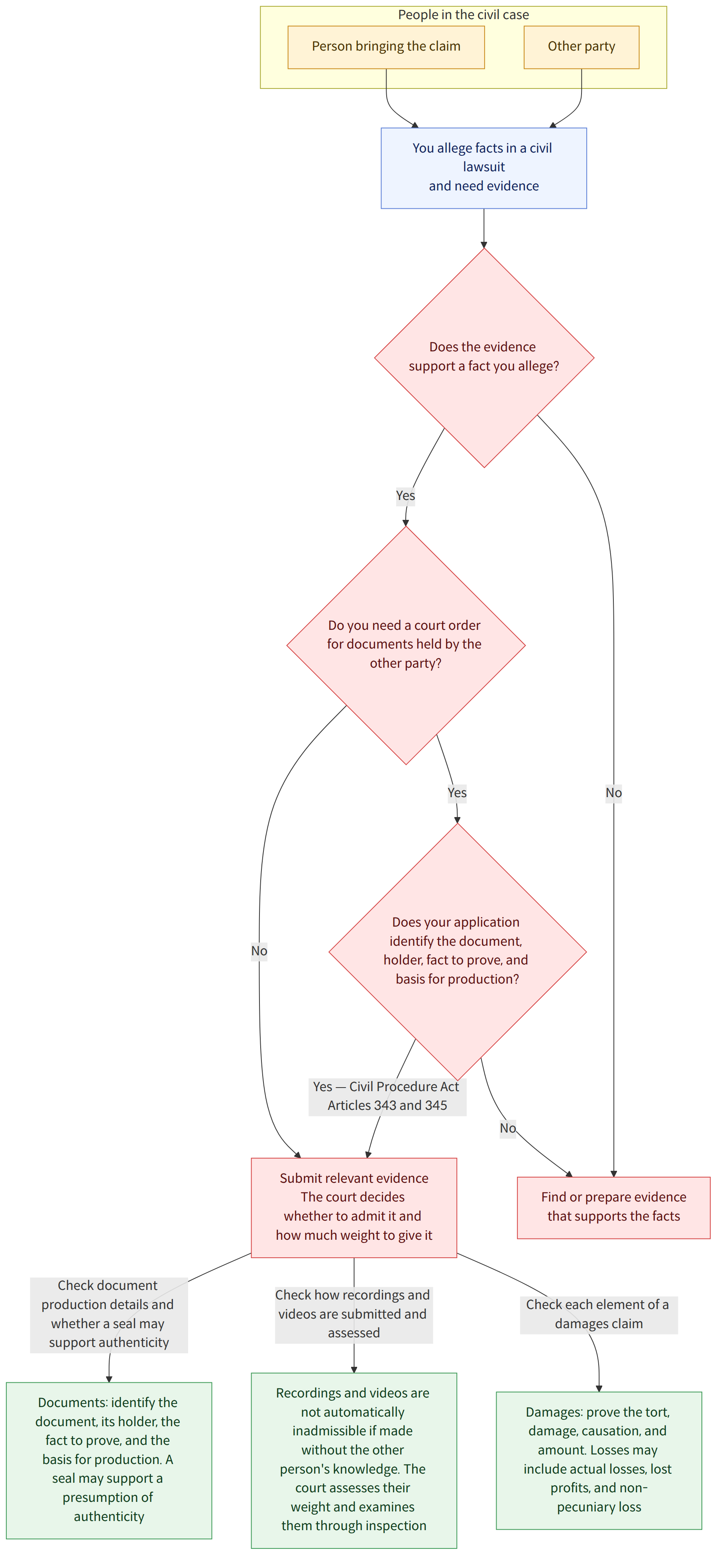
Key points
- Civil litigation follows the principle of free evaluation of evidence. Accordingly, even if material is admissible, the court determines its probative value (Civil Procedure Act, Article 202 (민사소송법 제202조)).
- You can apply for an order to produce documents held by the other party. You must identify and describe the document, state who possesses it, specify the fact to be proved, and explain the basis for the duty to produce it (Civil Procedure Act, Articles 343 and 345 (민사소송법 제343조·제345조)).
- If a document bears the seal impression of the person named as its author, the authenticity of the document as a whole may be presumed. If content was later added to a blank document, whether it was added with proper authority may be at issue (Civil Procedure Act, Article 358 (민사소송법 제358조)).
- A conversation or video recorded without the other party’s knowledge is not automatically inadmissible simply for that reason. The court decides whether to believe it as evidence, and recordings and video materials are examined through inspection (Civil Procedure Rules, Article 121(2) (민사소송규칙 제121조 제2항)).
- Facts established in a related criminal judgment can serve as persuasive evidence in a civil trial, but the civil court is not necessarily bound by that judgment. Nor is a prosecution decision that there is no suspicion of a crime binding on the civil court.
- A claim for damages requires proof of the tort, the occurrence of damage, causation, and the amount of damages. Damages may include actual losses, lost profits, and non-pecuniary loss.
- There are procedures for applying to the court for a witness, an expert appraisal, financial transaction information, or investigation records. The application must state the necessary details, such as the fact to be proved or the purpose of the evidence.
Frequently asked questions
Q. Can I submit a conversation recorded without the other person’s knowledge as evidence in a civil lawsuit?
A recording is not automatically inadmissible as evidence simply because it was made without the other person’s knowledge. The court determines the probative value of its contents, and a recording tape is examined as evidence through inspection. One approach described in case examples is to submit a transcript as documentary evidence together with the audio file or tape.
Q. If the other party’s wrongdoing is established in a criminal trial, will it be established in the same way in a civil lawsuit?
Facts established in a final criminal judgment can serve as persuasive evidence in a civil trial. However, the civil court is not necessarily bound by the criminal judgment and may reach a different conclusion if special circumstances warrant, in light of other evidence in the civil trial.
Q. If the prosecution decides there is no suspicion of a crime, can I no longer claim civil damages?
You cannot conclude that you are at a disadvantage in a civil lawsuit solely because the prosecution decided there was no suspicion of a crime. The civil court is not bound by that decision and will decide the matter based on evidence supporting the facts of the case.
Q. How can I obtain a contract held by the other party as evidence in a civil lawsuit?
You can apply to the court handling the lawsuit for an order to produce documents. You must identify and describe the document, state who possesses it, specify the fact to be proved, and explain the basis for the duty to produce it. In principle, the applicant must prove that the document exists and is in the other party’s possession.
Q. Is it enough just to say that I never signed the contract or IOU submitted by the other party?
If the seal impression on a document is recognized as having been made with the signatory’s seal, the authenticity of the document as a whole may be presumed. To rebut this presumption, you must present a reasonable basis and supporting evidence, or prove, for example, that someone else affixed the seal.
Q. What do I need to submit when applying to call a witness in a civil lawsuit?
Submit a witness application to the court hearing the lawsuit, providing the witness’s identifying information and the matters to be proved through the examination. Case examples advise preparing and submitting the questions for the witness examination in advance and, as a matter of practice, applying at least two weeks before the hearing date.
Q. How should I submit a video recorded on my mobile phone to the court?
Save the video file to a USB drive or similar device and submit it to the court before the hearing date, specifying the video’s contents, when and where it was recorded, and what it is intended to prove. Audio and video materials are examined through inspection and may be played at the hearing.
Q. What evidence should I prepare for a claim for damages?
Prepare evidence to prove the tort, the occurrence of damage, the causal relationship between the two, and the amount of damages. In a case involving damages for assault, the guidance explains how to submit evidence of the amount of damages and the related criminal judgment.
Q. How can I check the other party’s financial transaction records or investigation records?
You can apply to the court for an order requiring the relevant financial institution to submit financial transaction records. Case examples also describe applying for a commission to transmit documents held by the police station or prosecutor’s office to obtain investigation records.
Relevant laws
- Civil Procedure Act, Article 202 (민사소송법 제202조)
- Civil Procedure Act, Article 313 (민사소송법 제313조)
- Civil Procedure Act, Article 343 (민사소송법 제343조)
- Civil Procedure Act, Article 344 (민사소송법 제344조)
- Civil Procedure Act, Article 345 (민사소송법 제345조)
- Civil Procedure Act, Article 349 (민사소송법 제349조)
- Civil Procedure Act, Article 351 (민사소송법 제351조)
- Civil Procedure Act, Article 318 (민사소송법 제318조)
- Civil Procedure Act, Article 311(1) (민사소송법 제311조 제1항)
- Civil Procedure Act, Article 358 (민사소송법 제358조)
- Civil Procedure Act, Article 110 (민사소송법 제110조)
- Civil Procedure Act, Article 256 (민사소송법 제256조)
- Civil Procedure Act, Article 257 (민사소송법 제257조)
- Civil Procedure Rules, Article 121(2) (민사소송규칙 제121조 제2항)
- Commercial Act, Article 32 (상법 제32조)
Watch out for
- The fact that evidence has been submitted or admitted does not, by itself, mean that the allegations it supports will be accepted. The court assesses the credibility of the evidence together with the entire proceedings.
- If a defendant who has received a copy of the complaint does not file an answer within the 30-day period for doing so, the facts underlying the claim may be deemed admitted.
- Questions for witness examination must be submitted in advance to allow preparation for cross-examination and service of the summons. Case examples describe the practice of applying at least two weeks before the hearing date.
Source cases
This guide was compiled by AI from the following Korea Legal Aid Corporation consultation cases (in Korean).
This guide is general legal information about Korean law, not legal advice for your situation. For a specific case, consult a lawyer or the Korea Legal Aid Corporation (call 132 in Korea).