
Guide to Capacity to Be a Party and Changes of Parties in Civil Litigation
Based on 105 consultation cases · Updated · Translated from the Korean original.
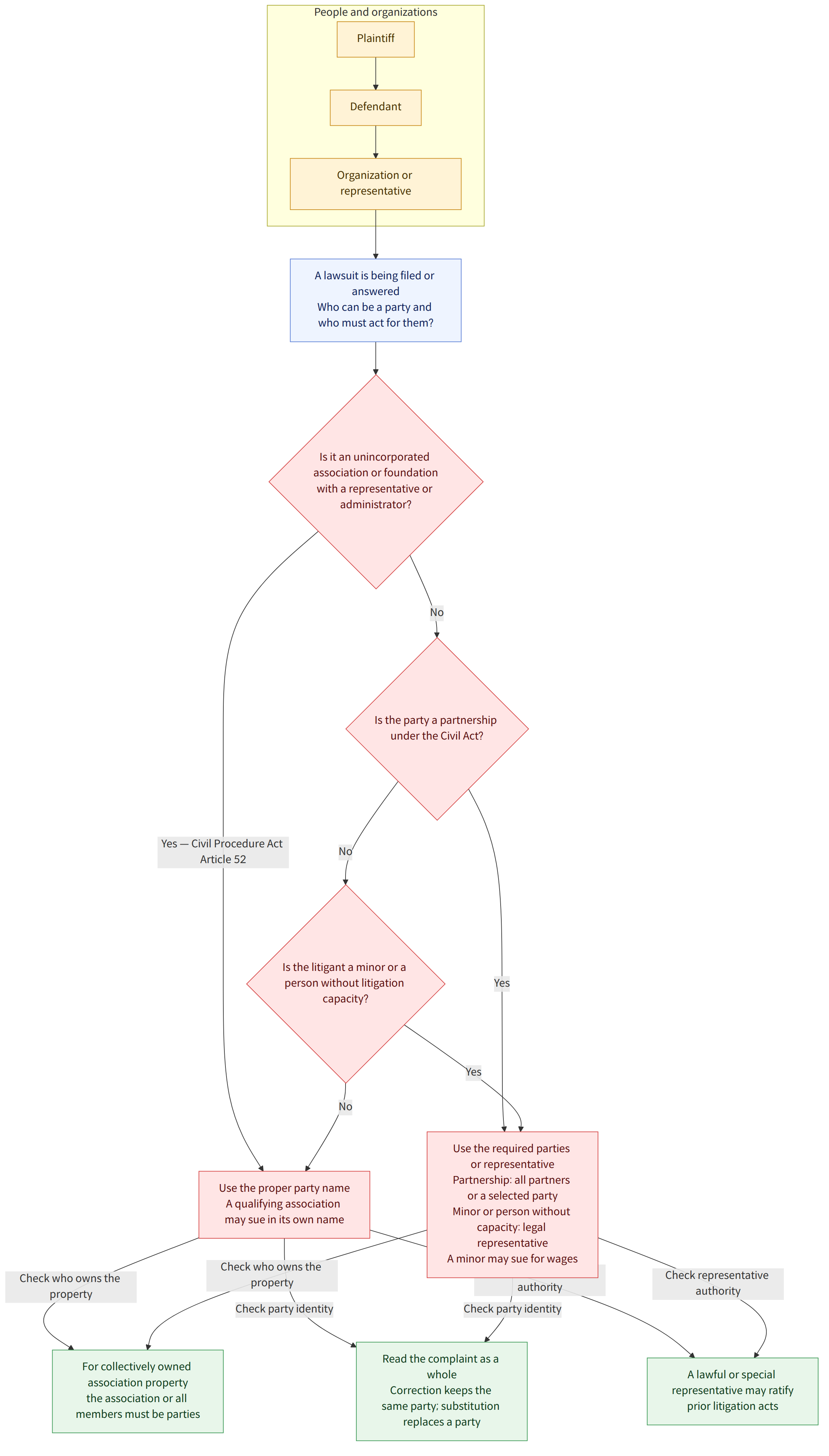
When bringing or responding to a lawsuit, you need to determine who may be a party and who must conduct the proceedings when direct litigation is difficult, such as in the case of an organization or a minor. Correcting a party designation is different from replacing a party with a new one, and the parties and procedures may vary depending on the organization’s substance and the nature of the lawsuit.
At a glance
Key points
- An unincorporated association or foundation may be a party to a lawsuit in its own name if it has a representative or administrator (Civil Procedure Act, Article 52 (민사소송법 제52조)).
- As a general rule, a partnership under the Civil Act does not have capacity to be a party to a lawsuit. All partners must litigate, or another method, such as appointing a selected party, must be used.
- As a general rule, a lawsuit concerning collectively owned property of an unincorporated association, such as a clan association, must be brought in the organization’s name or with all its members as parties.
- Correction of a party designation is a procedure for correcting the designation while preserving the identity of the party. It is distinct from substitution of a party, which replaces the original party with another person or organization.
- The parties are not determined solely by the names written in the complaint. The actual parties may be identified by examining the complaint as a whole, including the claim and its grounds.
- As a general rule, a minor or a person without litigation capacity must litigate through a legal representative. However, a minor may independently bring an action to claim wages.
- A claim for the return of a jointly titled deposit is not necessarily a necessary joint action. However, whether the deposit agreement requires a joint claim in order to receive the money from the bank must be considered separately from the requirements for bringing the lawsuit.
- Even if there is a defect in a representative’s authority, a lawful representative or special representative may ratify the prior litigation acts, potentially making them valid retroactively.
Frequently asked questions
Q. If the chair of the residents’ representative meeting was improperly elected, does that mean the meeting cannot be a party to a lawsuit?
If the previous residents’ representative meeting was lawfully constituted, the fact that a successor representative or building representative was improperly elected does not immediately deprive the association itself of the capacity to be a party to a lawsuit. In that case, the residents’ representative meeting made up of the previous members may have capacity to be a party.
Q. Can a lawsuit seeking repayment of money be filed in the name of a partnership under the Civil Act?
As a general rule, a partnership under the Civil Act does not have capacity to be a party to a lawsuit. All partners must be parties, or the lawsuit must be conducted by another method described in the relevant case, such as appointing a selected party to litigate on their behalf. However, the outcome may differ if, despite being called a partnership, it has the substance of an unincorporated association, including its own organization and decision-making structure.
Q. When there is a dispute over property of a clan association, can its representative sue in their personal name?
Property of a clan association is collectively owned, so its representative may not bring a lawsuit in their own name. The clan association must sue in its own name, or all of its members must be parties. It is also necessary to check whether the clan association has the substance of an organization and a representative.
Q. Can I change the plaintiff from the individual representative to the clan association while a lawsuit is pending?
An individual and a clan association are separate parties, so changing the plaintiff from the individual to the clan association is difficult to treat as a simple correction of the party designation. In the case in question, the court found that the parties were not identical and did not allow the correction. It indicated that the action could instead be withdrawn and a new action brought by the association.
Q. If I filed a lawsuit against someone who had already died, can I change the defendant to their heir?
After examining the entire complaint and the circumstances in which the action was brought, a correction of the party designation may be allowed if the actual defendant was an heir from the outset and only the name was entered incorrectly. However, a deceased person and their heir do not automatically become the same party, so it is important to determine who the actual party is.
Q. Can a minor bring a lawsuit alone, or can someone bring a lawsuit against a minor?
As a general rule, a minor must litigate through a legal representative, and a legal representative must also be designated when bringing an action against a minor. However, a minor may independently bring an action to claim wages for their own labor. If there is no legal representative or the representative cannot exercise their authority, an application may be made to appoint a special representative.
Q. Must all of the account holders jointly sue to recover a jointly titled deposit?
A claim for the return of a jointly titled deposit is not necessarily a necessary joint action in every case. The answer may depend on the nature of the deposit claim and the agreement—for example, whether the deposit consists of business funds or was deposited jointly for a specific purpose. However, if the joint account holders agreed that they would seek repayment together, they may have to follow that procedure to receive the deposit from the bank.
Q. If there is a problem with an organization representative’s authority, must the pending lawsuit start over from the beginning?
Even if there was a defect in the representative’s authority, a new representative or special representative may ratify the prior litigation acts, in which case those acts may become effective retroactively. There is also a court decision holding that, if a lawful representative is newly appointed after a special representative has been appointed, the new representative may validly take litigation steps even before the decision to dismiss the special representative.
Q. Is a lawsuit against a company that has applied for rehabilitation proceedings immediately suspended?
The mere fact that a preservation order or a custodian has been appointed following an application to commence rehabilitation proceedings does not automatically suspend the lawsuit. It is necessary to check whether the court ordered the proceedings suspended. In a lawsuit concerning company property, the custodian or, after commencement of rehabilitation proceedings, the administrator may become a party, which may raise the issue of substitution of parties.
Relevant laws
- Civil Procedure Act, Article 51 (민사소송법 제51조)
- Civil Procedure Act, Article 52 (민사소송법 제52조)
- Civil Procedure Act, Article 55 (민사소송법 제55조)
- Civil Procedure Act, Article 62 (민사소송법 제62조)
- Civil Procedure Act, Article 64 (민사소송법 제64조)
- Civil Procedure Act, Article 87 (민사소송법 제87조)
- Civil Procedure Act, Article 88 (민사소송법 제88조)
- Civil Procedure Act, Article 144 (민사소송법 제144조)
- Civil Procedure Act, Article 260 (민사소송법 제260조)
- Civil Procedure Act, Article 261 (민사소송법 제261조)
- Rules of Civil Procedure, Article 15 (민사소송규칙 제15조)
- Rules on Subject-Matter Jurisdiction in Civil and Family Litigation, Article 2 (민사및가사소송의사물관할에관한규칙 제2조)
- Civil Act, Article 276 (민법 제276조)
- Civil Act, Article 691 (민법 제691조)
- Civil Act, Article 709 (민법 제709조)
Watch out for
- Correction of a party designation differs from substitution of a party. A correction must preserve the identity of the party, so it may not be allowed when it would change the party, such as changing an individual into an organization.
- To sue in an organization’s name, check whether it has the substance of an unincorporated association, whether it has a representative or administrator, and whether the required procedures for litigation have been followed.
- When considering appointment of a special representative, examine whether circumstances specified by law exist, such as the absence of a legal representative or the representative’s inability to exercise their authority, as well as whether delay in the proceedings could cause harm.
- For a jointly titled deposit, whether the action is a necessary joint action and whether the account holders must follow an agreement to make a joint claim to recover the deposit from the bank may be separate issues.
Source cases
This guide was compiled by AI from the following Korea Legal Aid Corporation consultation cases (in Korean).
- 회장선거가 부적법하여 효력이 없는 경우, 입주자대표회의의 당사자능력이 소멸하는지
- 은행을 상대로 한 공동명의예금반환청구소송이 필수적 공동소송인지
- 2억원 초과 약속어음금청구사건에서 처가 소송대리 할 수 있는지
- 민법상 조합이 소송 제기 시 당사자능력과 소송수행방법
- 소송진행 중 피고회사가 회생절차개시 신청된 경우
- 종중재산에 관한 소송당사자로 종중이 될 수 있는지
- 피공탁자가 공탁금출급청구권의 확인을 구할 필요 있는지
- 특별대리인의 추인
- 종중대표자 명의로 소제기 후 종중으로 당사자변경이 가능한지
- 매도인 사망으로 그 장남이 단독상속 시 소유권이전등기청구의 상대방
- 입주자대표회의가 소송절차에서 당사자능력이 인정되는지
- 종중의 실체에 대한 기본적 동일성이 유지되고 있는 경우, 당사자변경에 해당하는지
- 고유한 의미의 종중에 해당하지 않지만 단체성이 인정되는 경우
- 선정당사자와 변호사 사이에 선정자들의 위임없는 부제소합의
- 미성년자를 상대로 한 소의 제기방법
- 자연부락원이 제기한 소(訴)의 당사자를 부락명의로 정정할 수 있는지
- 사망자를 상대로 한 표시정정
- 소송제기 당시에는 자연발생적으로 형성된 ‘고유의미의 종중’임을 주장하였다가, 소송 진행 중 특정지역 거주자나 특정 범위 ...
- 법원이 당사자를 직권으로 확정하여야 하는지
- 소송대리인인 변호사의 심급대리
- 소제기 시 법인대표자 개인으로 하였던 피고를 법인으로 변경 가능한지
- 피성년후견인에 대한 특별대리인선임
- 변론금지의재판과 소송무능력자
- 미성년자 단독으로 임금청구소송을 할 수 있는지
- 몰수형이 선고되지 않은 압수물에 대한 반환청구권
This guide is general legal information about Korean law, not legal advice for your situation. For a specific case, consult a lawyer or the Korea Legal Aid Corporation (call 132 in Korea).