
Jurisdiction in Civil Lawsuits: Where Should You File?
Based on 22 consultation cases · Updated · Translated from the Korean original.
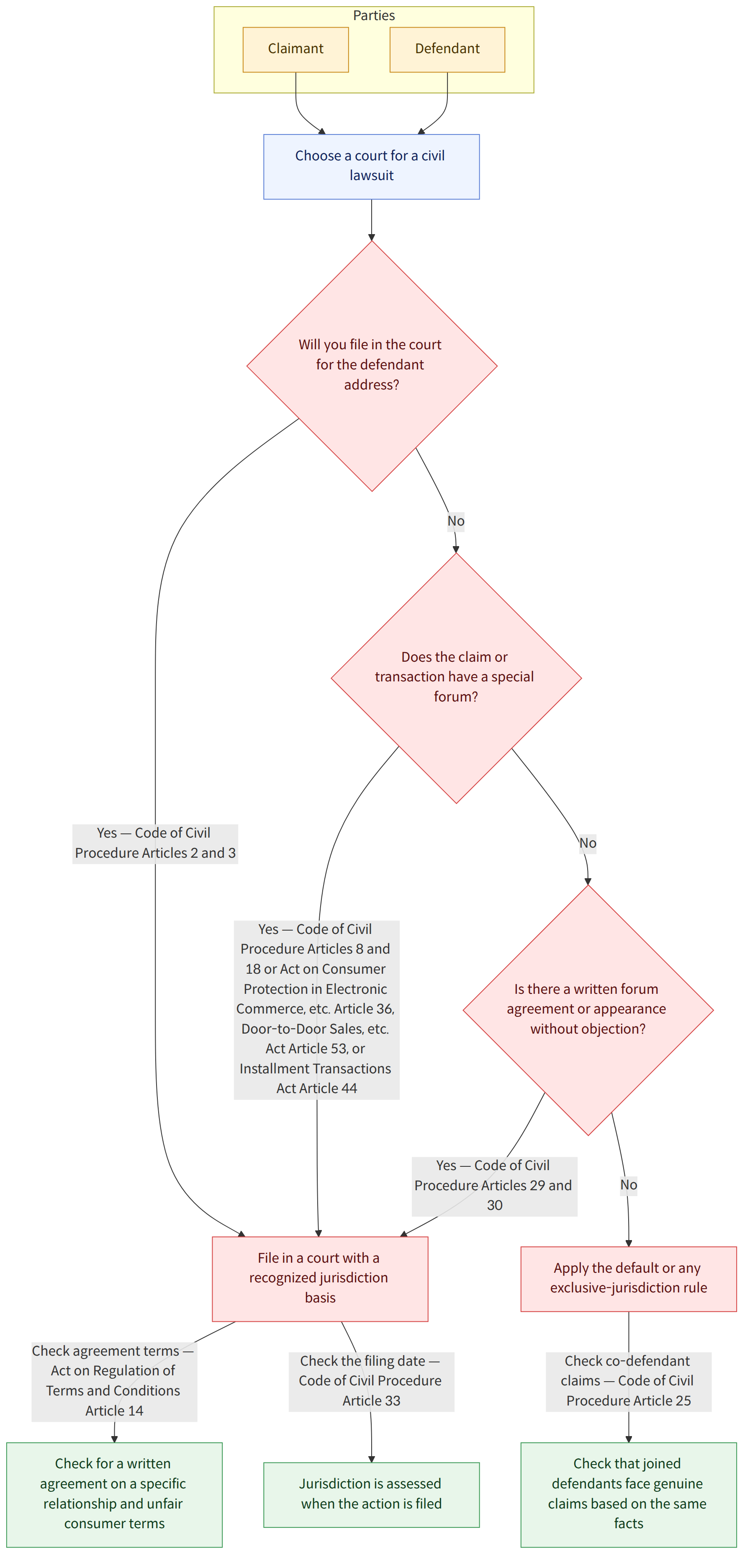
As a general rule, a civil lawsuit is filed in the court with jurisdiction over the defendant’s address. However, separate forums may be available for property rights, torts, consumer transactions, and other matters. The proper court may vary depending on any jurisdiction agreement, whether there are co-defendants, and whether the case is a family or enforcement matter, so both the nature of the claim and the circumstances at the time the action is filed should be considered.
At a glance
Key points
- The basic venue for a civil lawsuit is the court in which the defendant has a general forum. A person’s general forum is determined, as a general rule, by their address (Code of Civil Procedure, Articles 2 and 3 (민사소송법 제2조·제3조)).
- An action concerning a property right may also be brought in the court for the place of residence or the place of performance of the obligation. A tort action may also be brought in the court for the place where the tort occurred (Code of Civil Procedure, Articles 8 and 18 (민사소송법 제8조·제18조)).
- If multiple defendants, such as joint tortfeasors, are sued together based on the same factual cause, related jurisdiction may be recognized. However, if a party against whom there is no genuine claim is joined solely to establish jurisdiction, this may not be recognized and may constitute an abuse of the right to choose a forum (Code of Civil Procedure, Article 25 (민사소송법 제25조); Supreme Court, September 29, 2011, Decision 2011Ma62).
- The parties may agree in writing on the court of first instance having jurisdiction over a specific legal relationship. However, a jurisdiction clause in standard terms that is unfairly disadvantageous to a consumer may be void (Code of Civil Procedure, Article 29 (민사소송법 제29조); Act on the Regulation of Terms and Conditions, Article 14 (약관의 규제에 관한 법률 제14조)).
- Even if there is an agreement on jurisdiction, jurisdiction by appearance may be established if the defendant does not object to lack of jurisdiction and pleads on the merits or makes a statement at a preparatory hearing (Code of Civil Procedure, Article 30 (민사소송법 제30조)).
- Jurisdiction is determined at the time the action is filed. Accordingly, jurisdiction properly established when the action was filed may remain even if later circumstances change and the basis for jurisdiction ceases to exist (Code of Civil Procedure, Article 33 (민사소송법 제33조)).
- Lawsuits related to electronic commerce or door-to-door sales may fall within the exclusive jurisdiction of the court with jurisdiction over the consumer’s address, among other places. For lawsuits concerning installment contracts, the exclusive jurisdiction of the court for the buyer’s address or place of residence may also be at issue (Act on Consumer Protection in Electronic Commerce, etc., Article 36 (전자상거래 등에서의 소비자보호에 관한 법률 제36조); Door-to-Door Sales, etc. Act, Article 53 (방문판매 등에 관한 법률 제53조); Installment Transactions Act, Article 44 (할부거래에 관한 법률 제44조)).
Frequently asked questions
Q. Must a loan repayment lawsuit be filed in the defendant’s place of residence?
As a general rule, the action is brought in the court with jurisdiction over the defendant’s address. However, an action concerning a property right, such as a loan repayment claim, may also be brought in the court for the place of performance of the obligation. The examples explain that, absent a separate agreement, the creditor’s current address may be recognized as the place of performance (Code of Civil Procedure, Article 8 (민사소송법 제8조); Civil Act, Article 467 (민법 제467조)).
Q. If joint tortfeasors are named as defendants together, in which court can I file the lawsuit?
If claims against joint tortfeasors are based on the same factual cause, related jurisdiction may be recognized, allowing the action to proceed together in the court with jurisdiction over one of the defendants. However, related jurisdiction may not be recognized if someone against whom there is no genuine claim is added as a defendant solely to establish jurisdiction.
Q. Must I file a lawsuit only in the court designated in the contract?
When considering an agreement on jurisdiction, it is necessary to examine whether it is a written agreement concerning a specific legal relationship and whether it is exclusive. A forum-selection clause in standard terms that imposes significant inconvenience on consumers by designating a court in a distant location may be void as an unfair jurisdiction agreement. Also, if a separate exclusive-jurisdiction rule applies to a consumer transaction, that rule may take precedence over the agreement in the contract.
Q. If I filed an answer first without objecting to lack of jurisdiction, can the case no longer be transferred?
The mere filing of an answer does not immediately establish jurisdiction by appearance. The examples explain that an objection to lack of jurisdiction may be raised if the answer has not been stated at a hearing. However, jurisdiction may be established if the defendant states an answer on the merits at a hearing, so care should be taken in handling both the jurisdictional objection and the answer on the merits (Code of Civil Procedure, Article 30 (민사소송법 제30조)).
Q. Can I appeal if an application to transfer a case for lack of jurisdiction is denied?
According to the case-law explanation in the examples, transfer for lack of jurisdiction is a matter for the court to consider on its own authority, and the parties do not have a recognized right to apply for a transfer. Accordingly, an appeal against an order denying transfer may not be permitted. In one case, an extraordinary appeal was also found inadmissible on the ground that the party could not be considered to have suffered a disadvantage from the order denying transfer.
Q. Must a person to whom a claim has been assigned or a guarantor comply with the jurisdiction agreement in the original contract?
The examples cite a precedent holding that a specific successor to a contractual claim may succeed to the effect of a jurisdiction agreement attached to the claim relationship. By contrast, an agreement on jurisdiction between the principal debtor and the creditor is explained as not generally binding on a guarantor unless there is a separate agreement.
Q. If I have not divorced my spouse, must I file a claim against the person with whom they had an affair in the Family Court?
The examples explain that a damages claim based on divorce falls within the jurisdiction of the Family Court. However, if the marital relationship has not broken down, and the parties have neither completed a divorce nor are pursuing divorce proceedings, a claim against a third party is treated as an ordinary civil case. Whether the matter belongs in the Family Court or is an ordinary civil case must therefore be determined in light of those circumstances.
Q. Must disputes over online purchases or door-to-door sales be heard only in the court designated by the seller?
According to the examples, lawsuits related to transactions with mail-order sellers fall within the exclusive jurisdiction of the court having jurisdiction over the consumer’s address at the time the action is filed. Lawsuits related to door-to-door sales also fall within the exclusive jurisdiction of the court with jurisdiction over the consumer’s address, among other places. Therefore, even if the terms designate a court on the seller’s side, you should check whether a statutory exclusive-jurisdiction rule applies.
Q. Do municipal courts handle all lawsuits related to payment orders or provisional attachments?
The jurisdiction of a municipal court depends on the type of case and the value of the subject matter of the action, among other factors. The examples explain that even a suit to oppose a claim based on a payment order finalized by a municipal court must be brought in the district court or its branch with jurisdiction over the location of that municipal court if the right under the title of execution exceeds the scope of a small-claims case. They also explain that an application to convert a provisional attachment ordered by a municipal court into an attachment for compulsory execution must be made to that district court or its branch.
Relevant laws
- Code of Civil Procedure, Article 1 (민사소송법 제1조)
- Code of Civil Procedure, Article 2 (민사소송법 제2조)
- Code of Civil Procedure, Article 3 (민사소송법 제3조)
- Code of Civil Procedure, Article 8 (민사소송법 제8조)
- Code of Civil Procedure, Article 18 (민사소송법 제18조)
- Code of Civil Procedure, Article 25 (민사소송법 제25조)
- Code of Civil Procedure, Article 27 (민사소송법 제27조)
- Code of Civil Procedure, Article 29 (민사소송법 제29조)
- Code of Civil Procedure, Article 30 (민사소송법 제30조)
- Code of Civil Procedure, Article 33 (민사소송법 제33조)
- Code of Civil Procedure, Article 34 (민사소송법 제34조)
- Code of Civil Procedure, Article 39 (민사소송법 제39조)
- Code of Civil Procedure, Article 449 (민사소송법 제449조)
- Civil Act, Article 467 (민법 제467조)
- Act on the Regulation of Terms and Conditions, Article 2 (약관의 규제에 관한 법률 제2조)
Watch out for
- Jurisdiction may depend on the type of claim and the addresses of the defendant or consumer, the place of performance of the obligation, and the place where the tort occurred. Do not assume that a single criterion determines jurisdiction.
- Even if there is a jurisdiction agreement, check whether it is exclusive, whether a clause in standard terms is unfairly disadvantageous to the customer, and whether a statutory exclusive-jurisdiction rule applies.
- If, after filing an answer, you state matters concerning the merits at a hearing, jurisdiction by appearance may be established. To challenge lack of jurisdiction, consider whether filing an answer alone is sufficient and whether anything is stated at the hearing.
- The examples refer both to a former monetary threshold and to a revised threshold for small-claims cases within municipal-court jurisdiction. When applying a monetary threshold, check which threshold applies to the case and how the value of the subject matter of the action is calculated.
Source cases
This guide was compiled by AI from the following Korea Legal Aid Corporation consultation cases (in Korean).
- 불법행위에 대한 소 제기 시 관할
- 이송신청 및 특별항고 제기 가부
- 대여금청구소송을 채권자의 주소지 관할법원에 제기할 수 있는지
- 관할선택권의 남용
- 계약서상의 관할합의가 당사자 일방에게 불리한 경우 그 효력
- 관할항정
- 상간녀 소송의 재판관할
- 재소자가 복역 중인 교도소 소재지 관할법원에 소제기 가부
- 자녀의 양육비 명목으로 일정한 금전을 지급하기로 하는 각서를 작성한 경우, 그 지급을 구하는 재판의 관할법원
- 관할합의의 효력이 특정승계인에게 미치는지 여부
- 지급명령에 대한 청구이의의 소의 관할
- 인터넷으로 구입한 물건과 관련된 소송의 관할
- 지방법원 항소부에 재판계속 중 합의부의 사물관할에 속하는 반소를 제기한 경우 고등법원으로 사건이 이송되는지
- 이행명령의 관할
- 할부계약에 의한 관할합의의 효력
- 시군법원에서 받은 채권가압류결정에 대해서 본압류 전이신청을 할 때의 관할법원
- 원금과 이자를 합한 금액이 3,000만원을 초과하는 경우 관할법원
- 관할합의에 위반한 소송에 대한 대응방안 - 관할위반 항변 없이 답변서를 제출한 경우
- 시·군법원의 관할
- 방문판매와 관련된 소송의 관할
- 관할합의에 위반한 소송에 대한 대응방안
- 주채무자와 채권자의 관할합의가 보증인에게 미치는지 여부
This guide is general legal information about Korean law, not legal advice for your situation. For a specific case, consult a lawyer or the Korea Legal Aid Corporation (call 132 in Korea).