
Guide to Civil Statutes of Limitations: Time Limits and How to Interrupt Them
Based on 188 consultation cases · Updated · Translated from the Korean original.
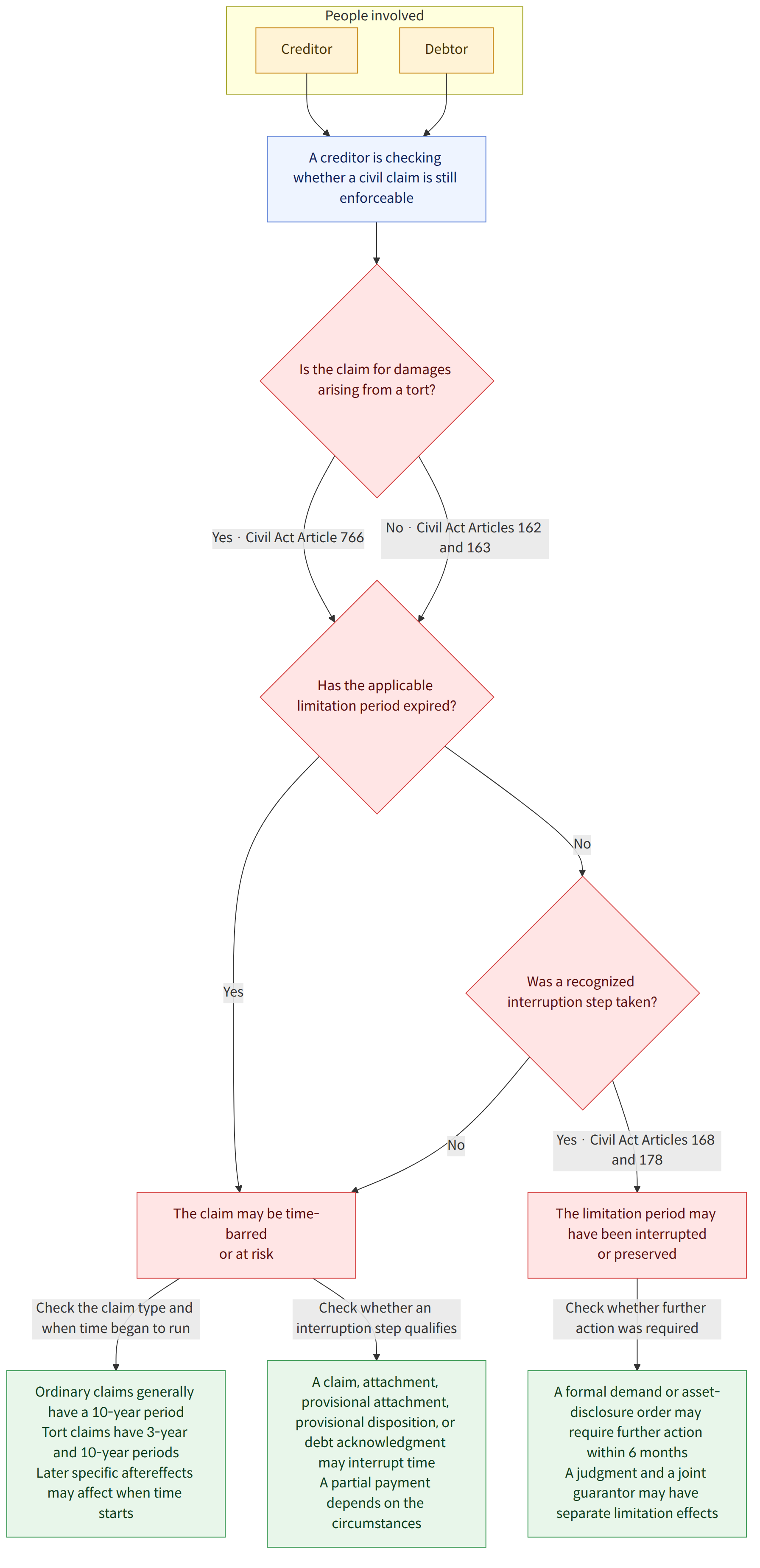
The limitation period varies depending on the type of claim. For ordinary claims, as well as claims for wages, the price of goods, and damages for torts, you should check the applicable time limit and when it begins to run. Filing a lawsuit, attachment or provisional attachment, and acknowledgment of a debt may affect the limitation period. In some cases, however, such as a formal demand or an order to disclose assets, further action must be taken within a specified period.
At a glance
Key points
- As a general rule, an ordinary claim is extinguished by prescription if it is not exercised for 10 years. However, a shorter period may apply to claims for which a shorter period is prescribed by law (Civil Act, Articles 162 and 163 (민법 제162조, 제163조)).
- For a claim for damages arising from a tort, both of the following periods apply: 3 years from the date the victim or their legal representative becomes aware of the damage and the person who caused it, and 10 years from the date of the tort (Civil Act, Article 766 (민법 제766조)).
- If aftereffects or an increase in damages that could not reasonably have been anticipated at the time of the tort later become apparent, the limitation period may begin when the damage becomes actual and specific. The relevant point in time must be determined based on the specific circumstances (Cases 9 and 20).
- The limitation period may be interrupted by a claim, attachment, provisional attachment, provisional disposition, or acknowledgment of a debt. A partial payment may also constitute acknowledgment of a debt, but the outcome depends on the circumstances, including which debt the payment was for (Civil Act, Articles 168 and 178 (민법 제168조, 제178조); Case 11).
- A formal demand, such as one made by certified content mail, does not by itself maintain the effect of interrupting the limitation period indefinitely. As a general rule, further action, such as filing a lawsuit or attaching property, must be taken within 6 months (Civil Act, Article 174 (민법 제174조); Cases 7 and 14).
- An order to disclose assets may have only the effect of a formal demand, rather than the same effect as an attachment. Its effect may therefore be lost if no further action is taken within 6 months after the order is served (Cases 6 and 7).
- If a creditor appears as a defendant in a lawsuit brought by the debtor, actively asserts their rights, and that assertion is accepted, it may be recognized as a judicial claim. However, if the lawsuit ends without a decision on the merits, another step to interrupt the limitation period may need to be taken within 6 months (Civil Act, Article 170 (민법 제170조); Cases 6 and 17).
- If a claim is confirmed by judgment, its limitation period may become 10 years. However, the same period does not automatically apply to a joint guarantor who was not a party to the judgment. The limitation periods for the principal debtor and the guarantor must be considered separately (Civil Act, Articles 165 and 440 (민법 제165조, 제440조); Case 25).
Frequently asked questions
Q. Is the limitation period 10 years for all civil claims?
No. The general rule is 10 years, but a shorter period, such as 3 or 5 years, may apply depending on the type of claim. You should first identify the nature of the claim and the basis on which it arose.
Q. If I learn about aftereffects some time after being injured by a tort, does the limitation period still start on the date of the accident?
If new damage or an increase in damage that could not reasonably have been anticipated at the time of the accident becomes apparent later, the limitation period may begin when that damage is confirmed as actual and specific. However, when the damage was known at the time must be determined based on the specific circumstances.
Q. If the debtor makes a partial repayment, does the limitation period for the remaining debt start again?
If a partial payment is made before the limitation period expires and there is no dispute about the amount paid, it may be treated as an acknowledgment of the debt, interrupting the limitation period for the remaining debt as well. However, the outcome may differ if special circumstances apply, such as uncertainty over which of several separate debts the payment was for.
Q. Does sending certified content mail keep the limitation period interrupted?
A formal demand may have a provisional effect of interrupting the limitation period if certain conditions are met, but repeatedly making demands alone does not keep that effect in force. As a general rule, further action, such as filing a lawsuit or attaching property, must be taken within 6 months after the demand.
Q. If I obtain an order to disclose assets, does it interrupt the limitation period just like an attachment?
An order to disclose assets is not treated as a ground for interrupting the limitation period in the same way as an attachment, provisional attachment, or provisional disposition; it may have only the effect of a formal demand. That effect may be lost if no further action, such as filing a lawsuit or attaching property, is taken within 6 months after the order is served.
Q. If the debtor files a lawsuit first, can I interrupt the limitation period by asserting my claim as the defendant?
If the defendant actively asserts their rights in the lawsuit and that assertion is accepted, it may constitute a judicial claim. However, merely defending the lawsuit does not always have this effect, and if the case ends without a decision on the merits, you may need to take another step within 6 months.
Q. Does a judgment against the principal debtor make the guarantor's debt subject to a 10-year limitation period too?
Even if a judgment between the principal debtor and the creditor makes the limitation period for the principal debt 10 years, that same period does not automatically apply to a guarantor who was not a party to the judgment. The limitation period applicable to the guarantee debt may depend on the nature of that claim, and you should also consider whether the limitation period for the principal debt has expired.
Q. Does obtaining a notarial deed for a promissory note extend the limitation period to 10 years?
A notarial deed may be used for compulsory execution, but it does not have the same res judicata effect as a final judgment. Therefore, the deed alone does not change the limitation period to 10 years. The nature and limitation period of the underlying claim and the claim under the note must each be considered.
Relevant laws
- Civil Act, Article 162 (민법 제162조)
- Civil Act, Article 163 (민법 제163조)
- Civil Act, Article 165 (민법 제165조)
- Civil Act, Article 166 (민법 제166조)
- Civil Act, Article 168 (민법 제168조)
- Civil Act, Article 170 (민법 제170조)
- Civil Act, Article 174 (민법 제174조)
- Civil Act, Article 178 (민법 제178조)
- Civil Act, Article 423 (민법 제423조)
- Civil Act, Article 440 (민법 제440조)
- Civil Act, Article 766 (민법 제766조)
- Commercial Act, Article 64 (상법 제64조)
- Commercial Act, Article 724(2) (상법 제724조 제2항)
- Guarantee of Automobile Accident Compensation Act, Article 10 (자동차손해배상 보장법 제10조)
- Guarantee of Automobile Accident Compensation Act, Article 41 (자동차손해배상 보장법 제41조)
Watch out for
- The limitation period and the date on which it begins to run may vary depending on the type of claim, the due date for payment, when the damage became specifically known, and other factors.
- A formal demand, an order to disclose assets, filing a lawsuit, and a provisional attachment do not all have the same effect. If a proceeding is withdrawn or ends without a decision on the merits, check the deadline for taking further action.
- The effect of interrupting the limitation period may differ for claims against the principal debtor, a guarantor, a joint and several debtor, or an insurance company. The relevant debts and legal relationships should therefore be considered separately.
- Whether the limitation period has expired may not be something the court determines automatically. In an actual dispute, the parties' arguments and the specific facts are important.
Source cases
This guide was compiled by AI from the following Korea Legal Aid Corporation consultation cases (in Korean).
- 부동산중개인이 체결한 보증보험 계약상 보험금청구권의 소멸시효 기간
- 국가배상청구권의 소멸시효기간은 어떻게 되는지
- 부동산실명법위반 명의신탁, 부동산소유권이전등기청구권 소멸시효
- 농업협동조합이 조합원에게 판매한 사료대금채권의 소멸시효 기간
- 교통사고피해자의 보험회사에 대한 책임보험 배상청구권의 소멸시효기간
- 소멸시효 중단
- 재산명시결정에 소멸시효중단의 효력이 인정되는지
- 물상보증인의 제소에 대한 저당권자의 응소가 소멸시효 중단사유인지
- 교통사고로 인한 후유증 치료비청구권의 소멸시효 기산점
- 새마을금고가 상인회원에게 대여한 대출금채권의 소멸시효기간
- 시효완성 전에 채무일부를 변제한 경우 소멸시효 중단효력 있는지
- 채권자의 회생절차 참가로 인한 시효중단이 보증채무에도 미치는지
- 할부금채권에 대한 소멸시효기간은 어느 때부터 진행하는지
- 소멸시효완성 후 제기된 소 취하 후 다시 소제기 한 경우 소멸시효중단여부
- 채권 확보수단으로 받은 약속어음 공정증서의 소멸시효 기간
- 임금채권 담보로 받은 어음채권행사의 경우 임금채권의 소멸시효 중단여부
- 피고로 응소하여 한 권리주장, 시효중단사유인 재판상청구인지
- 부동산취득시효완성 한 때 소유권이전등기청구권의 소멸시효기간
- 연대채무자 1인에 대한 소멸시효 중단의 효력
- 교통사고 16년 후 후유증 발생 시 손해배상청구권의 소멸시효 기산점
- 10년 전 확정된 소유권이전등기이행판결에 의한 등기신청 여부
- 인낙조서의 원인인 계약이 무효인 때 시효중단을 위한 재소 가능한지
- 형사사건관련 변제공탁이 소멸시효중단사유인 묵시적 승인이 되는지
- 가해자의 보험자가 의료기관에 치료비 직접지급시 소멸시효중단범위
- 주채무자에 대한 판결확정의 경우 보증채무의 소멸시효기간 변동여부
This guide is general legal information about Korean law, not legal advice for your situation. For a specific case, consult a lawyer or the Korea Legal Aid Corporation (call 132 in Korea).