
Guide to Grounds and Procedures for Retrial in Civil Litigation
Based on 28 consultation cases · Updated · Translated from the Korean original.
A retrial is a procedure for challenging a final judgment on the merits when a ground prescribed by law exists. Even if there is a ground for retrial, it may not be permitted, or a different procedure may be required, depending on the judgment at issue, the filing deadline, and the history of the case.
At a glance
Key points
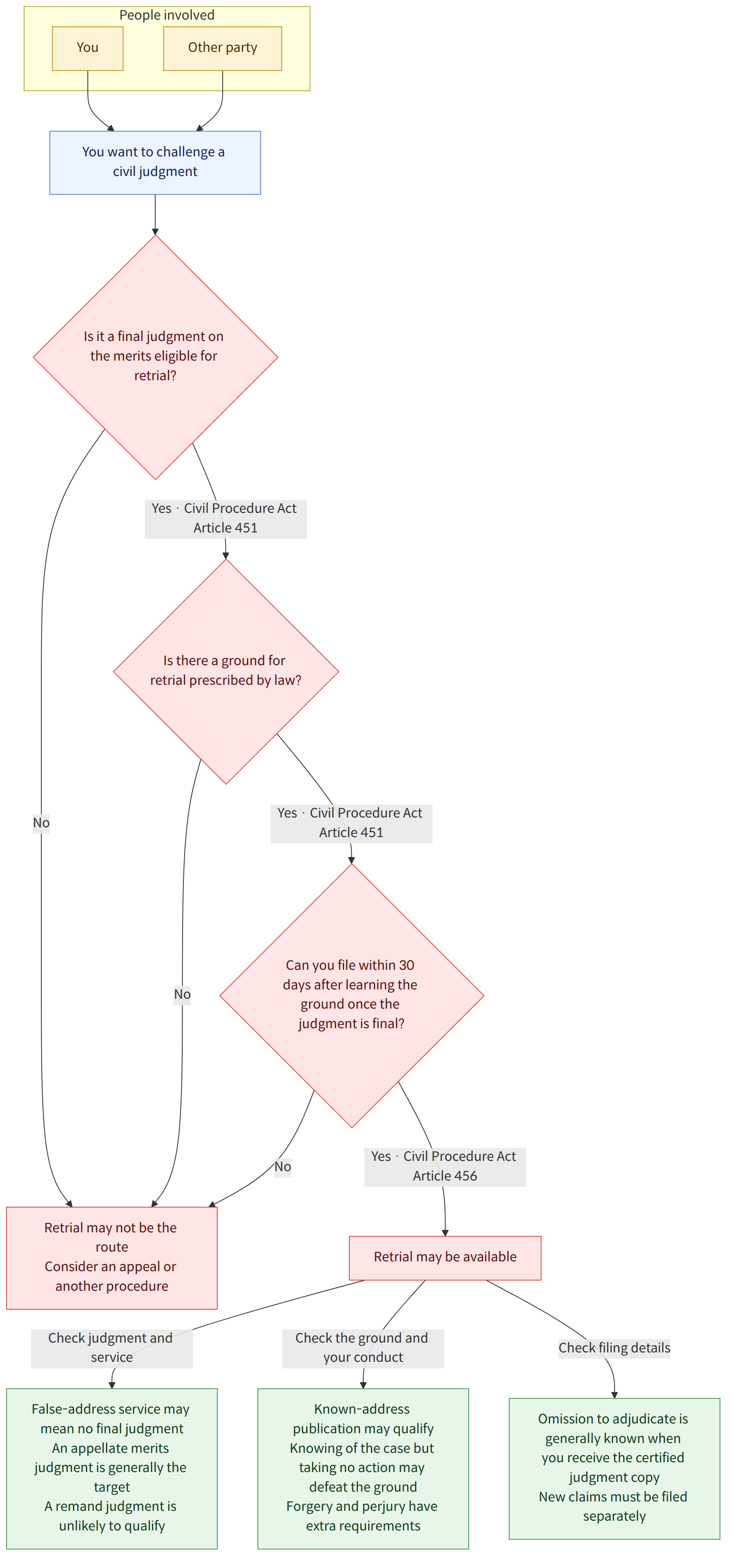
- A retrial is directed at a final judgment on the merits, and the ground for retrial must be one prescribed by law (Civil Procedure Act, Article 451 (민사소송법 제451조)).
- If the other party knew your address but proceeded with the lawsuit by service by publication, this may constitute a ground for retrial. However, a ground may not be recognized if you knew about the proceedings but took no action (Case 2).
- If documents were sent to a false address, received by a third party, and a judgment was issued, the judgment may not have been legally served on the defendant and may not have become final. An appeal, rather than a retrial, may therefore be at issue (Case 1).
- The mere fact that a document was forged or that perjury occurred is not enough. For forged evidence, the requirements for criminal punishment are at issue. For perjury, the testimony must have served as a basis for the judgment and must have had the potential to affect the outcome (Civil Procedure Act, Article 451(1)(6) and (7), and Article 451(2) (민사소송법 제451조 제1항 제6호·제7호, 제2항)).
- An action for retrial must be filed within 30 days from the date, after the judgment becomes final, on which the ground for retrial became known. Unless there are special circumstances, an omission to adjudicate may be regarded as having become known when the certified copy of the judgment was received (Civil Procedure Act, Article 456 (민사소송법 제456조); Case 8).
- If the appellate court issued a judgment on the merits, the appellate judgment, not the first-instance judgment, is generally the subject of retrial. A judgment setting aside a decision and remanding the case is unlikely to be regarded as a final judgment on the merits subject to retrial (Civil Procedure Act, Article 451(3) (민사소송법 제451조 제3항); Cases 15 and 17).
- A final decision recommending performance has no effect of res judicata and cannot be challenged by retrial or quasi-retrial. Before enforcement, an action to oppose a claim may be at issue; after enforcement is complete, an action for restitution of unjust enrichment or another appropriate action may be at issue (Trial of Small Claims Act, Article 5-8(3) (소액사건심판법 제5조의8 제3항); Cases 5 and 16).
- An action for retrial may seek to have the judgment set aside and a decision made on the claim in the original action, but a new claim, such as cancellation of registration, cannot be joined and must be filed separately (Cases 12 and 22).
Frequently asked questions
Q. If the other party won by giving a false address, should I seek a retrial?
If the other party sent litigation documents to a false address and a third party received them, the judgment may not have been legally served on you, meaning the time to appeal may not have started and the judgment may not have become final. In that case, you should consider whether you can challenge the judgment by appeal rather than by retrial. By contrast, if the other party knew your address but proceeded with the lawsuit by service by publication, and the judgment became final, this may constitute a ground for retrial.
Q. Can I seek a retrial even if I knew the lawsuit was proceeding by service by publication but did not respond?
If you knew about the proceedings while the lawsuit was pending but took no action, a ground for retrial may not be recognized unless there are special circumstances. You may also consider an appeal filed after the deadline due to a justifiable reason, but if two weeks have passed since you reviewed the case record, you may have missed the period for filing such an appeal described in the case.
Q. Can I seek a retrial if it is clear that the evidence in the judgment was forged and the statute of limitations has expired?
If it is clear that the evidence was forged and a conviction could not be obtained because the statute of limitations had expired, this may be a case in which a conviction cannot be obtained for a reason other than insufficient evidence. Accordingly, a ground for retrial concerning forged evidence under the Civil Procedure Act may be recognized.
Q. Can a retrial be sought if a witness in a civil lawsuit is convicted of perjury?
A conviction for perjury does not always permit a retrial. The false testimony must have been admitted as evidence establishing a fact on which the judgment was based and must be reflected in the written judgment. There must also be a possibility that the outcome would have been different without that testimony.
Q. By when must I file for a retrial based on an omission to adjudicate?
An action for retrial must be filed within 30 days from the date, after the judgment becomes final, on which the ground for retrial became known. Unless there are special circumstances, an omission to adjudicate can be identified by reading the certified copy of the judgment, so the date you received that copy may be regarded as the date the period began.
Q. If a case went through an appeal, should the retrial be directed at the first-instance judgment or the appellate judgment?
If the appellate court issued a judgment on the merits of the case, a retrial of the first-instance judgment is not permitted; the retrial must instead be directed at the appellate judgment. If the ground for retrial concerns the appellate judgment or is common to both judgments, an action for retrial filed against the first-instance judgment may be transferred to the appellate court.
Q. Can a final decision recommending performance be challenged by quasi-retrial on the ground of forged evidence?
A final decision recommending performance does not have the effect of res judicata of a final judgment, so an action for quasi-retrial cannot be filed even if the decision has a defect that would constitute a ground for retrial. If enforcement has not been completed, an action to oppose a claim may be considered; if enforcement has been completed, an action for restitution of unjust enrichment or another appropriate action may be considered.
Q. When seeking a retrial, can I also request cancellation of the registration of real estate transferred under the judgment?
An action for retrial cannot be joined with a new claim, such as cancellation of a registration, in addition to seeking to have the judgment set aside and a decision on the claim in the original action. A claim for cancellation of registration must be filed in a separate lawsuit.
Q. Can I claim that a mediation record is invalid if its terms violate the law?
A mediation record has the same effect as a judicial settlement. Unless there is a ground for it to be void from the outset, you cannot claim that it is invalid solely because its terms contravene a mandatory law. If there was a defect in the mediation, relief through quasi-retrial proceedings may be at issue.
Relevant laws
- Civil Procedure Act, Article 41 (민사소송법 제41조)
- Civil Procedure Act, Article 173(1) (민사소송법 제173조 제1항)
- Civil Procedure Act, Article 216 (민사소송법 제216조)
- Civil Procedure Act, Article 451 (민사소송법 제451조)
- Civil Procedure Act, Article 454(1) (민사소송법 제454조 제1항)
- Civil Procedure Act, Article 456 (민사소송법 제456조)
- Civil Procedure Act, Article 458(1) (민사소송법 제458조 제1항)
- Civil Procedure Act, Article 459(1) (민사소송법 제459조 제1항)
- Civil Procedure Act, Article 461 (민사소송법 제461조)
- Civil Execution Act, Article 44(2) (민사집행법 제44조 제2항)
- Trial of Small Claims Act, Article 5-7(1) (소액사건심판법 제5조의7 제1항)
- Trial of Small Claims Act, Article 5-8(3) (소액사건심판법 제5조의8 제3항)
- Civil Mediation Act, Article 27 (민사조정법 제27조)
- Civil Mediation Act, Article 28 (민사조정법 제28조)
- Civil Mediation Act, Article 29 (민사조정법 제29조)
Watch out for
- Merely claiming that a ground for retrial exists does not mean a retrial will be permitted. Both the effect of the ground on the judgment and the requirements prescribed by law must be considered.
- The deadline for seeking a retrial may depend on when the judgment became final and when the ground for retrial became known. One case held that a judgment dismissing an appeal without further examination became final when it was served and took effect.
- Where documents were sent to a false address and where proceedings were conducted by service by publication may involve different questions about whether the judgment became final and which procedure is available to challenge it.
- A decision recommending performance, a judgment setting aside a decision and remanding the case, and a case in which the appellate court issued a judgment on the merits may differ from ordinary final judgments in whether they are subject to retrial, and should be distinguished.
Source cases
This guide was compiled by AI from the following Korea Legal Aid Corporation consultation cases (in Korean).
- 허위의 주소로 사위(詐僞)판결을 받은 경우 재심사유인지
- 상대방 주소를 알면서도 공시송달로 소송진행한 경우 재심사유인지
- 재심사유
- 민사상 증인이 위증죄의 확정판결을 받으면 항상 재심청구사유인지
- 확정된 이행권고결정에 재심사유에 해당하는 하자가 있음을 이유로 준재심의 소를 제기할 수 있는지 여부
- 대표이사가 법인에 대한 배임죄로 유죄판결 받은 경우 재심을 청구할 수 있는지 여부
- 확정된 재심판결에 대하여도 재심의 소를 제기할 수 있는지 여부
- 재심기간
- 재심사유
- 재심기간의 준수 여부
- 방어방법제출이 방해된 경우
- 재심의 소에서 신청구를 병합할 수 있는지 여부
- 조정조서에 서명을 하고 난 후의 구제절차
- 소권의 남용
- 항소심에서 본안판결을 한 사건의 재심대상
- 소액사건의 재심
- 파기환송판결을 대상으로 재심이 가능한지 여부
- 원재판에 관여한 법관이 그 재심사건의 재판에 관여할 수 있는지 여부
- 대법원 판례를 변경하는 경우임에도 2/3 이하의 합의체에서 심판을 하지 않는 경우 재심 가능여부
- 재심의 관할
- ‘재심을 제기할 판결이 전에 선고한 확정판결과 저촉되는 때’의 뜻
- 재심의 소에서 신청구를 병합할 수 있는지
- 재심의 소 제기가 채권자대위권의 목적이 될 수 있는지 여부
- 심리불속행 판결로 기각된 사건의 재심청구기간
- 조정조서의 효력과 준재심의 소
This guide is general legal information about Korean law, not legal advice for your situation. For a specific case, consult a lawyer or the Korea Legal Aid Corporation (call 132 in Korea).