
Guide to the Effects, Rescission, and Termination of Settlement Agreements
Based on 36 consultation cases · Updated · Translated from the Korean original.
When a settlement agreement is made, the parties’ rights and obligations are generally determined by its terms, so it is difficult to undo the settlement merely because the actual damages later prove greater or someone has changed their mind. However, depending on the specific circumstances—including the scope of the settlement, mistake or fraud, additional losses that were difficult to foresee, or the other party’s failure to perform—rescission, termination, or an additional claim may be possible.
At a glance
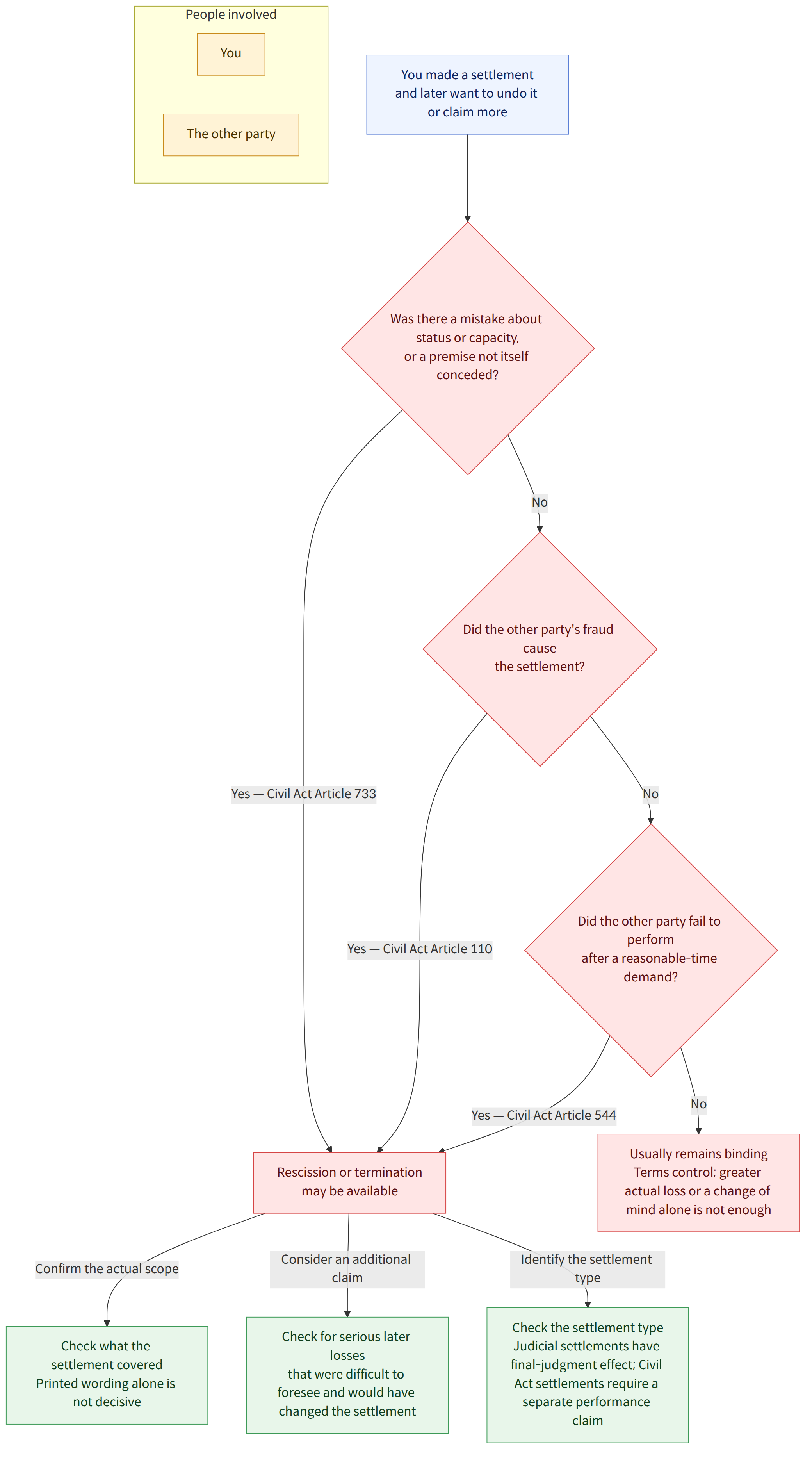
Key points
- A settlement is a contract under which the parties make mutual concessions to end a dispute. As a general rule, once it is concluded, the rights conceded are extinguished and the rights established by the settlement arise (Civil Act, Articles 731 and 732 (민법 제731조·제732조)).
- As a general rule, a settlement agreement cannot be rescinded on the ground of mistake. However, rescission may be possible if there was a mistake concerning a party’s status or capacity, or concerning a matter that formed the premise or basis of the dispute but was not itself the subject of a concession (Civil Act, Article 733 (민법 제733조)).
- If the parties settled on the undisputed premise that only one party was at fault in the accident, the settlement may be rescinded for a mistake concerning that premise. However, rescission may be difficult if the parties disputed and settled the contributory negligence ratio itself (Cases 9, 12, and 17).
- Wording preprinted in a settlement agreement does not automatically become part of the settlement terms. Whether the wording is merely sample language is determined by examining the parties’ intentions, the circumstances in which the settlement was reached, and other specific circumstances (Cases 1 and 8).
- There may be grounds to find that a serious subsequent loss was not within the scope of the waiver under the settlement if it was difficult to foresee at the time of settlement and, had it been foreseen, the parties would not have settled for that amount (Cases 4, 14, and 24).
- A mistake concerning the dispute that was the subject of the settlement is generally not grounds for rescission, but if the settlement was made as a result of the other party’s fraud, rescission for fraud may be claimed (Civil Act, Article 110 (민법 제110조); Cases 6, 10, and 15).
- A settlement agreement may also be terminated if the other party fails to perform their obligations. Unless special circumstances apply, you must first demand performance within a reasonable period, and the other party must fail to perform within that period (Civil Act, Article 544 (민법 제544조); Cases 16 and 22).
- Settlements under the Civil Act and judicial settlements have different effects. A judicial settlement is recorded and has the same effect as a final judgment, whereas if a party fails to perform a settlement under the Civil Act, performance must be claimed separately (Civil Procedure Act, Article 220 (민사소송법 제220조); Case 7).
Frequently asked questions
Q. If I learn after entering into a settlement agreement that my actual damages are greater, can I make another claim?
As a general rule, a claim may be made only within the scope of the settlement, and it is difficult to undo the settlement merely because the actual damages exceed the settlement amount. However, an additional claim may be possible for a serious subsequent loss that was difficult to foresee at the time of the settlement and that, if foreseen, would have led the parties not to settle for that amount.
Q. If the settlement agreement is printed with the wording “I will raise no civil or criminal objections,” can I still claim damages for a permanent disability?
The scope of the settlement is not determined merely because that wording is printed on the agreement. The wording is assessed in light of various circumstances, including how the settlement was reached, the extent of the injury, and the relationship between the parties, to determine whether it reflects the actual terms of the settlement or is merely sample wording. Depending on the specific circumstances, there may be grounds to claim damages for a permanent disability.
Q. I settled because I thought the traffic accident was entirely my fault. Can I rescind the settlement if the other party was also at fault?
If the parties agreed without dispute on the premise that the other party was not at fault, and that premise was mistaken, there may be grounds to rescind the settlement agreement. By contrast, if the parties disputed and then compromised on the contributory negligence ratio itself, it may be difficult to rescind the agreement based solely on a mistake about that ratio.
Q. Can I rescind a settlement if it later turns out that there was no responsibility for the accident or no causal connection?
If responsibility or causation itself was in dispute between the parties, the settlement generally cannot be rescinded merely because it later turns out that one party was not responsible. However, rescission may be possible if the parties did not dispute responsibility, treated it as a premise of the settlement, and that premise was mistaken.
Q. Can I rescind a settlement agreement if the other party lied to me to get me to settle?
A mistake concerning the dispute that was the subject of the settlement is generally not grounds for rescission, but if the settlement was made as a result of the other party’s fraud, it may be rescinded on that ground. The specific issues include whether there was deceptive conduct and whether it led to the settlement.
Q. If the other party does not pay the settlement amount, can I terminate the settlement and claim all of my original damages?
A settlement agreement is also a contract, so it may be terminated if the other party fails to perform their obligations. Unless special circumstances apply, you must first demand performance within a reasonable period, and the other party must fail to perform within that period. If you seek additional damages after termination, you must prove those damages.
Q. Is it more advantageous to settle separately and withdraw the lawsuit, or to enter into a judicial settlement while the lawsuit is pending?
Once a judicial settlement is reached, a record of settlement is prepared, and it has the same effect as a final judgment. A settlement under the Civil Act does not, by itself, have the same enforceability as a final judgment, so if the other party fails to perform their promise, you may have to bring a separate claim for performance.
Q. If the injured person settles, are the parents’ or child’s rights to claim consolation damages extinguished as well?
The injured person’s own settlement does not automatically extinguish the family’s independent right to claim consolation damages, such as a parent’s right. However, the outcome may depend on whether the family expressly or implicitly indicated that they were also waiving their own claims, or, in the case of a minor child, whether special circumstances show that the person with parental authority settled on the child’s behalf as well.
Relevant laws
- Civil Act, Article 103 (민법 제103조)
- Civil Act, Article 104 (민법 제104조)
- Civil Act, Article 105 (민법 제105조)
- Civil Act, Article 109 (민법 제109조)
- Civil Act, Article 110 (민법 제110조)
- Civil Act, Article 544 (민법 제544조)
- Civil Act, Article 731 (민법 제731조)
- Civil Act, Article 732 (민법 제732조)
- Civil Act, Article 733 (민법 제733조)
- Civil Act, Article 750 (민법 제750조)
- Civil Act, Article 751 (민법 제751조)
- Civil Act, Article 752 (민법 제752조)
- Civil Act, Article 756 (민법 제756조)
- Civil Act, Article 766(1) (민법 제766조 제1항)
- Commercial Act, Article 724(2) (상법 제724조 제2항)
Watch out for
- Even if a settlement agreement contains broad waiver-of-rights or no-action clauses, whether those clauses reflect the actual terms of the settlement may depend on the specific circumstances.
- Rescission of a settlement agreement for mistake is recognized only in limited circumstances. It is necessary to distinguish a mistake concerning a premise of the dispute from a mistake concerning an issue that was itself disputed and compromised by the parties.
- To terminate a settlement agreement because the other party failed to perform, you must generally first demand performance within a reasonable period, unless special circumstances apply.
- Settlements under the Civil Act and judicial settlements have different effects, so the form of settlement and whether a record of settlement was prepared must be distinguished.
Source cases
This guide was compiled by AI from the following Korea Legal Aid Corporation consultation cases (in Korean).
- 교통사고 합의서양식에 인쇄된 ‘부제소(不提訴) 합의’ 문구의 효력
- 교통사고의 손해배상에 관한 합의 시 불공정행위로 무효가 되는 경우
- 퇴직금 지급 합의에 대해 잔존퇴직금을 다툼을 이유로 취소할 수 있는지
- 일체의 권리를 포기한다는 합의가 후유장해로 인한 손해배상에도 효력이 미치는지 여부
- 의료사고에서 화해 취소가 인정되는 경우
- 의료사고에서 화해 취소가 부정되는 경우
- 민법상 화해와 재판상 화해의 차이
- 교통사고 합의서에 인쇄된 ‘부제소 합의문구’의 효력
- 교통사고 과실비율에 대한 착오와 합의의 취소
- 사기를 이유로 한 화해계약의 취소
- 피해자가 민사상 합의시 그 부모의 위자료도 같이 포기되는가 여부
- 과실상계비율을 착오한 합의의 취소가능성
- 화해계약의 묵시적 해제가 가능한지
- 일체의 청구권 포기 약정과 예상치 못한 추후 손해에 대한 배상
- 배상합의 후 사망이 의사의 치료행위와 무관한 것으로 판명된 경우
- 화해계약 불이행의 경우 화해계약 해제하고 양보한 부분의 청구도 가능한지
- 합의의 중요부분에 착오가 있는 경우 합의의 취소가 가능한지
- 화해계약의 묵시적 합의해제
- 합의시도가 시효중단의 사유에 해당하는지
- 화해권고결정 이의기간 도과시 처리방법
- 가해운전자와 민사상 합의한 후 차주에게 손해배상을 청구할 수 있는지
- 화해계약의 해제가 가능한지 여부
- 부부 일방이 의식불명이 경우 화해계약에 관한 대리권 문제
- 청구권 포기 약정 후 예상치 못한 추후 손해에 대한 청구
- 피해자가 합의한 경우 그의 미성년 자녀도 위자료청구권을 상실하는지
This guide is general legal information about Korean law, not legal advice for your situation. For a specific case, consult a lawyer or the Korea Legal Aid Corporation (call 132 in Korea).