
Guide to the Effect of Attachment Before Judgment of Claims and How to Apply
Based on 28 consultation cases · Updated · Translated from the Korean original.
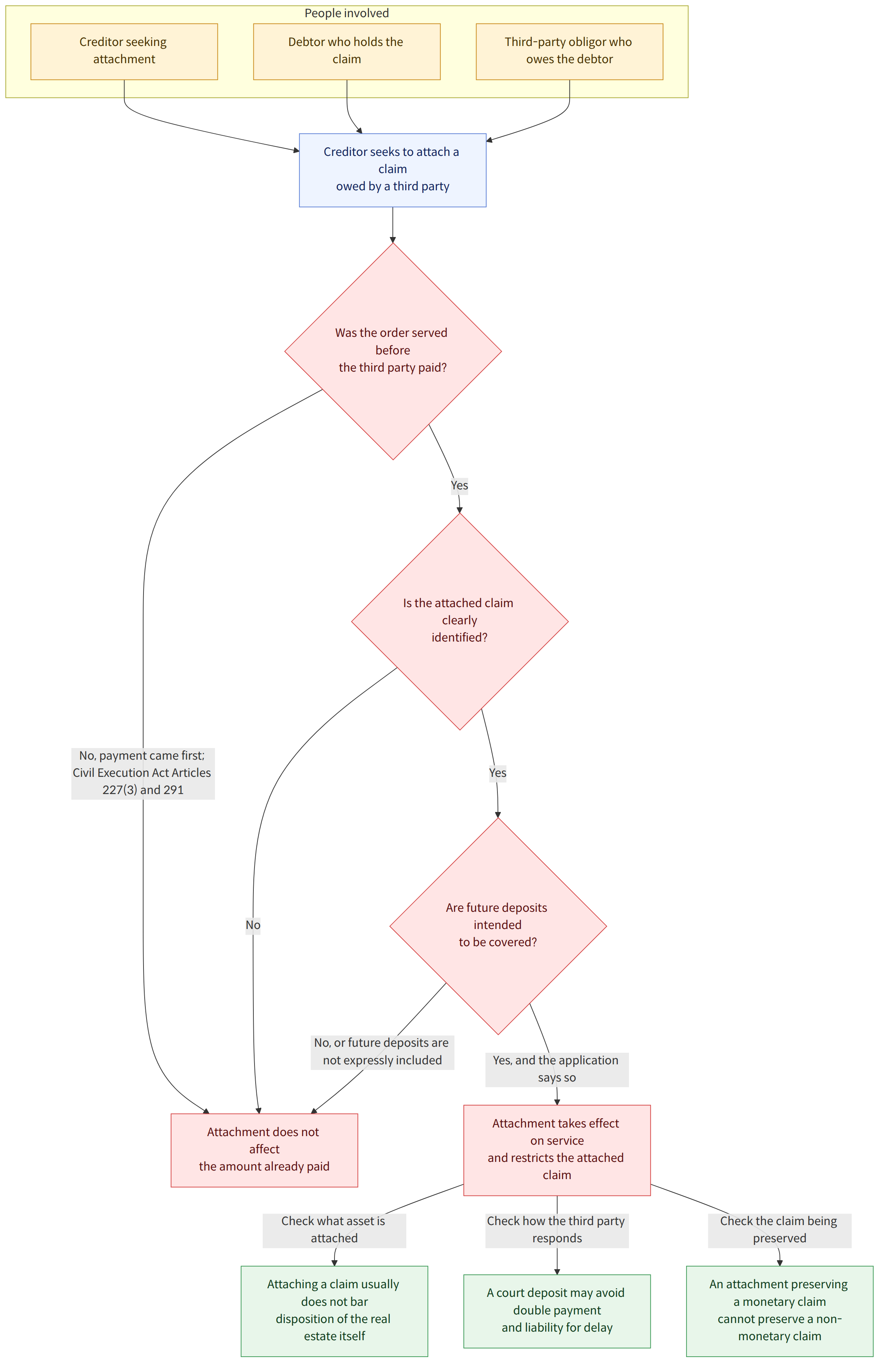
An attachment before judgment of a claim is a procedure for preserving a claim that the debtor holds against a third-party obligor. It takes effect as a prohibition on payment when the order is served on the third-party obligor. However, its effect and the possibility of recovery may vary depending on the asset attached, how it is described, when service occurs, and how the third-party obligor responds.
At a glance
Key points
- An attachment before judgment of a claim restricts disposition of the claim and, as a general rule, does not prohibit disposition of the real estate that is the subject of that claim. However, an exception such as that in the cases may apply if a claim for registration of transfer of ownership that had been provisionally registered is attached before judgment, the attachment is registered, and ownership is then transferred (Cases 1 and 4).
- An attachment before judgment of a claim takes effect when the order is served on the third-party obligor. If service occurs after the third-party obligor has already paid the debt and the attached claim has been extinguished, the attachment does not affect the amount paid (Civil Execution Act, Articles 227(3) and 291 (민사집행법 제227조 제3항, 제291조); Case 15).
- The claim to be attached must be specified so that the third-party obligor and the type of claim can be identified. An application may designate multiple financial institutions as third-party obligors for a deposit claim, but it may not be allowed after considering, among other things, whether the attachment is disproportionate (Case 10).
- To attach future deposits as well, the application must clearly state that deposit claims arising from future deposits are included. Merely stating that the deposit claim is attached up to the amount claimed may not include amounts deposited in the future (Cases 19 and 23).
- Even when a monetary claim subject to attachment becomes due, the third-party obligor’s debt is not extinguished, and merely withholding payment may not relieve the third-party obligor of liability for delay. The cases explain that the third-party obligor may avoid the risk of double payment and liability for delay by depositing the relevant funds with the court (Civil Execution Act, Articles 248(1) and 291 (민사집행법 제248조 제1항, 제291조); Case 8).
- If notice of an assignment of a claim and an attachment order arrive on the same day and their order of arrival cannot be determined, the third-party obligor may resolve the uncertainty in the legal relationship by making a deposit in lieu of payment (Case 12).
- The right being preserved by an attachment and the claim in the action on the merits may differ if the bases of the claims are the same. However, an attachment before judgment to preserve a monetary claim cannot be used to preserve a non-monetary claim (Cases 13, 14, and 17).
- An attachment of deposited securities restricts disposition of shares, but according to the explanation in the cases, the exercise of a shareholder’s voting rights is not a prohibited disposition (Civil Execution Rules, Article 177 (민사집행규칙 제177조); Cases 24 and 25).
Frequently asked questions
Q. If a claim for registration of transfer of ownership is attached before judgment, can that also prevent the sale of the real estate or registration of transfer of ownership?
As a general rule, an attachment before judgment of a claim for registration of transfer of ownership is an attachment of a claim, so it does not prohibit disposition of the real estate itself. However, in a case where a claim for registration of transfer of ownership that had been provisionally registered was attached before judgment, the attachment was registered, and ownership was subsequently transferred, the attaching creditor may assert that the subsequent registration is subject to the prohibition on disposition.
Q. What happens if the debt is paid before the attachment order reaches the third-party obligor?
An attachment before judgment of a claim takes effect when the order is served on the third-party obligor. Therefore, if the order is served after the third-party obligor has already made payment and the attached claim has been extinguished, the attachment does not affect the amount paid.
Q. Can I attach a deposit claim even if I do not know which bank holds the deposit?
According to the cases, an application may be made by designating multiple financial institutions as third-party obligors. However, it may not be allowed if the number of third-party obligors is excessive, for example, because the attachment is disproportionate. The amount claimed against each third-party obligor must also be specified.
Q. Will deposits made after the attachment application is filed also be attached?
The answer may depend on the wording of the application. If it does not expressly state that deposit claims to be created by future deposits are included, the attachment may be considered to cover only deposits existing at the time of attachment. However, cases have explained that where the application clearly states that future deposits are included, the attachment may also take effect against amounts deposited later.
Q. Does the landlord have to pay no interest on an attached lease deposit even if the payment due date has passed?
An attachment before judgment does not extinguish the third-party obligor’s underlying debt, so the third-party obligor may be liable for delay after the payment due date has passed. The cases explain that the third-party obligor may avoid the risk of double payment and liability for delay by depositing the attached monetary claim with the court.
Q. If the leased home is sold after the claim for return of the lease deposit has been attached, against whom should I assert the attachment?
If a leased home is transferred under a lease that meets the requirements for asserting opposing effect under the Housing Lease Protection Act (주택임대차보호법), the transferee may succeed to the landlord’s status and also to the status of third-party obligor with respect to the attachment. In that case, the attaching creditor may assert the effect of the attachment against the transferee, rather than the transferor.
Q. Can I bring an action for performance on a claim that has been attached before judgment?
The mere existence of an attachment before judgment of a claim does not prohibit the debtor from bringing an action for performance against the third-party obligor and obtaining an enforceable title. However, even if the debtor obtains a judgment, the attachment may restrict compulsory execution based on that enforceable title.
Q. Can I use an attachment even if the claim specified when applying for it differs from the claim recognized in the action on the merits?
If the bases of the claims underlying the two rights are the same, the preservative effect of the attachment may extend to the right recognized in the merits proceedings. However, an attachment before judgment based on a monetary claim cannot be used to preserve a non-monetary claim, and there may also be cases in which an attachment cannot be repurposed to secure another right after the right being preserved has been discharged.
Q. Can I exercise voting rights at a shareholders’ meeting using shares that have been attached before judgment?
According to the explanation in the cases, the prohibition on disposition imposed by an attachment of deposited securities does not include the exercise of a shareholder’s voting rights. Accordingly, an attachment alone does not prevent the exercise of voting rights.
Relevant laws
- Civil Execution Act, Article 31 (민사집행법 제31조)
- Civil Execution Act, Article 48(1) (민사집행법 제48조 제1항)
- Civil Execution Act, Article 159 (민사집행법 제159조)
- Civil Execution Act, Article 189(2)(3) (민사집행법 제189조 제2항 제3호)
- Civil Execution Act, Article 227(1) and (3) (민사집행법 제227조 제1항·제3항)
- Civil Execution Act, Article 228 (민사집행법 제228조)
- Civil Execution Act, Article 229(5) (민사집행법 제229조 제5항)
- Civil Execution Act, Article 230 (민사집행법 제230조)
- Civil Execution Act, Article 231 (민사집행법 제231조)
- Civil Execution Act, Article 243 (민사집행법 제243조)
- Civil Execution Act, Article 248(1) (민사집행법 제248조 제1항)
- Civil Execution Act, Article 251(1) (민사집행법 제251조 제1항)
- Civil Execution Act, Article 283(1) (민사집행법 제283조 제1항)
- Civil Execution Act, Article 291 (민사집행법 제291조)
- Civil Execution Act, Article 300 (민사집행법 제300조)
Watch out for
- An attachment before judgment of a claim must be distinguished from an attachment before judgment of the real estate itself. Do not assume that attaching a claim automatically allows you to assert against a third party that disposition of the real estate is prohibited.
- The time when the attachment order is served on the third-party obligor is important. Check the sequence of notice of assignment of the claim, attachment, actual payment, and notice of withdrawal of the attachment.
- To preserve claims that may arise in the future, such as future deposits, carefully check whether the wording of the application includes future claims among the assets to be attached.
- An attachment before judgment does not change the payment due date or extinguish the third-party obligor’s debt. If payment is being withheld, consider possible responses such as depositing the amount with the court.
Source cases
This guide was compiled by AI from the following Korea Legal Aid Corporation consultation cases (in Korean).
- 소유권이전등기청구권 가압류 후 소유권이전등기된 경우 가압류의 효력
- 보증인의 구상권 행사 시 피구상자의 채권자가 한 가압류 효력 주장 여부
- 임차보증금반환채권 압류 후 임차권 양도 시 이행기 도래 여부
- 소유권 이전서류 교부한 후 송달된 소유권이전등기청구권 가압류의 효력
- 제3채무자에 대한 근저당권부채권 가압류절차
- 임대차보증금반환채권 가압류와 임대주택 양도
- 부동산가압류 후 설정된 근저당권자의 배당순위
- 채권의 가압류가 있는 경우 제3채무자가 이행지체책임을 면하는지
- 주식을 가압류하는 방법
- 예금채권에 대한 가압류
- 채권가압류 신청취하에 따른 가압류집행의 효력상실 시기
- 채권양도 통지와 채권가압류 결정문이 같은 날 송달된 경우 우선순위
- 채권가압류의 유용 (3)
- 채권가압류의 유용 (1)
- 동일한 피압류채권에 대한 다른 채권자의 가압류 명령이 추심권자의 추심 종료 후에 제3채무자에게 송달된 경우
- 예금채권 가압류와 은행의 상계권 행사
- 채권가압류의 유용 (2)
- 부당한 예금채권 가압류에 대한 손해배상
- 장래 예금에 대한 가압류의 효력 (1)
- 가압류 된 채권에 기한 이행소송
- 카드 매출채권에 대한 가압류
- 가압류 된 채권에 기한 강제집행
- 장래 예금에 대한 가압류의 효력 (2)
- 예탁증권에 대한 가압류 절차
- 예탁증권에 대한 가압류의 효력
This guide is general legal information about Korean law, not legal advice for your situation. For a specific case, consult a lawyer or the Korea Legal Aid Corporation (call 132 in Korea).