
Guide to the Use, Management, and Partition of Jointly Owned Property
Based on 43 consultation cases · Updated · Translated from the Korean original.
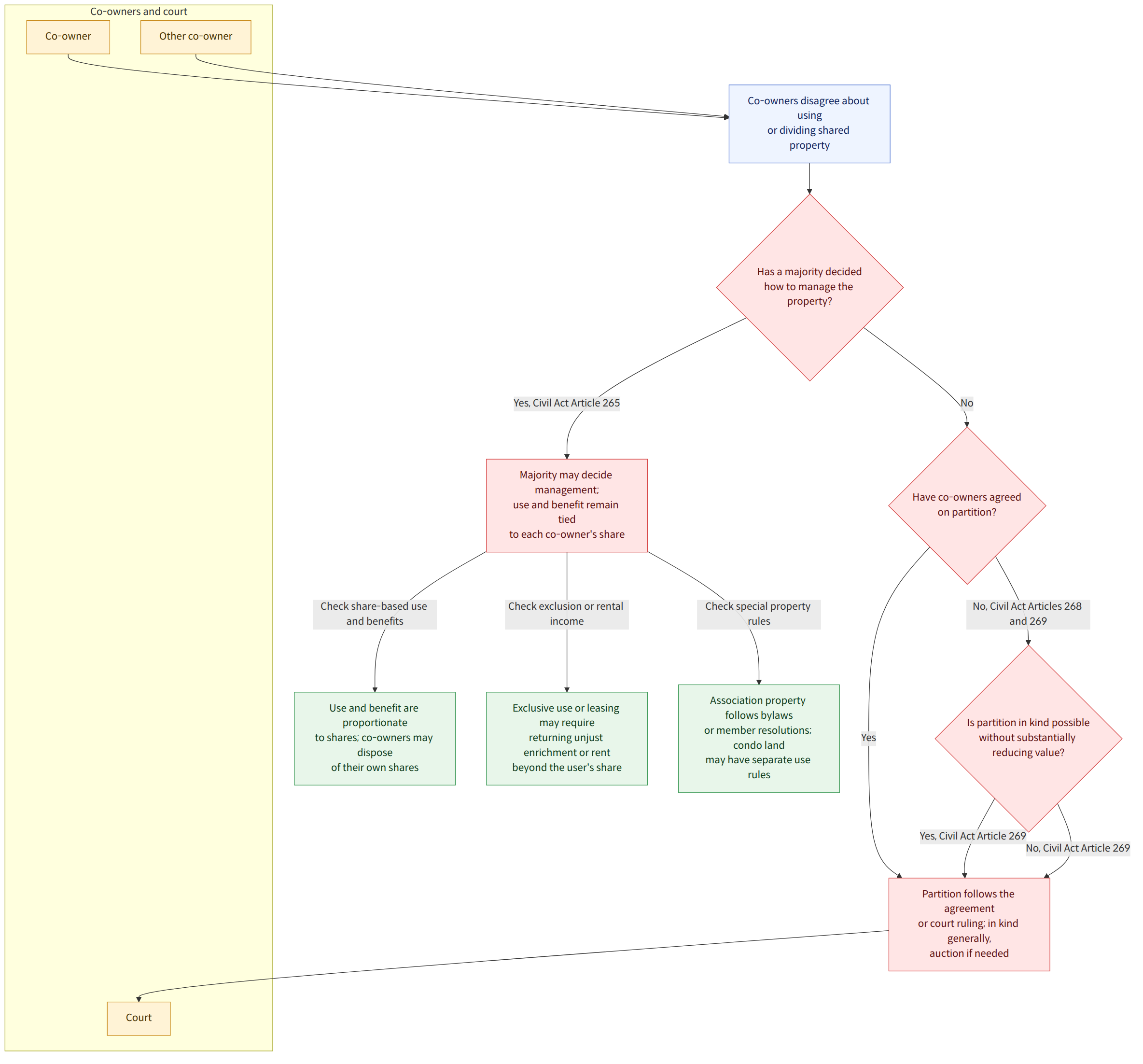
Co-owners may use and benefit from the entire jointly owned property in proportion to their shares, but the manner of use may be determined by holders of a majority of the shares. If the co-owners cannot reach an agreement, a co-owner may demand partition, although the available procedures vary depending on the method of partition and the type of property.
At a glance
Key points
- Co-owners may use and benefit from the entire jointly owned property in proportion to their shares and may dispose of their shares (Civil Act, Article 263 (민법 제263조)).
- The manner of managing jointly owned property may be determined by holders of a majority of the shares. A majority share owner may decide that the property will be used exclusively, but this may give rise to a claim for unjust enrichment by other co-owners who were unable to use it (Civil Act, Article 265 (민법 제265조); Supreme Court Decision 2011Da42430, rendered February 27, 2014 (대법원 2014. 2. 27. 선고 2011다42430 판결)).
- If a co-owner leases jointly owned property without the consent of the other co-owners, the co-owner who leased it may be required to return the benefit equivalent to rent received in excess of that co-owner’s share (Civil Act, Article 741 (민법 제741조)).
- If the co-owners cannot agree on partition, a co-owner may petition the court for partition. Partition in kind is the general rule, but partition by auction and division of the proceeds is permitted if partition in kind is impossible or is likely to substantially reduce the property’s value (Civil Act, Articles 268 and 269 (민법 제268조, 제269조)).
- The court determines the method of partition based on the circumstances, so the person who requested partition is not guaranteed sole ownership of the specific portion they want. If the co-owners have already reached an agreement on partition, they may need to seek registration in accordance with the agreement rather than demand partition again (Supreme Court Decision 94Da30348 and 30355, rendered January 12, 1995 (대법원 1995. 1. 12. 선고 94다30348, 30355 판결)).
- Property of an unincorporated association is held in collective ownership. Its management and disposition must follow the bylaws, if any, or otherwise require a resolution of the members’ general meeting (Civil Act, Articles 275 and 276 (민법 제275조, 제276조)).
- If a church continues to exist as an unincorporated association, the general rule is that the preexisting church continues with its remaining members even if some members leave. Those who leave may lose their rights to use and benefit from the preexisting church’s property (Supreme Court Decision 2004Da37775, rendered April 20, 2006 (대법원 2006. 4. 20. 선고 2004다37775 판결)).
- Unless there are special circumstances, a unit owner in a condominium building may use all the land beneath the building for its intended purpose, regardless of the unit owner’s share of the land. However, if there are co-owners other than the unit owners, those co-owners may be entitled to claim restitution for unjust enrichment (Supreme Court Decision 2011Da58701, rendered March 14, 2013 (대법원 2013. 3. 14. 선고 2011다58701 판결)).
Frequently asked questions
Q. May a co-owner with a majority share use the property alone?
The manner of managing jointly owned property may be determined by holders of a majority of the shares. Accordingly, a majority share owner may be permitted to decide, as a management measure, that the property will be used exclusively. However, if another co-owner has been unable to use or profit from the property, the co-owner who used it may be required to return unjust enrichment corresponding to that other co-owner’s share.
Q. What happens if one co-owner leases the property without the other co-owners’ consent?
A co-owner who leases the property may be required to return to the other co-owners the portion of the rental income that exceeds that co-owner’s share. The amount to be returned is determined based on factors such as the equivalent rent, depending on the circumstances of the case.
Q. May I demand partition of jointly owned property even if the other co-owners do not agree?
Unless the co-owners have agreed not to partition the property, any co-owner may demand partition. If they cannot reach an agreement, a co-owner may petition the court, but there is no guarantee that the method of partition ordered by the court will be the method the petitioner wants.
Q. If we agreed to partition jointly owned property but the other party will not cooperate with the registration process, do we need to file a partition lawsuit again?
If the co-owners have already reached an agreement on partition, a new lawsuit seeking partition may not be permitted. You should consider seeking registration of the transfer of ownership or confirmation of ownership in accordance with the agreement.
Q. May the representative of a clan association sell clan land without a resolution of the general meeting?
The disposition of property belonging to a clan association must follow the procedures set out in its bylaws. If the bylaws do not specify a procedure, a resolution of the clan association’s general meeting is required. A disposition made without following the required procedure may be invalid.
Q. If a church splits into two groups, is the church’s property divided between them?
If a church continues to exist as an unincorporated association, the property of the preexisting church does not, as a general rule, become divided between two groups merely because some members have left. The preexisting church continues with its remaining members, and members who leave may lose their rights to use and benefit from the church’s property.
Q. Can I use all the land beneath a condominium building even if my share of the land is small?
Unless there are special circumstances, a unit owner may use the entire land beneath a condominium building for its intended purpose, regardless of the unit owner’s share of that land. However, if there are co-owners of the land other than the unit owners, it should be separately considered whether those co-owners may claim restitution for unjust enrichment.
Q. Can one co-owner file a lawsuit alone to protect jointly owned property?
In some cases, any co-owner may independently take measures to preserve jointly owned property. However, separate requirements apply to lawsuits concerning property held in collective ownership by an unincorporated association. For example, the lawsuit may need to be brought in the association’s name following a resolution of its general meeting, or all members may need to be named as parties.
Relevant laws
- Civil Act, Article 127 (민법 제127조)
- Civil Act, Article 186 (민법 제186조)
- Civil Act, Article 187 (민법 제187조)
- Civil Act, Article 263 (민법 제263조)
- Civil Act, Article 264 (민법 제264조)
- Civil Act, Article 265 (민법 제265조)
- Civil Act, Article 268 (민법 제268조)
- Civil Act, Article 269 (민법 제269조)
- Civil Act, Article 272 (민법 제272조)
- Civil Act, Article 275 (민법 제275조)
- Civil Act, Article 276 (민법 제276조)
- Civil Act, Article 487 (민법 제487조)
- Civil Act, Article 741 (민법 제741조)
- Civil Act, Article 830(3) (민법 제830조 제3항)
- Civil Act, Article 1006 (민법 제1006조)
Watch out for
- A partition lawsuit may require all other co-owners to be included as parties. Because an heir may acquire a share by inheritance even if it has not been registered, the inheritance relationships should be verified.
- Partition in kind is the general rule, but the property may instead be partitioned by auction depending on its condition and the extent to which partition would reduce its value. A building that has not been registered and was constructed without a building permit or notification may not be eligible for partition by auction.
- Procedures for managing or disposing of property held in collective ownership, and for bringing lawsuits concerning such property, may differ from those applicable to jointly owned property. For unincorporated associations such as clan associations and churches, check the bylaws and whether a resolution of the general meeting was adopted.
- Even where the co-owners have a special agreement on use and enjoyment, its terms may not automatically bind a specific successor if they infringe on the essential nature of the right to a share in jointly owned property. Consider the terms of the agreement and whether the successor knew of it when acquiring the share.
Source cases
This guide was compiled by AI from the following Korea Legal Aid Corporation consultation cases (in Korean).
- 교회가 두 개로 나누어진 경우 교회재산의 사용·수익 및 귀속관계
- 종중총회 결의 없이 종중대표자가 행한 종중재산 처분행위의 효력
- 공동소유인 토지를 분할하는 방법
- 공유부동산을 공유자 1인 단독으로 임대한 경우 부당이득 성립 여부
- 공유부분의 체납관리비 부담관계
- 특허권이 공유인 경우에 특허권의 분할청구 가부
- 종중원이 종산에 분묘를 설치할 권한이 있는지
- 매매중도금 지급 후 토지공유자 중 1인이 사망 시 소유권이전 방법
- 공유자의 사용수익 및 부당이득 문제
- 건축허가나 신고 없이 건축된 미등기 건물에 대하여 경매에 의한 공유물분할이 허용되는지 여부
- 상호명의신탁관계로 있던 토지의 지분이 경매된 경우 구분소유적 공유관계를 낙찰자에게 주장할 수 있는지
- 대지사용과 관련한 공유지분권자와 대지권자와의 관계
- 유체동산의 공유지분권자의 유체동산 경매시 대항방법
- 집합건물 구분소유자들의 대지 사용 적법 여부
- 동업 외 목적으로 공동예금한 경우의 압류 추심명령 송달받은 은행의 지급거절 가부
- 공유자의 보존행위로서 말소등기청구 가부
- 공유물의 사용 수익에 관한 문제
- 공유물 분할협의 후 그 협의사항을 이행하지 않는 경우 그 청구 방법
- 상속으로 공동소유하는 토지의 매매에 대한 묵시적 추인 여부
- 공유물의 보존행위와 관리방법
- 지방자치법 시행 이전의 동·리가 관습법상 인정되는 법인인지 여부 및 동·리 재산의 소유형태
- 공유물분할청구소송의 경우 상속등기를 하지 않은 상속인이 있을 시의 문제
- 공유자 일부 상대방을 공유로 남기는 방식의 현물분할 가부
- 구분소유자의 다른 구분소유자에 대한 부당이득반환청구 가부
- 공유물에 관한 특약이 특정승계인에게 당연승계되는지 여부
This guide is general legal information about Korean law, not legal advice for your situation. For a specific case, consult a lawyer or the Korea Legal Aid Corporation (call 132 in Korea).