
Guide to Other Real Rights: Security Rights and Provisional Registrations
Based on 53 consultation cases · Updated · Translated from the Korean original.
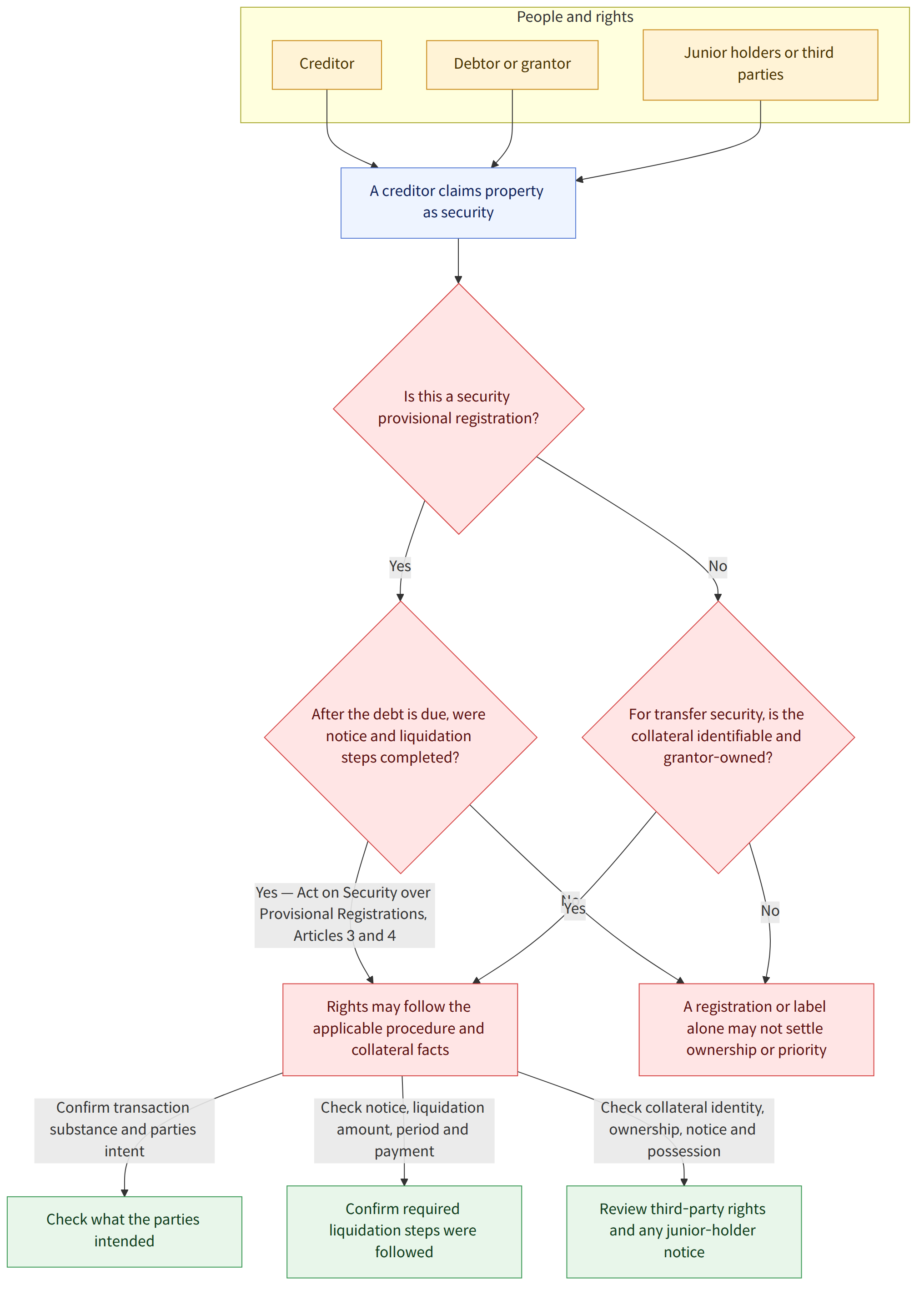
The effect of a security provisional registration or a transfer-for-security arrangement is not determined solely by the name used in a registration or contract. It depends on the substance of the transaction, the parties’ intent, and whether the collateral is sufficiently identified. Liquidation procedures, methods of public notice and possession, the priority of rights, and the exercise of rights by third parties affect the acquisition of ownership and entitlement to priority payment.
At a glance
Key points
- Whether a provisional registration made to secure a claim is a security provisional registration is determined by the substance of the transaction and the parties’ intent, not merely by the stated cause in the register or the form of the documents (Cases 1 and 8).
- As a general rule, for a holder of a security provisional registration to acquire ownership of real estate through liquidation, the holder must, after the debt becomes due, give notice stating the assessed liquidation amount and other relevant information. The holder must then pay the liquidation amount after the two-month liquidation period has run from the date the notice is received (Act on Security over Provisional Registrations, Articles 3 and 4 (가등기담보 등에 관한 법률 제3조·제4조); Cases 1, 4, and 18).
- Even if the liquidation assessment is below the objectively proper amount, a notice specifying the assessed value and the amount of the secured claim may cause the liquidation period to begin running. However, the debtor may refuse registration or delivery until receiving the proper liquidation amount, or repay the secured debt and seek cancellation of the provisional registration (Cases 13 and 18).
- Even when the Act on Security over Provisional Registrations does not apply, the principal registration alone may not conclusively establish ownership of the secured real estate. If the arrangement is a transfer for security in the weaker sense, a settlement procedure may be required (Cases 8 and 16).
- A transfer-for-security arrangement over movable property may be established by constructive delivery. In relation to third parties, the transfer-for-security holder may assert rights as the owner of the collateral. However, a later holder of a second transfer-for-security right does not acquire rights through constructive delivery alone (Cases 11 and 15).
- The collateral in a transfer-for-security arrangement over aggregate property must be externally and objectively identifiable by factors such as type, location, and quantity. The security may extend to property owned by the grantor that is added to the aggregate, but it does not extend to property owned by a third party (Cases 10 and 19).
- If there are junior right holders after enforcement of a security provisional registration, the statutory notice procedure must be followed. Once the liquidation procedure ends, the right to use and enjoy the collateral may vest in the creditor (Cases 24 and 25).
Frequently asked questions
Q. If I cannot repay the money, does a security provisional registration alone transfer ownership of the real estate?
If it is a security provisional registration, the creditor generally cannot conclusively acquire ownership merely by completing the principal registration. The creditor must follow the procedures prescribed by law, including notice of the liquidation amount and the liquidation period; a principal registration made in violation of those procedures may be invalid (Cases 1 and 4).
Q. If the appraised value of the real estate stated in the liquidation notice is wrong, is the notice itself invalid?
If the creditor specified the appraised value of the real estate at the time of notice and the amount of the secured claim, the notice and the running of the liquidation period may not be invalid solely because the liquidation amount the creditor subjectively appraised was less than the proper amount. However, the debtor may refuse registration or delivery until receiving the proper liquidation amount, or repay the debt and seek cancellation of the provisional registration (Case 18).
Q. If the holder of the provisional registration did not complete the principal registration before the auction ended, can the auction purchaser immediately claim damages?
If the principal registration based on the provisional registration has not yet been completed, the auction purchaser has not lost ownership. It is therefore difficult to conclude that liability for damages arises on that basis alone under Article 578 of the Civil Act (민법 제578조). If ownership is lost through principal registration, the purchaser may seek to hold the debtor or creditor liable under the warranty against defects in a separate lawsuit (Case 2).
Q. What happens if, after movable property is provided as security by constructive delivery, another creditor takes security over the same property?
A transfer-for-security right established first may be asserted against third parties. A later transfer-for-security right may not be acquired through constructive delivery alone, because good-faith acquisition is not recognized on that basis. Where the transfer-for-security holder has an enforceable notarial deed, the options described include privately realizing the collateral in accordance with the agreement or auctioning it on the basis of an enforceable deed (Cases 11 and 15).
Q. If all the pigs on a farm are taken as security under a transfer-for-security arrangement, does that also cover pigs born or brought onto the farm later?
If all the pigs on a farm constitute an identified aggregate of property subject to a transfer-for-security arrangement, identified by factors such as type and location, the security may also cover piglets born later and pigs owned by the grantor that are subsequently brought onto the farm. However, pigs owned by a third party do not become part of the aggregate and are not covered by the security (Cases 10 and 19).
Q. If a machine provided as security under a transfer-for-security arrangement burns down, can the security right be exercised over the fire insurance proceeds?
According to the precedent recognized in the case, if the collateral subject to a transfer-for-security arrangement is destroyed and the grantor acquires a claim to insurance proceeds, the security may extend to that claim as well. The transfer-for-security holder must exercise the right of subrogation against the insurance proceeds before they are paid (Civil Act, Articles 342, 355, and 370 (민법 제342조·제355조·제370조); Case 12).
Q. If a junior right holder arises after a security provisional registration is established, can an amount added to the claim later receive priority?
If a subsequent agreement adds to or increases the secured claim of an existing security provisional registration after a junior right holder or third-party acquirer has arisen, the added or increased portion may not be entitled to priority over that third party. The specific circumstances are important, including whether the parties agreed at the time the security was established to include future claims (Case 22).
Q. After the liquidation period ends, can the debtor continue using the real estate and collecting rent?
Where there is no liquidation amount and the liquidation procedure has ended in accordance with the statutory procedure, the right to use and enjoy the collateral may vest in the creditor even if the principal registration has not yet been completed. It therefore cannot be assumed that the debtor may continue to use and enjoy the property until the registration is transferred (Case 25).
Relevant laws
- Civil Act, Article 189 (민법 제189조)
- Civil Act, Article 275(1) (민법 제275조 제1항)
- Civil Act, Article 276(1) (민법 제276조 제1항)
- Civil Act, Article 278 (민법 제278조)
- Civil Act, Article 342 (민법 제342조)
- Civil Act, Article 355 (민법 제355조)
- Civil Act, Article 360 (민법 제360조)
- Civil Act, Article 370 (민법 제370조)
- Civil Act, Article 567 (민법 제567조)
- Civil Act, Article 578 (민법 제578조)
- Civil Act, Article 607 (민법 제607조)
- Civil Act, Article 608 (민법 제608조)
- Civil Act, Article 741 (민법 제741조)
- Act on Security over Provisional Registrations, Article 1 (가등기담보 등에 관한 법률 제1조)
- Act on Security over Provisional Registrations, Article 2 (가등기담보 등에 관한 법률 제2조)
Watch out for
- Do not assume, based only on the cause stated in the register or the name used in the contract, that a provisional registration is either a security provisional registration or a provisional registration to preserve priority. The substance of the transaction and the parties’ intent are important.
- The liquidation period begins on the date the liquidation notice reaches the debtor or other relevant recipient. Defects in the recipient or content of the notice may affect the acquisition of ownership through principal registration.
- If there is a senior security right over the real estate, the amount of the claim secured by that right must be taken into account when calculating the liquidation amount. Whether the law applies may also depend on the relationship between the value of the secured real estate and the amount of the secured claim.
- The outcome for a transfer-for-security arrangement over movable property or aggregate property may depend on the identification of the collateral, the method of possession, and whether a third party owns any of the property. The contract and the actual rights and interests should therefore be checked.
Source cases
This guide was compiled by AI from the following Korea Legal Aid Corporation consultation cases (in Korean).
- 가등기담보권자가 청산절차를 거치지 않은 경우 소유권취득여부
- 매각부동산에 대한 가등기권자의 본등기 전에 담보책임을 물을 수 있는지
- 양도담보등기 마치지 못한 부동산, 제3자가 가압류 한 경우 양도담보권 효력
- 돈을 빌려주고 소유권이전등기청구권가등기 해둔 경우 채권회수 방법
- 양도담보물이 다른 채권자의 강제집행으로 매각된 경우 부당이득반환
- 토지수용보상금 중 담보물권자의 채권을 공제한 잔액에 대한 압류의 효력
- 채권자 아닌 제3자 명의로 설정된 담보가등기의 효력
- 가등기담보 등에 관한 법률의 적용 없는 담보 가등기의 법률관계
- 공장저당권실행시 양도담보기계 매각된 경우 양도담보권자 부당이득청구
- 양도담보된 돼지의 새끼돼지에도 양도담보권이 미치는지
- 채무자가 이중으로 동산양도담보계약을 체결한 경우 그 효력
- 담보목적물소실 보험금청구권, 양도담보권자의 물상대위권행사 여부
- 채권자의 청산금 통지에 대해 채무자의 명시적 동의가 있어야 청산금이 확정되는지 여부
- 경매진행 중 가등기권자가 본등기 한 경우 경매개시결정 기입등기의 효력
- 동산양도담보계약서를 공증 받은 경우 양도담보권자의 강제집행방법
- 가등기담보권자가 대외적으로 소유권을 행사하는 것을 묵인한 것을 묵시적 대물변제 또는 귀속청산을 마친 것으로 볼 수 있는지 여부...
- 부동산양도담보 설정자의 임의처분
- 가등기담보권 실행에 있어서 청산금을 잘못 평가한 통지의 효력
- 집합물에 대한 양도담보권자가 점유개정의 방법으로 양도담보권설정계약 당시 존재하는 집합물의 점유를 취득한 후 양도담보권설정자가 ...
- 양도담보 공장기계에 공장저당권 설정된 경우 양도담보권의 효력
- 조합대표자가 총회결의 없이 조합재산을 양도담보한 행위의 효력
- 가등기담보권 설정 후에 후순위 권리자 등 이해관계 있는 제3자가 생긴 경우, 새로운 약정으로 기존 가등기담보권에 피담보채권을 ...
- 부동산 평가액이 피담보채권액에 미달하는 경우
- 가등기담보 등에 관한 법률상 후순위 권리자가 있는 경우의 정산절차 및 가등기담보권자에 의한 정산시 상계가 가능한지 여부
- 가등기담보권의 청산절차 종료 후 담보목적물의 사용·수익권 귀속권자
This guide is general legal information about Korean law, not legal advice for your situation. For a specific case, consult a lawyer or the Korea Legal Aid Corporation (call 132 in Korea).