
Commercial Insurance: A Guide to Insurance Claims, Exclusions, and Policy Termination
Based on 163 consultation cases · Updated · Translated from the Korean original.
Whether insurance benefits are payable depends not only on the circumstances of the incident but also on the type of insurance, the policy terms, compliance with the duty of disclosure, and the payment and notice procedures. Even if an insurer has denied a claim, an exclusion clause or policy termination is not necessarily valid in every case; the applicable legal standards and the terms of the policy must be considered together.
At a glance
Key points
- Under certain conditions, an injured party under liability insurance may claim compensation directly from the insurer, and the insurer of a joint tortfeasor who has paid damages to the injured party may seek direct contribution from another insurer for that insurer’s share (Commercial Act, Article 724(2) (상법 제724조 제2항), Case 1).
- Guarantee insurance may, in substance, have the character of a guarantee, but the guarantee insurer and the guarantor under the principal contract cannot automatically be treated as co-guarantors for purposes of applying the rules on recourse (Civil Act, Article 448 (민법 제448조), Case 2).
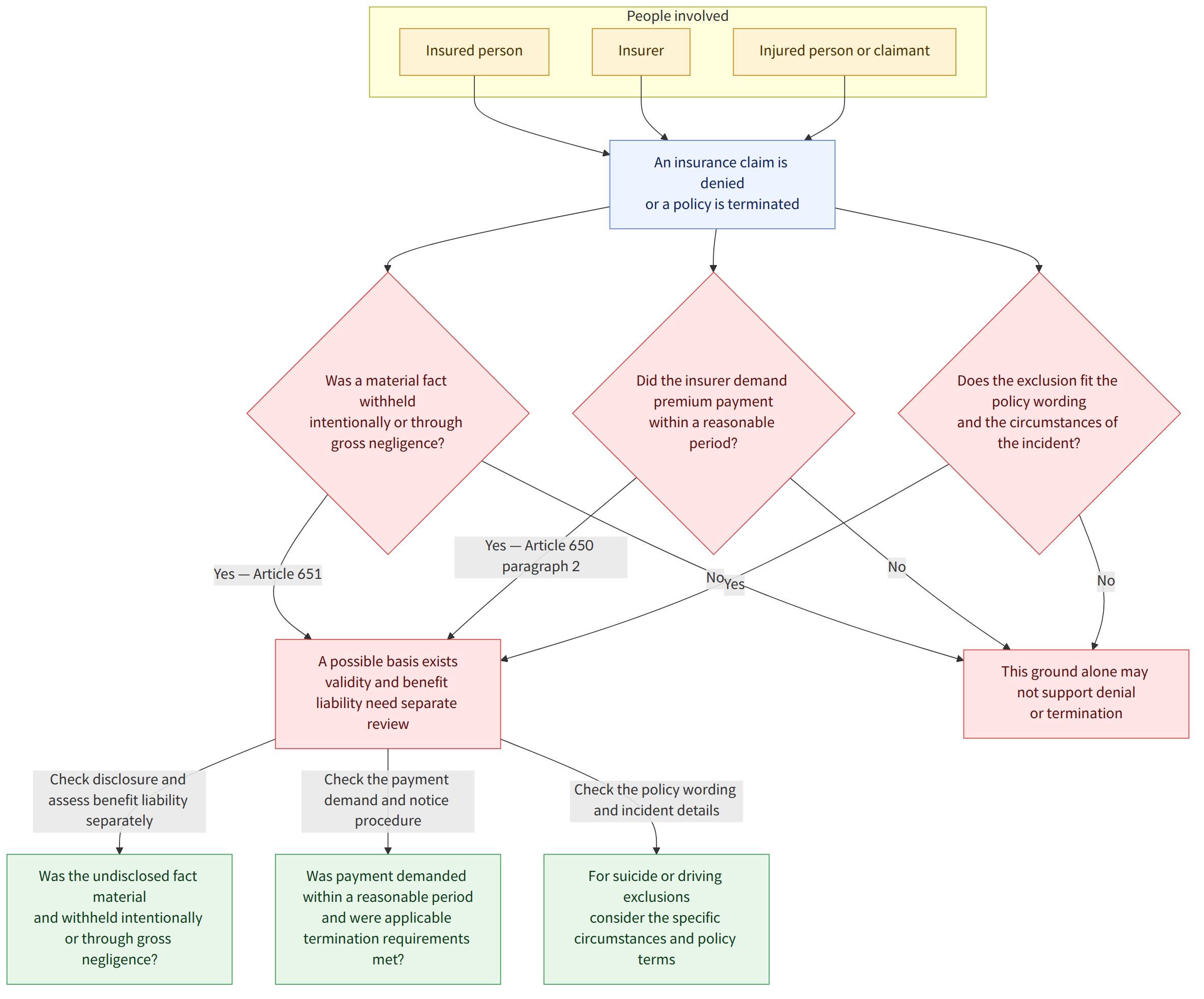
- A policy clause providing that nonpayment of premiums alone automatically causes the policy to lapse without following any procedure may be invalid. The insurer must demand payment within a reasonable period, and a notice of termination given at the same time may also be valid if the applicable requirements are met (Commercial Act, Article 650(2) (상법 제650조 제2항), Article 663 (상법 제663조), Case 4).
- To terminate a policy on the ground that the duty of disclosure was breached, it must be determined whether a material fact was not disclosed intentionally or through gross negligence. The policy may be terminated even if there is no causal connection between the insured event and the undisclosed fact, but the insurer’s liability to pay benefits must be assessed separately (Commercial Act, Article 651 (상법 제651조), Article 655 (상법 제655조), Cases 18 and 19).
- Whether the suicide exclusion applies under life insurance depends on the specific circumstances, including whether the insured consciously ended their life of their own free will. The mere fact that the insured had a mental illness or was in an extreme mental state does not automatically determine the outcome (Cases 5 and 16).
- A life insurance policy covering another person’s death requires the insured’s written consent when the policy is concluded. Without that consent, the policy may be void (Commercial Act, Article 731(1) (상법 제731조 제1항), Case 9).
- An exclusion clause for unlicensed or drunk driving under accident insurance may be limited in its effect if it means that coverage is denied even when the accident was caused by negligence. However, the specific wording of the policy and the nature of the accident must be examined (Commercial Act, Article 732-2 (상법 제732조의2), Article 739 (상법 제739조), Article 663 (상법 제663조), Case 10).
- The extent to which an insurer may exercise subrogation rights against a third party after paying benefits depends on the type of insurance and the relationship between the parties. The law provides an exception for claims against family members who share the insured’s livelihood, and the amended provision discussed in the case should also be checked (Commercial Act, Article 682 (상법 제682조), Cases 13 and 25).
Frequently asked questions
Q. If one insurer has paid the injured party in full, can it seek contribution from another insurer?
The insurers of joint tortfeasors who each hold insurance policies may be directly liable for the damages owed to the injured party. If one insurer pays the injured party and thereby discharges the obligation jointly, it may seek direct contribution from another insurer for that insurer’s share.
Q. If I receive notice that my policy lapsed because I did not pay the premium, am I unable to receive insurance benefits?
A policy clause providing that nonpayment of premiums immediately causes the policy to lapse may be invalid because it conflicts with the Commercial Act. The insurer must demand payment within a reasonable period. Even where a notice of termination is given at the same time, the specific requirements, including the length of the demand period, must be examined.
Q. What happens if I settle with the at-fault party after receiving treatment for a traffic accident through national health insurance?
The National Health Insurance Service may acquire a right of recourse against the at-fault party to the extent of the benefits it paid. Accordingly, when settling, it is important to distinguish the benefits paid by the Service from the damages the injured party may claim, such as out-of-pocket expenses, and to check with the Service.
Q. Can the insurer terminate my policy even if the undisclosed illness was unrelated to the cause of the accident?
If you intentionally or through gross negligence failed to disclose a material fact, the insurer may terminate the policy even if there is no causal connection between the accident and that fact. However, whether benefits are payable is assessed separately. The insurer may be liable to pay benefits if it is established that there was no causal connection between the insured event and the breach of the duty of disclosure.
Q. Are life insurance benefits unavailable if the insured dies by suicide?
Suicide may generally be a ground for exclusion, but a death occurring while the insured’s ability to make decisions freely was impaired may be treated differently from a case in which the insured intentionally caused their own death within the meaning of the policy. The specific circumstances, including any mental illness and the insured’s condition at the time of the incident, must be examined.
Q. Can I take out life insurance on a family member without their consent?
A policy covering another person’s death requires the insured’s written consent when the policy is concluded. A policy concluded without consent may be void, so the consent procedure cannot be skipped merely because the insured is a family member.
Q. Will accident insurance benefits always be denied if an accident occurs while I am driving without a license?
Benefits are not always denied merely because the policy contains an exclusion for unlicensed driving. A clause in accident insurance that denies coverage even when an accident was caused by negligence may be invalid, but it is necessary to examine whether the conduct is considered intentional and to review the policy terms.
Q. If the at-fault vehicle’s insurer claims that it is exempt from liability, can I also not claim under my uninsured motorist coverage?
Coverage under uninsured motorist insurance may apply even where the at-fault vehicle’s insurer’s liability has not been clearly established as a matter of law. The injured party’s insurer may first pay benefits in accordance with the policy. Whether a separate claim for contribution or restitution for unjust enrichment is available must be determined separately.
Q. Will the limitation period expire if I delay making an insurance claim?
The limitation period for an insurance claim and the date from which it runs must be determined by examining the applicable law, the contract, and the date the insured event occurred. The period under the former Commercial Act cited in the case should not be applied automatically to a current matter. Even after the limitation period has expired, whether the insurer’s reliance on the limitation period constitutes an abuse of rights depends on exceptional circumstances.
Relevant laws
- Commercial Act, Article 638-3 (상법 제638조의3)
- Commercial Act, Article 650(2) (상법 제650조 제2항)
- Commercial Act, Article 651 (상법 제651조)
- Commercial Act, Article 652(1) (상법 제652조 제1항)
- Commercial Act, Article 655 (상법 제655조)
- Commercial Act, Article 659(1) (상법 제659조 제1항)
- Commercial Act, Article 662 (상법 제662조)
- Commercial Act, Article 663 (상법 제663조)
- Commercial Act, Article 682 (상법 제682조)
- Commercial Act, Article 723 (상법 제723조)
- Commercial Act, Article 724(2) (상법 제724조 제2항)
- Commercial Act, Article 725 (상법 제725조)
- Commercial Act, Article 726-2 (상법 제726조의2)
- Commercial Act, Article 731(1) (상법 제731조 제1항)
- Commercial Act, Article 732 (상법 제732조)
Watch out for
- Statutory requirements and time limits may apply to policy termination. Check the content, timing, and delivery of any demand for unpaid premiums or notice concerning a breach of the duty of disclosure.
- The limitation period for an insurance claim may differ under the former law cited in a case and the provisions currently in force. Check the law applicable to the policy and the date of the incident.
- Whether benefits are payable is not determined solely by the exclusion wording in the policy. The type of insurance, circumstances of the incident, process by which the policy was concluded, and whether the policy terms were explained must also be considered.
Source cases
This guide was compiled by AI from the following Korea Legal Aid Corporation consultation cases (in Korean).
- 공동불법행위자의 보험자 상호간 발생한 직접구상권의 소멸시효기간
- 보증보험계약상 보험자와 주계약상 보증인간의 구상권 관계
- 교통사고 합의 후 국민건강보험의 보험급여 부담 여부
- 계속보험료납입지체와 해지예고부 납입최고
- 피보험자의 자살과 보험자의 면책 여부
- 다른 상해보험 가입 사실에 대한 고지의무 위반으로 인한 보험계약 해지 여부
- 차 안에서 잠자던 중 질식사한 경우 자동차보험 적용 여부
- 보험계약자의 기망에 의한 보증보험계약 취소 시 피보험자에 대한 대항력
- 피보험자의 서면에 의한 동의 없이 체결된 생명보험계약의 효력
- 무보험자동차에 의한 상해특약상 무면허·음주운전 면책조항의 효력
- 무면허운전 사실을 인식 못한 경우 무면허운전 면책약관의 적용 여부
- 15세 미만자 등의 사망을 보험사고로 한 보험계약은 무효라고 정한 상법 제732조가 효력규정인지 여부.
- 무단운전자가 보험계약자의 동거가족인 경우 상법상 보험자대위 여부
- 피보험자의 주소변경통보 불이행에 대한 보험회사 약관의 효력
- 업무용 자동차종합보험계약약관 중 대인배상 Ⅱ에서 산업재해보상보험법에 의해 재해보상을 받을 수 있는 사람에 대하여는 보상하지 않...
- 인보험에서 보험자의 면책사유로 규정한 ‘피보험자의 고의’와 자배법상 ‘승객의 고의 또는 자살행위’의 의미
- 보험금청구권의 소멸시효 기간 및 보험사의 소멸시효 항변이 권리남용에 해당하는 경우
- 보험사에게 질병진단을 받은 사실을 고지하지 않았더라도 보험금 지급을 청구할 수 있는 경우
- 고지의무 위반이 있는 경우 그 위반이 사고발생과 무관하더라도 보험해지가능한지
- 피보험자가 손해배상판결에 항소하지 않아 확정시킨 경우 보험자 면책되는지
- 의뢰인이 도중에 하차한 후 발생한 사고를 통상의 대리운전 중 사고로 볼 수 있는지 여부
- 보험계약이 선량한 풍속 기타 사회질서에 반하여 무효가 되는 경우
- 임차인이 임차건물과 그 안의 동산 및 기계 등에 대하여 자신을 소유자로 기재하여 보험계약을 체결한 경우, 그 중 건물 부분에 ...
- 상해보험계약자의 장해등급 판정에 있어 미국의사협회(a.m.a.)의 신체장해평가지침 제1판 내지 제5판의 증거채택 가부
- 무보험자동차에 의한 상해담보특약이 적용되어 보험회사가 피해자에게 보험금을 지급한 경우 가해차량 보험자에게 부당이득반환을 청구할...
This guide is general legal information about Korean law, not legal advice for your situation. For a specific case, consult a lawyer or the Korea Legal Aid Corporation (call 132 in Korea).