
General Commercial Matters: A Guide to Transactions, Agency, and Trade-Name Liability
Based on 99 consultation cases · Updated · Translated from the Korean original.
In commercial transactions, who bears contractual liability depends on factors such as the name used, the other party’s understanding, the scope of an agent’s authority, and whether the business was actually transferred. Rules under the Commercial Act, including those on interest and limitation periods, may apply to transactions between merchants. Separate liability principles may also apply depending on the type of transaction, such as carriage or lodging.
At a glance
Key points
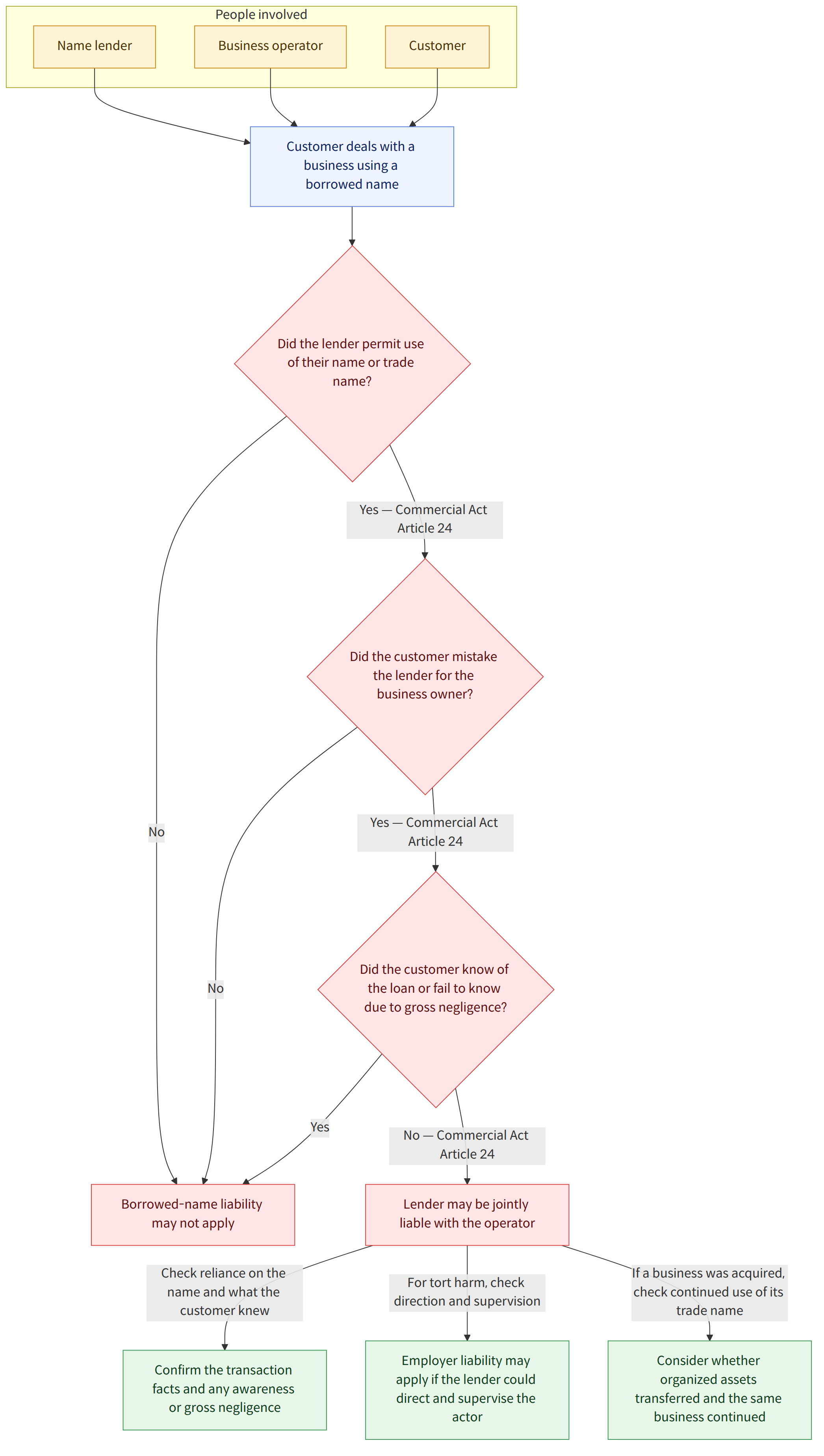
- A person who permits another to conduct business using their name or trade name may be liable together with the person using the borrowed name if a party to the transaction mistakes the name lender for the business owner (Commercial Act, Article 24 (상법 제24조)). However, liability may not be found if the other party knew that the name had been lent or failed to know this due to gross negligence.
- Liability for transactions arising from lending a name must be distinguished from employer liability for a tort. If a person who lent their name for a business was objectively in a position to direct and supervise the person who committed the act, employer liability may be found. However, liability may also be denied, for example, if the injured party was grossly negligent (Civil Act, Article 756 (민법 제756조)).
- A business transfer cannot be determined solely from the fact that some facilities or only the trade name were transferred. The circumstances as a whole must be considered, including whether organized functional assets were transferred and the same business activities continued. A person who acquires a business and continues to use the transferor’s trade name may be liable for the transferor’s business debts (Commercial Act, Article 42 (상법 제42조)).
- The authority of a site manager or sales representative is not determined by their job title alone. The nature and scope of their duties are important, and whether the other party had a justifiable reason for believing that the person had authority may be relevant to whether the company is liable for a contract made outside that authority (Commercial Act, Articles 14 and 15 (상법 제14조·제15조)).
- A loan of money for a merchant’s business may be presumed to be a commercial act. Even if no interest was agreed upon for a loan between merchants, statutory interest under commercial law may be claimed if the loan was related to the business (Commercial Act, Articles 47, 54, and 55 (상법 제47조·제54조·제55조)).
- If a transaction constitutes a commercial act for one party, the Commercial Act may also apply to the other party. The limitation period for commercial claims is generally five years, but a shorter period provided by another law applies instead (Commercial Act, Articles 3 and 64 (상법 제3조·제64조)).
- A carrier may be liable for loss of, damage to, or delay in delivery of goods if it cannot prove that it exercised due care. In passenger carriage, it is also important to prove that due care in carriage was not neglected (Commercial Act, Articles 135 and 148 (상법 제135조·제148조)).
- A lodging business operator may have a duty to protect guests by providing safe rooms and related facilities. The mere fact that a vehicle was parked in an inn’s parking lot does not establish that the inn took custody of it; specific circumstances, such as access controls or an attendant, must be considered (Commercial Act, Article 152 (상법 제152조)).
Frequently asked questions
Q. Can I claim the price of goods from someone who merely lent their name?
If a person permits another to conduct business under their own name or trade name, and a person dealing with the business mistakes the name lender for the business owner and enters into a transaction, the name lender may be liable jointly and severally with the person using the borrowed name. However, liability may be denied if the other party knew that the name had been lent or failed to know this due to gross negligence (Commercial Act, Article 24 (상법 제24조)).
Q. Must someone who lent their name also compensate for harm caused by the borrower’s tort?
The name lender’s liability under the Commercial Act is intended to protect a party who entered into a transaction in reliance on the name and credit. Accordingly, it may be difficult to hold the name lender liable where the harm caused by a tort occurred independently of that reliance. However, liability as an employer under the Civil Act may be at issue if the name lender was objectively in a position to direct and supervise the person who committed the act (Commercial Act, Article 24 (상법 제24조); Civil Act, Article 756 (민법 제756조)).
Q. Are contracts entered into by a company’s site manager or sales representative binding on the company?
A person’s job title alone does not establish that they have authority to enter into a contract. It is necessary to consider whether their duties include entering into contracts, whether the transaction falls within the scope of those duties, and whether the other party had a justifiable reason to believe the person had authority (Commercial Act, Articles 14 and 15 (상법 제14조·제15조)).
Q. If I acquire a factory or facilities at auction and use the former company’s trade name, do I also assume its existing debts?
The mere use of a trade name does not establish that existing debts have been assumed. Whether a business transfer took place is determined by considering the specific circumstances as a whole, including whether organized business assets were transferred and the business continued while retaining its identity (Commercial Act, Article 42 (상법 제42조)).
Q. Can I claim interest even if none was agreed when I lent business funds to a merchant?
If a loan is found to have been made for a merchant’s business, statutory interest under the Commercial Act may be claimed. However, under the Civil Act, interest for the loan period generally cannot be claimed on a consumer loan unless interest was agreed upon; default damages after the due date are a separate matter (Commercial Act, Articles 47, 54, and 55 (상법 제47조·제54조·제55조); Civil Act, Articles 379 and 397 (민법 제379조·제397조)).
Q. Can the commercial limitation period apply to a joint and several guarantor who is not a merchant?
If a transaction constitutes a commercial act for either party, the Commercial Act may also apply to a party who is not a merchant. In the case in question, it was held that if the principal obligation incurred for business purposes is extinguished as a commercial obligation, the joint and several guarantee obligation accessory to it may also be extinguished, absent special circumstances (Commercial Act, Articles 3, 47, and 64 (상법 제3조·제47조·제64조)).
Q. If a vehicle is stolen from an inn’s parking lot, can I claim compensation from the inn?
An important question is whether the inn and the guest agreed that the inn would take custody of the vehicle. Liability may be recognized if the inn controlled access to the parking lot, employed an attendant, or there were other specific circumstances showing that the vehicle was entrusted to it, such as the guest handing over the keys. However, custody may not be found where the inn merely provided a parking space (Commercial Act, Article 152 (상법 제152조)).
Q. Can I claim damages from a carrier if goods are wrongly delivered to someone else or are damaged?
Where a receipt for goods or a bill of lading has been issued, the goods must generally be delivered in exchange for the document, and liability may arise if they are delivered to someone who is not entitled to them. A carrier may also be liable for damage to the goods if it cannot prove that it exercised due care; an exemption clause may not apply in cases of intent or gross negligence (Commercial Act, Articles 129, 135, and 820 (상법 제129조·제135조·제820조)).
Relevant laws
- Commercial Act, Article 3 (상법 제3조)
- Commercial Act, Article 9 (상법 제9조)
- Commercial Act, Article 11 (상법 제11조)
- Commercial Act, Article 14 (상법 제14조)
- Commercial Act, Article 15 (상법 제15조)
- Commercial Act, Article 18 (상법 제18조)
- Commercial Act, Article 22 (상법 제22조)
- Commercial Act, Article 23 (상법 제23조)
- Commercial Act, Article 24 (상법 제24조)
- Commercial Act, Article 25 (상법 제25조)
- Commercial Act, Article 41 (상법 제41조)
- Commercial Act, Article 42 (상법 제42조)
- Commercial Act, Article 46 (상법 제46조)
- Commercial Act, Article 47 (상법 제47조)
- Commercial Act, Article 48 (상법 제48조)
Watch out for
- To establish name-lending liability or an agent’s authority, examine the specific circumstances of the transaction, including contracts, transaction statements, business registration or use of a trade name, and the person’s actual duties.
- For name-lending liability, it matters whether the other party entered into the transaction in reliance on the name. Whether the other party knew of the name lending or failed to know of it due to gross negligence may be a matter the party disputing liability must prove.
- Whether a business was transferred and whether the limitation period for claims arising from a business applies depend on the type of transaction and the facts. Do not decide the issue based only on the general explanation that commercial claims are subject to a five-year limitation period; also check whether another law provides a shorter period and consider the nature of the claim.
Related articles
Source cases
This guide was compiled by AI from the following Korea Legal Aid Corporation consultation cases (in Korean).
- 항공기 하루 연착에 따른 정신적 손해배상청구 가부
- 아파트 건설회사의 현장소장과 체결한 아파트 입주계약의 효력
- 상법상 명의대여자의 책임이 불법행위의 경우에도 적용되는지
- 단체협약에 기한 근로자 유족들의 회사에 대한 위로금채권의 시효기간
- 보증도로 인하여 타인에게 운송물을 인도한 운송인의 손해배상책임
- 상호계속사용자가 영업양수인이 되기 위한 요건
- 부동산경매절차에서 기존회사의 공장건물과 시설을 낙찰받고 상호도 사용한 경우 기존회사의 채무도 승계하는지
- 화물상환증의 면책사유로 운송물이 파손된 경우 운송인의 손해배상책임
- 열차 출발시 출입문 수동 개폐하고 내리다 다친 경우 배상 책임
- 부분적 포괄대리권을 가진 사용인으로 오인될 만한 유사한 명칭을 사용한 사용인의 책임 여부
- 영업양도인이 근처에서 상호만 바꾸어 다시 영업할 수 있는지
- 여관에서 발생한 화재로 투숙객이 사망한 경우 숙박업자의 책임
- 부분적 포괄대리권을 가진 사용인의 표현책임
- 여관 부설 주차장에 주차한 차량이 도난 당한 경우 여관의 책임
- 물품거래 시 명의대여자의 책임
- 타인의 영업을 위하여 명의만을 빌려준 자의 그 영업에 대한 책임
- 유사한 상호를 사용하는 자에 대한 상호사용 금지방법
- 처가 남편의 사업자금에 필요한 돈을 빌린 경우 남편의 책임
- 오피스텔 분양관련 업무를 처리한 관리부장이 부분적 포괄대리권을 가진 상업사용인에 해당하는지 여부
- 선하증권상 수하인 아닌 자에게 물건 인도시 보세창고업자책임
- 동업관계 탈퇴인에게 명의대여자 책임을 물을 수 있는지
- 상인 사이 이자약정 없는 대여금채권의 이자청구가 가능한지
- 수인의 당사자 중 1인에게만 상행위가 되는 경우 전원에 대하여 상법이 적용되는지
- 가장지배인이 소송수행할 수 있는지
- 명의대여와 사용자책임
This guide is general legal information about Korean law, not legal advice for your situation. For a specific case, consult a lawyer or the Korea Legal Aid Corporation (call 132 in Korea).