
Guide to the Return of a Commercial Lease Tenant’s Security Deposit
Based on 8 consultation cases · Updated · Translated from the Korean original.
Even after a commercial lease ends, outstanding tenant obligations—such as returning the premises and restoring them to their original condition—may affect the return of the security deposit. However, the entire deposit cannot be withheld solely because of minor deficiencies in restoration. The specific circumstances, including whether the contract has ended and whether the tenant has opposability, must also be considered.
At a glance
Key points
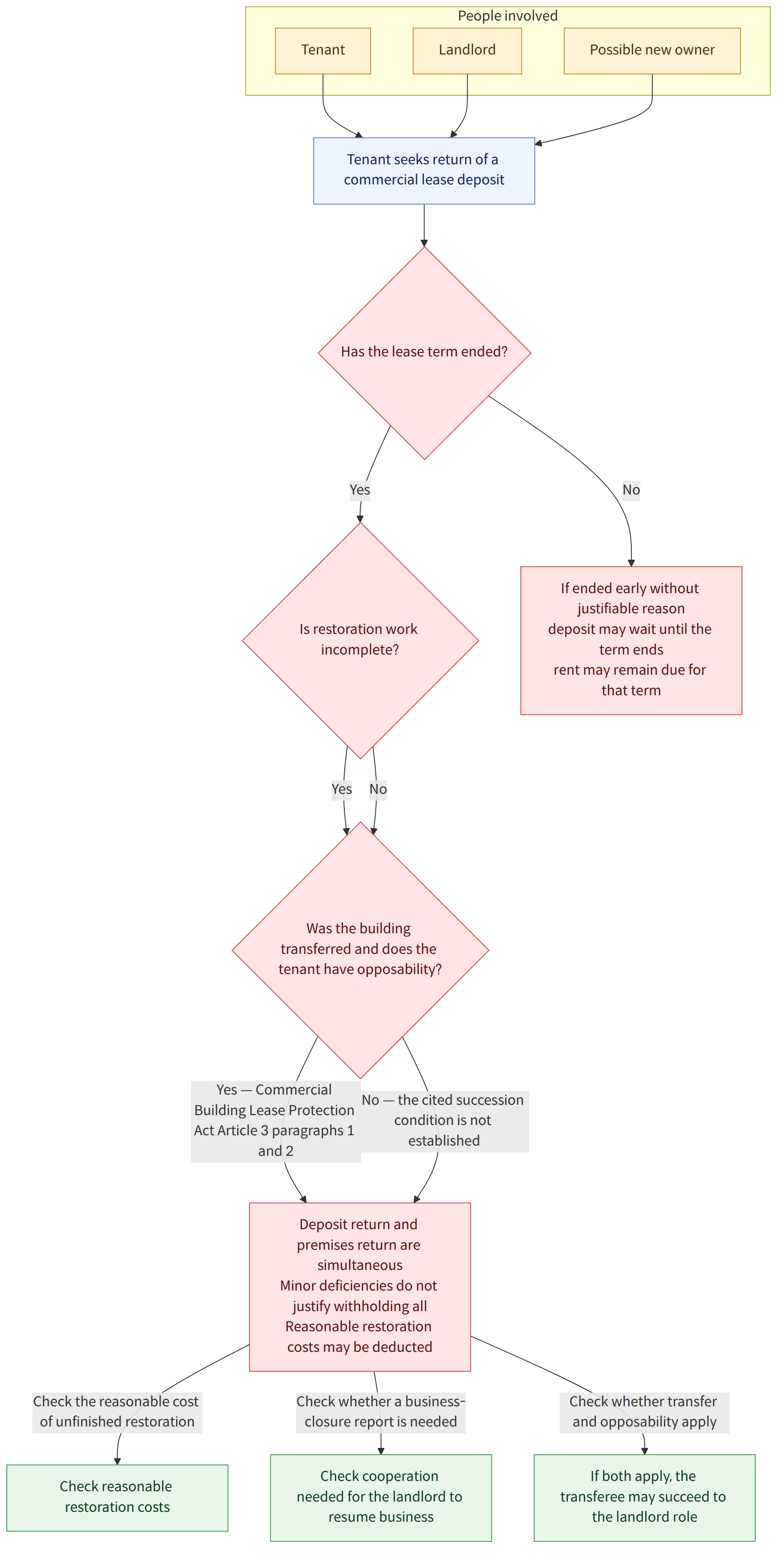
- When a lease ends, the tenant’s duty to return the premises and the landlord’s duty to return the security deposit are obligations to be performed simultaneously.
- A landlord’s refusal to return the entire security deposit because the tenant failed to complete minor restoration work may violate the principle of good faith. However, the reasonable cost of restoring the parts left incomplete may be deducted from the security deposit (Example 1; Civil Act, Article 536 (민법 제536조)).
- The tenant’s duty to restore the premises may include a duty to cooperate so that the landlord or another party can resume business there. Accordingly, if a business-closure reporting procedure is required, as in the example, the tenant may have to complete it (Example 4; Supreme Court Decision 2008Da34903, rendered October 9, 2008).
- If time remains on the lease and the tenant seeks to terminate it unilaterally without a justifiable reason, the example explains that the tenant cannot recover the security deposit until the remaining term has ended and must also pay rent for that remaining term (Example 8).
- Even if the leased building is transferred, the transferee may succeed to the landlord’s position and assume the duty to return the security deposit if the tenant has opposability (Example 7; Commercial Building Lease Protection Act, Article 3, Paragraphs 1 and 2 (상가건물 임대차보호법 제3조 제1항·제2항)).
- It is difficult to state exactly when a lawsuit seeking return of a security deposit will conclude. However, the example explains that procedures under the Commercial Building Lease Protection Act and the Small Claims Act may be shorter than those for an ordinary civil lawsuit (Example 2).
- When applying for an auction based on a judgment ordering return of the security deposit or a similar basis, the tenant may not have to surrender the leased premises first. However, to receive distribution proceeds, the tenant must surrender the premises to the person who acquires ownership through the auction (Example 3; Commercial Building Lease Protection Act, Article 5, Paragraphs 1 and 3 (상가건물 임대차보호법 제5조 제1항·제3항)).
- Under the threshold stated in the examples, the applicable security-deposit amount is calculated by adding 100 times the monthly rent to the security deposit. The qualifying limits for small-amount tenants and the specified priority-repayment amounts vary by region (Examples 5 and 6; Commercial Building Lease Protection Act, Articles 2 and 14, and Enforcement Decree, Articles 2, 6, and 7 (상가건물 임대차보호법 제2조·제14조 및 시행령 제2조·제6조·제7조)).
Frequently asked questions
Q. Can I be denied the return of my entire security deposit because I did not fully restore the premises in a minor respect?
If the uncompleted restoration is minor and the amount of damage is small, refusing to return the entire security deposit may violate the principle of good faith. However, the landlord may deduct from the security deposit the reasonable cost of restoring the parts that were left incomplete.
Q. I vacated the premises. Do I have to file a business-closure report before I can get my security deposit back?
The example explains that the tenant’s duty to restore the premises may also include a duty to cooperate so that the landlord can resume business at the premises. The tenant may have to complete the business-closure reporting procedure so that it does not obstruct the landlord from obtaining a new business permit for the premises.
Q. Can I get my security deposit back if I close my business before the lease term ends?
The example explains that if a tenant unilaterally terminates the contract without a justifiable reason, the tenant may not recover the security deposit until the remaining contract term has ended and may also have to pay rent for the remaining term. Whether the contract can be terminated must be assessed in light of the specific circumstances.
Q. If the commercial building I rent is sold to someone else, from whom should I claim my security deposit?
The example explains that if a building is transferred after the tenant has moved in and obtained opposability by registering the business, the transferee succeeds to the landlord’s position. In that case, the tenant must seek return of the security deposit from the transferee, not the former owner.
Q. How long does a lawsuit to recover a security deposit take?
The example explains that it is difficult to give an exact estimate of how long the process will take. However, even where the security deposit exceeds KRW 20 million, procedures under the Small Claims Act may be used under the Commercial Building Lease Protection Act, potentially shortening the process compared with an ordinary civil lawsuit.
Q. Do I have to vacate the commercial premises before I can apply for an auction after obtaining a judgment for return of my security deposit?
The example explains that when applying for an auction based on a final judgment ordering the return of the security deposit, the tenant does not have to surrender the leased premises first. However, to receive distribution proceeds, the tenant must surrender the premises to the person who acquires the commercial building through the auction.
Q. Which must happen first: return of the security deposit or handover of the premises?
The example explains that the tenant’s duty to return the premises and the landlord’s duty to return the security deposit are obligations to be performed simultaneously. If the tenant does not properly perform the duty to return the premises, the tenant may be unable to recover the security deposit until that duty has been fulfilled.
Q. How is the applicable security-deposit threshold calculated for commercial premises with monthly rent?
The calculation method presented in the example is to add 100 times the monthly rent to the security deposit. For example, the security deposit of KRW 100 million and monthly rent of KRW 700,000 in the example were calculated as KRW 170 million, which the example said fell within the applicable threshold for Gwangju Metropolitan City at that time.
Q. Can a small-amount tenant receive the security deposit before other secured creditors?
The example explains that certain tenants may receive priority repayment of a specified portion of their security deposit, up to one-half of the value of the leased building. The applicable security-deposit limits and priority-repayment amounts vary by region.
Relevant laws
- Civil Act, Article 536 (민법 제536조)
- Civil Act, Article 615 (민법 제615조)
- Civil Act, Article 654 (민법 제654조)
- Commercial Building Lease Protection Act, Article 1 (상가건물 임대차보호법 제1조)
- Commercial Building Lease Protection Act, Article 2 (상가건물 임대차보호법 제2조)
- Commercial Building Lease Protection Act, Article 3, Paragraphs 1 and 2 (상가건물 임대차보호법 제3조 제1항·제2항)
- Commercial Building Lease Protection Act, Article 5, Paragraphs 1 and 3 (상가건물 임대차보호법 제5조 제1항·제3항)
- Commercial Building Lease Protection Act, Article 14, Paragraph 3 (상가건물 임대차보호법 제14조 제3항)
- Commercial Building Lease Protection Act, Article 18 (상가건물 임대차보호법 제18조)
- Enforcement Decree of the Commercial Building Lease Protection Act, Article 2 (상가건물 임대차보호법 시행령 제2조)
- Enforcement Decree of the Commercial Building Lease Protection Act, Articles 6 and 7 (상가건물 임대차보호법 시행령 제6조·제7조)
- Small Claims Act, Articles 6, 7, 10, and 11-2 (소액사건심판법 제6조·제7조·제10조·제11조의2)
- Civil Execution Act, Article 41 (민사집행법 제41조)
Watch out for
- Because return of the security deposit and return of the premises may be obligations to be performed simultaneously, check whether the tenant still has outstanding obligations, such as handing over the premises or restoring them to their original condition.
- Even if some restoration work remains incomplete, this does not automatically justify withholding the entire security deposit, although the reasonable cost of the necessary repairs may be deducted.
- If the tenant unilaterally stops operating while time remains on the lease, as in the example, return of the security deposit may be delayed and the tenant may remain liable for rent for the rest of the term.
- Do not assume that the regional security-deposit thresholds or priority-repayment amounts for small-amount tenants stated in the examples reflect the current rules; verify the applicable figures.
Source cases
This guide was compiled by AI from the following Korea Legal Aid Corporation consultation cases (in Korean).
This guide is general legal information about Korean law, not legal advice for your situation. For a specific case, consult a lawyer or the Korea Legal Aid Corporation (call 132 in Korea).