
A Guide to Recovering Key Money and Claiming Damages in Commercial Leases
Based on 49 consultation cases · Updated · Translated from the Korean original.
Key money is paid in exchange for transferring or allowing the use of business facilities, customer relationships, business know-how, advantages associated with the location of the premises, and similar value. In general, the mere end of a lease does not entitle the tenant to demand that the landlord return the key money. However, the tenant may claim damages if the landlord interferes with recovery of the key money, such as by preventing the tenant from entering into a contract with a new tenant without justifiable cause.
At a glance
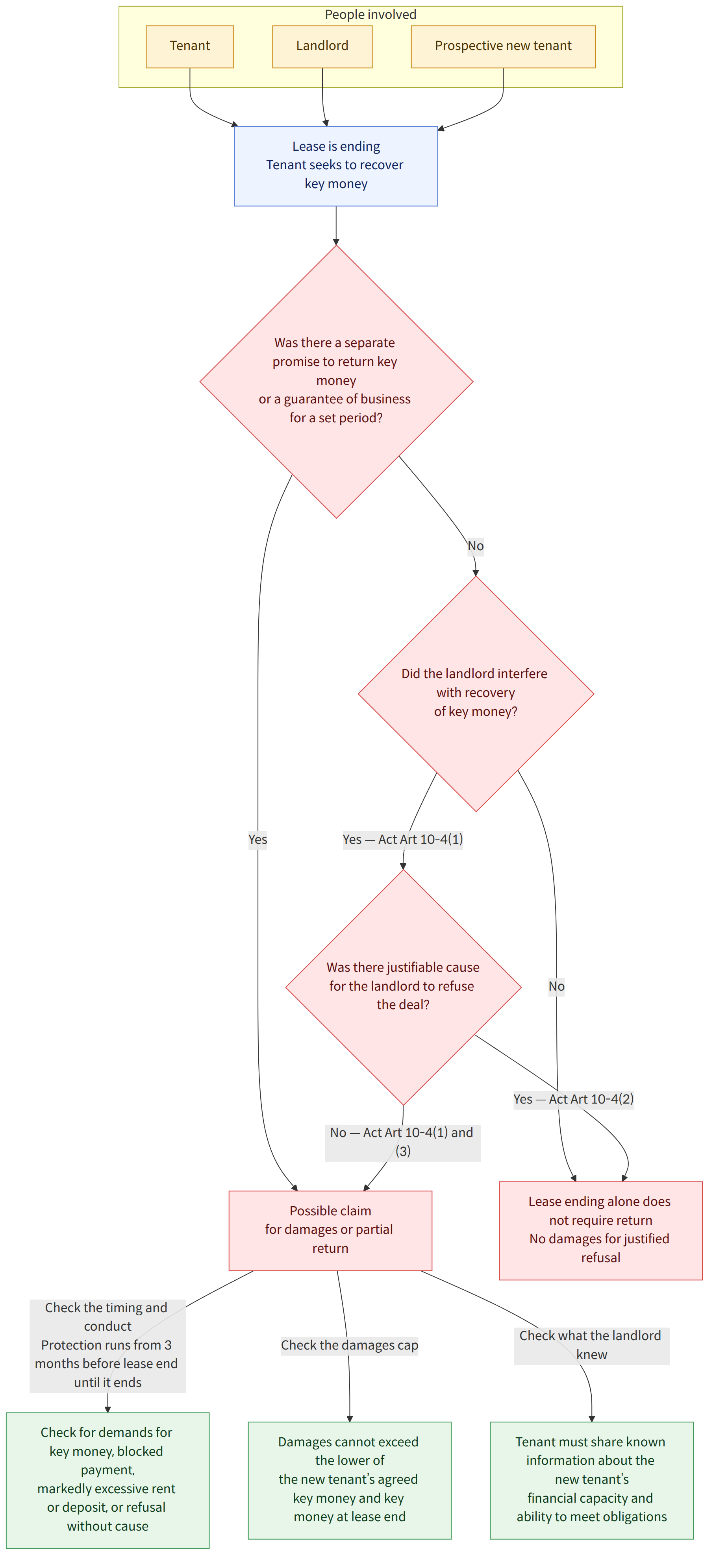
Key points
- Key money is paid in exchange for transferring or allowing the use of tangible or intangible property value, including business facilities and equipment, customer relationships, goodwill, business know-how, and business advantages arising from the location of the premises (Commercial Building Lease Protection Act, Article 10-3 (상가건물임대차보호법 제10조의3)).
- A key money agreement is separate from a lease agreement or an agreement to assign a leasehold right, but depending on the circumstances in which the agreements were made and their terms, they may be found to be inseparable (Supreme Court of Korea, Decision 2002Da25013; Supreme Court of Korea, Decision 2016Da261175).
- Typically, key money is received from a new tenant, so the tenant cannot demand its return from the landlord merely because the lease has ended.
- The landlord must not interfere with recovery of the key money from three months before the end of the lease term until the lease ends. Interference may include demanding key money, obstructing its payment, demanding markedly excessive rent or a security deposit, or refusing to enter into a contract without justifiable cause (Commercial Building Lease Protection Act, Article 10-4(1) (상가건물임대차보호법 제10조의4 제1항)).
- If the landlord causes damage through interference, the landlord may be liable for damages. The amount may not exceed the lower of the key money the new tenant agreed to pay and the key money at the time the lease ended (Commercial Building Lease Protection Act, Article 10-4(3) (상가건물임대차보호법 제10조의4 제3항)).
- There may be justifiable cause for the landlord to refuse to enter into a contract if, for example, the new tenant lacks the financial capacity to pay the security deposit or rent, or is likely to breach the tenant’s obligations. The tenant must provide the landlord with information known to the tenant about the new tenant’s financial capacity and ability to perform their obligations (Commercial Building Lease Protection Act, Article 10-4(2) and (5) (상가건물임대차보호법 제10조의4 제2항·제5항)).
- If the landlord received key money after guaranteeing that the business could operate for a specified period but fails to guarantee the business for that period, the landlord may, depending on the circumstances, have to return part of the key money corresponding to the remaining period (Supreme Court of Korea, Decision 2010Da85164).
- A tenant cannot exercise a lien over the leased building solely on the basis of a claim for the return of key money (Supreme Court of Korea, Decision 93Da62119).
Frequently asked questions
Q. When the lease ends, can I ask the landlord to return the key money?
The mere fact that the lease term has expired does not entitle the landlord to demand that the landlord return the key money. Typically, the key money is received from a new tenant. The specific circumstances must be examined, including whether the landlord separately agreed to return the key money or interfered with its recovery.
Q. If the contract says that the key money is “recognized,” must the landlord return it?
That wording alone is insufficient to conclude that the parties agreed to return the key money when the lease ends. Case law generally interprets it to mean that the landlord will allow the tenant to recover the key money and will be liable if the landlord interferes with its recovery without justifiable cause (Supreme Court of Korea, Decision 2000Da4517).
Q. What happens if the landlord demands an excessively high security deposit or rent from a new tenant?
If recovery of the key money was thwarted because the landlord demanded rent or a security deposit that was markedly higher than those in the surrounding area, or demanded an excessive amount in light of the burdens associated with the building, this may constitute interference. If damage results, the tenant may claim damages from the landlord (Commercial Building Lease Protection Act, Article 10-4(1) and (3) (상가건물임대차보호법 제10조의4 제1항·제3항)).
Q. Must the landlord enter into a contract even if the new tenant cannot afford the security deposit or rent?
No. If the new tenant lacks the financial capacity to pay the security deposit or rent, this may be justifiable cause for the landlord to refuse to enter into a contract. The tenant must provide the landlord with information known to the tenant about the new tenant’s financial capacity and ability to perform their obligations.
Q. Can the landlord refuse a new tenant because the tenant’s business is not the type the landlord wants?
Whether the reason for refusal is justifiable is determined by considering the specific circumstances, including the surrounding commercial area and the type of business. If reasonable grounds are established, rather than the landlord merely seeking to avoid entering into a contract, the refusal may be justifiable. In one case, it was held that the landlord could refuse to allow an entertainment business to move in, taking into account concerns about the cleanliness of the building and intoxicated patrons late at night.
Q. If interference with recovery of the key money is established, how much can I receive in damages?
If the landlord’s interference causes damage, the tenant may claim damages. The damages may not exceed the lower of the key money the new tenant agreed to pay and the key money at the time the lease ended. The claim must be brought within three years from the date the lease ended (Commercial Building Lease Protection Act, Article 10-4(3) and (4) (상가건물임대차보호법 제10조의4 제3항·제4항)).
Q. If the key money agreement is rescinded, can the agreement to assign the leasehold right also be rescinded?
In principle, a key money agreement and an agreement to assign a leasehold right are separate contracts. However, they may be rescinded together if they were made as one economic and factual arrangement, such that it appears that neither contract would have been made without the other.
Q. Can I continue to occupy the premises if the landlord does not return the key money?
A claim for the return of key money cannot be regarded as a claim arising in connection with the building. Therefore, the tenant cannot rely solely on that claim to exercise a lien and refuse to surrender the premises (Supreme Court of Korea, Decision 93Da62119).
Relevant laws
- Commercial Building Lease Protection Act, Article 8 (상가건물임대차보호법 제8조)
- Commercial Building Lease Protection Act, Article 10 (상가건물임대차보호법 제10조)
- Commercial Building Lease Protection Act, Article 10-3 (상가건물임대차보호법 제10조의3)
- Commercial Building Lease Protection Act, Article 10-4 (상가건물임대차보호법 제10조의4)
- Commercial Building Lease Protection Act, Article 10-5 (상가건물임대차보호법 제10조의5)
- Civil Act, Article 320 (민법 제320조)
Watch out for
- The provisions prohibiting interference with recovery of key money apply to conduct occurring from three months before the end of the lease term until the lease ends. The timing of introducing a new tenant and relevant supporting materials should therefore be checked.
- The landlord is not liable for damages merely because the landlord did not enter into a contract with the new tenant. The new tenant’s financial capacity and ability to perform the tenant’s obligations, the grounds for refusal, and the landlord’s requested terms should all be considered.
- The claim for damages must be brought within three years from the date the lease ends, and the amount of damages is subject to a statutory cap.
Source cases
This guide was compiled by AI from the following Korea Legal Aid Corporation consultation cases (in Korean).
- 상가임대차에서 임대인이 권리금을 인정한다는 약정의 효력
- 권리금 회수 기회 상실과 손해배상책임
- 영업용 건물의 임대차에 수반하여 지급되는 권리금계약 취소
- 임대인의 과도한 보증금 요구
- 임대인에 청구
- 권리금회수 방해금지 의무(2)
- 상가임대차에서 임차인이 권리금을 회수할 수 있는지
- 무자력 임차인과 권리금
- 임대인이 임차인의 신규임차인 주선에 대해 거절할 수 있는지
- 권리금회수 방해금지 의무
- 기존임차인이 임대인에게 신규임차인의 자력등에 대한 정보 제공의무가 있는지, 임대인은 신규임차인의 자력을 이유로 임대차계약 체결...
- 임대인이 임차인이 주선한 신규임차인이 되려는 자에게 권리금을 요구하거나 권리금을 수수하는 것이 가능한지
- 임대차계약시에 권리금이 수수되었으나 임대인의 사정으로 임대차계약이 중도 해지되어 그 보장 기간 동안 임차상가건물의 이용이 불가...
- 권리금의 귀속
- 권리금 반환 약정의 의미
- 건물이 경매되는 경우에도 권리금을 받을 수 있는지
- 전대차와 권리금 반환
- 권리금과 유치권
- 권리금 반환 약정의 의미
- 권리금과 임차권보장의 약정
- 권리금계약과 임차권양도계약의 관계
- 권리금의 법적 성질
- 권리금과 업무상배임죄
- 권리금을 인정한다는 의미
- 권리금이란 무엇인가요?
This guide is general legal information about Korean law, not legal advice for your situation. For a specific case, consult a lawyer or the Korea Legal Aid Corporation (call 132 in Korea).