
Requirements for Opposability in Commercial Building Leases and Points to Note
Based on 10 consultation cases · Updated · Translated from the Korean original.
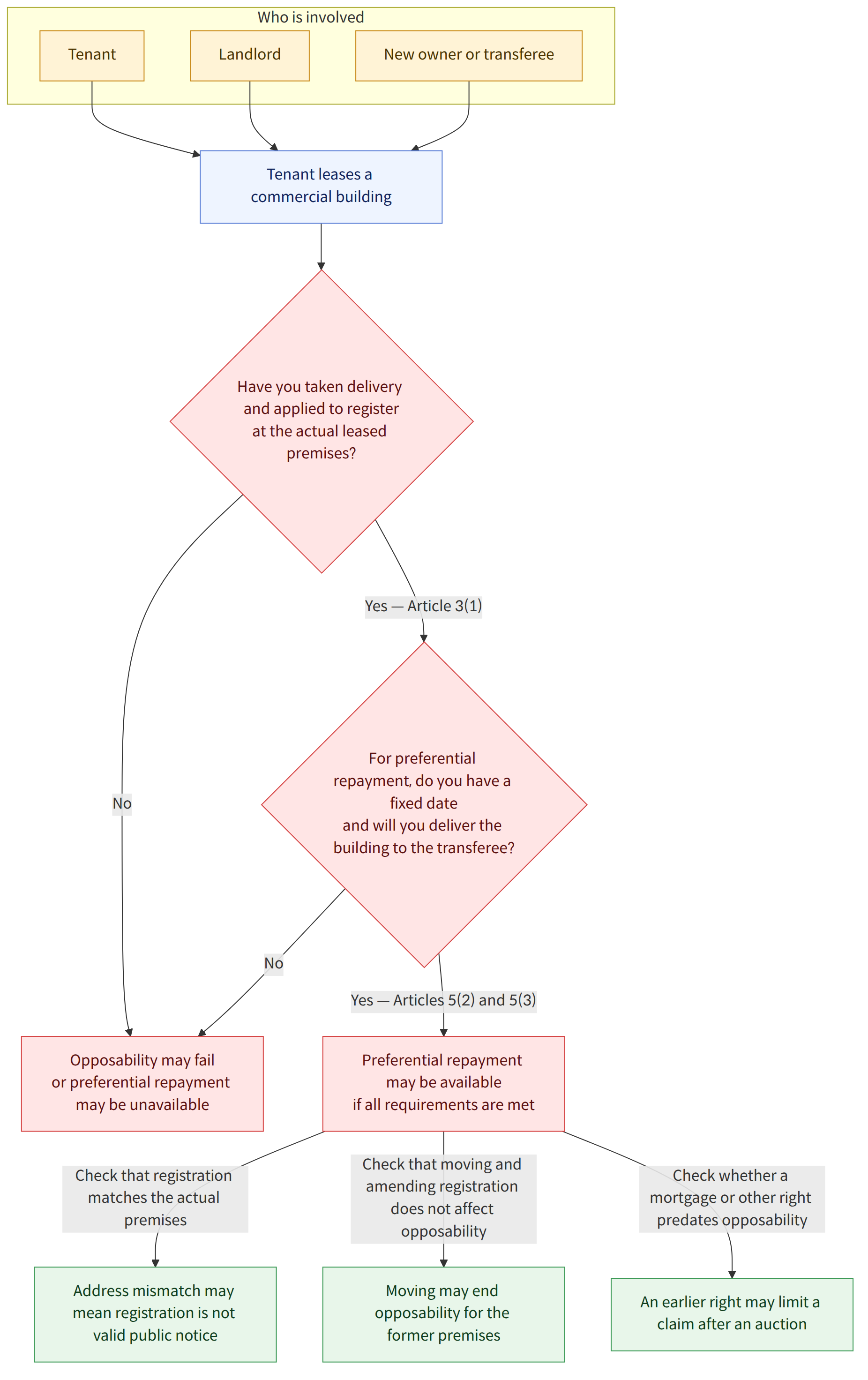
A commercial tenant may assert the lease against third parties from the day after taking delivery of the leased building and applying to register a business at that building. However, the business premises shown on the business registration must match the actual leased premises, and opposability and the right to preferential repayment of the deposit have different requirements.
At a glance
Key points
- Opposability is a tenant’s right to assert the terms of the lease against third parties, such as a transferee of the leased building.
- To acquire opposability, the tenant must take delivery of the leased building and apply to register a business there. The right takes effect on the day after the application is filed (Commercial Building Lease Protection Act, Article 3(1) (상가건물임대차보호법 제3조 제1항)).
- If the leased property shown on the business registration does not match the actual leased premises, the registration may not be recognized as a valid means of giving public notice of the lease (Supreme Court of Korea, September 25, 2008, decision 2008다44238).
- After the tenant acquires opposability, if ownership of the building changes, the transferee succeeds to the landlord’s position whether the change results from a sale, auction, or other means (Commercial Building Lease Protection Act, Article 3(2) (상가건물임대차보호법 제3조 제2항)).
- If the tenant moves the business to another location and amends the business registration, the tenant may lose opposability with respect to the former business premises (Daegu District Court, May 20, 2008, decision 2007나20356).
- A fixed date is a requirement for preferential repayment, separate from opposability. To receive repayment of the deposit ahead of subsequent-ranking right holders and others in an auction or public sale, the tenant must satisfy the requirements for opposability, including taking delivery of the building and registering the business, and obtain a fixed date (Commercial Building Lease Protection Act, Article 5(2) (상가건물임대차보호법 제5조 제2항)).
- If a mortgage or other right was established on the building before the tenant satisfied the requirements for opposability, the tenant may be unable to assert the leasehold right if ownership later changes through an auction (Example 1).
- To receive the deposit based on the right to preferential repayment in an auction or public sale, the tenant must deliver the leased building to the transferee (Commercial Building Lease Protection Act, Article 5(3) (상가건물임대차보호법 제5조 제3항)).
Frequently asked questions
Q. What does opposability mean in a commercial building lease?
It is the tenant’s right to assert the terms of the lease against a transferee of the building or other interested parties. Once the tenant has acquired this right, the tenant may also assert the lease against a new owner if ownership changes.
Q. When does opposability take effect?
The tenant satisfies the requirements for opposability by taking delivery of the leased building and applying to register a business at that building. The right takes effect on the day after the business registration application is filed (Commercial Building Lease Protection Act, Article 3(1) (상가건물임대차보호법 제3조 제1항)).
Q. What happens if the address on the business registration differs from the actual leased premises?
If the location shown in the lease agreement and business registration does not match the actual leased premises or the building’s registered description, the business registration may not be recognized as a means of giving public notice of the lease. In that case, the tenant may not acquire opposability under the Commercial Building Lease Protection Act.
Q. Will opposability be maintained if I move my business and amend my business registration?
If the business registration is changed to show a different location, the corrected registration no longer gives public notice of the lease at the former location. As a result, the tenant may lose opposability previously acquired for the former business premises.
Q. Can I assert my lease against a new owner if the building changes hands?
A tenant who has acquired opposability may assert the existing lease against the new owner. Whether ownership changes through a sale, inheritance, auction, or other means, the transferee succeeds to the landlord’s position (Commercial Building Lease Protection Act, Article 3(2) (상가건물임대차보호법 제3조 제2항)).
Q. Does opposability alone give me priority to recover my deposit in an auction?
Opposability and the right to preferential repayment must be distinguished. According to the example, to claim preferential repayment, the tenant must satisfy the requirements for opposability and obtain a fixed date on the lease agreement. To receive the deposit in an auction or public sale, the tenant must deliver the leased building to the transferee (Commercial Building Lease Protection Act, Articles 5(2) and 5(3) (상가건물임대차보호법 제5조 제2항·제3항)).
Q. What happens if a building is auctioned after a mortgage was established but before I registered my business?
If a mortgage or other right was established before the tenant took delivery of the building and applied for business registration, the tenant may be unable to assert the leasehold right after ownership changes through an auction. You should check when rights were established in relation to the lease and when the requirements for opposability were met.
Q. Does acquiring opposability mean that I have also obtained a fixed date?
No. Even if taking delivery of the building and applying for business registration satisfy the requirements for opposability, the tenant must separately obtain a fixed date on the lease agreement to qualify for preferential repayment. A fixed date alone cannot replace the requirements for opposability either.
Relevant laws
- Commercial Building Lease Protection Act, Article 3(1) (상가건물임대차보호법 제3조 제1항)
- Commercial Building Lease Protection Act, Article 3(2) (상가건물임대차보호법 제3조 제2항)
- Commercial Building Lease Protection Act, Article 4(3) (상가건물임대차보호법 제4조 제3항)
- Commercial Building Lease Protection Act, Article 5(1) (상가건물임대차보호법 제5조 제1항)
- Commercial Building Lease Protection Act, Article 5(2) (상가건물임대차보호법 제5조 제2항)
- Commercial Building Lease Protection Act, Article 5(3) (상가건물임대차보호법 제5조 제3항)
- Civil Act, Article 278 (민법 제278조)
- Civil Act, Article 450(1) (민법 제450조 제1항)
Watch out for
- Check that the description of the leased property in the business registration application and the attached lease agreement matches the actual leased premises.
- Amending the business registration to show a different business address may cause you to lose opposability for the former premises, so consider the consequences before making the change.
- A fixed date is a requirement separate from opposability, and the right to preferential repayment is recognized only if the requirements described in the example are met.
- To receive the deposit through preferential repayment in an auction or public sale, you must deliver the leased building to the transferee.
Source cases
This guide was compiled by AI from the following Korea Legal Aid Corporation consultation cases (in Korean).
- 상가임차인의 대항력 구비요건
- 상가임대차계약서와 다른 층을 임차하여 사용 시 그 계약의 효력
- 상가건물임대차보호법상 대항력을 인정받기 위하여 사업자등록이 갖추어야 할 요건
- 건물 공동임차 시 임차인을 공동임차인 중 1인으로 하기로 약정한 경우
- 임차건물의 양수인이 임대인의 지위를 승계하는 경우, 임차건물의 소유권이 이전되기 전에 이미 발생한 연체차임이나 관리비 등이 양...
- 임차할 건물에 대한 등록사항 등 열람·제공요청 가능한지
- 임대를 한 상가건물의 경매절차에서 건물의 소유자가 바뀐 경우, 양수인이 임대인의 지위를 승계하는지 여부
- 임차한 상가건물을 사업장으로 하여 사업자등록을 한 사람이 사업장을 다른 장소로 변경하는 사업자등록정정을 한 경우, 상가건물임대...
- 대항력은 무엇인가요?
- 건물의 주인이 바뀐 경우는?
This guide is general legal information about Korean law, not legal advice for your situation. For a specific case, consult a lawyer or the Korea Legal Aid Corporation (call 132 in Korea).