
Other Commercial Lease Issues: Rights and Precautions
Based on 68 consultation cases · Updated · Translated from the Korean original.
In commercial leases, the landlord’s repair obligations, the tenant’s restoration and reimbursement issues, and rent after the lease ends depend on the contract and the actual condition and use of the premises. When ownership of the building changes or a tenancy or claim for return of the security deposit is transferred, the applicable requirements and legal effects must likewise be distinguished.
At a glance
Key points
- Key money is not something that can automatically be claimed back from the landlord. However, the matter may be considered separately if special circumstances prevented the tenant from completing the guaranteed lease period or if the landlord obstructed the opportunity to recover the key money through a new tenant (Case 1).
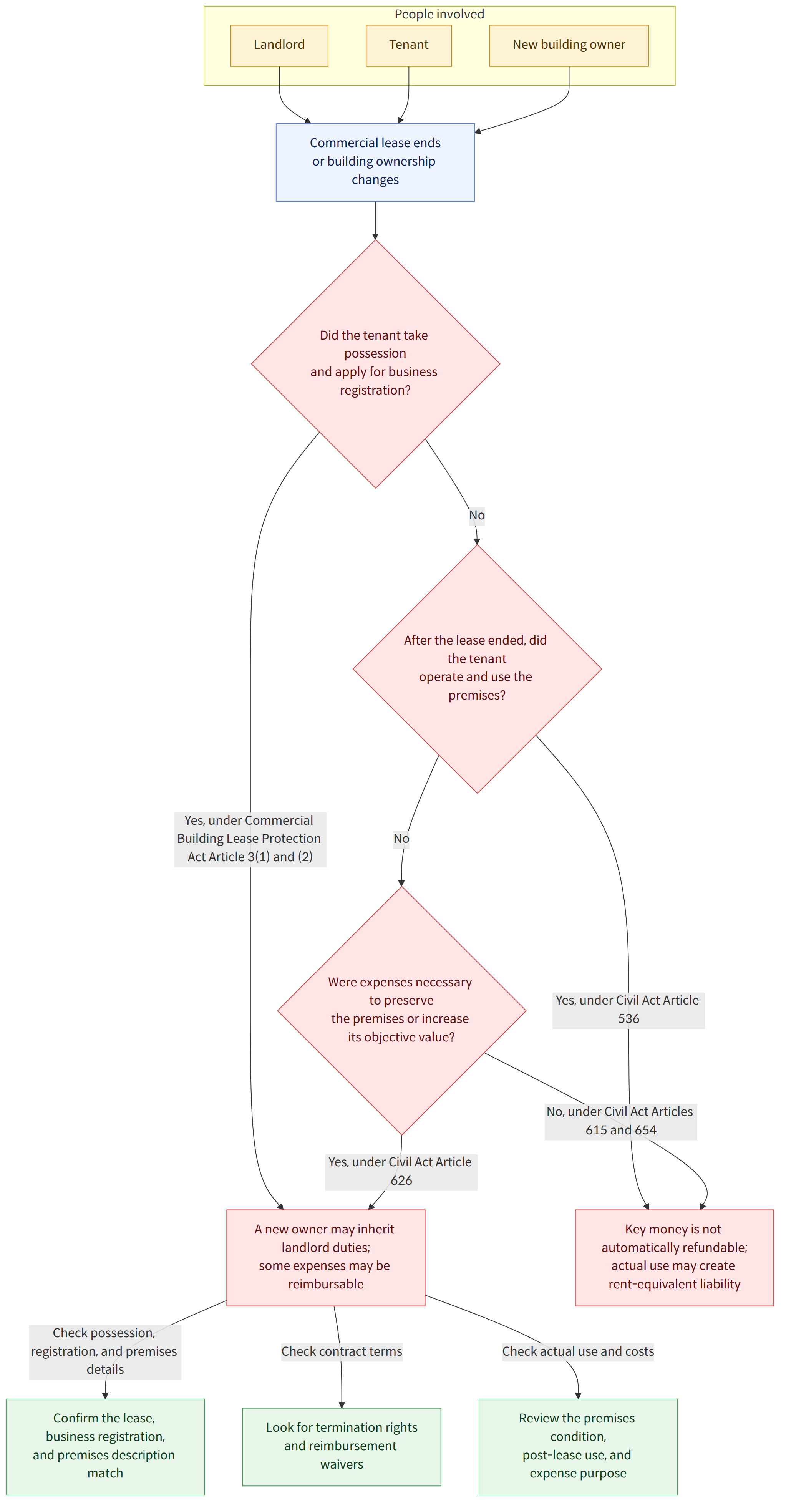
- Even if a commercial building is transferred, a transferee may succeed to the landlord’s position if the tenant has taken possession of the building and applied for business registration, thereby acquiring opposability (Commercial Building Lease Protection Act, Article 3(1) and (2) (상가건물임대차보호법 제3조 제1항·제2항)).
- The landlord must make repairs necessary for the tenant to use and enjoy the leased premises. However, it is necessary to consider whether the damage is minor and does not interfere with use, or whether it is serious enough to interfere with the tenant’s business (Civil Act, Article 623 (민법 제623조)).
- If there is no special agreement to the contrary, the tenant may not have to bear the cost of restoring ordinary wear and tear. By contrast, facilities installed by the tenant for the tenant’s business may have to be removed when the contract ends. An agreement waiving a claim for facility costs does not, by itself, relieve the tenant of the duty to restore the premises (Civil Act, Articles 615 and 654 (민법 제615조·제654조), Cases 4 and 12).
- Whether the tenant’s expenses must be reimbursed depends on whether they were necessary to preserve the premises, were beneficial expenses that increased its objective value, or were facility costs incurred solely for the tenant’s business. You should also check whether the contract contains an agreement waiving the right to claim reimbursement (Civil Act, Article 626 (민법 제626조)).
- After the contract ends, the return of the security deposit and the return of the building are, in principle, obligations to be performed simultaneously. Whether the tenant merely remained in possession or actually operated a business and used and enjoyed the premises may affect whether the tenant owes unjust enrichment equivalent to rent (Civil Act, Article 536 (민법 제536조), Case 8).
- A tenant cannot necessarily terminate a contract unilaterally during its term based solely on personal circumstances. You should check, among other things, whether the contract reserves a right to terminate. Nor may the tenant refuse to pay all rent merely because use of the premises is partly impaired (Civil Act, Articles 635 and 636 (민법 제635조·제636조), Cases 21 and 25).
- An agreement restricting the tenant’s right to request renewal to the tenant’s disadvantage may be invalid, but it is necessary to separately check whether a statutory ground for refusing renewal applies. A subtenant who has obtained the landlord’s consent may exercise the right to request renewal on the tenant’s behalf if certain requirements are met (Commercial Building Lease Protection Act, Articles 10, 13(2), and 15 (상가건물임대차보호법 제10조·제13조 제2항·제15조)).
Frequently asked questions
Q. When a commercial lease ends, can I recover key money or facility investment costs from the landlord?
As a general rule, key money is not something the landlord is automatically required to refund. A tenant may be able to recover key money by assigning the tenancy or subletting the premises. The matter should be considered separately if special circumstances—such as the tenant being unable to complete a guaranteed lease period for reasons attributable to the landlord—apply, or if the landlord obstructed the tenant’s opportunity to recover the key money through a new tenant. For facility costs, it is also important to determine whether they were beneficial expenses that objectively increased the property’s value or costs incurred solely for the tenant’s business, and whether the contract contains an agreement to waive reimbursement.
Q. If the owner of a commercial building changes, do I have to move out for the new owner?
A tenant who has taken possession of the building and applied for business registration, thereby acquiring opposability, may assert the tenancy against a person who acquires ownership of the building. In that case, the transferee may succeed to the landlord’s position and assume the obligation to return the security deposit, so there may be cases in which the tenant cannot claim the deposit from the former owner. You should also check that the lease, business registration details, and description of the leased premises are consistent with one another.
Q. When a lease ends, do I have to repair fluorescent lights or equipment that broke after long use?
The landlord may be responsible for ordinary wear and tear arising from normal use if the tenant is not at fault and there is no special agreement to the contrary. However, you should check whether the contract requires the tenant to repair even specified types of wear and tear, and whether the damage exceeds what would result from ordinary use. The scope of restoration depends on the contract and the actual condition of the premises.
Q. Can I claim from the landlord the cost of a boiler or other facilities installed by the tenant?
If an expense objectively increased the value of the leased property, it may qualify as a beneficial expense, and the tenant may claim reimbursement upon termination of the lease to the extent that the increase in value remains. By contrast, facilities needed only for the tenant’s own business may not qualify as beneficial expenses. You should also check for any prior agreement waiving the right to claim reimbursement or requiring restoration. Evidence supporting the amount spent and the increase in value is important when claiming beneficial expenses.
Q. If my lease ends before I get my security deposit back, can I continue to possess the shop?
Returning the leased premises and returning the security deposit may be obligations that must be performed simultaneously. Therefore, the tenant’s continued possession while invoking the right to withhold performance does not, by itself, immediately constitute unlawful possession. However, if the tenant obtained an actual benefit by continuing to operate a business after the lease ended, the tenant may have to repay unjust enrichment equivalent to rent. The outcome may differ if the tenant merely remained in possession without using or enjoying the premises.
Q. Can I terminate my lease immediately if I want to close my store for personal reasons, even though the term has not expired?
If the lease specifies a term and the tenant has not reserved a separate right to terminate early, it may be difficult for the tenant to terminate the lease unilaterally based solely on personal circumstances. You may need to consider performing the contract or agreeing with the landlord to end it. A situation in which a new tenant moves in before the term expires and the landlord receives rent twice over the same period may be considered separately.
Q. Can the landlord refuse to renew the lease on the grounds that the building will be reconstructed?
The Commercial Building Lease Protection Act provides that certain grounds for reconstruction may justify refusing to renew a lease. Whether a refusal to renew is justified may depend on specific circumstances, such as how concrete the reconstruction plan is and whether it is likely to proceed in practice. Therefore, it should not be assumed that a landlord can always refuse renewal merely by citing reconstruction. An agreement restricting the tenant’s right to request renewal to the tenant’s disadvantage may also be invalid.
Q. Can a subtenant request renewal if the landlord’s consent was given after the sublease agreement was made?
Under the standards explained in the case, the landlord’s consent may be given either before or after the sublease agreement is made, and consent may be express or implied. However, the tenant and subtenant must prove that consent was given. A subtenant who has obtained consent may exercise the tenant’s right to request renewal on the tenant’s behalf if the statutory requirements are met.
Relevant laws
- Commercial Building Lease Protection Act, Article 2(1) (상가건물임대차보호법 제2조 제1항)
- Commercial Building Lease Protection Act, Article 3(1) and (2) (상가건물임대차보호법 제3조 제1항·제2항)
- Commercial Building Lease Protection Act, Article 9(1) (상가건물임대차보호법 제9조 제1항)
- Commercial Building Lease Protection Act, Article 10(1), (4), and (5) (상가건물임대차보호법 제10조 제1항·제4항·제5항)
- Commercial Building Lease Protection Act, Article 10-4 (상가건물임대차보호법 제10조의4)
- Commercial Building Lease Protection Act, Article 13(2) (상가건물임대차보호법 제13조 제2항)
- Commercial Building Lease Protection Act, Article 15 (상가건물임대차보호법 제15조)
- Civil Act, proviso to Article 345 (민법 제345조 단서)
- Civil Act, Article 346 (민법 제346조)
- Civil Act, Article 451(1) (민법 제451조 제1항)
- Civil Act, Article 536 (민법 제536조)
- Civil Act, Article 543(1) (민법 제543조 제1항)
- Civil Act, Article 615 (민법 제615조)
- Civil Act, Article 617 (민법 제617조)
- Civil Act, Article 618 (민법 제618조)
Watch out for
- Whether key money, facility costs, or beneficial expenses must be reimbursed is not determined merely by what they are called. Check the contract’s provisions waiving reimbursement or requiring restoration, as well as the purpose of the expenditure and whether it increased the property’s value.
- If the tenant remains in possession of the shop after the lease ends, the fact that the tenant is waiting for the security deposit to be returned does not always exempt the tenant from paying an amount equivalent to rent. Whether the tenant actually operated a business or used and enjoyed the premises is important.
- A transfer of the building, a sublease, an assignment of the tenancy, and an assignment of the claim for return of the security deposit are distinct legal relationships. You should distinguish which of these requires the landlord’s consent and against whom the deposit should be claimed.
- The laws and standards cited in a case may reflect the law in effect when the consultation took place. In an actual dispute, check the law applicable at the time the contract was made and currently, as well as the specific terms of the contract.
Source cases
This guide was compiled by AI from the following Korea Legal Aid Corporation consultation cases (in Korean).
- 상가임차인의 임차건물에 대한 시설투자비 등 회수방법
- 임차건물의 소유권 변동 시 임차인의 계약해지권
- 상가 영구임대계약의 임차인이 임대차계약을 해지할 수 있는지
- 임대차계약 만료 후 임차인이 임차목적물의 통상적인 손모에 대해서도 수리하여 반환할 의무가 있는지
- 임차인의 유익비상환청구권의 행사요건
- 임대차종료 시 ‘영업허가명의변경약정’을 민사소송으로 청구 가능한지
- 임차한 지하층에 습기가 찰 때 임대인에게 수선의무 있는지
- 계약종료 후 목적물을 계속 점유할 때 부당이득 여부
- 임대차 및 전대차의 기간 종료 후 전대인의 차임상당 청구 가능한지
- 임차인이 지출한 도시가스보일러 설치비용은 임대인이 부담하는지
- 임차인에게 불리한 약정의 효력
- 임대인 과실로 임대차계약이 종료된 경우 임차인의 원상회복의무 면제 여부
- 양도금지특약부임차권 양도인이 임대인의 동의를 받아주지 못한 경우
- 임대인과 임차인 사이에서 장래 임대목적물 반환시 임차인의 원상복구비용의 보증금 명목으로 지급하기로 약정한 금액을 임대차 종료시...
- 상가건물임대차보호법의 위헌여부(3)
- 상가임대차중개시 중개업자의 의무
- 임대인에게 그 소유 건물의 다른 부분에서 제3자에게 임차인의 영업 등 수익활동을 해할 우려가 있는 행위를 하지 아니하도록 할 ...
- 임차권양도금지특약 시 임차보증금반환채권의 양도까지 금지되는지
- 대리점영업을 양도하면서 점포도 넘겨줄 경우 임차권양도계약인지
- 상가건물이 양도된 경우 임차인의 법적지위
- 임대차계약기간 만료 전에도 계약을 해지할 수 있는지
- 상가 업종제한규약의 양수인 적용 여부
- 전대차에 대한 임대인의 동의의 시기
- 임차보증금반환채권에도 질권을 설정할 수 있는지
- 임대차계약에 있어서 목적물의 사용·수익이 부분적으로 지장이 있는 경우, 임차인의 차임지급의무의 범위
This guide is general legal information about Korean law, not legal advice for your situation. For a specific case, consult a lawyer or the Korea Legal Aid Corporation (call 132 in Korea).