
Guide to Preferential Rights to Payment for Commercial Leases
Based on 39 consultation cases · Updated · Translated from the Korean original.
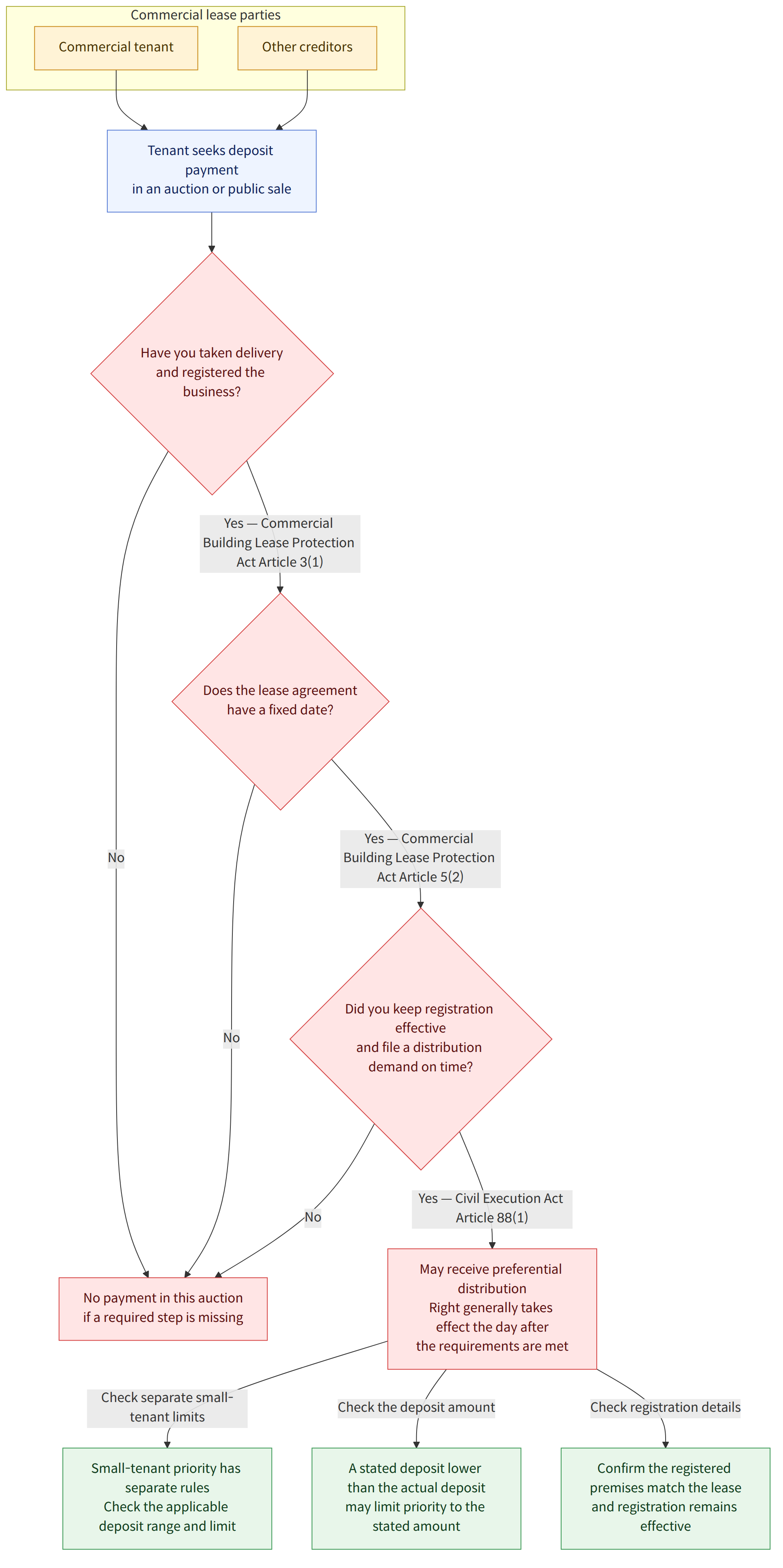
As a general rule, for a commercial tenant to receive preferential payment of a deposit in an auction or public sale, the tenant must take delivery of the building, register the business, and have a fixed date on the lease agreement. A small tenant’s right to receive preferential payment of a certain amount ahead of others is subject to separate requirements and statutory limits. Even if the tenant meets the requirements for a right, the tenant must also file a demand for distribution and continue to satisfy the requirements.
At a glance
Key points
- A general preferential right to payment is recognized only if the tenant satisfies both the requirements for enforceability against third parties—taking delivery of the building and registering the business—and the requirement that the lease agreement have a fixed date (Commercial Building Lease Protection Act, Article 3(1) and Article 5(2) (상가건물임대차보호법 제3조 제1항, 제5조 제2항)).
- Even if the tenant has registered the business and obtained a fixed date, the preferential right to payment may not take effect immediately if the tenant has not yet taken delivery of the building. The examples explain that the right takes effect from the day after the requirements for enforceability against third parties have been met (Examples 12 and 22).
- A small tenant may receive payment ahead of other holders of security interests within the deposit range and up to the amount prescribed by law. The tenant must satisfy the requirements for enforceability against third parties before registration of the application for auction. The specific range and limit must be checked under the laws applicable at the relevant time (Commercial Building Lease Protection Act, Article 14, and Enforcement Decree, Articles 6 and 7 (상가건물임대차보호법 제14조, 시행령 제6조·제7조)).
- Business registration is both a requirement for acquiring and a requirement for maintaining the preferential right to payment. It must be properly maintained until the deadline for filing a demand for distribution. If the tenant has actually ceased business or sublet the premises, the requirements may not be met even if the registration remains on file (Examples 7, 19, and 20).
- To exercise a preferential right to payment, the tenant must file a demand for distribution by the deadline set in the auction proceedings. If the tenant is excluded from the distribution for failing to file a demand, it is difficult to claim the return of unjust enrichment from a junior creditor (Civil Execution Act, Article 88(1) (민사집행법 제88조 제1항); Examples 13 and 19).
- If the description of the leased premises in the agreement attached to the business registration differs from the real estate register, or if the tenant lacks a floor plan of a partially leased space, the business registration may fail to publicize the lease, causing problems with enforceability against third parties and the preferential right to payment (Example 6).
- If the lease agreement states a deposit lower than the actual amount and is given a fixed date, the tenant may receive preferential payment based on the amount stated in the agreement, not the full amount actually paid (Example 8).
- If the deposit is increased upon renewal, the amount that generally has priority over a mortgagee whose mortgage was established before the increase is limited to the deposit before the mortgage was established. If the tenant enters into a new agreement with the new owner that replaces the former agreement, the preferential right to payment based on the former agreement may also cease to exist (Examples 15 and 21).
Frequently asked questions
Q. What requirements must I meet to receive preferential payment of my commercial lease deposit?
To qualify for the general preferential right to payment, the tenant must satisfy the requirements for enforceability against third parties by taking delivery of the building and applying for business registration, and the lease agreement must have a fixed date. The order of distribution may vary depending on when these requirements are met and when any senior rights arose.
Q. Can a small tenant’s deposit be protected even if the lease agreement does not have a fixed date?
The examples explain that a small-tenant’s right to receive preferential payment of a certain amount ahead of others is separate from the general preferential right to payment. A tenant may receive preferential payment of a certain amount if they fall within the statutory definition of a small tenant and satisfy the requirements for enforceability against third parties before registration of the application for auction, but the prescribed scope and limit must be met.
Q. Do I have to file a demand for distribution once an auction begins?
Yes. Even if you have a preferential right to payment, you must file a demand for distribution by the deadline set in the auction proceedings in order to receive a distribution. If you miss the deadline, it is difficult to claim the amount distributed to a junior creditor as unjust enrichment and demand its return.
Q. Will I retain my preferential right to payment if I keep my business registration but stop operating my business?
According to the examples, business registration must be properly maintained as a means of publicizing the actual lease. If the tenant has effectively ceased business or sublet the premises and no longer operates a business there, the requirements may no longer be met even if the registration remains on file. In some cases, the subtenant who directly occupies the premises and operates the business must have business registration.
Q. Can I receive preferential payment of the actual amount if the lease agreement states a lower deposit?
The examples explain that if the lease agreement bearing a fixed date states a deposit lower than the actual amount, the distribution may be based on the lower amount stated in the agreement. To protect the actual deposit, the lease agreement and business registration must accurately reflect the relevant details.
Q. If I increase the deposit when renewing my lease, does the increased amount also rank ahead of an existing mortgage?
If a mortgage was established before the deposit was increased, the amount that generally has priority over the mortgagee is limited to the deposit before the increase. If the increased portion is given a new fixed date, you may assert a preferential right to payment against security holders and general creditors whose rights rank below it.
Q. Could there be a problem with my preferential right to payment if the shop description in the lease agreement differs from the real estate register?
It may cause a problem. If the business registration does not serve as a means of publicizing the lease to third parties, it may be difficult to assert enforceability against third parties and the preferential right to payment that depends on it. If only part of a building is leased, you should also check that a floor plan identifying the leased area is available.
Q. Will my existing preferential right to payment remain in effect if I sign a new lease agreement with the new building owner?
As a general rule, the new owner succeeds to the former landlord’s position. However, if the new owner and tenant agree to end the former agreement and establish their legal relationship under a separate agreement, the preferential right to payment based on the former agreement may cease to exist. The terms of the new agreement and the circumstances in which it was made should be examined.
Relevant laws
- Commercial Building Lease Protection Act, Article 3 (상가건물임대차보호법 제3조)
- Commercial Building Lease Protection Act, Article 4 (상가건물임대차보호법 제4조)
- Commercial Building Lease Protection Act, Article 5 (상가건물임대차보호법 제5조)
- Commercial Building Lease Protection Act, Article 6 (상가건물임대차보호법 제6조)
- Commercial Building Lease Protection Act, Article 8 (상가건물임대차보호법 제8조)
- Commercial Building Lease Protection Act, Article 14 (상가건물임대차보호법 제14조)
- Commercial Building Lease Protection Act, Article 15 (상가건물임대차보호법 제15조)
- Enforcement Decree of the Commercial Building Lease Protection Act, Article 3 (상가건물임대차보호법 시행령 제3조)
- Enforcement Decree of the Commercial Building Lease Protection Act, Article 6 (상가건물임대차보호법 시행령 제6조)
- Enforcement Decree of the Commercial Building Lease Protection Act, Article 7 (상가건물임대차보호법 시행령 제7조)
- Civil Execution Act, Article 88 (민사집행법 제88조)
- Framework Act on National Taxes, Article 35 (국세기본법 제35조)
Watch out for
- The regional deposit thresholds and preferential payment limits for small tenants may differ between the historical criteria described in the examples and the current criteria. Check the laws in force at the relevant time and the criteria for the applicable region.
- The requirements, including business registration, must remain satisfied until the deadline for filing a demand for distribution, and a demand for distribution must also be filed separately. Take care not to miss the deadline or the required filing procedure in the auction proceedings.
- An increase in the deposit, a change of landlord, execution of a new agreement, subletting, or cessation of business may affect the scope or continued validity of the preferential right to payment. Check the lease agreement and business registration together.
Source cases
This guide was compiled by AI from the following Korea Legal Aid Corporation consultation cases (in Korean).
- 상가건물임대차보호법 시행 전 저당권자가 있는 경우 최우선변제권
- 소액임차인의 최우선변제권의 범위 및 보장금액의 한도
- 상가건물임대차계약 시 임차인에게 불리한 약정의 효력
- 대항력과 최우선변제권을 겸유하고 있는 상가임차권의 법률관계
- 상가건물임대차보호법 시행 전후에 받은 각 확정일자의 효력
- 사업자등록신청서에 첨부한 임대차계약서상의 임대차 목적물 소재지가 당해 상가건물에 대한 등기부상의 표시와 불일치하는 경우의 우선...
- 상가를 전대한 임차인의 우선변제권 행사 가능 여부
- 임차인이 보증금액을 실제보다 적게 신고한 경우 우선변제권의 범위
- 구분점포 각각에 대하여 일괄하여 단일한 임대차 관계가 성립한 경우 우선변제를 받을 임차인의 범위를 판단하는 기준
- 상가임차보증금에 대한 우선변제권의 확보방법
- 가족명의로 상가임대차계약을 변경시 대항력문제
- 확정일자 부여방법
- 우선변제권을 가진 임차인이 근저당권에 기한 강제경매절차에서 배당요구를 하지 않은 경우, 배당받은 후순위채권자에 대한 부당이득반...
- 상가경매로 인한 보증금 법적 우선보호 가능 여부
- 임대차계약 기간 중에 임대차 목적물의 양수인인 새로운 임대인과 임대차계약을 체결한 경우 기존의 임대차계약에 기한 우선변제권이 ...
- 수차례 임대차계약을 갱신한 경우 배당요구 종기 후 확정일자를 변동하여 우선변제권을 주장할 수 있는지 여부
- 상가건물의 새로운 소유자와 사이에 체결한 임대차계약
- 임대차계약 갱신 후 배당요구
- 상가건물임대차보호법상 우선변제권의 행사방법
- 배당요구 종기까지 적법한 사업자등록이 유지되지 않은 경우의 우선변제권
- 계약을 갱신하면서 임대보증금을 인상하는 경우의 우선변제권
- 우선변제권 있는 상가임차인과 저당권자 사이의 배당순위
- 임차상가건물에 임차권등기가 되기 전에 이미 저당권이 설정되어 있었던 경우에 임차인이 저당권자보다 우선하는지
- 임차권한 없는 자로부터의 임대차
- 상가건물 임대차보호법상의 대항요건 및 확정일자를 갖춘 임차인과 조세채권자와의 우선순위 결정 방법
This guide is general legal information about Korean law, not legal advice for your situation. For a specific case, consult a lawyer or the Korea Legal Aid Corporation (call 132 in Korea).