
Essential Guide to Demanding Renewal of a Commercial Lease
Based on 9 consultation cases · Updated · Translated from the Korean original.
A tenant may demand renewal within the period described in the case studies, and the landlord generally cannot refuse without a ground specified by law. However, the outcome may vary depending on factors such as rent arrears, succession to the landlord’s status, and whether the property is subleased. A demand for renewal must be distinguished from termination of the lease due to rent arrears.
At a glance
Key points
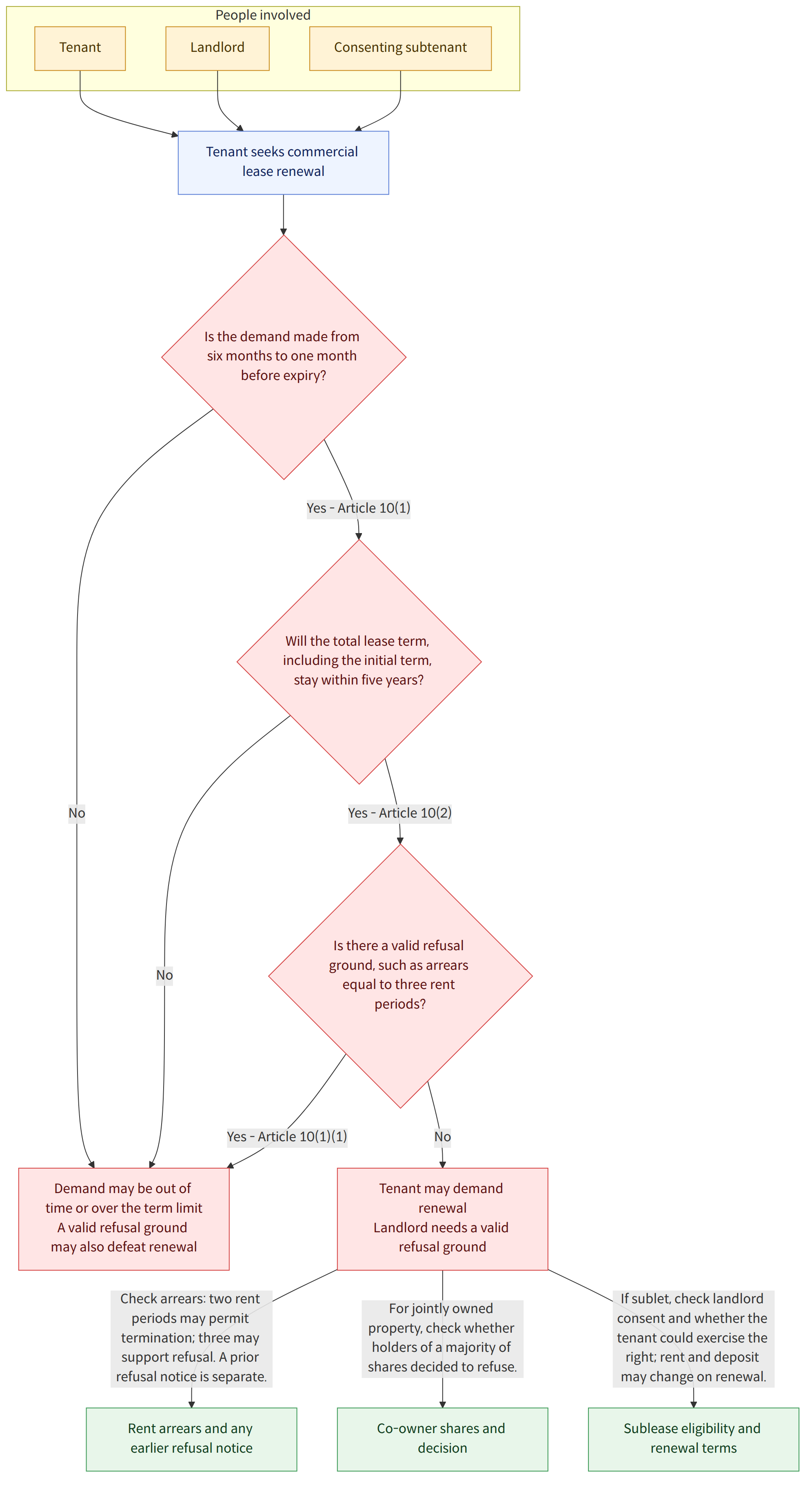
- A tenant may demand renewal during the period beginning six months and ending one month before the lease expires. The landlord may not refuse without a valid reason (Commercial Building Lease Protection Act, Article 10(1) (상가건물임대차보호법 제10조 제1항)).
- According to the case studies, the right to demand renewal may be exercised only within a limit under which the total lease term, including the initial lease term, does not exceed five years (Commercial Building Lease Protection Act, Article 10(2) (상가건물임대차보호법 제10조 제2항); Case Studies 6 and 8).
- Even if the landlord first gives notice refusing renewal, the tenant may separately demand renewal if there is no valid ground for refusal (Supreme Court Decision 2013Da35115, April 30, 2014; Case Study 5).
- The landlord may not refuse a renewal demand solely because rent was paid late once. However, having fallen into arrears in an amount equivalent to three periods’ rent may be a ground for refusal (Commercial Building Lease Protection Act, Article 10(1)(1) (상가건물임대차보호법 제10조 제1항 제1호); Case Studies 1 and 9).
- Separately from the three-period arrears threshold for refusing renewal, the case study explains that the landlord may terminate the lease if the amount of rent in arrears reaches the equivalent of two periods’ rent (Civil Act, Article 640 (민법 제640조); Supreme Court Decision 2012Da28486, July 24, 2014; Case Study 1).
- Refusal to renew a lease for a jointly owned commercial property constitutes an act of management of jointly owned property. Given the co-owners’ shares in the case study, a decision by holders of a majority of the shares is required (Civil Act, Article 265 (민법 제265조); Supreme Court Decision 2010Da37905, September 9, 2010; Case Study 4).
- A subtenant who has obtained the landlord’s consent may demand renewal on behalf of the tenant during the period in which the tenant may exercise the right to demand renewal. However, if circumstances prevent the tenant from exercising that right, the subtenant may also be unable to exercise it (Commercial Building Lease Protection Act, Article 13(2) (상가건물임대차보호법 제13조 제2항); Case Study 6).
- Upon renewal, the lease is generally deemed to have been made on the same terms as the previous lease, but rent and the security deposit may be increased or decreased within the limits prescribed by law (Commercial Building Lease Protection Act, Articles 10(3) and 11 (상가건물임대차보호법 제10조 제3항, 제11조); Case Study 3).
Frequently asked questions
Q. Can I demand renewal even if my landlord has already refused to renew the lease?
That may be possible. According to the case study, the landlord’s notice of refusal and the tenant’s demand for renewal are separate legal mechanisms. Therefore, if there is no valid ground for refusal, the tenant may demand renewal even if the landlord gave notice first.
Q. Can my landlord refuse to renew the lease because I paid the rent late once?
The case study explains that a single late rent payment does not allow the landlord to refuse a renewal demand. However, a ground for refusal may arise if the tenant has ever fallen into arrears in an amount equivalent to three periods’ rent.
Q. If I fall two periods behind on rent, can the landlord both refuse renewal and terminate the lease?
The case study distinguishes between the two issues. A ground for refusing a renewal demand is having fallen into arrears in an amount equivalent to three periods’ rent, while termination under Article 640 of the Civil Act (민법 제640조) may be possible when the amount of rent in arrears reaches the equivalent of two periods’ rent.
Q. Can I demand renewal if I owe rent to the former landlord after the commercial property is sold to someone else?
According to the case study, if the transferee did not separately acquire the claim for rent arrears, it is difficult to refuse renewal solely because rent was owed to the former landlord. Whether rent owed to the transferee amounts to three periods’ rent must be considered separately.
Q. Is a notice refusing renewal effective if only one of the co-owners gives it?
In the case study, only one of the co-owners, each holding a one-half share, gave notice, and the other co-owner’s consent was not established. The court therefore found that the refusal to renew was invalid. The co-owners’ respective shares and whether they made a decision must be checked.
Q. Can a subtenant with the landlord’s consent demand renewal directly?
According to the case study, a subtenant who entered into a sublease with the landlord’s consent may demand renewal from the landlord on behalf of the tenant during the period in which the tenant may exercise the right to demand renewal. Because this involves exercising the tenant’s rights on the tenant’s behalf, it is also affected by the status of the tenant’s rights.
Q. Can my landlord refuse renewal on the grounds of reconstruction even though the building is safe?
The case study discusses a lower-court decision that recognized refusal to renew for the purpose of reconstruction even where there were no safety concerns. However, this explanation is based on a lower-court ruling, not a Supreme Court decision.
Q. Can my landlord increase the rent or security deposit when the lease is renewed?
According to the case study, rent and the security deposit may still be increased or decreased after renewal, within the limits set by applicable laws and regulations. Case Study 3 states a cap on increases and a restriction on further increases within one year of an increase. Rather than applying those figures unchanged to other situations, you should check the assumptions underlying that case study.
Relevant laws
- Commercial Building Lease Protection Act, Article 10 (상가건물임대차보호법 제10조)
- Commercial Building Lease Protection Act, Article 10(1)(1) (상가건물임대차보호법 제10조 제1항 제1호)
- Commercial Building Lease Protection Act, Article 10(1)(7)(c) (상가건물임대차보호법 제10조 제1항 제7호 다목)
- Commercial Building Lease Protection Act, Article 10(2) (상가건물임대차보호법 제10조 제2항)
- Commercial Building Lease Protection Act, Article 10(3) (상가건물임대차보호법 제10조 제3항)
- Commercial Building Lease Protection Act, Article 10(4) (상가건물임대차보호법 제10조 제4항)
- Commercial Building Lease Protection Act, Article 11 (상가건물임대차보호법 제11조)
- Commercial Building Lease Protection Act, Article 13(2) (상가건물임대차보호법 제13조 제2항)
- Commercial Building Lease Protection Act, Article 15 (상가건물임대차보호법 제15조)
- Enforcement Decree of the Commercial Building Lease Protection Act, Article 4 (상가건물임대차보호법 시행령 제4조)
- Civil Act, Article 265 (민법 제265조)
- Civil Act, Article 640 (민법 제640조)
Watch out for
- The case studies describe the period for demanding renewal as beginning six months and ending one month before the lease expires. Check the deadline carefully so that you do not miss it.
- The three-period arrears threshold described as a ground for refusing a renewal demand and the two-period arrears threshold described as a ground for terminating the lease are different standards.
- The discussion of reconstruction in Case Study 2 is based on a lower-court decision, so it should not be stated as though it were settled law established by the Supreme Court.
- The rent-increase figures in Case Study 3 and the overall lease-term limit discussed in Case Studies 6 and 8 are based on the content of those individual consultation cases. When applying them to a specific lease, you should also consider the assumptions underlying the relevant case study.
Source cases
This guide was compiled by AI from the following Korea Legal Aid Corporation consultation cases (in Korean).
- 임대차 계약서에 민법 제640조와 동일한 내용의 특약이 있는 경우 상가건물임대차보호법 제10조 및 제15조의 적용가부
- 건물이 노후하거나 안전에 문제가 있는 경우가 아니더라도 임대인이 건물을 철거하거나 재건축하기 위하여 임차인의 계약갱신요구를 거...
- 계약갱신과 차임과 보증금
- 상가건물의 임대인이 공동소유자들인 경우 임차인의 계약갱신청구에 대한 임대인들의 적법한 거절 방법
- 임대인이 먼저 임차인에게 갱신거절 통지를 한 경우에도 임차인의 계약갱신요구가 가능한지
- 전차인의 계약갱신요구권
- 임대인 지위승계와 차임연체 갱신청구
- 갱신청구권 기간
- 차임연체와 갱신청구
This guide is general legal information about Korean law, not legal advice for your situation. For a specific case, consult a lawyer or the Korea Legal Aid Corporation (call 132 in Korea).