
How Far Does Protection Extend Under the Commercial Lease Rules?
Based on 10 consultation cases · Updated · Translated from the Korean original.
The Commercial Building Lease Protection Act applies to leases of buildings subject to business registration that are used for business purposes. When determining whether a lease is covered, both the regional thresholds and the amount calculated by converting monthly rent must be considered. A corporate tenant may also be protected if it meets the requirements, but leases for offices of nonprofit organizations and leases exceeding the statutory thresholds may require case-specific consideration.
At a glance
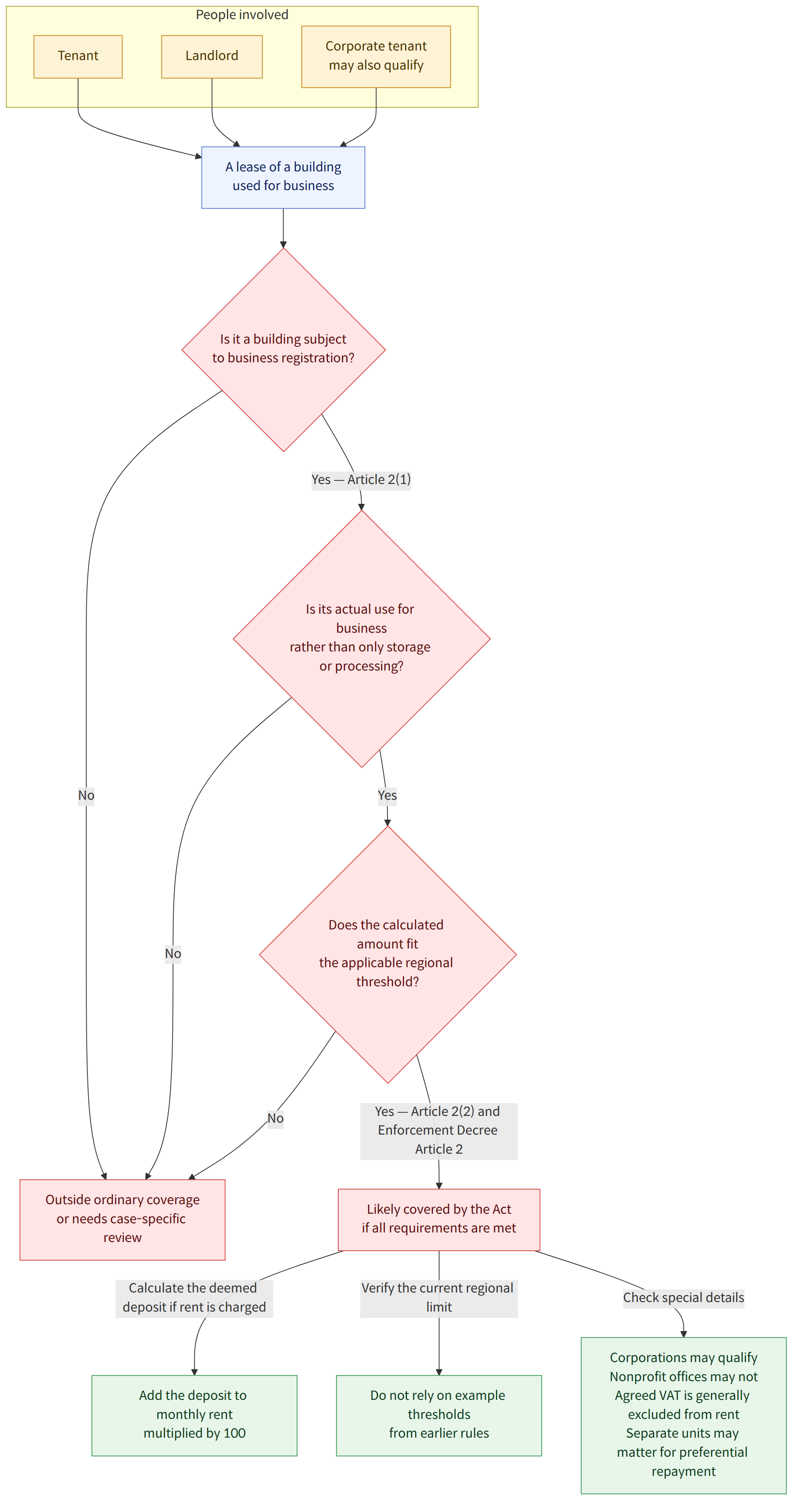
Key points
- The basic category covered is a lease of a building subject to business registration that is used for business purposes. Applicability is determined by the building’s actual condition and use, not merely by its description in public records (Commercial Building Lease Protection Act, Article 2(1) (상가건물 임대차보호법 제2조 제1항); Supreme Court Decision 2009Da40967, rendered July 28, 2011).
- Premises used only for storing, manufacturing, or processing goods may not be considered to be used for business purposes. However, if profit-making business activities also take place there, the lease may be covered (Supreme Court Decision 2009Da40967, rendered July 28, 2011).
- The deposit threshold for determining the scope of coverage varies by region. If there is monthly rent, the example calculates the relevant amount by multiplying the monthly rent by 100 and adding the result to the deposit (Commercial Building Lease Protection Act, Article 2(2) (상가건물 임대차보호법 제2조 제2항); Enforcement Decree of the Commercial Building Lease Protection Act, Article 2 (상가건물 임대차보호법 시행령 제2조)).
- The regional deposit thresholds in the example are amounts based on the Enforcement Decree in force at the time and should not be applied as they stand to a current lease.
- A corporation can also be a merchant. Accordingly, a corporation that leases premises in its own name may be protected if it meets the applicable requirements, including falling within the scope of coverage, and uses the premises for business purposes (Commercial Act, Article 5(2) (상법 제5조 제2항)).
- The example explains that leases of offices for nonprofit organizations such as alumni associations and hobby clubs are not covered by the Commercial Building Lease Protection Act.
- If several separately owned units are leased from the same landlord and used for a single business at one business site, such that the arrangement can be regarded as one lease relationship, the deposits may be aggregated when determining eligibility for preferential repayment, even if separate contracts were signed (Supreme Court Decision 2013Da27152, rendered October 29, 2015).
- The example cites a precedent holding that, absent special circumstances, VAT that the tenant has agreed to bear is not included in the rent used to determine the scope of coverage (Suwon District Court Decision 2008Na27056, rendered April 29, 2009).
Frequently asked questions
Q. Which leases are covered by the Commercial Building Lease Protection Act?
The basic category covered is a lease of a building subject to business registration that is used for business purposes. Applicability is determined by examining the building’s actual use and purpose, not merely its name or how it is described in public records.
Q. If there is monthly rent in addition to the deposit, how is the applicable scope calculated?
In the example, the monthly rent is multiplied by 100 and the resulting amount is added to the deposit to calculate the deemed deposit. For instance, with a deposit of 30 million won and monthly rent of 500,000 won, the example’s calculation gives 80 million won.
Q. Do the regional deposit thresholds in the example still apply as they are?
No. The example gives thresholds from enforcement decrees that applied at different times, so the amounts differ. To determine whether a particular lease is covered, you must check the threshold applicable to that lease.
Q. Can a company receive protection when it is the tenant?
A corporation can also be a merchant, so a lease is not excluded from coverage merely because the contract was made in the company’s name rather than an individual’s. The example explains that a corporation may be protected if the lease falls within the scope of the Act and the leased premises are used for business purposes.
Q. Does the Act cover premises that are not used for business, such as an alumni association office?
The example explains that the Act would not apply to an office lease for a nonprofit organization such as an alumni association or hobby club. Whether the premises are used for business and the nature of the organization must both be considered.
Q. Can a space that looks like a warehouse or workshop still qualify as a commercial building?
If the premises are used only for factual activities such as storing, manufacturing, or processing goods, they may not be considered to be used for business purposes. However, if business activities also take place there, the lease may be covered. The decision is based on how the premises are actually used.
Q. If several units are leased under separate contracts but used as one business site, are the deposits aggregated?
If several separately owned units are leased from the same landlord and used for a single business at one business site, and the arrangement can substantively be regarded as one lease relationship, the deposits may be aggregated for assessment. The fact that separate contracts were signed for each unit does not, by itself, mean that each must be assessed separately.
Q. Is the VAT that the tenant has agreed to pay included in the monthly rent?
The precedent cited in the example held that an agreement stating that VAT is additional does not, by itself, provide a reason to include the VAT amount in the rent referred to by the Act. The precedent, however, assumes that there are no special circumstances.
Q. Can a subtenant who contracted with a shopping center management committee rather than the landlord be protected?
In the example, a subtenant who contracted with a shopping center management committee that had been authorized by the unit owners to lease the premises was treated as a subtenant with the landlord’s consent. The example explains that, within the period during which the tenant may exercise the right to request renewal, the subtenant may request renewal on the tenant’s behalf.
Relevant laws
- Commercial Building Lease Protection Act, Article 1 (상가건물 임대차보호법 제1조)
- Commercial Building Lease Protection Act, Article 2(1) and (2) (상가건물 임대차보호법 제2조 제1항·제2항)
- Commercial Building Lease Protection Act, Article 3(1) and (2) (상가건물 임대차보호법 제3조 제1항·제2항)
- Commercial Building Lease Protection Act, Article 5(2) (상가건물 임대차보호법 제5조 제2항)
- Commercial Building Lease Protection Act, Article 10 (상가건물 임대차보호법 제10조)
- Commercial Building Lease Protection Act, Article 13(2) (상가건물 임대차보호법 제13조 제2항)
- Commercial Building Lease Protection Act, Article 14 (상가건물 임대차보호법 제14조)
- Enforcement Decree of the Commercial Building Lease Protection Act, Article 2 (상가건물 임대차보호법 시행령 제2조)
- Commercial Act, Article 4 (상법 제4조)
- Commercial Act, Article 5(1) and (2) (상법 제5조 제1항·제2항)
- Corporate Tax Act, Article 111 (법인세법 제111조)
- Value-Added Tax Act, Articles 2, 8, 13, and 15 (부가가치세법 제2조·제8조·제13조·제15조)
- Income Tax Act, Article 168 (소득세법 제168조)
Watch out for
- The deposit thresholds given in the example are based on an earlier Enforcement Decree. Do not use those amounts as they stand without checking the contract date and the applicable threshold.
- If there is monthly rent, do not compare only the deposit; add the rent using the conversion method explained in the example.
- Applicability cannot readily be determined from labels such as factory, warehouse, or office alone. Consider whether business activities actually take place and how the premises are used.
- If several units have been leased or the contract was made with an operator rather than the landlord, do not decide the issue based only on the number of contracts or the identity of the other contracting party. Check the substance of the lease relationship and whether authority was delegated.
Related articles
Source cases
This guide was compiled by AI from the following Korea Legal Aid Corporation consultation cases (in Korean).
- 상가건물임대차보호법의 적용범위
- 법인에도 상가건물임대차보호법이 적용되는지
- 보증금 외에 월세가 있는 경우 보증금액 산정방법
- 임차보증금액이 상가건물임대차보호법상의 적용범위를 초과한 경우
- 전차인에게도 상가건물임대차보호법이 적용되는지
- 상가건물 임대차보호법 적용 대상인 ‘상가건물 임대차’의 의미 및 이러한 ‘상가건물’에 해당하는지에 관한 판단 기준
- 구분점포 각각에 대하여 일괄하여 단일한 임대차관계가 성립한 것으로 볼 수 있는 경우, 우선변제를 받을 임차인의 범위를 판단하는...
- 동창회사무실도 상가건물임대차보호법이 적용되는지
- 임차인이 부담하기로 한 부가가치세액이 상가건물 임대차보호법 제2조 제2항 에 정한 ‘차임’에 포함되는지 여부
- 법인의 상가건물 임대차보호법 적용여부
This guide is general legal information about Korean law, not legal advice for your situation. For a specific case, consult a lawyer or the Korea Legal Aid Corporation (call 132 in Korea).