
Guide to the Right of Small-Amount Commercial Tenants to First-Priority Payment
Based on 10 consultation cases · Updated · Translated from the Korean original.
Whether a small-amount commercial tenant is entitled to first-priority payment may depend on the deposit amount, the circumstances of the lease, how the premises are used, and what is being auctioned. Many of the cases presented considered whether legal principles relating to residential leases could be applied analogously to commercial leases. The requirements and facts must therefore be examined in each specific case.
At a glance
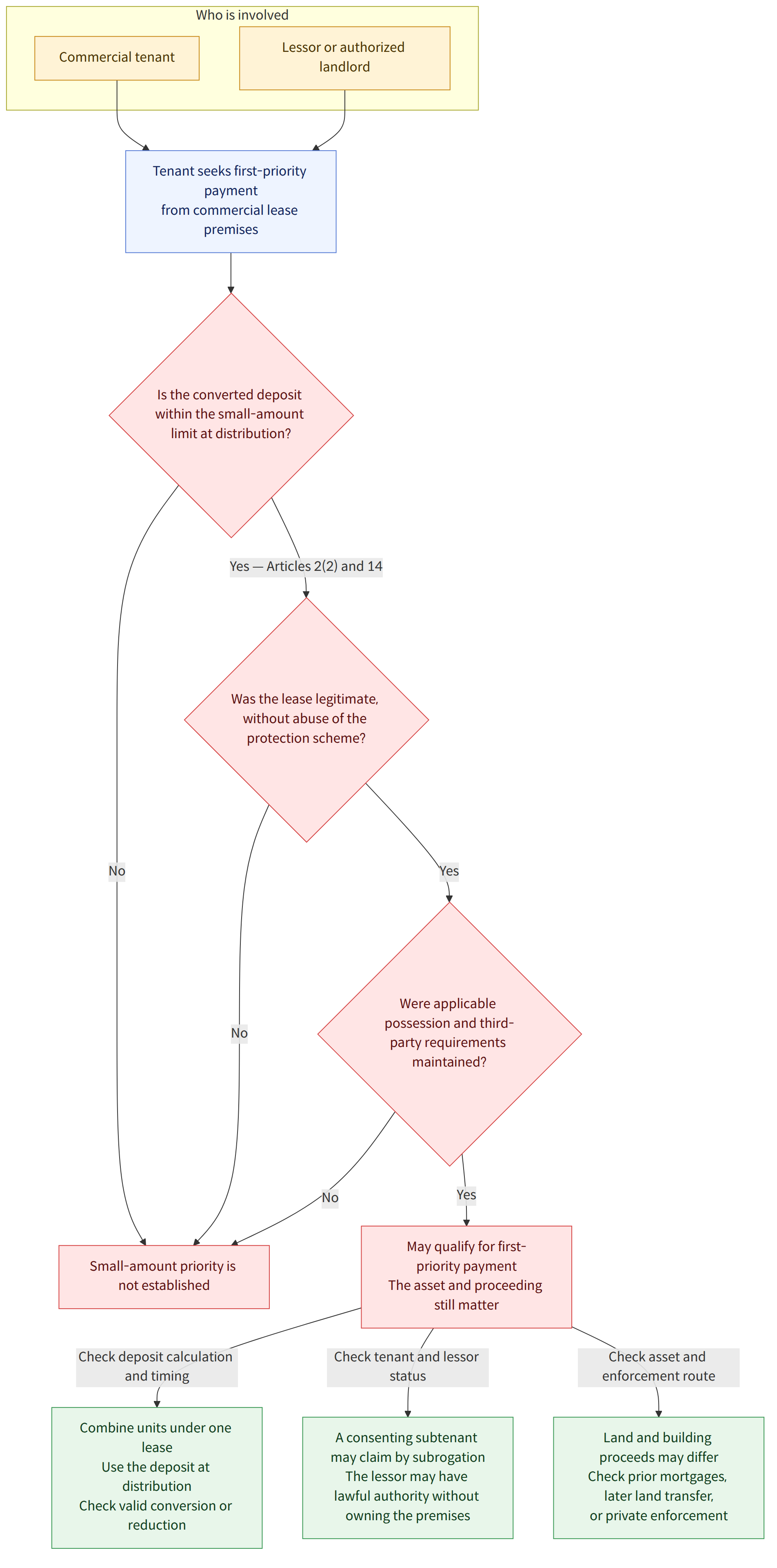
Key points
- There is a case in which it was held that the right to first-priority payment could be exercised against the proceeds of an auction of land even if land owned by the lessor when the lease was formed was later transferred to a third party (Case 1).
- It was considered possible for a subtenant with the lessor’s consent to exercise the tenant’s right to preferential payment by subrogation if possession and the requirements for enforceability against third parties were lawfully maintained (Case 2).
- There is a case in which it was considered possible to exercise the right to first-priority payment in a private enforcement proceeding by a holder of a security right created by provisional registration (Case 3).
- If several separately partitioned units are used as one business premises and are covered by a single lease relationship, whether the tenant qualifies as a small-amount tenant is determined based on the combined converted deposit amount, rather than separately for each unit (Commercial Building Lease Protection Act, Articles 2(2) and 14 (상가건물 임대차보호법 제2조 제2항, 제14조); Case 4).
- It was considered possible to receive protection after converting an existing claim into a deposit or legitimately reducing the deposit, provided the necessary requirements are met and there are no special circumstances, such as the lease being a sham (Cases 5 and 7).
- There is a case in which it was held that, if the deposit increases or decreases during the lease, small-amount tenant status is determined based on the deposit amount at the time of distribution (Case 8).
- If a tenant leases commercial premises built on land after a mortgage was created over the land, the tenant cannot claim priority over the prior mortgagee against the proceeds of an auction of the land, but may receive first-priority payment from the auction proceeds of the commercial building (Case 6).
- A tenant may be excluded from protection as a small-amount tenant if the lease was made with knowledge that an auction was imminent and for the purpose of abusing the protection scheme. A person who is not the owner may nevertheless be the lessor if they have lawful authority to lease the premises (Cases 9 and 10).
Frequently asked questions
Q. Can I receive first-priority payment from an auction of the land alone after ownership of the commercial premises and the land has become separated?
There is a case in which it was held that the right to receive first-priority payment from the proceeds of a land auction could be exercised even where land owned by the lessor when the lease was formed was later transferred to a third party. However, applying this rule to commercial leases is an assessment based on analogous application of the legal principles governing residential leases.
Q. Can a subtenant with the lessor’s consent receive first-priority payment?
It was considered possible for a subtenant to exercise the tenant’s right to preferential payment by subrogation if the sublease was lawful, possession was succeeded to, and the requirements for enforceability against third parties were maintained without interruption. The lessor’s consent to the sublease and how the requirements were maintained are important.
Q. Can I exercise my rights if the commercial premises are disposed of through private enforcement by a holder of a security right created by provisional registration, rather than through an auction?
The case presented considered that a small-amount tenant could exercise the right to first-priority payment even in a private enforcement proceeding by a holder of a security right created by provisional registration. This determination applies legal principles relating to residential leases to commercial leases by analogy.
Q. If I rent several separately partitioned units and use them as one business premises, is small-amount tenant status determined separately for each unit?
If the arrangement is found to be a single lease covering all the units, rather than separate lease relationships for each unit, the units are not assessed separately. The converted deposit amounts for all the units are added together to determine whether the tenant qualifies as a small-amount tenant.
Q. Can I still receive protection if I enter into a lease by converting money owed to me by the lessor into a deposit, or if I later reduce the deposit?
Protection may not be denied solely because an existing claim was converted into a deposit. A deposit may also be reduced legitimately under a new agreement and still qualify for protection, provided the necessary requirements are met and there are no special circumstances, such as the lease being a sham.
Q. If the deposit changes during the lease, which amount is used to determine whether I qualify as a small-amount tenant?
The case presented explains that, in principle, the amount of the deposit at the time of distribution is used as the basis for the determination. Thus, a tenant who qualified as a small-amount tenant when the lease was made may no longer qualify if the deposit is increased beyond the limit before distribution; conversely, the tenant may qualify if the deposit is reduced.
Q. If I lease commercial premises built after a mortgage was created over the land, do I have priority over others in an auction of the land as well?
According to the case presented, a small-amount tenant who leases commercial premises built after a mortgage was created over the land cannot claim priority over the prior mortgagee against the proceeds of an auction of the land. However, it was considered possible to receive first-priority payment from the auction proceeds of the commercial building.
Q. Can I receive protection if I enter into a lease meeting the requirements for a small-amount tenant, knowing that an auction is imminent?
A tenant may be excluded from protection as a small-amount tenant if the lease was made to abuse the scheme and obtain an improper benefit in anticipation of an imminent auction. The circumstances surrounding the lease, including the deposit amount and timing of payment, may be relevant.
Q. Can I receive protection as a small-amount tenant if I entered into a lease with someone who does not own the commercial premises?
It was considered that protection may be available even if the lessor is not the owner, provided the lessor has lawful authority to enter into a lease of the commercial premises. It must be confirmed whether the person actually had lawful authority to lease the premises.
Relevant laws
- Housing Lease Protection Act, Article 3(1) (주택임대차보호법 제3조 제1항)
- Housing Lease Protection Act, Article 3-2(2) (주택임대차보호법 제3조의2 제2항)
- Housing Lease Protection Act, Article 8(1) (주택임대차보호법 제8조 제1항)
- Housing Lease Protection Act, Article 8(3) (주택임대차보호법 제8조 제3항)
- Commercial Building Lease Protection Act, Article 2(2) (상가건물 임대차보호법 제2조 제2항)
- Commercial Building Lease Protection Act, Article 14 (상가건물 임대차보호법 제14조)
- Act on Security by Provisional Registration, etc. (가등기담보 등에 관한 법률)
Watch out for
- Many of the cases presented concern the Housing Lease Protection Act and considered whether their rulings could be applied analogously to commercial leases. Do not assume that the outcome will always be the same in a commercial lease case.
- If several units are recognized as one business premises covered by a single lease relationship, the converted deposit amounts may be added together for the assessment.
- If the deposit has increased or decreased, check the amount at the time of distribution rather than looking only at the amount when the lease was made.
- Protection may be limited if the lease is a sham or if there are circumstances showing that the right to first-priority payment was abused.
Source cases
This guide was compiled by AI from the following Korea Legal Aid Corporation consultation cases (in Korean).
- 토지에 대한 최우선변제권 행사 가부
- 전차인의 최우선변제권 행사
- 가등기담보 등에 관한 법률상의 사적실행 절차에서도 주택임차인의 소액보증금 최우선변제권이 인정되는지 여부
- 수 개의 구분점포를 동일 임대인에게 임차한 경우
- 기존채권을 임대차보증금으로 전환하여 임대차계약을 체결한 경우에도 소액임차인으로서 보호받을 수 있는지 여부
- 나대지에 저당권이 설정된 후 신축건물을 임차한 경우
- 보증금액이 감액된 경우 소액임차인 최우선변제권 행사 가부
- 임대차관계가 지속되는 동안 임대차보증금의 증감ㆍ변동이 있는 경우, 소액임차인에 해당하는지 여부의 판단 기준
- 상가건물임대차보호법을 악용하여 임대차계약을 체결한 경우
- 상가 소유자가 아닌 사람과 임대차계약을 체결한 경우의 적용여부
This guide is general legal information about Korean law, not legal advice for your situation. For a specific case, consult a lawyer or the Korea Legal Aid Corporation (call 132 in Korea).