
Commercial Lease Terms: Agreed Terms, Renewal, and Termination
Based on 9 consultation cases · Updated · Translated from the Korean original.
If a commercial lease is agreed for a term of less than one year, it is treated as a one-year lease in principle, but the tenant may assert that the shorter agreed term is valid. The right to request renewal, implicit renewal, and the continued existence of a lease when the deposit has not been returned each have different requirements and effects. You should therefore review the contract and the law applicable at the relevant time.
At a glance
Key points
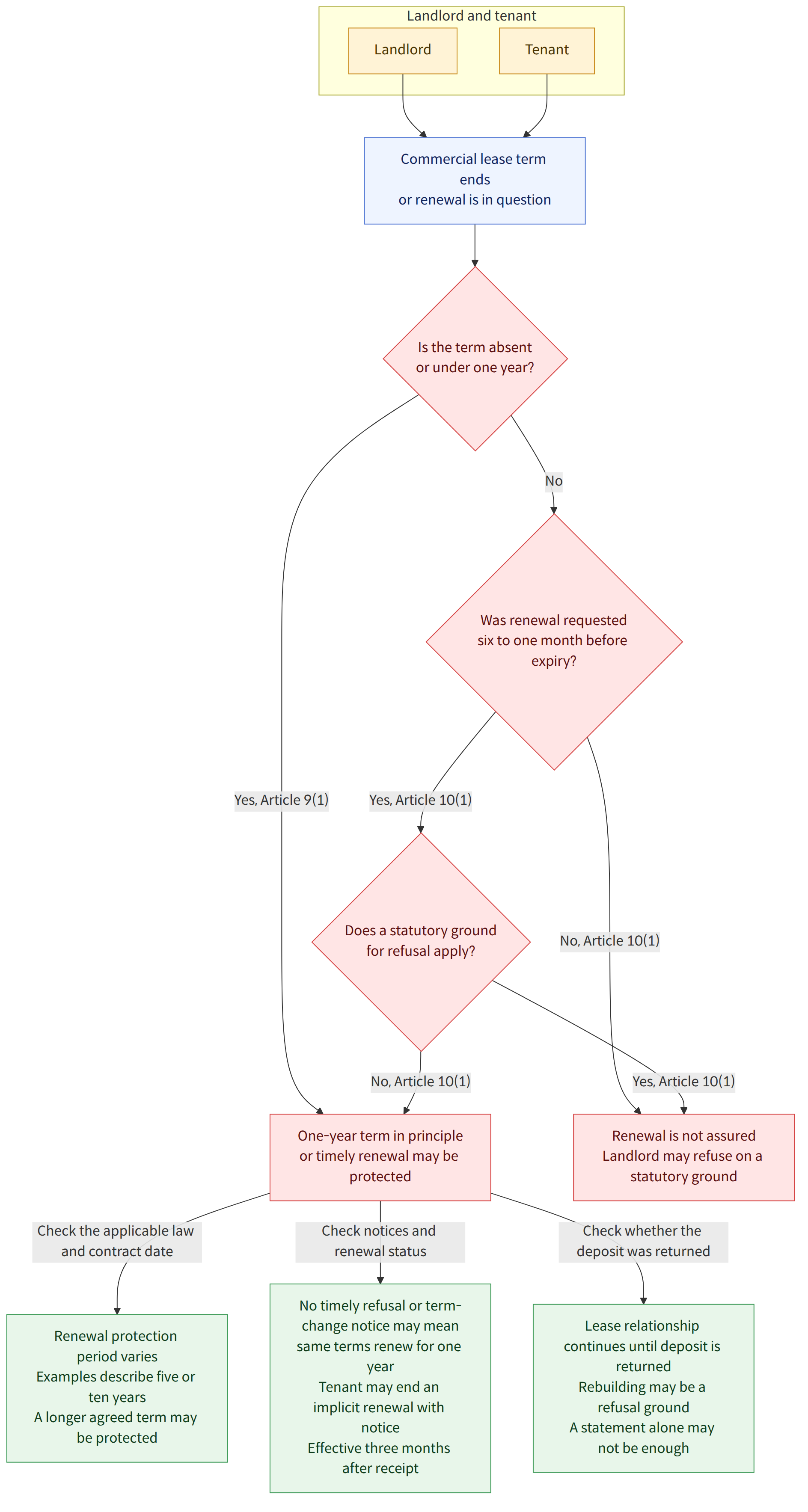
- A lease for which no term is specified, or for which a term of less than one year is specified, is treated as having a one-year term in principle. However, the tenant may assert that the agreed term of less than one year is valid (Commercial Building Lease Protection Act, Article 9(1) (상가건물임대차보호법 제9조 제1항)).
- The right to request renewal may be exercised during the period from six months to one month before the lease expires. The landlord may refuse renewal if a statutory ground applies (Commercial Building Lease Protection Act, Article 10(1) (상가건물임대차보호법 제10조 제1항)).
- The overall period protected by the right to request renewal is described as five years or ten years, depending on the example. Because the period varies according to the contract date and amendments to the law, do not assume that a single period applies in every case; check the applicable law (Commercial Building Lease Protection Act, Article 10(2) (상가건물임대차보호법 제10조 제2항)).
- The period protected by the right to request renewal is not a maximum lease term. If the landlord and tenant agree on a longer term, the term stated in the contract may be protected.
- If the landlord does not give notice of refusal to renew or of a change in terms within the specified period, the lease may be deemed renewed on the same terms as before, and the term of the renewed lease is treated as one year (Commercial Building Lease Protection Act, Article 10(4) (상가건물임대차보호법 제10조 제4항)).
- If the lease is implicitly renewed, the tenant may notify the landlord of termination at any time. Termination takes effect three months after the landlord receives the notice (Commercial Building Lease Protection Act, Article 10(5) (상가건물임대차보호법 제10조 제5항)).
- If the deposit has not been returned after the lease ends, the lease relationship is deemed to continue until the deposit is returned (Commercial Building Lease Protection Act, Article 9(2) (상가건물임대차보호법 제9조 제2항)).
- If the landlord needs to recover possession in order to demolish or rebuild all or most of the building, this may be a ground for refusing renewal. The examples alone do not establish whether merely stating that the building will be rebuilt is sufficient (Commercial Building Lease Protection Act, Article 10(1)(7) (상가건물임대차보호법 제10조 제1항 제7호)).
Frequently asked questions
Q. Can a commercial lease be agreed for six or eight months?
The lease may be agreed for a term of less than one year. In principle, it is treated as a one-year lease, but the tenant may assert that the agreed term of less than one year is valid.
Q. If the contract states a term of less than one year, must the tenant stay for a full year?
No. To protect the tenant’s economic stability, the law treats the lease as having a one-year term in principle, while allowing the tenant to assert that the shorter term agreed upon is valid if the tenant so wishes.
Q. Can I request renewal if the landlord tells me to leave when the lease expires?
In principle, the tenant may request renewal from six months to one month before the lease expires. However, the landlord may refuse if a statutory ground applies, such as the tenant’s failure to pay rent.
Q. How long can the right to request renewal be exercised?
The examples provided include both cases in which the total lease term is described as not exceeding five years and cases in which it is described as not exceeding ten years. You should check the law in effect when the contract was made.
Q. If the landlord does not give notice about renewal, for how many years is the lease automatically extended?
The examples explain that if the landlord does not give notice of refusal to renew or of a change in terms within the specified period, the lease is renewed on the same terms as before, and its term is treated as one year. The original lease term does not simply repeat.
Q. If a lease has been implicitly renewed and the tenant wants to leave, what should the tenant do?
The tenant may notify the landlord of termination of the lease. The termination takes effect three months after the notice reaches the landlord.
Q. If the lease has ended but I continue to occupy the premises because my deposit has not been returned, is that unjust enrichment?
According to the example, the lease relationship is deemed to continue until the deposit is returned. Accordingly, it explains that the tenant’s continued possession while the deposit remains unpaid does not immediately constitute unjust enrichment.
Q. Can the landlord refuse renewal on the grounds that the building will be rebuilt?
If the landlord needs to recover possession in order to demolish or rebuild all or most of the building, this may be a statutory ground for refusing renewal. Whether that ground actually applies must be assessed in light of the specific circumstances of the case.
Q. If the contract says seven years, can I lease the premises for more than five years?
The example explains that the period during which the right to request renewal may be exercised does not set a maximum term for the lease. If the landlord and tenant have agreed to a seven-year term, the term stated in the contract may be protected.
Relevant laws
- Commercial Building Lease Protection Act (상가건물임대차보호법) Article 2
- Commercial Building Lease Protection Act (상가건물임대차보호법) Article 3
- Commercial Building Lease Protection Act (상가건물임대차보호법) Article 9
- Commercial Building Lease Protection Act (상가건물임대차보호법) Article 10
- Enforcement Decree of the Commercial Building Lease Protection Act (상가건물임대차보호법 시행령)
- Value-Added Tax Act (부가가치세법) Article 8
- Income Tax Act (소득세법) Article 168
- Corporate Tax Act (법인세법) Article 111
Watch out for
- A request for renewal must be made during the period from six months to one month before the lease expires, so take care not to miss the deadline.
- The overall period associated with the right to request renewal is stated as five years or ten years in different examples. Do not assume, based only on the explanations in those examples, that one period applies to all contracts currently in effect.
- Even if the tenant gives notice of termination after an implicit renewal, the lease does not end immediately. The examples explain that termination takes effect three months after notice is given.
- The effect of an agreement for a term of less than one year and whether the Commercial Building Lease Protection Act applies must be considered together with the tenant’s assertion and the statutory requirements for its application.
Source cases
This guide was compiled by AI from the following Korea Legal Aid Corporation consultation cases (in Korean).
This guide is general legal information about Korean law, not legal advice for your situation. For a specific case, consult a lawyer or the Korea Legal Aid Corporation (call 132 in Korea).