
Guide to Changes in Deposits and Rent under Commercial Leases
Based on 11 consultation cases · Updated · Translated from the Korean original.
During a commercial lease, if the rent or deposit becomes unreasonable because of changes in economic conditions or other circumstances, either party may seek an increase or decrease for the future. The applicable limit on increases may vary depending on whether the increase is sought as a claim or agreed to by the parties, and whether the arrangement is a lease renewal or a new lease after the previous lease ends.
At a glance
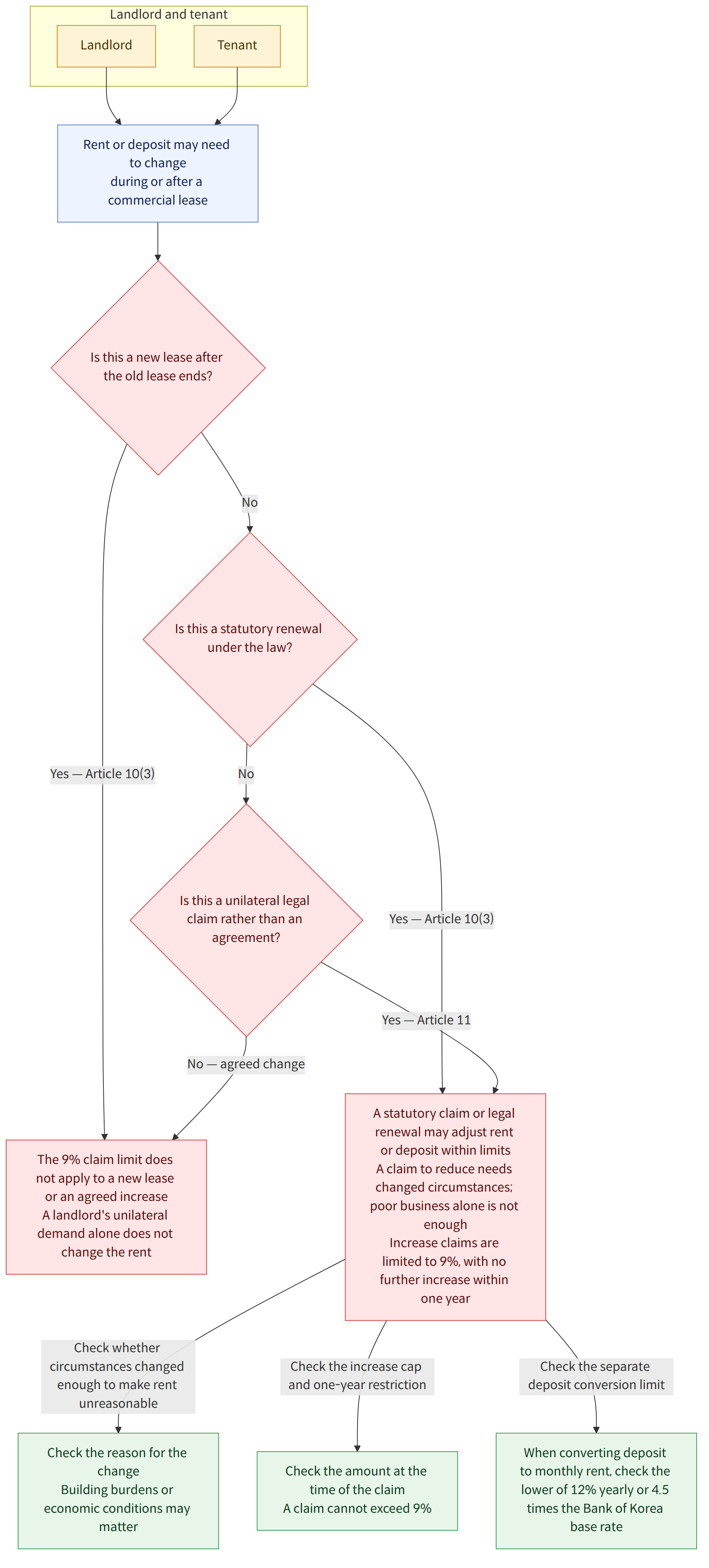
Key points
- Poor business performance alone does not automatically reduce the rent. If the rent or other amounts have become unreasonable because of burdens associated with the leased building or changes in economic conditions, the tenant may seek a reduction for the future (Commercial Building Lease Protection Act, Article 11 (상가건물임대차보호법 제11조), Case 1).
- Under the standard cited in the cases, a claim to increase the rent or deposit may not exceed 9% of the amount at the time of the claim, and no further increase may be sought within one year after an increase (Commercial Building Lease Protection Act, Article 11 (상가건물임대차보호법 제11조); Enforcement Decree of the Commercial Building Lease Protection Act, Article 4 (상가건물임대차보호법 시행령 제4조); Cases 1, 2, 4, and 8).
- A unilateral increase sought by one party under the law during the lease term must be distinguished from an increase agreed to by the parties. The decisions cited in the cases, including lower court decisions, found that the 9% limit does not apply to increases agreed to by the parties (Cases 7 and 9).
- Under the Supreme Court decision cited in the cases, the 9% limit on claims to increase or decrease rent does not apply when the parties enter into a new lease after the existing lease ends. By contrast, where the lease is renewed under the law, the rent and deposit may be increased or decreased within the statutory limits (Commercial Building Lease Protection Act, Article 10(3) (상가건물임대차보호법 제10조 제3항); Cases 3, 7, and 10).
- A separate cap applies to the rate used when part of the deposit is converted into monthly rent. The standard cited in the cases is the lower of 12% per year or a rate calculated by multiplying the Bank of Korea base rate by 4.5 (Commercial Building Lease Protection Act, Article 12 (상가건물임대차보호법 제12조); Enforcement Decree of the Commercial Building Lease Protection Act, Article 5 (상가건물임대차보호법 시행령 제5조); Case 2).
- A Supreme Court decision is cited for the proposition that an agreement to exceed the statutory increase limit may be invalid as to the excess, and that rent already paid above the limit may be recoverable as unjust enrichment (Commercial Building Lease Protection Act, Articles 11 and 15 (상가건물임대차보호법 제11조·제15조); Civil Act, Article 741 (민법 제741조); Case 6).
- A term allowing the landlord to raise the rent unilaterally while preventing the tenant from objecting is invalid because it is unfavorable to the tenant. A unilateral demand alone does not increase the rent (Commercial Building Lease Protection Act, Articles 11 and 15 (상가건물임대차보호법 제11조·제15조); Cases 1 and 11).
- The cases include an example in which partial nonpayment of an increased rent is added to other arrears to determine whether the total equals three rental installments. The total amount of arrears matters in connection with refusal to renew or termination of the lease (Commercial Building Lease Protection Act, Article 10(1)(1) (상가건물임대차보호법 제10조 제1항 제1호) and Article 10-8 (상가건물임대차보호법 제10조의8); Case 5).
Frequently asked questions
Q. If my business is doing poorly, can I ask for a rent reduction?
Poor business performance alone does not automatically reduce the rent. If the agreed rent has become unreasonable because of changes in the burdens associated with the leased building, such as taxes and public charges, or changes in economic conditions, the tenant may seek a reduction for the future (Case 1).
Q. If my landlord says they are going to raise the rent substantially, do I have to accept it?
The rent does not change merely because the landlord demands it unilaterally. When a rent increase is sought under the law during the term of the lease, the limits cited in the cases apply: no more than 9% of the rent and deposit at the time of the request, and a one-year restriction (Cases 4 and 11).
Q. Can the rent be raised again if less than a year has passed since the last increase?
Article 11 of the Commercial Building Lease Protection Act (상가건물임대차보호법 제11조), cited in the cases, states that a further increase may not be sought within one year after the lease agreement or the rent or other agreed amounts have been increased. However, an increase agreed to by the parties must be distinguished from an increase sought under the law (Cases 1, 7, and 9).
Q. How is the rent calculated if part of the deposit is converted into monthly rent?
Under the standard cited in the cases, the converted amount may not exceed the lower of 12% per year or a rate calculated by multiplying the Bank of Korea base rate by 4.5. The specific conversion amount must be calculated after confirming which standard applies (Case 2).
Q. Can the rent be increased by 15% when we renew the lease after it ends?
The Supreme Court decision cited in the cases found that the 9% limit on claims to increase or decrease rent does not apply when the parties enter into a new lease after the existing contract ends. The cases also cite a decision distinguishing an increase agreed to by the parties from a unilateral increase sought under the law (Cases 7 and 9).
Q. If I have already paid rent above the statutory limit, can I get the excess back?
The Supreme Court decision discussed in the cases explains that the portion of an agreement exceeding the statutory increase limit is invalid and that the tenant may seek repayment of any excess rent paid as unjust enrichment. This conclusion must, however, be considered in light of the distinction between an increase sought under the law and one agreed to by the parties (Cases 6 and 9).
Q. If I pay only the original rent and not the increase, will I be three rental installments in arrears?
The cases explain that unpaid increases are added together to determine whether the arrears amount to three rental installments. Therefore, even if only a small amount is unpaid each month, the total arrears matter (Case 5).
Q. What happens if the landlord does not give notice of renewal or a change in terms before the lease expires?
Under the provisions cited in the cases, if no notice of refusal to renew or change of terms is given within the specified period, the lease is deemed renewed on the same terms as the previous lease. The cases explain that in this situation the tenant may give notice of termination, which takes effect three months after the landlord receives the notice (Case 3).
Relevant laws
- Commercial Building Lease Protection Act, Article 1 (상가건물임대차보호법 제1조)
- Commercial Building Lease Protection Act, Article 2 (상가건물임대차보호법 제2조)
- Commercial Building Lease Protection Act, Article 9 (상가건물임대차보호법 제9조)
- Commercial Building Lease Protection Act, Article 10 (상가건물임대차보호법 제10조)
- Commercial Building Lease Protection Act, Article 10-8 (상가건물임대차보호법 제10조의8)
- Commercial Building Lease Protection Act, Article 11 (상가건물임대차보호법 제11조)
- Commercial Building Lease Protection Act, Article 12 (상가건물임대차보호법 제12조)
- Commercial Building Lease Protection Act, Article 15 (상가건물임대차보호법 제15조)
- Enforcement Decree of the Commercial Building Lease Protection Act, Article 2 (상가건물임대차보호법 시행령 제2조)
- Enforcement Decree of the Commercial Building Lease Protection Act, Article 4 (상가건물임대차보호법 시행령 제4조)
- Enforcement Decree of the Commercial Building Lease Protection Act, Article 5 (상가건물임대차보호법 시행령 제5조)
- Civil Act, Article 628 (민법 제628조)
- Civil Act, Article 652 (민법 제652조)
- Civil Act, Article 741 (민법 제741조)
Watch out for
- The 9% cap and the standard for converting a deposit into monthly rent presented in the cases reflect the laws and decisions cited in those cases. First confirm the type of lease and the laws that apply.
- An increase sought under the law, an increase agreed to by the parties, and a new lease entered into after the existing lease ends are treated differently in the cases and should be distinguished.
- Under the provision cited in the cases, the right to request renewal is recognized only where the total lease period, including the initial lease, does not exceed five years; renewal may be refused if a statutory ground applies (Case 4).
- The timing of notice refusing renewal or changing the terms, and the total amount of rent arrears, may affect renewal or termination of the lease. Check the lease terms and when notice was given.
Source cases
This guide was compiled by AI from the following Korea Legal Aid Corporation consultation cases (in Korean).
- 상가영업 부진을 이유로 월세인하를 요구할 수 있는지
- 임대인이 임차인에게 고율의 월세를 부과할 때 구제방법
- 상가임대인이 임대차기간 만료된 3개월 후 보증금증액 요구한 경우
- 건물 주인이 상가임대료를 대폭 인상하는 경우 규제방안
- 차임증액청구의 효력과 차임의 연체
- 상가건물임대차보호법상의 차임 증액비율을 초과한 경우 초과 부분의 반환을 청구할 수 있는지 여부
- 임대차계약 기간이 종료하여 임대인과 재계약 협상을 하면서 임대인이 기존 차임에서 15% 인상된 금액으로 차임을 정해도 유효한지...
- 상가임대차월세상한선
- 차임인상합의에도 상가건물임대차보호법 및 동법 시행령 상의 인상율(100분의 9한도)가 적용되는지 여부
- 재계약과 보증금 등 인상
- 일방적 차임인상이 가능하도록 정한 약정의 효력
This guide is general legal information about Korean law, not legal advice for your situation. For a specific case, consult a lawyer or the Korea Legal Aid Corporation (call 132 in Korea).