
Guide to the Requirements and Procedure for Filing a Constitutional Complaint
Based on 290 consultation cases · Updated · Translated from the Korean original.
A constitutional complaint may be filed when the exercise or non-exercise of public authority infringes your fundamental rights under the Constitution, but it must satisfy requirements such as the infringement being current, direct, and personal to you. If another statutory remedy is available, you must generally pursue it first. The subject matter and filing deadline also vary depending on the circumstances.
At a glance
Key points
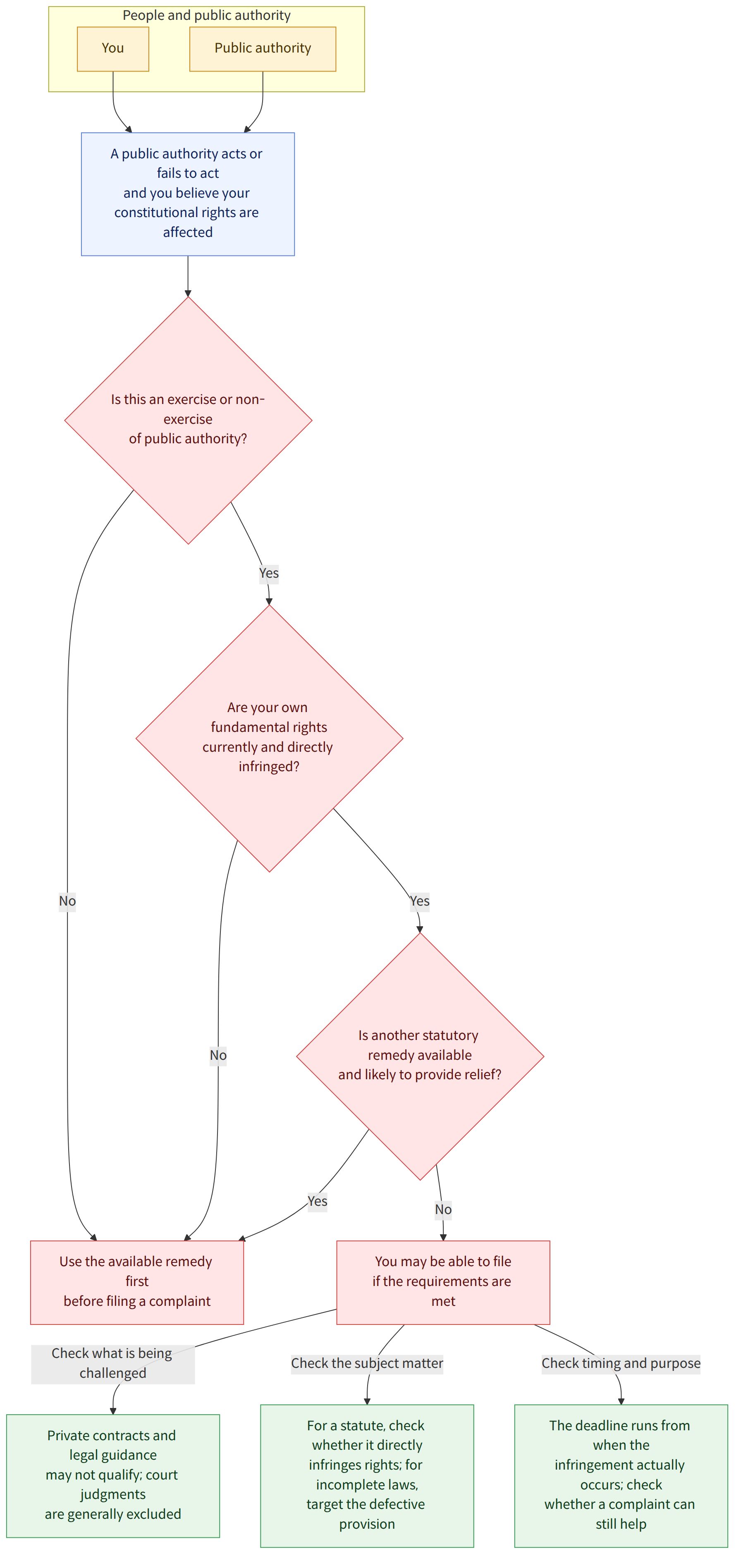
- The exercise or non-exercise of public authority, including by the legislature or executive, may be challenged through a constitutional complaint. However, a private-law contract or legal guidance or reply may not qualify as an exercise of public authority (Examples 14, 16, 19).
- The complainant must show that their own fundamental rights are currently and directly infringed. As a rule, a person may not assert on behalf of someone else an infringement of that person’s or an organization’s members’ fundamental rights (Examples 13, 20).
- To challenge a statute itself, the statute must generally infringe fundamental rights directly, without a separate implementing act. An exception may be recognized where there is an implementing act but no means to challenge it, or where the person would otherwise be forced to pursue an indirect procedure (Examples 3, 4, 7).
- If another statute provides a remedy, you must generally pursue that remedy first. Exceptions may be considered where the procedure is unavailable or there is no reasonable prospect of obtaining relief through it (Examples 5, 6, 21).
- The filing deadline for a constitutional complaint against a statute is assessed from the time the infringement of fundamental rights actually occurs. A distinction is made between infringement occurring when the statute takes effect and infringement arising later due to subsequent circumstances (Examples 9, 12, 23).
- A complete failure to legislate must be distinguished from incomplete legislation. To challenge incomplete legislation, the claim must target the defective statutory provision itself, and the filing deadline also applies (Examples 12, 23).
- Court judgments are generally excluded from constitutional complaints. However, the examples explain that a judgment applying a statute whose effect was lost following a Constitutional Court ruling that it was unconstitutional may exceptionally be challenged (Example 18).
- It is also important whether granting the complaint could provide a practical benefit. For example, once the limitation period for prosecuting the alleged offense has expired, a constitutional complaint against a decision not to prosecute may no longer serve a protective purpose (Example 22).
Frequently asked questions
Q. Can I challenge an administrative agency’s rejection of an application through a constitutional complaint?
It may be subject to a constitutional complaint if the applicant has a statutory right to apply, the agency’s rejection definitively denies the application and constitutes an exercise of public authority, and the matter concerns an infringement of fundamental rights. However, if another statutory remedy is available, you must generally pursue it first.
Q. Can I file a constitutional complaint directly against a statute or enforcement decree?
Possibly, but the statute or decree must directly infringe your fundamental rights without a separate implementing act. If the infringement occurs only after an implementing act, you must generally challenge that act. Exceptions may be considered where no remedy is available or a remedy would be ineffective.
Q. Do I have to pursue another procedure before filing a constitutional complaint?
If another statute provides a procedure for protecting your rights, you must generally exhaust that procedure before filing a constitutional complaint. However, an exception to the exhaustion requirement may be recognized where the procedure is unavailable or there is little prospect that pursuing it would provide relief.
Q. When does the filing deadline for a constitutional complaint against a statute begin to run?
The examples explain that the deadline is calculated from the time the infringement of fundamental rights actually occurs. Because a distinction is made between infringement occurring when the statute takes effect and infringement arising later due to separate circumstances, the applicable period and start date must be determined by examining when the specific infringement occurred.
Q. Can I file a constitutional complaint because the legislature failed to enact a law?
A distinction must be made between a complete failure to legislate despite a constitutional duty to do so and legislation that was enacted but is incomplete. To challenge incomplete legislation, you must assert that the defective statute or provision is unconstitutional, rather than challenge the legislative omission itself, and you must comply with the filing deadline.
Q. Can a final court judgment be set aside through a constitutional complaint?
Court judgments are generally not subject to constitutional complaints. However, the examples explain that a constitutional complaint may exceptionally be permitted against a judgment that applied a statute whose effect was lost following a Constitutional Court ruling that it was unconstitutional.
Q. Can an organization file a constitutional complaint on behalf of its members?
A corporation or certain organizations may file a constitutional complaint in their own name if their own fundamental rights, which they are capable of enjoying by their nature, have been infringed. However, an organization generally may not challenge an infringement of its members’ fundamental rights on their behalf.
Q. Can I file a constitutional complaint challenging a prosecutor’s decision after the limitation period for prosecution has expired?
Once the limitation period for prosecution has expired, whether a constitutional complaint could still serve a protective purpose may depend on whether granting it could produce the desired result. The examples distinguish between a complainant challenging a decision not to prosecute and a suspect challenging a decision to suspend prosecution subject to conditions; the person’s status and the nature of the decision should therefore both be considered.
Q. Can I file a constitutional complaint if I am dissatisfied with the response to my petition?
The examples explain that if a lawful petition was reviewed and the outcome was communicated, the response generally does not constitute an exercise of public authority subject to a constitutional complaint merely because it did not give sufficient reasons or meet the petitioner’s expectations. Whether the petition procedure itself infringed the right to petition may, however, be considered separately.
Relevant laws
- Constitutional Court Act, Article 68(1) (헌법재판소법 제68조 제1항)
- Constitutional Court Act, Article 69(1) (헌법재판소법 제69조 제1항)
- Constitutional Court Act, Article 75(3) (헌법재판소법 제75조 제3항)
- Constitution of the Republic of Korea, Article 26 (헌법 제26조)
- Constitution of the Republic of Korea, Article 111(1)(5) (헌법 제111조 제1항 제5호)
- Administrative Appeals Act, Article 3 (행정심판법 제3조)
- Administrative Litigation Act, Article 4(3) (행정소송법 제4조 제3호)
- Criminal Procedure Act, Article 260 (형사소송법 제260조)
- Criminal Procedure Act, Article 266-3 (형사소송법 제266조의3)
- Criminal Procedure Act, Article 266-4 (형사소송법 제266조의4)
Watch out for
- The statutes and rulings cited in the examples may include provisions that were in force before amendments or material based on past cases. Before filing, check the laws and procedures in force at the relevant time.
- The date a statute takes effect, the date the grounds for infringement arise, and the date you learn of those grounds may differ. The starting point for calculating the filing deadline must therefore be assessed in light of the specific circumstances.
- First check whether another remedy, such as administrative litigation or an appeal, is available. If you fail to pursue the required procedure, your constitutional complaint may be inadmissible.
- If it is determined that no fundamental right was infringed or that the complaint could provide no practical relief, the case may not proceed to a decision on the merits.
Related articles
Source cases
This guide was compiled by AI from the following Korea Legal Aid Corporation consultation cases (in Korean).
- 유죄판결을 자격취득 결격사유로 한 규정의 위헌 여부
- 지목변경신청반려처분에 대한 헌법소원심판청구 가능한지
- 구체적 집행행위규정에 있는 법령에 대한 헌법소원심판청구 가능한지
- 행정입법에 대한 헌법소원심판청구 가능한지
- 공권력의 불행사에 대한 헌법소원심판청구기간
- 별도의 고소없이 곧바로 불기소처분의 취소를 구하는 헌법소원심판청구 가능한지
- 법률규정에 대한 헌법소원심판청구 가능한지
- 소액임차인의 최우선변제권 규정의 재산권 침해 여부
- 법령에 대한 헌법소원심판청구기간의 기산점
- 대학입학고사 주요요강에 대한 헌법소원심판청구 가능한지
- 국민연금법상 연금보험료 강제징수의 재산권 등 침해 여부
- 부진정입법부작위에 대한 헌법소원심판청구의 행사기간
- 입법절차의 하자에 대한 헌법소원심판청구 가능한지
- 형식적인 청원처리결과 통지에 대한 헌법소원심판청구 가능한지
- 피의자신문조서 일부내용 삭제 제출에 대한 헌법소원심판청구 가능한지
- 토지손실보상금 지급행위에 대한 헌법소원심판청구 가능한지
- ‘기소중지’ 처분에 대한 헌법소원심판청구 가능한지
- 법원의 재판에 대한 헌법소원심판청구 가능한지
- 공법인의 취업응시자격제한에 대한 헌법소원심판청구가 가능한지
- 자연인 아닌 법인이 헌법소원심판 청구인이 될 수 있는지
- 검사가 법원의 결정에도 불구하고 한 열람등 거부행위에 대한 헌법소원심판청구 가능한지
- 기소유예처분에 대한 헌법소원심판청구 시 공소시효가 완성된 경우
- 부진정입법부작위에 대한 헌법소원심판청구 가능한지
- ‘죄가 안됨’ 처분에 대한 헌법소원심판청구 가능한지
- 교도소장이 수형자와 헌법소원 등 소송사건의 대리인인 변호사의 접견내용을 녹음, 기록한 행위가 수형자의 재판을 받을 권리를 침해...
This guide is general legal information about Korean law, not legal advice for your situation. For a specific case, consult a lawyer or the Korea Legal Aid Corporation (call 132 in Korea).