
Guide to Constitutional Complaints under Article 68(2) of the Constitutional Court Act (헌법재판소법 제68조 제2항)
Based on 103 consultation cases · Updated · Translated from the Korean original.
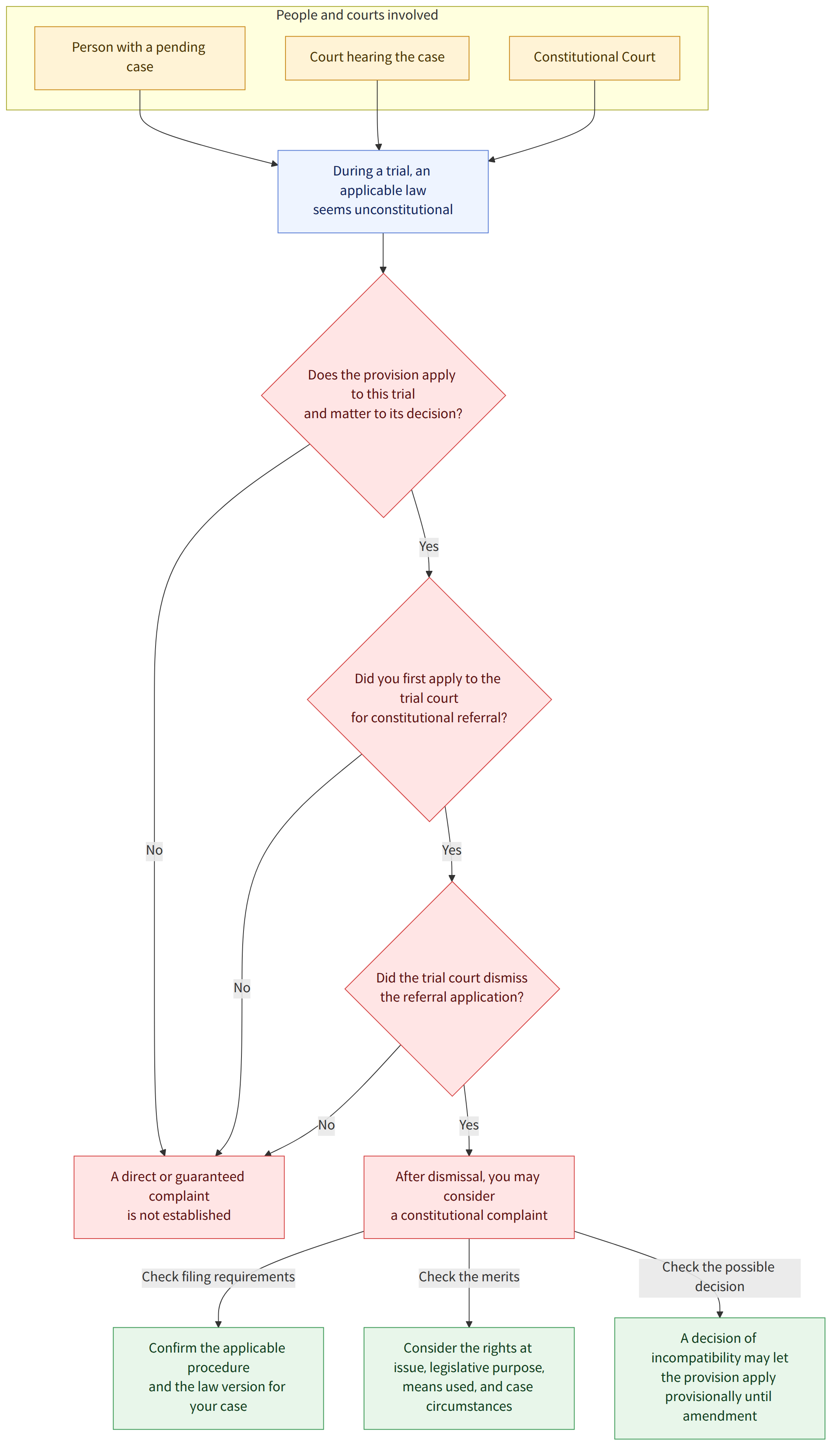
If you believe that a statutory provision applicable to your trial is contrary to the Constitution, you may consider applying to the court during the trial to refer the provision for constitutional review and, if the application is dismissed, filing a constitutional complaint with the Constitutional Court. The Constitutional Court reviews issues such as violations of fundamental rights and may find the statutory provision constitutional, unconstitutional, or incompatible with the Constitution.
At a glance
Key points
- If the constitutionality of a statutory provision applicable to a pending case is at issue, the cases describe first applying to the court hearing the case to refer the provision for constitutional review (Case 3).
- Some cases involve considering a constitutional complaint after the court dismisses the application for referral. However, the requirements and procedures for filing must be met, so dismissal alone does not guarantee an outcome (Case 3).
- The unconstitutionality of a statutory provision is not established merely by making that claim. The Constitutional Court considers the fundamental rights at issue—such as property rights, the right to equality, freedom of occupation, and the right to a trial—as well as the legislative purpose and the suitability of the means used (Cases 1, 9, and 15).
- In areas where the legislature has discretion to make policy judgments, many cases have respected that discretion and found the statutory provisions constitutional (Cases 2, 16, and 18).
- Conversely, some cases have found that a statutory provision violates the principle of proportionality and infringes freedom of contract, or constitutes discrimination without reasonable grounds (Cases 11 and 24).
- Even if the Constitutional Court finds a provision unconstitutional, it may issue a decision of incompatibility with the Constitution instead of immediately depriving the provision of effect. In that event, the provision may continue to apply provisionally until the law is amended (Case 24).
- Whether a provision is unconstitutional depends on the specific provision and the circumstances of the case. Even where property rights are restricted, the outcome may differ depending on how the public interest and the extent of the restriction are assessed (Cases 1, 21, and 22).
- Some of the statutory provisions discussed in the cases were later deleted or amended. For a current case, you should check the content and version of the law applicable at the relevant time (Cases 11 and 19).
Frequently asked questions
Q. If I think a law is unconstitutional while my case is being heard, can I file a constitutional complaint right away?
The cases describe a procedure in which you first apply to the court hearing the case to refer the relevant statutory provision for constitutional review, and consider filing a constitutional complaint after the court dismisses the application. The specific requirements for applying depend on the law and procedure applicable to the case.
Q. If I apply to the court to refer a statute for constitutional review, will the case necessarily go to the Constitutional Court?
No. The cases proceed on the basis that the court may dismiss the application for referral. Nor is the final determination of whether the statutory provision is unconstitutional decided merely by filing the application.
Q. Can any statutory provision be challenged by a constitutional complaint?
The cases concern disputes over whether a statutory provision that is a prerequisite to the decision in a trial is unconstitutional. It is therefore important that the provision applies to the trial in question, rather than being unrelated to the case.
Q. Can a law be considered unconstitutional if it restricts property rights?
A restriction on property rights does not, by itself, make a law unconstitutional. The Constitutional Court has found provisions constitutional after considering factors such as the public-interest purpose and the degree of restriction, and has also found that certain provisions do not violate the principle of just compensation.
Q. If I feel that a law is unfair, can I claim that it violates the right to equality?
Whether the right to equality has been violated is determined by considering factors such as whether there is a difference between the groups being compared and whether there is a reasonable basis for the difference in treatment. For example, a provision that treated interest on retirement benefits differently for people acquitted on retrial and people who received a decision not to prosecute was found to discriminate without reasonable grounds.
Q. If I file a constitutional complaint, will the statutory provision necessarily be ruled unconstitutional?
No. The cases include many findings that provisions are constitutional, as well as findings that provisions violate freedom of contract or the principle of equality. The outcome depends on the purpose and content of the provision and the extent to which it restricts fundamental rights.
Q. Does a decision of incompatibility with the Constitution mean the same thing as a decision that a law is unconstitutional?
The cases describe a decision of incompatibility with the Constitution as a modified form of an unconstitutionality decision. If immediately invalidating a law could create a legal vacuum or confusion, the law may be allowed to apply provisionally until it is amended.
Q. If the Constitutional Court rules that a past law was unconstitutional, does that ruling apply to my current case?
The effect must be determined by reference to the specific decision and the circumstances of the case. The cases also raised separately the question of whether a decision applies to contracts entered into before the unconstitutionality decision, and some statutory provisions were deleted. You should therefore check the relevant effective date and version of the law.
Relevant laws
- Constitutional Court Act, Article 68(2) (헌법재판소법 제68조 제2항)
- Constitution, Article 23(3) (헌법 제23조 제3항)
- Constitution, Article 27(3) (헌법 제27조 제3항)
- Civil Act, Article 651(1) (provision before its deletion in 2016; Case 11) (민법 제651조 제1항)
- Civil Execution Act, Articles 102 and 130 (민사집행법 제102조, 제130조)
- Framework Act on National Taxes, Article 35(1)(iii) (국세기본법 제35조 제1항 제3호)
- Private School Act, Article 28(1) (사립학교법 제28조 제1항)
- Act on the Registration of Real Estate under Actual Titleholder's Name, Articles 11(1) and 12(1) (부동산 실권리자명의 등기에 관한 법률 제11조 제1항, 제12조 제1항)
Watch out for
- First confirm whether the statutory provision actually applies to the trial and whether its constitutionality could affect the outcome of the case.
- The constitutional and unconstitutional findings described in the cases concern the statutory provisions and circumstances of those particular cases; the outcome in another case cannot be assumed to be the same.
- A decision of incompatibility with the Constitution may differ from a decision finding a law unconstitutional and immediately depriving it of effect. Check the terms of the decision and when it applies.
- The cases do not set out all the specific filing deadlines or submission methods for each procedure. For an actual case, you should separately check the current requirements for the relevant procedure.
Related articles
- When the Ground Is Polluted, Can the Landowner Be Made to Pay?
- When a School’s Land Is Not Simply Its Own to Sell
- When a Judge Says No: The Constitutional Challenge That Can Still Reach Korea’s Court
- The Police Line at the Rally: When Crossing It Becomes a Crime
- The Missing Motion: Why a Constitutional Challenge Can Fail Before It Begins
- The Case Ended. Did the Constitutional Challenge End with It?
Source cases
This guide was compiled by AI from the following Korea Legal Aid Corporation consultation cases (in Korean).
- 재건축결의에 반대한 구분소유권자 매도청구권 규정의 위헌 여부
- 공상공무원의 보상금 지급대상자 제외 규정의 위헌 여부
- 국세기본법상 국세우선 규정의 재산권 침해 여부
- 주식의 명의신탁을 증여로 의제하고 있는 상속세 및 증여세법의 위헌 여부
- 집시법 질서유지선
- 부부공유 유체동산 압류 규정의 재산권 침해 여부
- 민법상 인지청구의 소 규정의 위헌 여부
- 부동산 강제경매 중 무잉여로 경매가 취소된 경우 재판청구권 침해 여부
- 부동산중개 법정수수료제도가 평등권을 침해하는지 여부
- 사립학교법상 재산관리 시 관할청 허가 규정의 위헌 여부
- 임대차존속기간을 20년으로 제한한 법률조항이 계약의 자유를 침해하는지 여부(헌법재판소 2013
- 자연공원법상 입장료징수 규정의 위헌 여부
- 건설산업기본법상 건설업등록말소 규정의 위헌 여부
- 아동ㆍ청소년대상 성폭력범죄자의 신상정보 공개 및 고지 제도가 인격권, 개인정보자기결정권을 침해하는지 여부
- 매각허가결정에 대한 항고 시 보증금공탁제도의 재판청구권 침해 여부
- 집합투자기구 손익공제
- 의료법 의사면허취소
- 현금영수증 미발부 과태료
- 기존 명의신탁 실명등기의무 등 효력관련 규정의 위헌 여부
- 뇌물죄 벌금 필요적병과
- 하천법상 하천을 구성하는 토지에 대한 사권(私權)제한 규정의 위헌 여부
- 토지수용보상기준 규정의 헌법상 정당보상 규정 위배 여부
- 상소장 등에 인지를 첩부하도록 한 규정의 재판청구권 침해 여부
- 불기소처분과 재심으로 인한 무죄를 다르게 보는 것의 위헌 여부
- 자본시장법 감사인의 손해배상책임
This guide is general legal information about Korean law, not legal advice for your situation. For a specific case, consult a lawyer or the Korea Legal Aid Corporation (call 132 in Korea).