
Guide to the Procedure and Requirements for Constitutional Review of Statutes
Based on 42 consultation cases · Updated · Translated from the Korean original.
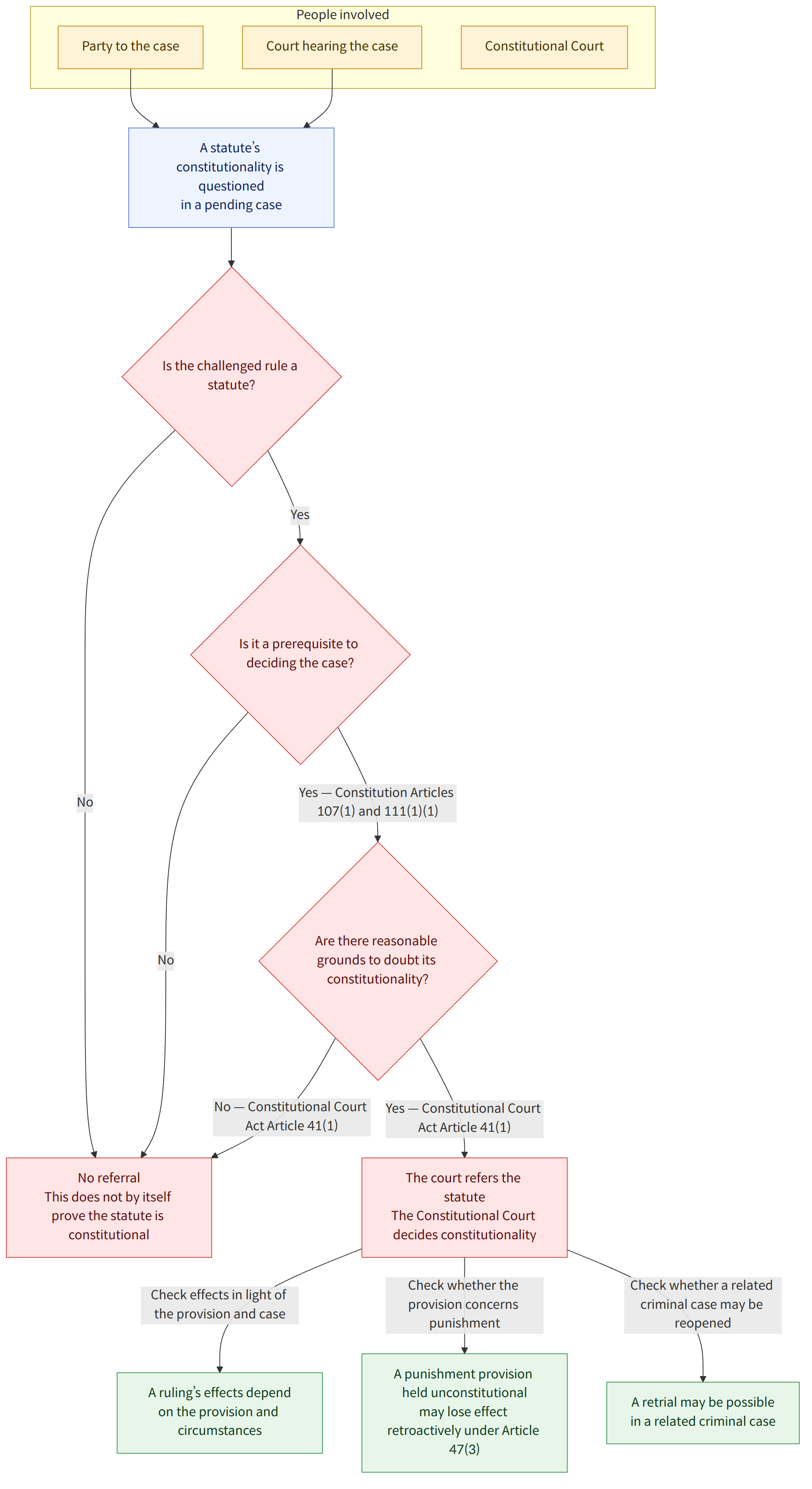
Constitutional review of statutes is a procedure in which a court refers a statute to the Constitutional Court for review when its constitutionality is in question in a case to which it applies. A party may apply to the court hearing the case for a referral, but the requirement that the issue be a prerequisite to the trial must be met, and filing an application alone does not result in a ruling that the statute is unconstitutional.
At a glance
Key points
- Constitutional review of statutes is a system of ex post, concrete review of legal norms in which a court refers a statute to the Constitutional Court, which then decides whether it is unconstitutional, when the statute’s constitutionality is a prerequisite to a specific trial (Constitution of the Republic of Korea, Article 107(1) and Article 111(1)(1) (대한민국헌법 제107조 제1항, 제111조 제1항 제1호)).
- A court may refer a matter on its own initiative or in response to a party’s application. A party applies to the court handling the case, and the court decides whether to refer the matter after considering whether the statute is a prerequisite to the trial and whether there are reasonable grounds to doubt its constitutionality (Constitutional Court Act, Article 41(1) (헌법재판소법 제41조 제1항); Case 2).
- The requirement that an issue be a prerequisite to the trial is met when the statute applies to the case and its constitutionality affects the judgment’s order or the legal meaning of its content or effect (Case 7).
- Even if a statute does not apply directly to the case, the requirement may be met if it is internally related to another applicable statute and affects the outcome of the case or the meaning of the applicable rule (Case 21).
- The subject of constitutional review of statutes is statutes. Decrees and regulations are not subject to this form of review; the example explains that a court may itself determine whether they are unconstitutional (Case 7).
- Denial of an application for referral does not necessarily mean that the court found the statute constitutional. The application may also be denied because the statute is not a prerequisite to the trial, and no appeal may be filed against a decision on whether to refer the matter (Constitutional Court Act, Article 41(4) (헌법재판소법 제41조 제4항); Cases 2 and 20).
- The effects of a ruling of unconstitutionality and the possibility of a retrial must be considered in light of the provision at issue and the circumstances of the case. The example explains that if a statutory provision concerning punishment is held unconstitutional, it may lose effect retroactively, and a retrial may be possible in a related criminal case (Constitutional Court Act, Article 47(3) (헌법재판소법 제47조 제3항); Cases 13, 15, and 18).
Frequently asked questions
Q. Who can request constitutional review of a statute?
The parties do not directly petition the Constitutional Court for constitutional review of a statute; instead, the court hearing the case refers the matter to the Constitutional Court. A party may apply to the court where the case is pending for a referral, and the court may also refer the matter on its own initiative.
Q. When is the requirement that an issue be a prerequisite to the trial met?
The statute in question must apply to the case, and its constitutionality must affect the judgment’s order or the legal meaning of the judgment’s content or effect. If a party challenges a provision unrelated to the case, the requirement that the issue be a prerequisite to the trial may not be met.
Q. Can a statute that does not directly apply to the case also be reviewed?
Even if a statute does not apply directly, the requirement may be met if it is internally related to a relevant statute and its constitutionality could change the outcome of the case or the meaning of a directly applicable rule. The relationship between the case and the two rules must be examined in each instance.
Q. Can a presidential decree or regulation, rather than a statute, be challenged through constitutional review of statutes?
According to the example, the subject of constitutional review of statutes is statutes, not decrees or regulations. It explains that courts may themselves determine whether a decree or regulation is unconstitutional.
Q. If a court denies an application for referral, does that conclusively mean the statute is constitutional?
That cannot be concluded categorically. An application for referral may be denied not only because the court finds the statute constitutional, but also because the requirement that the issue be a prerequisite to the trial is not met. No appeal may be filed against a decision on whether to refer the matter for constitutional review.
Q. If a court denies an application for referral, can a person petition the Constitutional Court for review?
The example explains that if a court denies an application for referral, a person may seek review of the statute’s constitutionality by filing a constitutional complaint under Article 68(2) of the Constitutional Court Act (헌법재판소법 제68조 제2항). However, the requirements for that procedure, including the requirement that the issue be a prerequisite to the trial, must be met.
Q. What happens to the review if the statute is amended or the trial ends while the review is pending?
If the requirement that the issue be a prerequisite to the trial ceases to be met, for example because the statute is amended, the review may become inadmissible. However, the example explains that review may exceptionally still be necessary where the requirement was met at the time of referral and a constitutional interpretation is needed, such as to address the risk of repeated infringement of fundamental rights.
Q. If a provision is held unconstitutional, can an existing criminal judgment also be challenged again?
The example explains that if a statutory provision concerning punishment is held unconstitutional and loses effect, a retrial may be requested in a case in which the person was punished under that provision. However, the effect of the unconstitutionality ruling and the availability of a retrial must be assessed in light of the provision and the circumstances of the case.
Relevant laws
- Constitution of the Republic of Korea, Article 37(2) (대한민국헌법 제37조 제2항)
- Constitution of the Republic of Korea, Article 75 (대한민국헌법 제75조)
- Constitution of the Republic of Korea, Article 107(1) (대한민국헌법 제107조 제1항)
- Constitution of the Republic of Korea, Article 111(1)(1) (대한민국헌법 제111조 제1항 제1호)
- Constitutional Court Act, Article 26(1) (헌법재판소법 제26조 제1항)
- Constitutional Court Act, Article 41(1), (4), and (5) (헌법재판소법 제41조 제1항·제4항·제5항)
- Constitutional Court Act, Article 47(3) (헌법재판소법 제47조 제3항)
- Constitutional Court Act, Article 68(2) (헌법재판소법 제68조 제2항)
- Act on Special Cases Concerning Expedition, etc. of Legal Proceedings, Article 3 (소송촉진 등에 관한 특례법 제3조)
- Illegal Checks Control Act, Article 2(2) (부정수표단속법 제2조 제2항)
- Act on the Punishment of Acts of Arranging Sexual Traffic, Article 21(1) (성매매알선 등 행위의 처벌에 관한 법률 제21조 제1항)
- Act on the Stamps Attached to Civil Litigation, etc., Article 1 (민사소송 등 인지법 제1조)
- Act on Special Cases concerning the Stamping of Documents and the Provision of Deposits, Article 2 (인지첩부 및 공탁제공에 관한 특례법 제2조)
- Juvenile Protection Act, Article 2(1) and (4), and Article 26(1) (청소년보호법 제2조 제1호·제4호, 제26조 제1항)
- Assembly and Demonstration Act, Articles 10 and 23 (집회 및 시위에 관한 법률 제10조·제23조)
Watch out for
- The Constitutional Court does not immediately review a statute merely because its constitutionality is in doubt. First, determine whether the statute is a prerequisite to a specific trial.
- Do not assume solely from the fact that an application for referral was denied that the court found the statute constitutional.
- If the statute is amended or the trial in question ends, the requirement that the issue be a prerequisite to the trial may cease to be met. Whether the exception described in the example applies must be determined separately.
- The possibility of a retrial following a ruling of unconstitutionality does not apply uniformly to every case. In particular, check the requirements concerning the loss of effect of a penal provision and retrials, as described in the example.
Related articles
- When a Trial Puts a Law on Trial: How Korea’s Constitutional Review Works
- A Constitutional Challenge Needs a Live Case—and the Right Law
- A Second Try at the Supreme Court Can Close the Constitutional Door
- When the Real Dispute Is the Court’s Interpretation, Not the Law
- A Retrial Is Not Yet a Second Trial: When Can a Convicted Person Challenge the Law?
- When an Old Inheritance Custom Excludes Women, Who Can Strike It Down?
Source cases
This guide was compiled by AI from the following Korea Legal Aid Corporation consultation cases (in Korean).
- 구 소송촉진등에관한특례법 제3조 제1항의 위헌 여부
- 위헌법률심판제도
- 부정수표단속법상 부정수표발행인 형사처벌 규정의 위헌 여부
- 성매매를 한 자를 형사처벌 하도록 규정한 법률조항의 위헌성 여부
- 소장 등에 인지 첩부하도록 한 규정의 재판청구권 침해 여부
- 청소년보호법상 주류 판매 금지규정의 위헌 여부
- 위헌법률심판에 있어서 재판의 전제성이란 무엇인지
- 야간시위금지조항의 위헌성
- 형사소송법상 구속기간 제한 규정의 위헌 여부
- 운전면허를 받은 사람이 자동차등을 이용하여 살인 또는 강간 등 범죄행위를 한 때 운전면허를 취소하도록 하는 규정의 위헌성 여부...
- 부동산실명법상 명의신탁 무효 규정의 위헌 여부
- 2002.1.1.이후 경매절차에 따라 토양오염관리대상시설을 인수한 자를 오염원인자로 간주하여 토양정화책임을 부과하고 위반 시 ...
- 재판에 영향을 미칠 염려가 있거나 미치게 하기 위한 집회 또는 시위를 금지하고 이를 위반한 자를 형사처벌하는 규정이 집회의 자...
- 채권자가 비면책채권 입증책임을 부담하는 것의 위헌성
- 법인의 종업원이 법위반시 법인에 벌금을 부과하는 것의 위헌 여부
- 음주운전의 경우 운전의 개념에 ‘도로 외의 곳’을 포함하도록 한 도로교통법 규정의 위헌여부
- 정당의 시ㆍ도당 하부조직의 운영을 위하여 당원협의회 등의 사무소를 두는 것을 금지한 정당법 규정의 위헌여부
- 경범죄처벌법상 ‘과다노출’ 금지조항의 위헌여부
- 인신보호법 제15조 중 ‘피수용자인 구제청구자’의 즉시항고 제기기간을 ‘3일’로 정한 부분이 피수용자의 재판청구권을 침해하는지...
- 법원의 합헌판단권이 인정되는지
- 간접적용되는 법률도 재판의 전제성이 인정될 수 있는지
- 보호의무자 2인의 동의와 정신건강의학과 전문의 1인의 진단으로 정신질환자에 대한 보호입원이 가능하도록 한 정신보건법(2011....
- 운전면허를 받은 사람이 다른 사람의 자동차등을 훔친 경우에는 운전면허를 필요적으로 취소하도록 한 규정이 헌법에 위배되는지.
- 공중도덕상 유해한 업무에 취업시킬 목적으로 근로자를 파견한 사람을 형사처벌하도록 하는 규정 중 ‘공중도덕상 유해한 업무’ 부분...
- 식품접객영업자 등 대통령령으로 정하는 영업자’는 ‘영업의 위생관리와 질서유지, 국민의 보건위생 증진을 위하여 총리령으로 정하는...
This guide is general legal information about Korean law, not legal advice for your situation. For a specific case, consult a lawyer or the Korea Legal Aid Corporation (call 132 in Korea).