
Guide to Claims for Compensation for Consumer Harm
Based on 26 consultation cases · Updated · Translated from the Korean original.
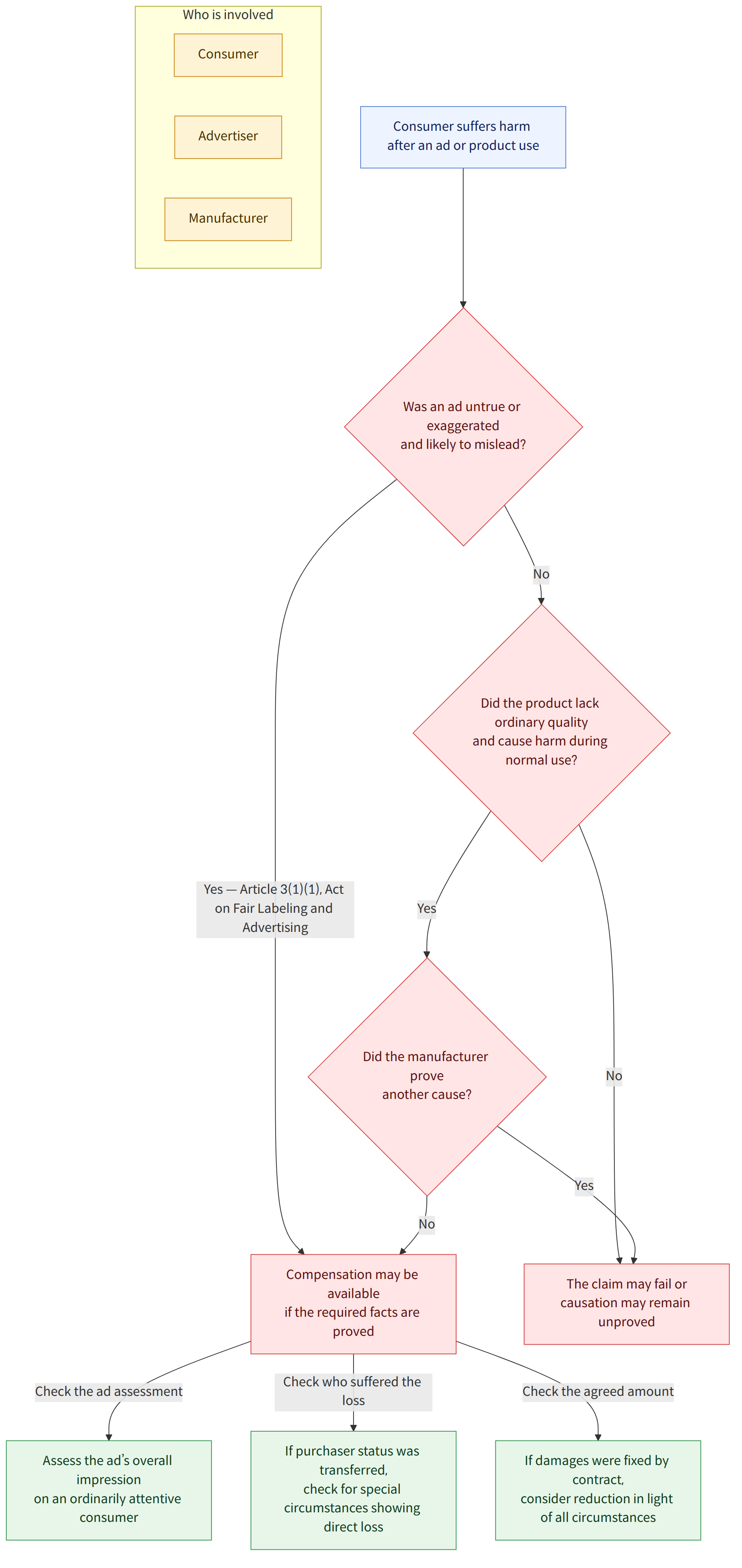
To obtain compensation for consumer harm, you must prove the facts required for the issues involved, such as whether an advertisement was false, whether a product was defective, and whether there was a causal link between the conduct and the damage. However, where it is difficult for consumers to prove a matter scientifically or technically, such as a product defect, the burden of proof may be eased if certain facts are established.
At a glance
Key points
- Whether an advertisement is false or exaggerated is determined objectively by reference to the overall and ultimate impression it would make on an ordinarily attentive consumer (Act on Fair Labeling and Advertising, Article 3(1)(1) (표시광고법 제3조 제1항 제1호); Examples 5, 14, and 24).
- Even if a consumer entered into a transaction after seeing an advertisement, entitlement to compensation depends on whether the advertisement was untrue or excessively exaggerated, whether it could mislead consumers, and other relevant factors (Examples 5 and 14).
- In a product-defect case, if the consumer proves facts supporting an inference that the product lacked its ordinary quality or performance, and that damage occurred despite use in the normal manner, causation between the defect and the damage may be presumed if the manufacturer cannot prove another cause (Examples 2 and 8).
- The mere fact that a product has passed its expected service life does not automatically extinguish the manufacturer’s responsibility to ensure safety. Whether the product was used normally and whether another cause of the fire or accident existed may be at issue (Examples 9 and 19).
- The right to claim damages for false or exaggerated advertising does not automatically transfer from the original apartment purchaser merely because the purchaser’s status is transferred to someone else. Special circumstances showing that the assignee suffered loss due to the advertising may be required (Example 4).
- Even if the injured party’s fault contributed to the occurrence or extent of the damage, where the amount of damages was fixed in advance by contract, the issue may be whether to reduce the agreed amount in light of all the circumstances, rather than to reduce damages for contributory negligence (Civil Act, Article 398(2) (민법 제398조 제2항); Example 15).
- The mere fact that a regulatory agency did not exercise its authority does not establish state liability for compensation. The relevant standard is whether, in the specific circumstances, the failure to exercise that authority was manifestly unreasonable (Example 3).
Frequently asked questions
Q. Can I claim compensation if an advertisement does not match reality?
An advertisement may be false or misleading if it is untrue or excessively exaggerated in a way that could mislead consumers and disrupt fair trade. The assessment generally considers objectively the overall impression the advertisement would make on an ordinarily attentive consumer.
Q. I was harmed while using a product normally. Do I have to prove the defect directly?
When it is difficult to establish a specific defect and causation scientifically or technically, consumers may prove facts showing that the product lacked the quality or performance it would ordinarily be expected to have, and that damage occurred despite its use in the normal manner. If the manufacturer cannot prove another cause, causation between the defect and the damage may be presumed.
Q. Can I no longer hold a manufacturer responsible once an appliance has passed its expected service life?
The manufacturer’s duty to ensure product safety does not automatically end merely because the product has passed its expected service life. It is necessary to consider whether the accident occurred during normal use and whether another cause led to it.
Q. I bought an apartment relying on the sales advertisement. Can I receive compensation if the advertised facility is never built?
Compensation may be at issue if a developer advertised that a facility would be built, for example, even though the development plan had not been finalized, or made other untrue or excessively exaggerated claims. Whether an advertisement could mislead consumers is assessed based on the overall impression it would make on an ordinary consumer.
Q. If I take over the purchaser’s status for an apartment that was advertised falsely or in an exaggerated way, does the right to claim damages transfer to me as well?
The right of the original apartment purchaser to claim damages for tort does not automatically transfer merely because the purchaser’s status is assigned to someone else. The assignee may have a claim if there are special circumstances showing that they suffered direct loss—for example, by relying on false or exaggerated advertising and acquiring the purchaser’s status at a price inflated by the advertising.
Q. What factors are considered when holding a manufacturer responsible for a dangerous product design?
A design defect may be found where adopting a reasonable alternative design could have prevented an accident or reduced the risk, but the product was made unsafe because that design was not adopted. The assessment takes into account the product’s characteristics and purpose, foreseeable risks, the possibility of avoiding those risks, and the feasibility and economic cost of an alternative design.
Q. If both product use and a disease diagnosis are confirmed, is causation also established?
The fact that someone was exposed to a product or substance and later developed an illness does not, by itself, establish that the exposure caused that person’s illness. The specific circumstances must be considered, including the type of illness and other contributing factors. One case discussed in the examples did not find a causal link between smoking and a particular type of lung cancer.
Q. Can I claim compensation from a carrier if cargo is damaged or a passenger is injured during transport?
If cargo is damaged during rail transport, the carrier’s negligence is presumed in the first instance. Unless the carrier proves that it exercised due care, it will be difficult for it to avoid liability for compensation. If a passenger is injured on a train, the carrier may also be held responsible unless it proves that it exercised due care to ensure passenger safety.
Relevant laws
- Monopoly Regulation and Fair Trade Act, Article 23(1)(3) (독점규제 및 공정거래에 관한 법률 제23조 제1항 제3호)
- Enforcement Decree of the Monopoly Regulation and Fair Trade Act, Article 36(1), Appendix Table 1-2, Subparagraph 4(a) (독점규제 및 공정거래에 관한 법률 시행령 제36조 제1항 [별표 1의2] 제4호 (가)목)
- Act on Fair Labeling and Advertising, Article 3(1)(1) (표시·광고의 공정화에 관한 법률 제3조 제1항 제1호)
- Enforcement Decree of the Act on Fair Labeling and Advertising, Article 3(1) (표시·광고의 공정화에 관한 법률 시행령 제3조 제1항)
- Former Act on Fair Labeling and Advertising (구 표시·광고의 공정화에 관한 법률)
- Former Pharmaceutical Affairs Act (구 약사법)
- Framework Act on Consumers (소비자기본법)
- Consumer Protection Act, Article 18(1)(5) (소비자보호법 제18조 제1항 제5호)
- Civil Act, Article 398(2) (민법 제398조 제2항)
- Civil Act, Article 750 (민법 제750조)
- Copyright Act (저작권법)
Watch out for
- The laws and standards applied vary from case to case. The relevant issues should be identified according to the type of harm, such as a product defect, false advertising, or a transport accident.
- Even where the consumer’s burden of proof may be eased, the consumer must establish facts supporting an inference that the product had a quality or performance problem, as well as normal use and the occurrence of damage.
- It may not be enough to establish only that there was a problem with an advertisement or product. You should also consider the causal link between the actual damage and the problematic conduct, and who holds the right to bring the claim.
- The examples do not specify any particular claim deadline or limitation period, so this guide alone cannot be used to determine a deadline.
Source cases
This guide was compiled by AI from the following Korea Legal Aid Corporation consultation cases (in Korean).
- 광고 및 행사가 부당한 이익에 의한 유인행위에 해당하지 않는지
- 소비자가 제조업자에게 일반불법행위책임을 물을 때의 입증정도
- 석면이 함유된 베이비파우더를 구입·사용한 영·유아와 부모들이 국가를 상대로 식품의약품안전청장 등이 규제권한을 행사하지 않음으로...
- 허위·과장광고로 인한 손해배상청구권을 가지고 있던 아파트 수분양자가 수분양자의 지위를 제3자에게 양도한 경우 양수인이 당연히 ...
- 건설회사의 허위 분양광고를 보고 아파트 분양을 받은 경우에 건설회사가 손해배상책임을 부담하는지
- 갑, 을의 흡연과 폐암 발병 사이에 인과관계가 인정되는지
- 분양받은 아파트의 입주가 지연되자 수분양자 갑이 아파트를 신축·분양하는 을 주식회사를 상대로 입주지연에 따른 지연손해금 지급을...
- 소비자가 제조업자 측에게 민법상 일반 불법행위책임으로 손해배상을 청구하는 경우, 증명책임의 분배
- 내구연한이 경과한 냉장고에서 화재가 발생한 경우 제조회사에 대한 손해배상이 가능한지
- 자동변속기가 장착된 차량의 급발진사고에서 대체설계 미채용에 의한 설계상의 결함 유무를 판단하는 기준
- 등록 없이 소비자보호법 제18조 제1항 제5호 소정의 소비자단체의 업무를 한 것에 해당하는지
- 대형백화점에서의 이른바 변칙세일
- 베트남전 참전군인들이 외국법인 등에 의해 제조되어 베트남전에서 살포된 고엽제 때문에 염소성여드름 등 질병이 발생하였다며 을 법...
- ‘표시·광고의 공정화에 관한 법률’ 제3조 제1항 제1호가 규정하는 ‘허위·과장의 광고’의 의미 및 판단 기준
- 채무자의 채무불이행으로 인한 손해배상액이 예정되어 있는데 손해의 발생 및 확대에 채권자에게도 과실이 있는 경우, 민법 제398...
- 텔레비전 방송보도의 내용이 특정인의 명예를 훼손하는 내용을 담고 있는지 여부에 관한 판단기준
- 열차의 창으로 유리조각이 날아 들어와 승객이 상해를 입은 경우의 운송인의 손해배상책임
- 수급인이 신축한 건물에 하자가 있는 경우, 도급인의 위자료 인정 가부
- 제조상의 결함을 인정되는지
- 저작권법상 공연권 침해로 손해배상책임이 발생하기 위한 요건
- 차장이 열차 출발전에 승강구의 문을 폐쇄하거나 열차 진행중 승강구에 매달려 가는 사람을 차안으로 들여 보내는 등의 조치를 다하...
- 종묘업자가 생산한 씨앗에 하자가 있는지의 판단 기준
- 철도편으로 탁송한 화물이 훼손된 경우에 철도운송인의 과실추정과 손해배상책임
- 광고가 일반 소비자를 대상으로 하는 경우 소비자를 오인시킬 우려가 있는지 여부의 판단기준
- 근로자의 사망으로 인한 손해배상 청구사건의 손실배상액 산정에 있어서는 피해자의 수익손실액에서 이미 지급받은 유족보상금은 공제하...
This guide is general legal information about Korean law, not legal advice for your situation. For a specific case, consult a lawyer or the Korea Legal Aid Corporation (call 132 in Korea).