
When and how can a contract be terminated or rescinded?
Based on 113 consultation cases · Updated · Translated from the Korean original.
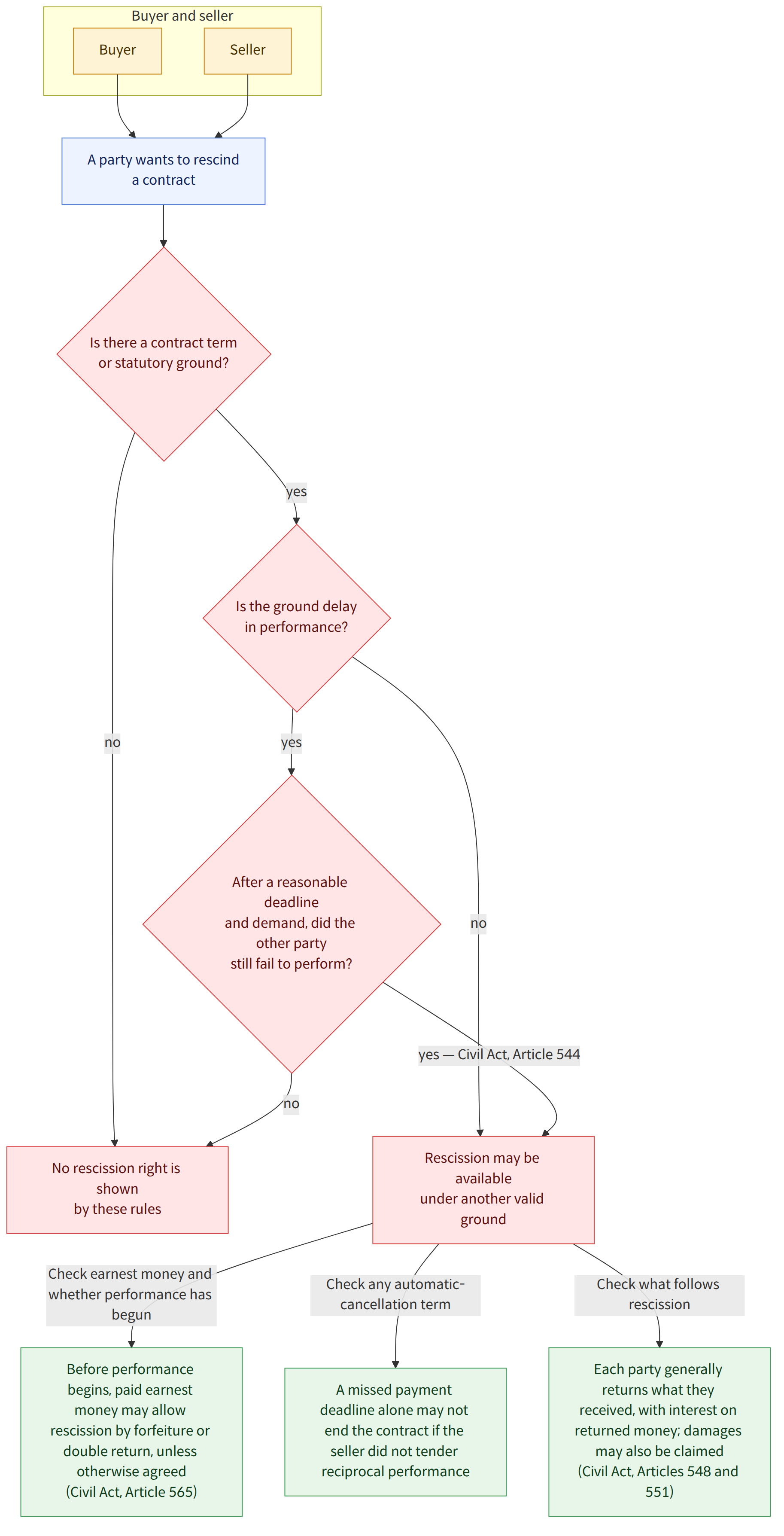
A contract cannot be rescinded whenever one party wants; there must be a contractual provision or a statutory ground for rescission. As a rule, to rescind for delay in performance, you must set a reasonable period and demand performance. Rescission may also give rise to issues of restitution and damages.
At a glance
Key points
- Unless otherwise agreed, earnest money may be treated as a cancellation deposit. Before either party begins performing the contract, the party who paid it may rescind the contract by forfeiting the earnest money, and the party who received it may rescind by returning twice that amount (Civil Act, Article 565).
- If a party merely promised to pay earnest money but did not actually pay it, the right to rescind by forfeiting earnest money does not generally arise (Case 12).
- As a rule, to rescind a contract for delay in performance, you must set a reasonable period and demand performance, and the other party must fail to perform within that period (Civil Act, Article 544).
- Even if the contract provides for automatic rescission if the balance is not paid, the contract may not be automatically rescinded merely because the deadline has passed if the seller did not tender performance of the reciprocal obligation and place the buyer in default (Case 11).
- When a contract is rescinded, each party must generally return what they received, and interest must be added to any money being returned from the date it was received (Civil Act, Article 548). A claim for damages for breach of contract may also be made separately from rescission (Civil Act, Article 551).
- The mere fact that the property being sold is subject to a provisional seizure will generally not allow the contract to be rescinded. However, rescission may be possible if circumstances show that the obligation to register the transfer of ownership cannot be performed (Case 15).
- To rescind a contract due to a change of circumstances, the objective circumstances underlying the contract must have changed in an unforeseeable way, and requirements such as maintaining the contract being manifestly contrary to the principle of good faith must be met (Case 13).
Frequently asked questions
Q. I have not paid the earnest money yet. Can I rescind the contract by forfeiting only the earnest money?
If you only promised to pay earnest money but did not actually pay it, as a rule you do not acquire the right to rescind the contract by forfeiting earnest money under the Civil Act. However, whether you may be required to pay the earnest money, or may rescind the earnest-money agreement or the main contract because of nonpayment, depends on the specific circumstances.
Q. The seller says they want to back out of the contract and will pay only 10% of the sale price, not twice the earnest money. Can the contract be rescinded?
If the contract provides that the seller must pay twice the amount of the earnest money in the event of a breach, the seller cannot rescind the contract in accordance with that provision simply by offering to return only 10% of the sale price. However, the right to rescind by forfeiting earnest money may itself be restricted if either party has already begun performing the contract.
Q. Can I rescind the contract immediately if the other party does not pay the balance?
Generally, you must set a reasonable period and demand payment of the balance, and may rescind the contract if payment is still not made within that period. However, no demand may be necessary in cases such as when the other party has already indicated that they do not intend to perform.
Q. When is a provision stating that the contract will be automatically rescinded if the balance is not paid by the due date effective?
Even if the contract contains such a special provision, where the seller’s obligation to transfer ownership and the buyer’s obligation to pay the balance are reciprocal obligations to be performed simultaneously, it is important to determine whether the seller tendered performance and thereby placed the buyer in default. Unless there are special circumstances, the mere fact that the due date has passed does not automatically rescind the contract.
Q. Can I rescind the contract if the property being sold is subject to a provisional seizure?
A provisional seizure does not, by itself, make it impossible to register a transfer of ownership, so that circumstance alone will generally not allow the contract to be rescinded. However, rescission may be possible if the seller is unable to lift the provisional seizure or otherwise is found unable to perform the obligation to register the transfer.
Q. If a contract is rescinded, do I get interest on the money I paid back?
As a rule, when money is returned as restitution following rescission of a contract, interest must be added from the date the money was received. This interest falls within the scope of restitution and is distinct from damages for delay in performing the obligation to return the money.
Q. Can I rescind a contract due to a change of circumstances simply because its purpose can no longer be achieved?
The fact that the purpose of the contract can no longer be achieved may not, by itself, be sufficient. It is necessary to consider whether the objective circumstances underlying the contract changed in an unforeseeable way, whether the party seeking rescission is free from responsibility, and whether maintaining the contract would be manifestly contrary to the principle of good faith.
Q. Can I rescind a gift contract to get back real estate I gave away?
A gift made without a written document may be rescindable, but if registration of the transfer of ownership of the real estate has already been completed, that part of the gift has already been performed and cannot be reversed for that reason alone. Whether the donor’s financial circumstances have changed substantially or another statutory ground for rescission applies must be considered separately.
Relevant laws
- National Land Planning and Utilization Act, Article 117(1), Article 118(1) and (6) (국토의 계획 및 이용에 관한 법률 제117조 제1항, 제118조 제1항·제6항)
- Civil Act, Articles 109, 153, 393, 398(2), 400–403, 536, 538, 543(1), 544–546, 548(1) and (2), 551, 555–558, 565, and 572–574 (민법 제109조, 제153조, 제393조, 제398조 제2항, 제400조부터 제403조까지, 제536조, 제538조, 제543조 제1항, 제544조부터 제546조까지, 제548조 제1항·제2항, 제551조, 제555조부터 제558조까지, 제565조, 제572조부터 제574조까지)
- Act on the Regulation of Terms and Conditions (약관의 규제에 관한 법률)
- Former Rules on Housing Supply, Article 27(3) and (4) (구 주택공급에 관한 규칙 제27조 제3항·제4항)
- Act on Special Cases Concerning the Expedition, etc. of Legal Proceedings, Article 3(1) (소송촉진 등에 관한 특례법 제3조 제1항)
Watch out for
- Even if the contract includes an automatic-rescission or penalty provision, the effect of rescission may depend on whether the parties’ obligations are reciprocal and whether the other party tendered performance.
- When demanding performance, if you demand an amount substantially greater than the actual debt and clearly state that you will refuse payment unless that amount is paid, rescission based on that demand may be ineffective.
- The effect of rescission or restitution may vary depending on whether performance had already begun before the contract was rescinded and whether a third party acquired rights after rescission.
- Contracts requiring permission for land transactions, gifts, presale contracts, and other agreements may be subject to different rescission requirements depending on their nature and terms. They should not be assessed solely by applying the general rules.
Source cases
This guide was compiled by AI from the following Korea Legal Aid Corporation consultation cases (in Korean).
- 토지거래 허가지역 내의 부동산 매매계약이 해제되는 경우
- 위약금특약이 없는 경우 매매계약해제와 손해배상의 범위
- 매매목적 토지의 수량이 부족한 경우 대금 감액청구가 가능한지
- 위약금특약이 있는 경우 매매계약해제와 손해배상의 범위
- 매수인의 잔금이행지체로 인한 계약해제의 법률관계
- 분양중도금 지체 중 입주예정일 도래한 경우 입주지연책임 발생시기
- 증여의사로 부동산소유권이전등기 후 증여계약 해제가 가능한지
- 중도금까지 받은 부동산 매도인이 이중매매를 한 경우
- 매수인의 소유권이전등기비용이 채무불이행으로 인한 손해인지
- 매매대금조로 받은 어음의 부도 예상을 이유로 계약해제 가능한지
- 부동산매매계약에서 잔대금미지급의 경우 자동해제된다는 특약의 효력
- 계약금을 지급하지 않고 있던 중 계약해제 할 경우 법률관계
- 지방자치단체로부터 매수한 토지가 공공공지로 편입된 경우 계약해제 가능한지
- 매도인을 위한 손해배상액예정만 있는 경우 매수인의 손해배상청구권
- 매매목적물이 가압류된 사유로 매매계약을 해제할 수 있는지
- 토지매수인으로부터 소유권이전등기를 마친 후 매매계약이 해제된 경우
- 매도인의 적법한 계약해제 후 매수인도 계약취소 할 수 있는지
- 중도금 지급기일 전에 중도금을 지급한 경우 매도인의 계약해제 가능 여부
- 채권자가 협력하지 않을 경우 계약해제 및 손해배상청구 가능한지
- 중도금 및 잔금 액수를 초과한 통장사본을 제시한 것이 적법한 이행제공인지
- 이행인수와 인수채무 불이행할 경우 매매계약해제가 가능한지
- 입주지연 지체상금산정의 경우 중도금 연기일수를 공제할 수 있는지
- 계약해제로 인한 원상회복의 경우 금전반환에 적용되는 이자비율
- 분양대상 아파트 부근에 군사격장이 있음을 이유로 한 계약해지
- 실제채무를 초과한 이행최고에 터 잡은 계약해제의 효력이 있는지
This guide is general legal information about Korean law, not legal advice for your situation. For a specific case, consult a lawyer or the Korea Legal Aid Corporation (call 132 in Korea).