
Key Guide to Crimes Relating to Credit, Business, and Auctions
Based on 14 consultation cases · Updated · Translated from the Korean original.
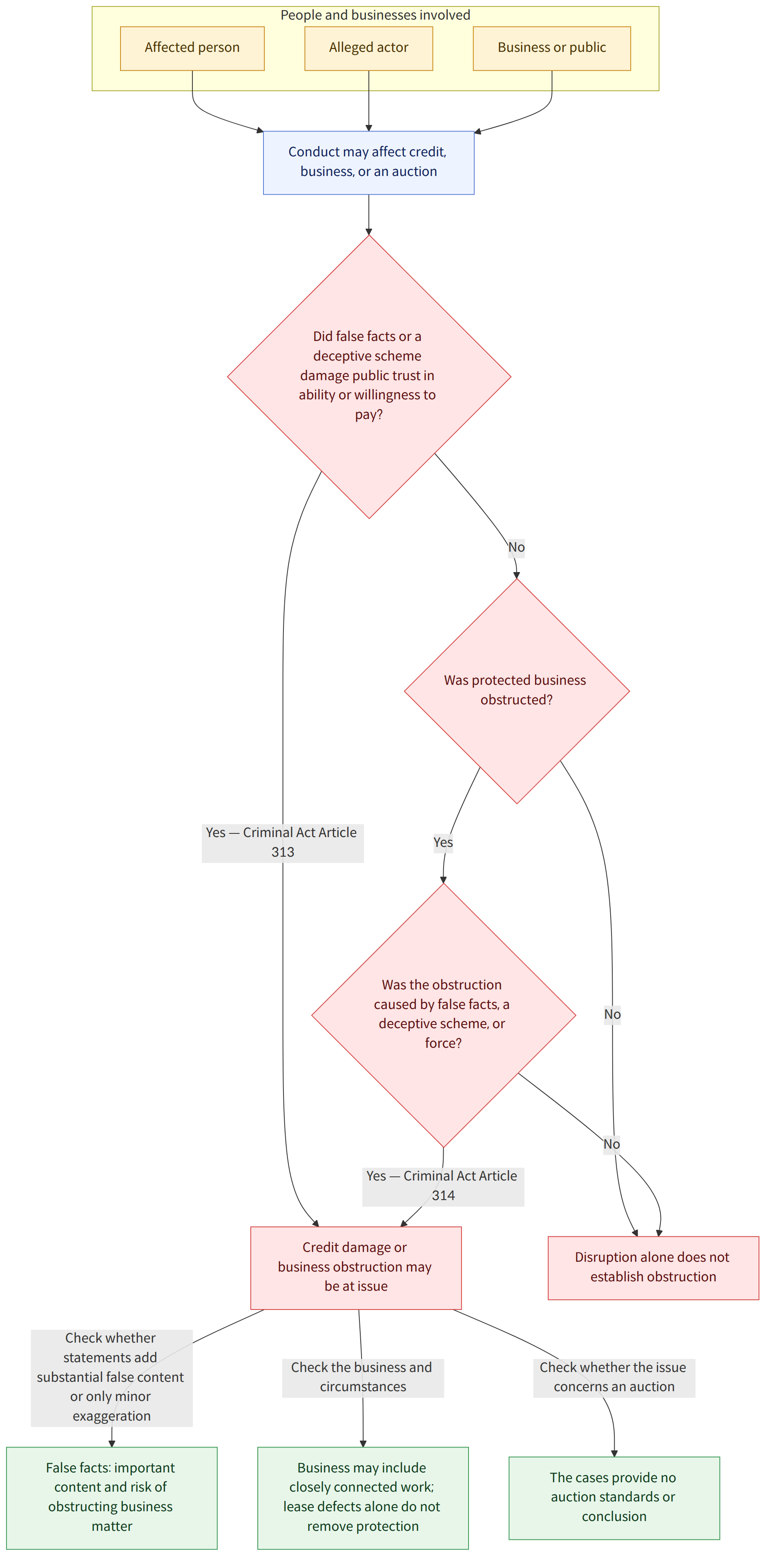
According to the cases provided, the offense of damaging credit may be at issue when false facts or a deceptive scheme damages public trust in another person’s ability or willingness to pay. Obstruction of business requires that protected business be obstructed through the dissemination of false facts, a deceptive scheme, or force; the outcome may vary depending on the nature of the statements and the circumstances and extent of the conduct. The cases provided do not include specific advice concerning crimes relating to auctions.
At a glance
Key points
- For purposes of obstruction of business, “business” means work or an undertaking carried on continuously by virtue of a person’s position in their occupation or social life, and may include ancillary work closely connected to the principal business (Cases 1 and 6).
- Obstruction of business requires that business be obstructed through the dissemination of false facts, a deceptive scheme, or force. The offense is not invariably established merely because business was actually disrupted (Criminal Act, Article 314 (형법 제314조); Case 8).
- False facts may include adding substantial false content that creates a risk of obstructing business, even if the basic facts are true. If the important content accords with objective facts and the statement amounts only to minor differences in detail or exaggeration, it may not qualify (Case 9).
- Personal opinions or value judgments may differ from the dissemination of objective facts about the past or present. For the offense of damaging credit, “credit” means the public’s trust in a person’s ability or willingness to pay (Criminal Act, Article 313 (형법 제313조); Cases 5, 13, and 14).
- If a landlord directly prevents an occupant from operating a business or removes their goods without following proper procedures, obstruction of business may be at issue. A defect in the lease relationship does not, by itself, mean that the business is excluded from protection (Case 1).
- One case held that moving construction materials did not constitute obstruction of business where the contract had been lawfully rescinded and the contractor had stopped the work. However, the specific circumstances, including whether the rescission was lawful, are important (Case 3).
- In one case, searching secret-protected electronic records on a company computer was recognized as a justifiable act under social norms after considering the circumstances, including that the investigation was limited to responding to specific grounds for suspicion (Criminal Act, Articles 316(2) and 20 (형법 제316조 제2항, 제20조); Case 2).
- None of the cases provided explains the elements or standards for determining whether a crime relating to auctions has been committed. No conclusion concerning auctions can be drawn from these cases alone.
Frequently asked questions
Q. Is it obstruction of business if the building owner locks a store to prevent it from operating?
If a landlord removes goods from a store that has been occupied and operated peacefully and locks the entrance to prevent business from being conducted, the offense of obstruction of business may be established. This case illustrates that a landlord cannot recover possession directly merely because the lease term has expired (Case 1).
Q. Can a slightly exaggerated statement count as a false fact for obstruction of business?
If the important points accord with objective facts and the statement amounts only to minor differences in detail or some exaggeration, with no risk of obstructing business, it may be difficult to regard it as a false fact. Conversely, even if the basic facts are true, adding substantial false content that creates a risk of obstructing business may constitute the offense (Case 9).
Q. Is saying that goods are expensive an offense of damaging credit?
In the case discussed, “credit” means the public’s trust in a person’s ability or willingness to pay. One case found that merely saying goods were expensive was not enough to constitute damage to that trust (Criminal Act, Article 313 (형법 제313조); Case 13).
Q. Is issuing a receipt in another business’s name an offense of damaging credit?
In one case, a business issued receipts in the name of a competitor, causing customers to mistakenly believe that the competitor was unfriendly or slow to deliver. The court found it difficult to regard this as damaging trust in the business’s ability or willingness to pay. However, this case concerned the offense of damaging credit, and did not determine uniformly whether any other offense was established (Case 11).
Q. Is it obstruction of business if I leave my job without preparing student records?
One case found that even if failing to prepare student records disrupted the operation of a kindergarten, that fact alone did not constitute obstruction of business through the dissemination of false facts, a deceptive scheme, or force. The offense cannot be deemed established solely because business was disrupted as a result (Criminal Act, Article 314 (형법 제314조); Case 8).
Q. Is it an offense of infringement of secrets to investigate a company employee’s computer?
If someone uses technical means to discover the contents of an electronic record protected by a secret device, such as a password, Criminal Act, Article 316(2) may be at issue. However, depending on the circumstances, such as a limited search of only work-related information in response to specific and reasonable grounds for suspicion, the conduct may be recognized as a justifiable act. The conclusion in the case therefore cannot be applied to every investigation (Criminal Act, Article 20 (형법 제20조); Case 2).
Q. Is moving the other party’s construction materials after rescinding a contract obstruction of business?
One case held that moving construction materials to another place did not constitute obstruction of business where the contract had been lawfully rescinded and the contractor had voluntarily stopped the work. Whether the contract was lawfully rescinded, including whether performance had first been demanded, may be important (Case 3).
Q. Is a union’s work-to-rule action obstruction of business?
Obstruction of business cannot be deemed established solely because a demand concerning management rights was made. One case considered the number and extent of train delays and whether there was a risk of serious disruption to business operations or substantial losses (Case 7).
Relevant laws
- Criminal Act, Article 20 (형법 제20조)
- Criminal Act, Article 136 (형법 제136조)
- Criminal Act, Article 313 (형법 제313조)
- Criminal Act, Article 314 (형법 제314조)
- Criminal Act, Article 316(2) (형법 제316조 제2항)
- Civil Act, Article 629(1) (민법 제629조 제1항)
- Constitution, Article 31 (헌법 제31조)
- Elementary and Secondary Education Act, Article 12 (초·중등교육법 제12조)
- Elementary and Secondary Education Act, Article 13 (초·중등교육법 제13조)
Watch out for
- Obstruction of business is not determined solely by the result that business was disrupted. The existence of dissemination of false facts, a deceptive scheme, or force, as well as the nature of the business, must also be considered.
- The conclusions in cases involving leases, construction contracts, and internal company investigations may vary depending on the specific circumstances, including the state of possession, how the contract was rescinded, and the scope of the investigation.
- The cases provided do not include any decisions concerning crimes relating to auctions, so criminal liability relating to auctions cannot be determined on the basis of this guide alone.
Source cases
This guide was compiled by AI from the following Korea Legal Aid Corporation consultation cases (in Korean).
- 임대인이 명도요구하면서 영업을 방해한 경우 형사책임
- 타인의 컴퓨터 하드디스크를 검색한 경우 비밀침해죄 성립 여부
- 계약해제 후 도급인이 공사자재 옮겨 둔 경우 업무방해 여부
- 채권을 과다 가압류한 것이 위계에 의한 업무방해인지
- 단순한 의견의 표시가 신용훼손죄 소정의 허위사실인지
- 초등학교 교실에서 위력을 행사한 경우 업무방해죄의 성립 여부
- 파업 목적의 정당성과 업무방해
- 생활기록부를 작성하지 않은 것이 업무방해인지
- 업무방해죄의 요건인 ‘허위의 사실 유포’의 의미
- 선정한 예상문제를 교습생들에게 준 경우 업무방해 여부
- 타인 명의 영수증 작성이 신용에 해당하는지
- 피해자의 승낙과 업무방해죄 성립여부
- 신용훼손죄에서 '신용'의 의미
- 신용훼손죄의 객체인 신용
This guide is general legal information about Korean law, not legal advice for your situation. For a specific case, consult a lawyer or the Korea Legal Aid Corporation (call 132 in Korea).