
Creditors’ Right of Revocation: Revoking Fraudulent Acts and Methods of Restoration
Based on 115 consultation cases · Updated · Translated from the Korean original.
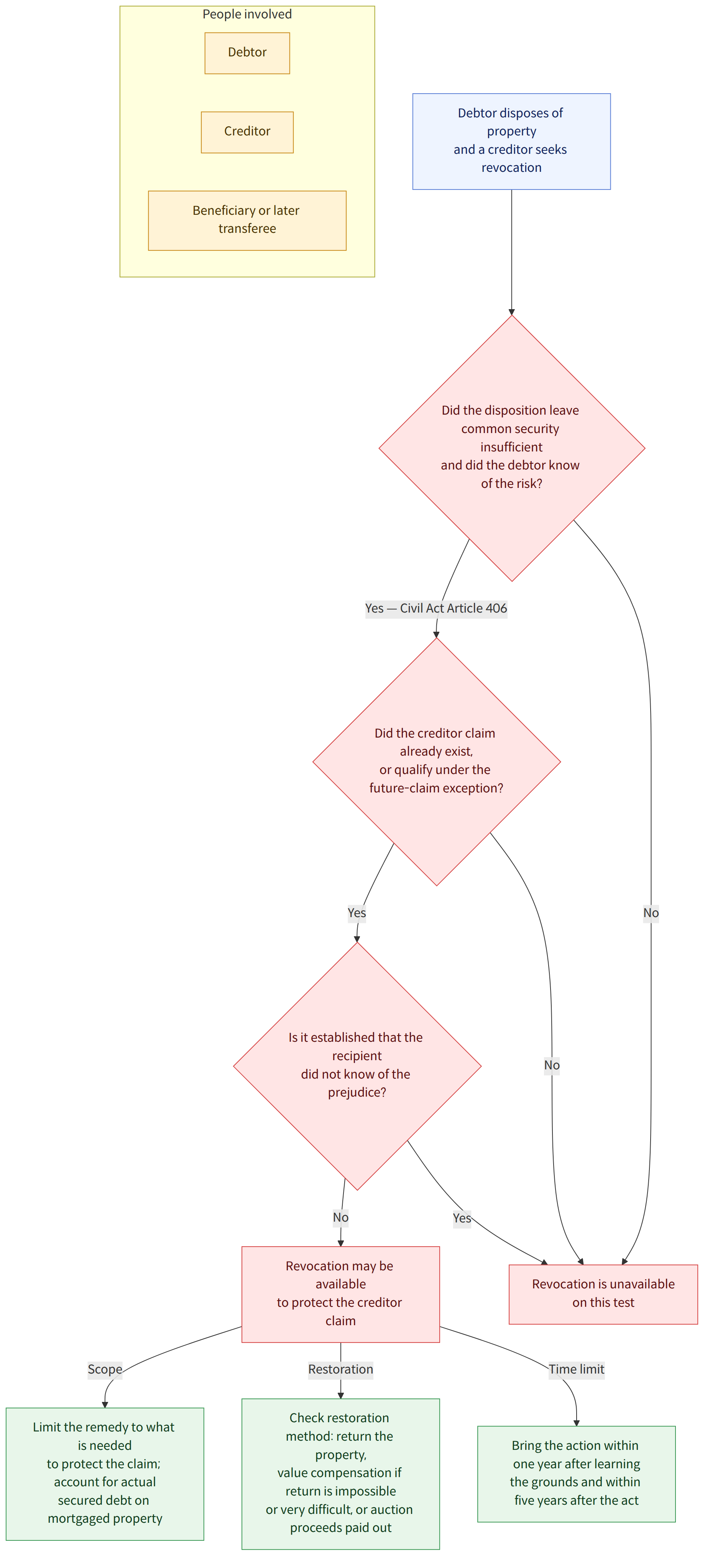
If a debtor disposes of property, leaving insufficient common security for general creditors, and the debtor knew of the circumstances, a creditor may seek revocation of the fraudulent act and restoration from the beneficiary or others. The scope of revocation and the method of restoration vary depending on factors such as security interests, whether an auction is underway, and the purpose and timing of the disposition. The action must be brought within the prescribed period.
At a glance
Key points
- The creditor’s right of revocation may be exercised when the debtor’s disposition of property leaves the common security insufficient, making it difficult for the creditor to obtain satisfaction of the claim. It is sufficient that the debtor was aware of that risk for the debtor to have the intent to prejudice creditors (Civil Act, Article 406 (민법 제406조)).
- An act cannot be revoked if it is established that the beneficiary or subsequent transferee did not know, at the time of the disposition, that it would prejudice the creditor. If the debtor’s intent to prejudice creditors is established, the beneficiary’s bad faith may be presumed, and the beneficiary’s good faith must be supported by objective evidence.
- As a general rule, the claim to be protected must have arisen before the fraudulent act. However, an exception may apply if, before the act, a legal relationship forming the basis for the claim already existed and the high probability that the claim would arise in the near future was subsequently realized.
- Revocation and restoration are limited to what is necessary to protect the creditor’s claim. For real estate subject to a mortgage, the relevant amount is generally the remainder after deducting the actual amount of the secured claim from the market value. The maximum secured amount must not be confused with the actual claim amount.
- If return of the property itself is impossible or significantly difficult, compensation for value may be sought. If real estate has been sold at auction and the sale proceeds have been paid in full, the beneficiary may be required to return the proceeds distributed to them instead of undoing the successful bidder’s ownership.
- Each of multiple creditors may seek revocation and restoration. Revocation and restoration are effective for the benefit of all creditors, but other claims may overlap to the extent that restoration has actually taken place (Civil Act, Article 407 (민법 제407조)).
- Renunciation of a debtor’s inheritance share under an agreement on the division of inherited property may also constitute a fraudulent act if it reduces the common security. However, only the portion falling short of the specific inheritance share, after taking special benefits and other factors into account, may be revoked.
- Property division and the provision of security to raise business funds cannot be deemed fraudulent acts based solely on their form. Relevant considerations include whether the property division exceeded a reasonable scope and whether the provision of security was necessary for the continuation of the business and the raising of new funds.
Frequently asked questions
Q. Can a debtor’s transfer of property to another person always be revoked?
Not necessarily. It must be established that the disposition left the common security insufficient, making it difficult to recover the creditor’s claim, and that the debtor knew of that risk. Revocation is also restricted if it is established that the beneficiary or subsequent transferee did not know of those facts at the time.
Q. By when must an action to revoke a fraudulent act be brought?
A creditor must bring an action within one year after learning the grounds for revocation and within five years after the juridical act constituting the fraudulent act. The date on which the creditor learned the grounds for revocation means the date on which the creditor learned of the specific fraudulent act and the debtor’s intent to prejudice creditors, not merely the date on which the creditor learned that property had been disposed of (Civil Act, Article 406 (민법 제406조)).
Q. Can an act be revoked even if a guarantee obligation or a claim for reimbursement had not yet arisen when the fraudulent act occurred?
As a general rule, the claim to be protected must have arisen before the fraudulent act. However, it may exceptionally qualify as a claim protected by the right of revocation if, at the time, a legal relationship forming the basis for the claim already existed and the high probability that the claim would arise in the near future was subsequently realized.
Q. Can a debtor’s renunciation of their share in an agreement on the division of inherited property also be revoked?
If a debtor in an excess-of-debt state renounces rights to an inheritance share, thereby reducing the common security available to general creditors, the renunciation may constitute a fraudulent act. However, revocation may be limited to the portion by which the share falls short of the debtor’s specific inheritance share, taking special benefits and contributions into account.
Q. How is the scope of revocation determined when real estate subject to a maximum-amount mortgage is transferred?
As a general rule, a fraudulent act is established to the extent of the amount remaining after deducting the actual amount of the secured claim from the market value of the real estate. The relevant amount may be the claim that actually arose, rather than the maximum amount secured by the mortgage. Even if the mortgage is later canceled, revocation and compensation for value are generally sought up to the amount of that remainder.
Q. Can multiple creditors sue to have the same disposition of property revoked?
Each creditor may seek revocation and restoration in their own right if the requirements are met, so multiple actions may be brought in relation to the same fraudulent act. However, once the property or its value has actually been restored, the interest in other claims may be limited to the extent that they overlap with that restoration (Civil Act, Article 407 (민법 제407조)).
Q. How can property transferred through a fraudulent act be restored if it has already been sold at auction?
Once the purchase price has been paid in full, restoration cannot be achieved by canceling the successful bidder’s ownership. Depending on the circumstances, the beneficiary may be ordered to return the proceeds distributed to them, or compensation for value may be sought if return of the property itself is impossible or significantly difficult.
Q. Can a transfer of real estate to a spouse as part of a divorce property division be revoked?
As a general rule, a division of property does not, by itself, constitute a fraudulent act. However, if the division is excessive and there are special circumstances indicating that it was a disposition made under the pretext of dividing property, it may be revoked to the extent that it exceeds a reasonable division. The creditor must prove those special circumstances.
Q. Is it a fraudulent act to enter into a consumer loan agreement or prepare a notarial deed to repay an existing debt?
Payment of an existing debt is, as a general rule, an exercise of a right that the creditor may demand. Therefore, unless the debtor and beneficiary acted in collusion, it is difficult to conclude that entering into a consumer loan agreement itself constitutes a fraudulent act. When a notarial deed consenting to compulsory execution is prepared, it must be examined whether the act substantially reduced the debtor’s assets available to satisfy creditors.
Relevant laws
- Civil Act, Article 406 (민법 제406조)
- Civil Act, Article 407 (민법 제407조)
- Civil Act, Article 320 (민법 제320조)
- Civil Act, Article 108 (민법 제108조)
- Civil Act, Article 839-2 (민법 제839조의2)
- Civil Act, Article 368 (민법 제368조)
- Civil Act, Article 481 (민법 제481조)
- Civil Act, Article 482 (민법 제482조)
- Civil Act, Article 103 (민법 제103조)
- Act on the Registration of Real Estate under Actual Titleholder's Name, Article 4 (부동산 실권리자명의 등기에 관한 법률 제4조)
- Housing Lease Protection Act, Article 3 (주택임대차보호법 제3조)
Watch out for
- The action must be brought within one year after learning the grounds for revocation and within five years after the juridical act occurred. The date on which the grounds for revocation were learned and the date on which the juridical act actually took place must be checked separately.
- The circumstances at the time of the disposition are important in determining whether an act was fraudulent, but it must also be considered whether the common security remains insufficient when the right of revocation is exercised.
- When calculating the value of real estate subject to a maximum-amount mortgage, the maximum secured amount must not be treated as equal to the actual amount of the secured claim.
- The outcome may vary depending on the specific circumstances and purpose, including property division, provision of security to raise funds for a new business, or a disposition on terms more favorable than an auction.
Related articles
Source cases
This guide was compiled by AI from the following Korea Legal Aid Corporation consultation cases (in Korean).
- 부동산매각대금완납 후 저당권설정행위가 사해행위취소 될 경우 원상회복방법
- 저당부동산에 대한 사해행위 후 저당권이 말소된 경우 사해행위의 취소범위
- 다수의 채권자가 사해행위취소로 가액배상을 청구한 경우 배상범위
- 사해행위 당시 성립되지 않은 채권도 채권자취소권의 피보전채권인지
- 공동상속재산의 분할협의가 채권자취소권의 대상이 되는지
- 채권자취소소송을 제기할 수 있는 기간은 어떻게 되는지
- 채무자가 연속하여 여러 개의 재산처분행위를 한 경우 사해행위인지
- 수탁자가 신탁부동산근저당권설정 한 경우 수탁자의 채권자에게 사해행위인지
- 원상회복으로 가액배상 명할 경우 우선변제권 없는 주택임차보증금 공제 여부
- 채권양도가 사해행위인 경우 원상회복방법
- 후순위근저당권설정으로 선순위근저당권자에게 변제한 경우 사해행위여부
- 수급인의 공사대금 담보조로 특정인에게 건물등기 하기로 한 약정의 효력
- 채권자 중 1인에게 채무자의 유일한 재산을 처분한 경우 사해행위인지
- 채무를 면할 목적으로 처에게 소유권을 이전한 행위를 취소할 수 있는지
- 채무초과상태에서 사업계속을 위한 근저당권설정행위가 사해행위인지
- 채권자의 우선변제권 확보 후 연대보증인의 재산처분이 사해행위인지
- 피담보채권액이 시가를 넘는 경우의 부동산 양도행위가 사해행위인지
- 소유권이전등기청구권보전을 위한 가등기가 사해행위인 경우 원상회복방법
- 사해의사 판단에 채무자 변제노력, 채권자태도 등을 참작할 수 있는지
- 연대보증인의 사해행위에 있어서 사해의사의 판단기준
- 이혼의 경우 재산분할명목으로 증여한 부동산이 채권자취소대상이 되는지
- 가등기에 기초한 본등기를 할 경우 사해행위여부의 판단기준시기
- 부동산 이중양도행위에 대한 채권자 사해행위 취소가 가능한지
- 기존 채무의 변제를 위한 소비대차계약의 체결 및 공정증서의 작성이 사해행위에 해당하는지 여부
- 매각대금 지급기일 직전에 그 보다 나은 조건으로 처분한 경우 사해행위인지
This guide is general legal information about Korean law, not legal advice for your situation. For a specific case, consult a lawyer or the Korea Legal Aid Corporation (call 132 in Korea).