
Guide to the Requirements and Effects of Exercising a Creditor’s Right of Subrogation
Based on 49 consultation cases · Updated · Translated from the Korean original.
A creditor’s right of subrogation allows a creditor to exercise, on the debtor’s behalf, a right the debtor has against a third party in order to preserve the creditor’s own claim. The creditor must have a claim to preserve and a need to preserve it. Whether the right may be exercised and what effects it has depend on the nature of the right and when the debtor or third party disposes of it.
At a glance
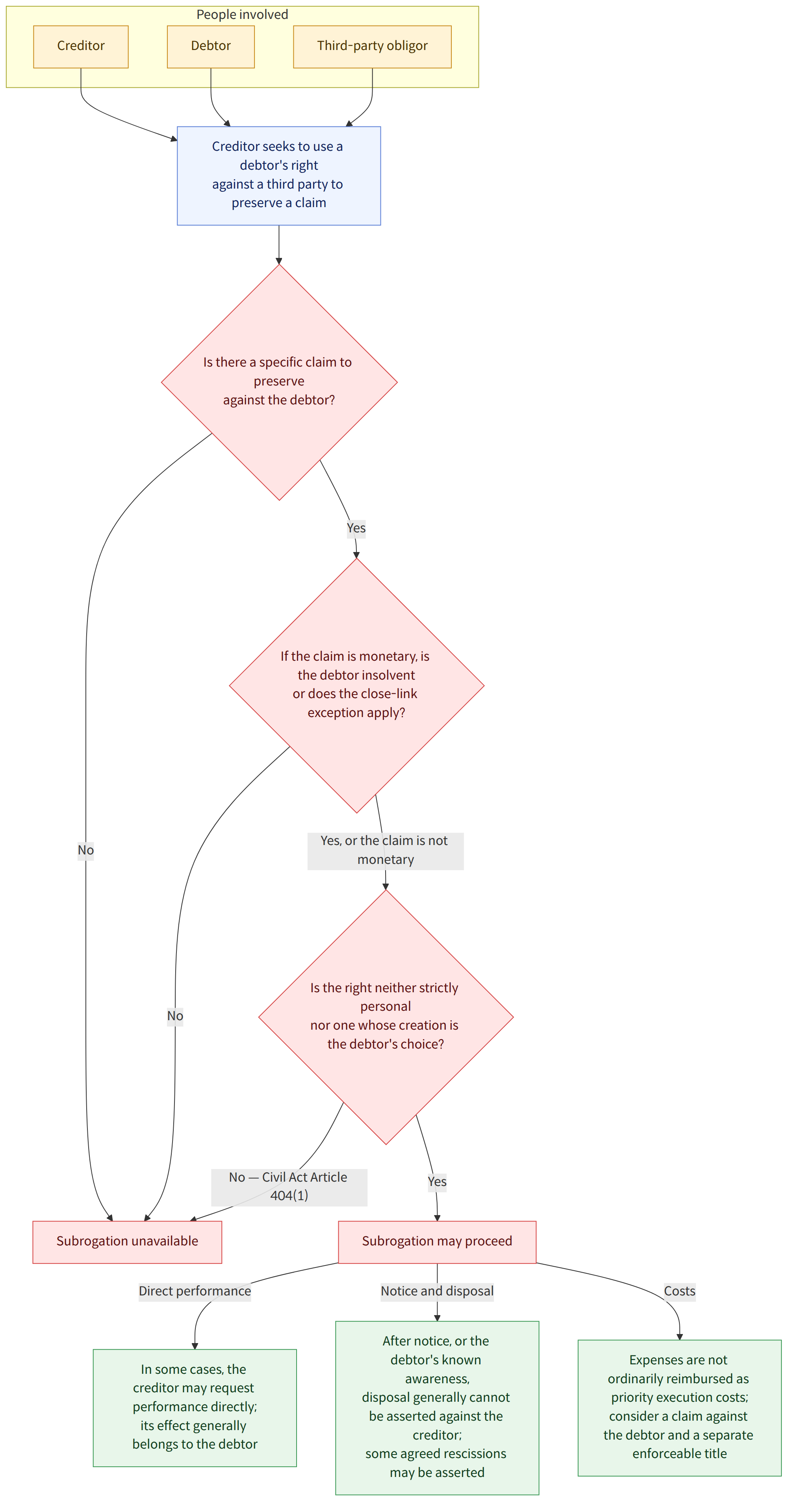
Key points
- To exercise the right of subrogation, the creditor must have a specific claim against the debtor to preserve. The existence of the claim to be preserved is a procedural requirement and is subject to the court’s examination on its own initiative (Cases 1, 9, and 16).
- If the claim to be preserved is a monetary claim, the debtor’s insolvency is generally required. However, an exception may apply where the right to be preserved and the right to be exercised by subrogation are closely related and subrogation is necessary for the actual performance of the claim (Cases 4, 6, 7, 10, and 25).
- As a general rule, a debtor’s right may not be exercised by subrogation if it is strictly personal, or if exercising it would create a new legal relationship whose creation the debtor must decide (Civil Act, Article 404(1) (민법 제404조 제1항), Cases 1 and 19).
- In some cases, the creditor may exercise the right of subrogation to ask the third-party obligor to perform directly to the creditor. However, the effect of that performance generally belongs to the debtor (Case 5).
- After receiving notice that the right of subrogation is being exercised, the debtor may not dispose of the right subject to subrogation in a way that can be asserted against the creditor. Even without notice, the same principle may apply if the debtor knew that the right was being exercised by subrogation (Civil Act, Article 405 (민법 제405조), Cases 2, 13, and 24).
- However, if, after notice, the contract is rescinded under an existing agreement because of the debtor’s nonperformance, the third-party obligor may assert the rescission against the creditor. The matter may be viewed differently if special circumstances exist, such as rescission by agreement between the debtor and the third-party obligor or a sham rescission (Case 3).
- The third-party obligor may dispute that the legal act giving rise to the claim to be preserved was invalid or that the claim was extinguished through payment or otherwise, but may not exercise in the debtor’s place a defense or right of formation that the debtor must exercise (Case 9).
- Expenses incurred in exercising the right of subrogation are not ordinarily reimbursed in priority as compulsory execution costs. You should consider claiming reimbursement from the debtor and obtaining a separate enforceable title (Civil Act, Article 688(3) (민법 제688조 제3항), Case 20).
Frequently asked questions
Q. What requirements must be met to exercise a creditor’s right of subrogation?
There must be a claim that the creditor seeks to preserve against the debtor, and the debtor must have a right against a third party that is subject to subrogation. When preserving a monetary claim, the debtor’s insolvency is generally required, but exceptions apply where the rights are closely related and exercising the right by subrogation is necessary.
Q. Can a company’s shareholder or representative director bring a subrogation action on the company’s behalf?
A representative director’s authority to conduct the company’s business or a shareholder’s shareholder rights are not, in themselves, specific proprietary claims. It is therefore difficult to exercise by subrogation the company’s proprietary claim against a third party based on those rights alone. As a general rule, exercising the right of subrogation requires a specific proprietary claim to be preserved.
Q. In a subrogation action, can the creditor ask the third-party obligor to perform directly to the creditor?
In some cases, yes. This is on the premise that even if the creditor directly claims performance, the effect of that performance belongs to the debtor, who is the original holder of the right.
Q. What happens if the debtor assigns or waives the right after receiving notice that the right of subrogation is being exercised?
After receiving notice, the debtor may not dispose of the right subject to subrogation in a way that can be asserted against the creditor. There is also a case in which the court held that, even without notice, the debtor could not assert a disposition against the creditor if the debtor knew that the right was being exercised by subrogation.
Q. If a sale contract is rescinded after notice that the right of subrogation is being exercised, does the rescission also take effect against the creditor?
According to a precedent, if, because of the debtor’s nonperformance, the contract is automatically rescinded under an agreement entered into before notice, or the third-party obligor rescinds the contract, the third-party obligor may assert that rescission against the creditor exercising the right of subrogation. However, the matter may be decided differently if the rescission was in substance by agreement between the parties or if special circumstances show that the appearance of rescission was created to assert it against the creditor.
Q. Can the third-party obligor argue that the creditor’s claim against the debtor is invalid or has already been paid?
Yes. The third-party obligor may argue that the legal act giving rise to the claim being preserved was invalid, or that the claim was extinguished through payment or otherwise. In that event, the court must examine and determine whether the claim being preserved exists.
Q. Can I exercise a right of subrogation over my former spouse’s rights to preserve a claim for division of property upon divorce?
A precedent explains that, before the scope and substance of a claim for division of property are set by agreement or adjudication, the right is unclear and indeterminate, so the right of subrogation may not be exercised to preserve it.
Q. Can I recover expenses incurred in exercising the right of subrogation in enforcement proceedings?
A precedent holds that expenses incurred in exercising the right of subrogation are not execution costs incurred directly for the purpose of compulsory execution. You should consider claiming reimbursement of the expenses from the debtor and, if necessary, obtaining a separate enforceable title.
Relevant laws
- Civil Act, Article 108 (민법 제108조)
- Civil Act, Article 404(1) (민법 제404조 제1항)
- Civil Act, Article 405(1) and (2) (민법 제405조 제1항·제2항)
- Civil Act, Article 406(2) (민법 제406조 제2항)
- Civil Act, Article 688(3) (민법 제688조 제3항)
- Civil Act, Article 1019(1) and (3) (민법 제1019조 제1항·제3항)
- Civil Act, Article 1026(1) and (2) (민법 제1026조 제1호·제2호)
- Commercial Act, Article 393(1) (상법 제393조 제1항)
- Debtor Rehabilitation and Bankruptcy Act, Articles 384 and 424 (채무자 회생 및 파산에 관한 법률 제384조·제424조)
- Civil Execution Act, Articles 31, 32, 53(1), 102, 287(1) and (3), and 301 (민사집행법 제31조·제32조·제53조 제1항·제102조·제287조 제1항·제3항·제301조)
- Civil Procedure Act, Article 83(1) (민사소송법 제83조 제1항)
- Act on Special Cases Concerning Expedition, etc. of Legal Proceedings, Article 3(1) (소송촉진 등에 관한 특례법 제3조 제1항)
- National Land Use Management Act (no specific provision identified) (국토이용관리법(조문 특정 없음))
- Act on Security over Provisional Registration, etc. (no specific provision identified) (가등기담보 등에 관한 법률(조문 특정 없음))
Watch out for
- If the claim to be preserved does not exist, a subrogation action may be procedurally improper for lack of standing. If the third-party obligor argues that the claim is invalid or has been paid, the court may examine whether the claim exists.
- When the right of subrogation is exercised to preserve a monetary claim, the debtor’s insolvency is generally required. An exception may apply where the rights are closely related and there is a real need for preservation.
- A disposition by the debtor after notice that the right of subrogation is being exercised is not invariably invalid. Rescission of a contract because of the debtor’s nonperformance must be distinguished from rescission by agreement between the parties.
- A right whose scope and substance have not yet been determined, such as a claim for division of property, or an offer or acceptance of a contract that must be left to the debtor’s own decision, may not be subject to subrogation.
Source cases
This guide was compiled by AI from the following Korea Legal Aid Corporation consultation cases (in Korean).
- 대표이사의 업무집행권에 의해 회사의 재산상청구권을 대위행사 가능한지
- 채권자가 양수인을 대위하여 양도인을 상대로 한 처분금지가처분의 효력
- 채권자대위권행사 통지 후에, 채무자의 채무불이행을 이유로 그 전부터 체결되어 있던 약정에 따라 계약이 해제된 경우, 제3채무자...
- 재산분할청구권의 보전을 위하여 채권자대위권을 행사할 수 있는지
- 제3채무자가 채권자대위소송의 채권자에게 바로 이행하도록 할 수 있는지
- 채무자의 공유자를 상대로 채권자대위권을 행사할 수 있는지
- 채무자 무자력 판단에서 가등기된 부동산, 적극재산에서 제외해야 하는지
- 파산채권자가 채권보전을 위하여 파산관재인의 권리를 대위할 수 있는지
- 채권자대위소송에서 제3채무자가 피보전채권의 발생원인이 된 법률행위의 무효, 변제 등을 주장하여 대항할 수 있는지
- 채권자대위권의 행사요건으로서의 ‘채권보전의 필요성’의 인정 기준
- 상속포기기간 만료 전 상속인의 채권자가 대위상속등기를 할 수 있는지
- 채권자가 채무자를 대위하여 제3자에게 ‘토지거래허가 신청절차 협력의무’의 이행을 구할 수 있는지
- 채권자대위권으로 부동산처분금지가처분 후 성립된 계약 합의해제의 효력
- 채권자가 채무자의 공동상속등기를 대위신청한 경우, 채권자가 소요된 비용의 상환을 제3자에게 청구할 수 있는지
- 채권자대위소송 계속 중 다른 채권자가 채권자대위권을 행사하면서 공동소송참가신청을 한 것이 적법한지
- 채권자대위소송에서 피보전채권의 존재 여부가 법원의 직권조사사항인지
- 채권자대위소송의 제3채무자가 소멸시효완성을 주장하여 대항할 수 있는지
- 가처분결정에 대한 본안제소명령신청을 채권자대위로 할 수 있는지
- 계약의 청약이나 승낙이 채권자대위권의 목적이 될 수 있는지
- 채권자대위권의 행사로 인해 지출한 비용을 회수하는 방법
- 채권자의 공동상속인이 지분을 초과하는 부분에 관하여 채무자를 대위할 보전의 필요성이 있는지
- 특정물에 대한 채권자가 채무자의 제3채무자에 대한 그 특정물에 관한 권리만을 대위행사할 수 있는지
- 채권자취소권을 대위행사할 수 있는지, 그 제소기간의 기준은 어떠한지
- 채권자대위소송의 채무자가 대위사실을 통지받지 않았지만 알고 있는 경우, 그 처분으로써 채권자에게 대항할 수 있는지
- 피보전채권이 금전채권인데 무자력을 필요로 하지 않는 경우
This guide is general legal information about Korean law, not legal advice for your situation. For a specific case, consult a lawyer or the Korea Legal Aid Corporation (call 132 in Korea).