
Guide to Claims for Damages by Crime Victims
Based on 40 consultation cases · Updated · Translated from the Korean original.
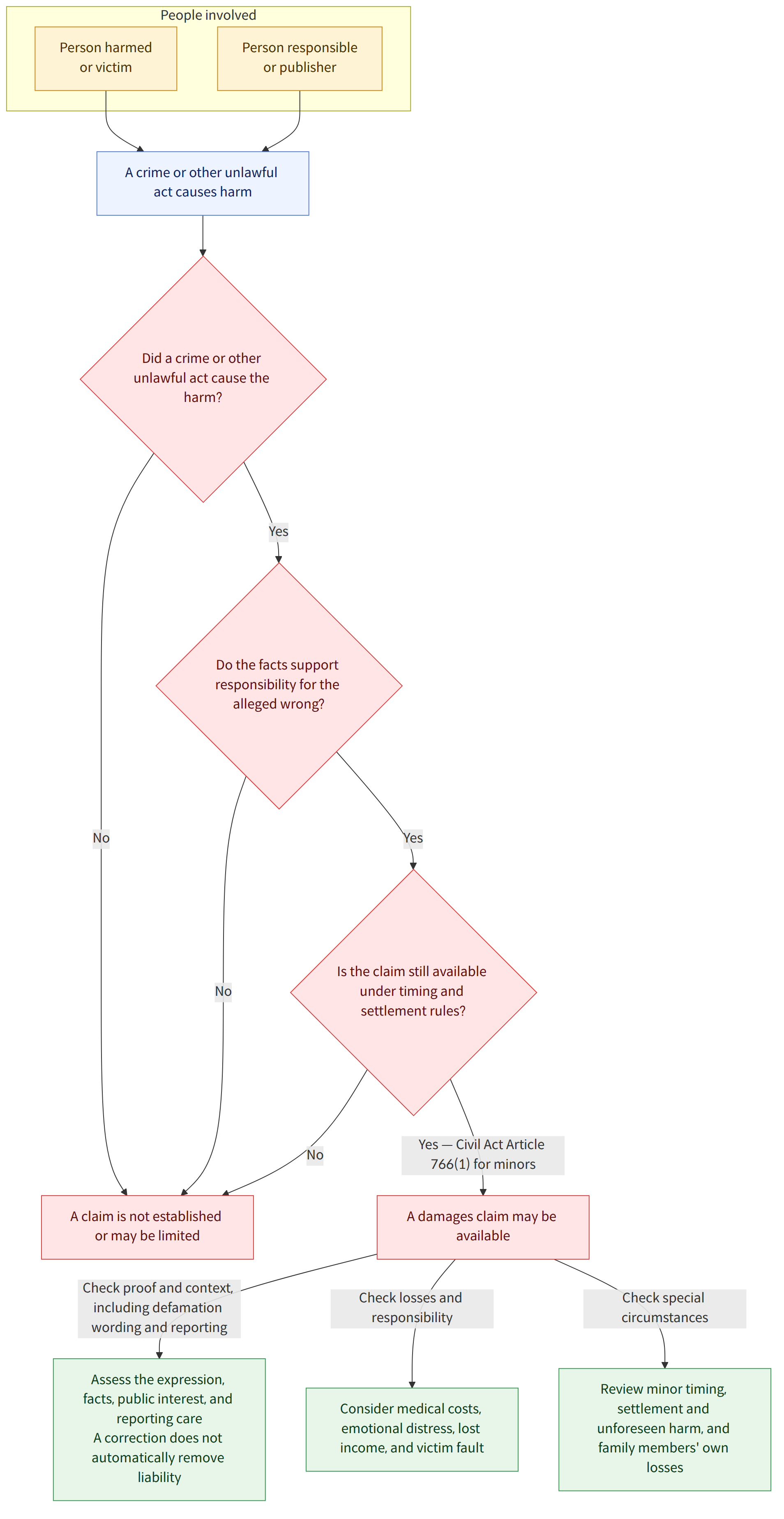
If you are harmed by a crime or other unlawful act, you may claim damages from the person responsible, including medical expenses, compensation for emotional distress, and lost income. Whether defamation occurred, the scope of recoverable damages, and the limitation period depend on the specific facts and circumstances.
At a glance
Key points
- If fraud is established, the victim may claim damages resulting from the fraud. The mere fact that the person responsible has been declared bankrupt and discharged from their debts does not determine whether fraud occurred (Case 4).
- Defamation is assessed by considering the form and content of the expression and the overall impression it gives readers. The outcome may vary depending on the specific content and wording, even for opinions, reviews, or reporting in the public interest (Cases 2, 7, 8, and 12).
- Before reporting on an allegation under investigation, a media outlet should conduct adequate reporting and take care not to present unverified claims as true. Publishing a correction does not automatically eliminate civil liability for damages (Cases 8 and 16).
- It is difficult to recognize the deceased person’s own right to compensation for emotional distress. However, if defamation of the deceased harms the surviving family members’ reputations or their feelings of remembrance and affection, they may be able to claim damages for their own losses (Case 3).
- If the victim was also at fault for causing or increasing the harm, this may be reflected in the calculation of damages. The court may consider this on its own initiative even if the person who caused the harm did not raise it in the lawsuit (Case 11).
- Unless there are exceptional circumstances, the limitation period for a minor’s claim for damages arising from an unlawful act begins when the legal representative learns of the harm and the person who caused it. In some cases, the relevant issue is when it became practically possible to claim damages (Civil Act, Article 766(1) (민법 제766조 제1항), Cases 14 and 22).
- As a general rule, it is difficult to claim additional damages after reaching a settlement. However, an additional claim may be possible in certain circumstances, such as where serious subsequent harm arose that could not have been anticipated at the time of settlement (Case 23).
- If a person dies or loses work capacity because of an accident, an amount equivalent to retirement benefits or lost income may be included in the damages, depending on the circumstances. The determination in a case concerning the age up to which a person could have worked depends on the specific circumstances and ruling in that case (Cases 13 and 20).
Frequently asked questions
Q. Does someone who has been declared bankrupt and discharged from their debts not have to repay borrowed money?
The mere fact that a person has been discharged from bankruptcy does not determine whether they committed fraud when borrowing the money. In the case, the debtor borrowed money despite having no intention or ability to repay it; this was found to constitute fraud, and the debtor was held liable to compensate the victim for the resulting damages.
Q. Can I be required to pay damages for defamation if I post an online review or criticize someone in harsh terms?
The assessment considers all relevant factors, including whether the statement expresses an opinion or asserts a specific fact, whether its main content is consistent with objective facts, and whether it serves the public interest. In some cases, no liability for damages was imposed for reviews or opinions expressed in the public interest. However, liability may be imposed where false information is reported and a person’s reputation is harmed.
Q. If a media outlet publishes a correction, does it no longer have to pay damages for defamation?
Publishing a correction does not automatically eliminate civil liability for damages. Liability may be imposed if a media outlet reports on an allegation under investigation without adequate reporting, or presents unverified claims as fact.
Q. If a deceased family member’s reputation is harmed, can the surviving family claim compensation for emotional distress on the deceased’s behalf?
The case held that it is difficult for surviving family members to claim, on the deceased person’s behalf, the deceased’s own right to compensation for emotional distress. However, if defamation harms the surviving family members’ own reputations or their feelings of remembrance and affection for the deceased, they may be able to claim damages for their own losses.
Q. Can I seek additional damages if I develop lasting effects after settling a claim for an assault?
If the victim agreed to waive the remaining claims in a settlement, it is generally difficult to seek additional damages. However, a further claim may be possible if serious subsequent harm arose that could not reasonably have been anticipated at the time of the settlement, and the circumstances indicate that the victim would not have settled had they known about it.
Q. When does the limitation period for a damages claim begin for harm suffered while I was a minor?
If the victim was a minor and there are no exceptional circumstances, the limitation period may begin to run when the victim’s legal representative learns of the damage and the person who caused it. In a case where it was practically difficult to claim damages before a final acquittal in a separate criminal case, the court held that the limitation period began when the acquittal became final.
Q. If the victim was also at fault, will damages be reduced only if the person who caused the harm argues this?
No. If the victim’s own fault is established from the evidence in the lawsuit, the court may consider it on its own initiative when determining the amount of damages, even if the person who caused the harm did not raise it.
Q. Can I claim damages from an event organizer, a school, or the parents of a student who caused the harm, in addition to the person who caused the accident?
Depending on the circumstances, a claim for damages may be brought if an event organizer failed to take reasonable safety precautions, or if a school’s duty to guide and supervise, or a parent’s duty to supervise and educate, was breached. Whether liability is imposed depends on how the accident occurred and whether each party breached their duty of care.
Q. If someone dies or becomes unable to work because of an accident, can they also claim lost income or retirement benefits?
A specific retirement benefit that the victim would have received if the accident had not occurred may be recoverable as lost earnings, and one case held that this applies to public officials as well. Lost income resulting from reduced work capacity may also be recoverable, but any determination of the age up to which the victim could have worked should be considered in light of the ruling and specific circumstances of that case.
Relevant laws
- Civil Act, Article 3 (민법 제3조)
- Civil Act, Article 35(1) (민법 제35조 제1항)
- Civil Act, Article 756(1) (민법 제756조 제1항)
- Civil Act, Article 760 (민법 제760조)
- Civil Act, Article 766(1) (민법 제766조 제1항)
- Civil Act, Article 997 (민법 제997조)
- Civil Act, Article 1015 (민법 제1015조)
- Criminal Act, Article 355(2) (형법 제355조 제2항)
- Criminal Act, Article 359 (형법 제359조)
- Bills of Exchange Act, Article 11(1) (어음법 제11조 제1항)
- Bills of Exchange Act, Article 17 (어음법 제17조)
- Bills of Exchange Act, Article 77(1) (어음법 제77조 제1항)
- Debtor Rehabilitation and Bankruptcy Act, Article 309 (채무자회생 및 파산에 관한 법률 제309조)
- Debtor Rehabilitation and Bankruptcy Act, Article 564(1) (채무자회생 및 파산에 관한 법률 제564조 제1항)
- Debtor Rehabilitation and Bankruptcy Act, Article 566 (채무자회생 및 파산에 관한 법률 제566조)
Watch out for
- Whether defamation occurred should be assessed by considering the overall purpose and context of the writing or report, the accuracy of the statements, and whether they serve the public interest, rather than examining isolated expressions.
- The wording of a settlement agreement and whether the harm could have been anticipated at the time of settlement may affect whether an additional claim for damages is possible.
- The date on which the limitation period begins may depend on factors such as the victim’s age, whether their legal representative knew of the harm, and when it became practically possible to claim damages.
- The age up to which a person could have worked and the scope of recoverable damages should be assessed in light of the individual circumstances, rather than applying a case’s conclusion to every situation.
Source cases
This guide was compiled by AI from the following Korea Legal Aid Corporation consultation cases (in Korean).
- 회사의 대표이사가 대표권을 남용하여 회사 명의의 약속어음을 발행한다는 사정을 상대방이 알았거나 중대한 과실로 알지 못하여 회사...
- 특정 국회의원에 대한 항의집회의 명예훼손 성부 및 손해배상 청구 가부
- 사자의 명예훼손에 대하여 유족 고유의 위자료 청구권 이외에 ‘사자 본인의 위자료 청구권’을 인정할 수 있는지 여부
- 개인파산·면책제도를 통하여 면책을 받은 채무자에 대한 차용금 사기죄의 심리방법
- 부동산 매수인의 매매잔금지급의무 해태와 배임죄 및 배임행위에 대한 손해배상 청구 가부
- 대물변제예약과 배임으로 인한 손해배상
- TV 시사고발프로그램의 고발 내용과 이로 인한 명예훼손과 손해배상 성부
- 신문이나 인터넷 매체의 기사가 타인의 명예를 훼손하여 불법행위가 되는지 판단하는 기준 및 언론기관이 수사기관 등에서 조사가 진...
- 상대방을 기망하여 인감증명서를 교부 받은 경우 사기죄의 성립 및 이로 인한 손해배상 청구 가부
- 공연 주최자가 실내 공연장에서 갑자기 과도하게 높은 볼륨으로 오프닝 뮤직을 내보내 관람자가 귀 신경이 파손되는 상해를 입은 경...
- 가해자가 주장하지 않은 피해자의 과실을 법원이 직권으로 참작하여 손해배상액을 감경 할 수 있는가
- 인터넷 카페나 자신의 블로그 등에 자신이 직접 겪은 불편사항 등을 후기 형태로 게시하는 행위와 명예훼손으로 인한 손해배상여부
- 여성 육체노동자의 가동 연한
- 민법 제766조 제1항에서 정한 ‘손해 및 가해자를 안 날’의 의미와 판단 기준
- 주식회사의 임원이 공적 업무수행을 위해서만 사용이 가능한 법인카드를 실질적 1인 주주의 양해를 얻어 개인 용도로 계속적, 반복...
- 명예훼손적 기사에 대한 언론사의 정정보도와 손해배상의 관계
- 업무상 횡령과 손해배상
- 공동불법행위자의 요건
- 피의자 진술로 인한 위증죄 성부와 손해배상여부
- 피해자가 사고로 인해 사망하여 퇴직금을 받지 못하게 된 경우, 퇴직금이 손해배상범위에 포함되는지.
- 회사가 타인의 사무를 처리하는 일을 영업으로 영위하고 있는 경우, 회사 대표이사가 그 타인의 사무를 처리하면서 업무상 임무에 ...
- 미성년자가 피해자인 경우 민법 제766조 제1항 소정의 3년의 기간의 관계
- 합의 후 발생한 손해에 대한 배상문제
- 교내에서 중학생의 학우에 대한 상해와 이에 대한 부모 및 교사의 손해배상책임
- 권리질권설정자의 배임죄 성부
This guide is general legal information about Korean law, not legal advice for your situation. For a specific case, consult a lawyer or the Korea Legal Aid Corporation (call 132 in Korea).