
Guide to Appeals in Criminal Cases: Appeal and Further Appeal Procedures and Key Considerations
Based on 21 consultation cases · Updated · Translated from the Korean original.
To challenge a criminal judgment, you must comply with the deadlines and filing requirements for an appeal or further appeal, as well as the deadline for submitting a statement of grounds for appeal. Whether the sentence can be increased on appeal depends, among other things, on whether the prosecutor also appealed. In a further appeal, there are limits on raising new issues that were not addressed by the appellate court.
At a glance
Key points
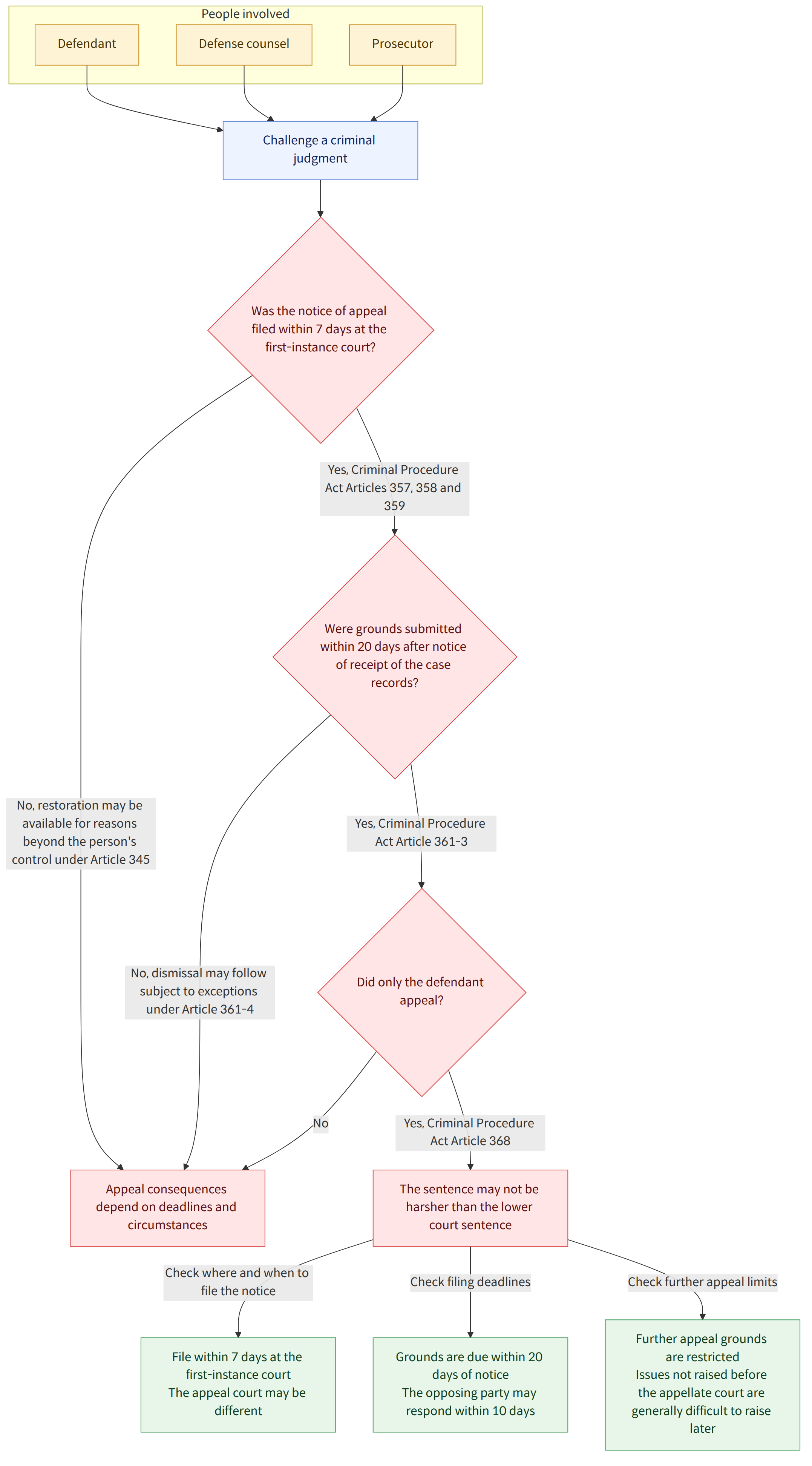
- An appeal against a judgment of the court of first instance must be filed within 7 days of the date the judgment is pronounced by submitting a notice of appeal to the court of first instance. The court with jurisdiction over the appeal may differ from the court where the notice of appeal must be filed (Criminal Procedure Act, Articles 357, 358, and 359 (형사소송법 제357조, 제358조, 제359조)).
- The appellant or counsel must submit a statement of grounds for appeal within 20 days of receiving notice from the appellate court that it has received the case records. The opposing party may submit a response within 10 days of receiving the statement of grounds for appeal (Criminal Procedure Act, Article 361-3 (형사소송법 제361조의3)).
- As a general rule, an appeal may be dismissed if the statement of grounds for appeal is not submitted within the time limit. Exceptions apply where the grounds for appeal are stated in the notice of appeal or the appellate court has grounds to examine on its own initiative (Criminal Procedure Act, Article 361-4 (형사소송법 제361조의4)).
- Grounds for appeal may include a violation of law, an error in finding the facts, or an improper sentence. If an issue was not raised before the appellate court, it is generally difficult to raise it for the first time as a ground for further appeal (Criminal Procedure Act, Article 364 (형사소송법 제364조); Case 10).
- If only the defendant appeals or an appeal is filed on the defendant’s behalf, the sentence may not be harsher than the sentence imposed by the lower court. Whether the sentence is disadvantageous is assessed substantively, not merely by formally comparing the operative parts of the judgments (Criminal Procedure Act, Article 368 (형사소송법 제368조); Cases 12, 15, and 19).
- A defense counsel needs the defendant’s consent to withdraw an appeal, and consent given in court must be expressly confirmed. A minor defendant who has a legal representative needs the legal representative’s consent to waive or withdraw an appeal (Criminal Procedure Act, Articles 350, 351, and 352 (형사소송법 제350조, 제351조, 제352조); Cases 4 and 18).
- A person who misses the deadline for appeal for reasons beyond their control may apply for restoration of the right to appeal. However, moving while proceedings are ongoing without notifying the court is generally not recognized as a reason beyond the person’s control (Criminal Procedure Act, Article 345 (형사소송법 제345조); Cases 3 and 9).
- The grounds for further appeal are restricted, and the court may issue its judgment without oral argument based on the case records (Criminal Procedure Act, Articles 383 and 390 (형사소송법 제383조, 제390조); Case 21).
Frequently asked questions
Q. Where and by when must I file a notice of appeal?
An appeal must be filed within 7 days of the date the judgment is pronounced. The notice of appeal must be submitted to the court of first instance that pronounced the judgment. The court that handles the appeal may vary depending on which court pronounced the judgment.
Q. When must I submit a statement of grounds for appeal?
The appellant or counsel must submit a statement of grounds for appeal within 20 days of receiving notice from the appellate court that it has received the case records. If counsel was appointed before the notice was received, the deadline may be calculated from the date counsel received notice. If counsel was appointed after the notice was received, the general rule is that the deadline is calculated from the date the defendant received notice.
Q. Will my appeal be dismissed immediately if I could not submit a statement of grounds for appeal because appointment of court-appointed counsel was delayed?
There are cases holding that an appeal should not be dismissed automatically merely because the deadline for submitting a statement of grounds for appeal has passed where the defendant requested appointment of a court-appointed defense counsel with sufficient time to spare, but the court delayed the appointment without good cause. The court must notify the appointed defense counsel that it has received the case records and give counsel an opportunity to submit the statement of grounds for appeal.
Q. Can my sentence be increased on appeal even if only the defendant appealed?
The prohibition against disadvantageous alteration applies when only the defendant appeals or an appeal is filed on the defendant’s behalf: the sentence may not be harsher than the sentence imposed by the lower court. However, this principle may not apply if the prosecutor also appeals. Whether the sentence is more or less favorable is assessed holistically and substantively, including whether the sentence is suspended.
Q. Can I have my right to appeal restored if I missed the deadline after moving during the proceedings and not notifying the court of my new address?
A person may apply for restoration of the right to appeal if they were unable to appeal within the time limit for reasons beyond their or their representative’s control. However, cases explain that moving while proceedings are ongoing without notifying the court of the new address or taking steps to check the status of the proceedings is unlikely to be regarded as a reason beyond the person’s control.
Q. Is the appeal withdrawn if my defense counsel says they are withdrawing it?
A defense counsel’s withdrawal of an appeal takes effect only with the defendant’s consent. Consent may be given orally in court, but because withdrawal prevents the appeal from being filed again, the defendant’s consent must be expressly confirmed.
Q. Can a minor defendant withdraw an appeal without their parents’ consent?
A minor defendant who has a legal representative must waive or withdraw an appeal with the legal representative’s consent. Without the required consent, the withdrawal is ineffective and the existing appeal may remain valid.
Q. Can I raise a new challenge in the Supreme Court concerning evidence that I did not challenge in the appellate court?
The Supreme Court reviews the appellate judgment after the fact. As a general rule, a matter that was not raised before the appellate court and that the appellate court did not consider on its own initiative cannot be raised as a ground for a further appeal. Accordingly, you should check whether the issue you wish to dispute was raised before the appellate court.
Q. Can the court decide a further appeal based only on written materials, without oral argument?
According to a case, the court hearing a further appeal may issue its judgment without oral argument based on the notice of further appeal, the statement of grounds for further appeal, and the other case records. Cases have also held that restrictions on the grounds for further appeal and the rules permitting a written review do not violate the right to a trial.
Relevant laws
- Criminal Procedure Act, Article 33 (형사소송법 제33조)
- Criminal Procedure Act, Article 59 (형사소송법 제59조)
- Criminal Procedure Act, Article 341 (형사소송법 제341조)
- Criminal Procedure Act, Article 342 (형사소송법 제342조)
- Criminal Procedure Act, Article 344 (형사소송법 제344조)
- Criminal Procedure Act, Article 345 (형사소송법 제345조)
- Criminal Procedure Act, Article 350 (형사소송법 제350조)
- Criminal Procedure Act, Article 351 (형사소송법 제351조)
- Criminal Procedure Act, Article 352 (형사소송법 제352조)
- Criminal Procedure Act, Article 354 (형사소송법 제354조)
- Criminal Procedure Act, Article 355 (형사소송법 제355조)
- Criminal Procedure Act, Article 357 (형사소송법 제357조)
- Criminal Procedure Act, Article 358 (형사소송법 제358조)
- Criminal Procedure Act, Article 359 (형사소송법 제359조)
- Criminal Procedure Act, Article 360 (형사소송법 제360조)
Watch out for
- The deadline for filing an appeal and the deadline for submitting a statement of grounds for appeal are different. Even if you file the notice of appeal on time, your appeal may be dismissed if you miss the deadline for submitting the statement of grounds for appeal.
- If counsel is appointed after notice that the case records have been received has already been served on the defendant, the deadline may be calculated from the date the defendant received notice, rather than the date notice was sent to counsel.
- If your address changes while proceedings are ongoing, notify the court of your new address and check on the progress of the proceedings. The fact that you did not know about the judgment because you failed to report a change of address does not, by itself, establish grounds for restoration of the right to appeal.
- If you withdraw an appeal or consent to its withdrawal, you may not be able to appeal again in the same case. Carefully confirm your intention to withdraw and whether you consent.
Source cases
This guide was compiled by AI from the following Korea Legal Aid Corporation consultation cases (in Korean).
- 형사사건의 항소절차와 상고절차는 어떻게 되는지
- 국선변호인 선정의 지연으로 항소이유서 제출기간이 경과된 경우
- 피고인이 주소지를 옮기면서 소송진행 상태를 알 수 있는 조치를 취하지 아니한 경우, 소송서류 불송달로 인한 불이익을 다툴 수 ...
- 변호인의 상소취하에 피고인의 동의가 없는 경우, 상소취하의 효력이 발생하는지 여부
- 상소장 제출에 관하여 재소자에 대한 특칙을 규정한 형사소송법 제344조 제1항이 정식재판청구서 제출에 관하여도 준용될 수 있는...
- 양형부당을 이유로 항소한 경우 사실오인을 이유로 상고할 수 있는지
- 피고인에게 소송기록접수통지를 한 후에 사선변호인이 선임된 경우, 항소이유서 제출기간의 기산일
- 피고인에게 소송기록접수통지가 되기 전에 변호인이 선임된 경우, 변호인의 항소이유서 제출기간의 기산일
- 재판 중 이사로 항소기간이 도과한 경우 상소권회복청구
- 상고심에서 그동안 주장하지 않은 새로운 주장을 할 수 있는지
- 청구인의 기명날인이 없는 정식재판청구서를 적법한 것으로 오인하여 접수한 경우, 법원이 취하여야 할 조치(=기각결정) 및 위와 ...
- 형사재판의 항소심에서 형량이 늘어날 수도 있는지
- 항소의 사유는 무엇인지
- 피고인의 상소권 포기 후 변호인이 상소를 제기할 수 있는지
- 피고인만 항소하였을 때, 항소심에서 원심의 집행유예보다 기간이 짧은 실형을 선고받을 수도 있는지
- 항소장에 경합범으로서 2개의 형이 선고된 죄 중 일죄에 대한 형만을 기재하였으나 항소이유서에서 그 나머지 일죄에 대하여도 항소...
- 항소장의 제출법원과 항소심의 관할
- 미성년자가 부모의 동의 없이 항소를 취하할 수 있는지
- 불이익변경금지 원칙의 의미 및 선고된 형이 피고인에게 불이익하게 변경되었는지 판단하는 기준
- 피고인에게 불이익하지 않은 하급심법원 재판에 대하여 피고인이 상소권을 가지는지 여부
- 상고이유를 제한한 형사소송법 제383조와 상고법원이 서면심리에 의하여, 변론 없이 판결할 수 있도록 규정한 같은 법 제390조...
This guide is general legal information about Korean law, not legal advice for your situation. For a specific case, consult a lawyer or the Korea Legal Aid Corporation (call 132 in Korea).