
Guide to Criminal Complaints and Accusations, Withdrawal, and Procedures
Based on 46 consultation cases · Updated · Translated from the Korean original.
A complaint is a victim’s or another person’s notification to an investigative authority of alleged criminal conduct, together with a request for punishment. An accusation may also be made by someone who is not entitled to file a complaint. The effect of withdrawing a complaint depends on the type of offense and when it is withdrawn, and merely signing an agreement does not withdraw a complaint.
At a glance
Key points
- A complaint or accusation may be made to a prosecutor or judicial police officer in writing or orally. If made orally, a written record must be prepared (Criminal Procedure Act, Article 237 (형사소송법 제237조)).
- A complaint may also be filed through a representative. It is sufficient to confirm that the person entitled to complain granted the authority, and the complaint period is calculated with reference to that person, not the representative (Criminal Procedure Act, Article 236 (형사소송법 제236조); Supreme Court Decision 2001Do3081, September 4, 2001).
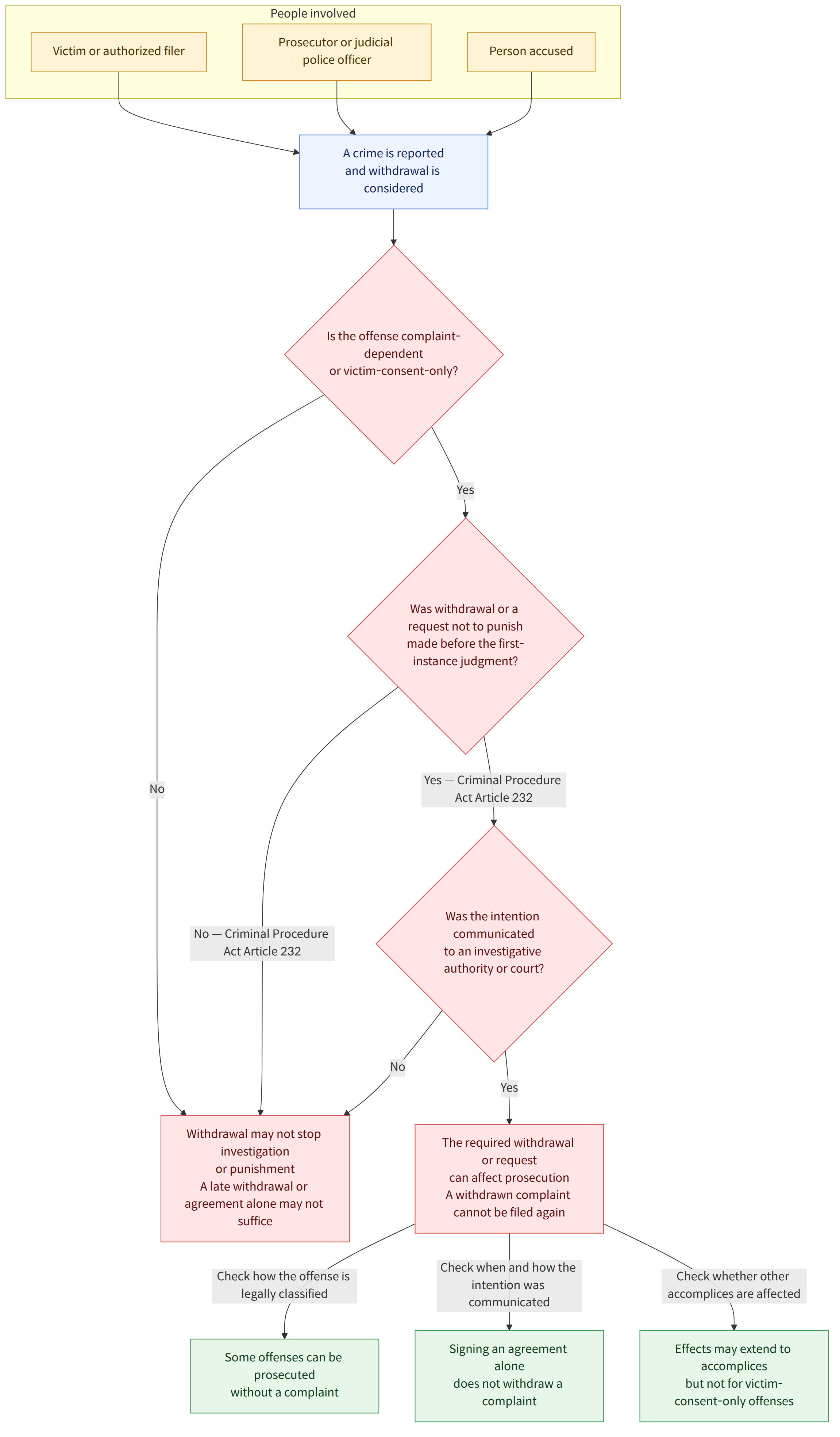
- A complaint concerning an offense subject to complaint must generally be withdrawn, and an intention not to seek punishment for an offense prosecutable only with the victim’s consent must generally be expressed, before the first-instance judgment is pronounced. A person who withdraws a complaint concerning an offense subject to complaint may not file another complaint (Criminal Procedure Act, Article 232 (형사소송법 제232조)).
- A complaint concerning an offense subject to complaint cannot be waived in advance, and merely signing an agreement is not treated as expressing an intention to withdraw a complaint to an investigative authority or court (Supreme Court Decision 67Do471, May 23, 1967; Supreme Court Decision 83Do516, September 27, 1983).
- For offenses that are neither subject to complaint nor prosecutable only with the victim’s consent, such as fraud, withdrawing a complaint may have no direct effect on the investigation or punishment. The case examples explain that rape and indecent assault by compulsion against a child or juvenile may also be prosecuted and punished even if no complaint is filed (explanation concerning the repeal of Criminal Act, Article 306 (형법 제306조); Act on the Protection of Children and Juveniles from Sexual Abuse, Article 7 (아동·청소년의 성보호에 관한 법률 제7조)).
- A complaint against, or its withdrawal with respect to, one accomplice in an offense subject to complaint may also affect the other accomplices. However, the principle that a complaint is indivisible does not apply to offenses prosecutable only with the victim’s consent (Criminal Procedure Act, Article 233 (형사소송법 제233조); Supreme Court Decision 93Do1689, April 26, 1994).
- A complainant may also request access to and copies of records in a non-prosecution case, including documents containing the complainant’s own statements and documents the complainant submitted. Access may be restricted for reasons such as protecting privacy or avoiding interference with an investigation (Prosecution Preservation of Records Rules, Articles 20-2 and 22 (검찰보존사무규칙 제20조의2, 제22조)).
- Rules govern the time for investigating and deciding complaint and accusation cases, but the case examples describe the three-month period for a prosecutor to investigate and decide as an advisory provision. A later decision is not invalid solely because the period has passed (Criminal Procedure Act, Article 257 (형사소송법 제257조)).
Frequently asked questions
Q. Can I file a complaint on behalf of a family member?
The victim, a legal representative, or another person entitled to file a complaint may do so. A person authorized by the victim may also file a complaint on the victim’s behalf. It must be confirmed that the authority was granted by a person legally entitled to complain, and the complaint period is calculated with reference to the person entitled to complain, such as the victim, not the representative.
Q. Does a complaint have to be made in writing?
No. A complaint may be made to a prosecutor or judicial police officer either in writing or orally. If it is made orally, the investigative authority must prepare a written record (Criminal Procedure Act, Article 237 (형사소송법 제237조)).
Q. If an agreement says, “I will make no civil or criminal claims,” can I no longer file a complaint?
The court decision discussed in the case examples holds that the right to complain about an offense subject to complaint cannot be waived in advance. Also, an agreement between the parties alone is not treated as an expression of an intention to withdraw a complaint to an investigative authority or court.
Q. Does withdrawing a complaint end the case at any time?
It depends on whether the offense is subject to complaint or is an offense for which prosecution may not proceed against the victim’s wishes. For such offenses, a complaint must generally be withdrawn, or an intention not to seek punishment expressed, before the first-instance judgment is pronounced. An agreement submitted after judgment has been pronounced is not a basis for dismissing the prosecution (Criminal Procedure Act, Articles 232 and 327 (형사소송법 제232조, 제327조)).
Q. Can I file another complaint after withdrawing one?
According to the case examples, a person who withdraws a complaint concerning an offense subject to complaint may not file another complaint (Criminal Procedure Act, Article 232(2) (형사소송법 제232조 제2항)). However, if the offense is not subject to complaint, withdrawing the complaint may not prevent an investigation or punishment.
Q. Can I avoid punishment by withdrawing a complaint about rape or indecent assault by compulsion against a child or juvenile?
The case examples explain that, following an amendment to the Criminal Act, the provision making rape an offense subject to complaint was repealed, so prosecution and punishment are possible even if no complaint is filed. They also explain that withdrawing a complaint alone does not prevent punishment for indecent assault by compulsion against a child or juvenile, although the withdrawal may be considered in sentencing.
Q. Can I access or copy investigation records from a case that was not prosecuted?
A complainant may request access to and copies of documents in the records of a non-prosecution case that contain the complainant’s own statements, as well as documents the complainant submitted. Access to other records is not categorically prohibited, but may be denied for reasons such as effects on privacy or an investigation.
Q. By when must a case I have reported be handled?
The case examples explain that a rule requires a prosecutor to complete the investigation and decide whether to prosecute within three months of receiving a complaint or accusation. However, because this is treated as an advisory provision, a decision made after that period is not invalid solely because the deadline passed.
Q. Can a prosecutor who is close to the suspect be removed from the case?
The case examples explain that the law does not provide for a prosecutor’s disqualification, challenge, or recusal at the investigation stage, and does not guarantee a victim the right to demand that the prosecutor be replaced. If an unfair decision is suspected, a complaint may be submitted; an appeal or application for a court ruling may also be considered in the case of a non-prosecution decision.
Relevant laws
- Criminal Procedure Act, Articles 17 to 25 (형사소송법 제17조부터 제25조)
- Criminal Procedure Act, Article 59-2 (형사소송법 제59조의2)
- Criminal Procedure Act, Article 223 (형사소송법 제223조)
- Criminal Procedure Act, Article 225 (형사소송법 제225조)
- Criminal Procedure Act, Article 230 (형사소송법 제230조)
- Criminal Procedure Act, Article 232 (형사소송법 제232조)
- Criminal Procedure Act, Article 233 (형사소송법 제233조)
- Criminal Procedure Act, Article 236 (형사소송법 제236조)
- Criminal Procedure Act, Article 237 (형사소송법 제237조)
- Criminal Procedure Act, Article 238 (형사소송법 제238조)
- Criminal Procedure Act, Article 239 (형사소송법 제239조)
- Criminal Procedure Act, Article 246 (형사소송법 제246조)
- Criminal Procedure Act, Article 257 (형사소송법 제257조)
- Criminal Procedure Act, Article 260 (형사소송법 제260조)
- Criminal Procedure Act, Article 327 (형사소송법 제327조)
Watch out for
- Because the effect of withdrawing a complaint depends on the type of offense, before reaching an agreement or withdrawing a complaint, check whether the offense is subject to complaint or is one for which prosecution may not proceed against the victim’s wishes.
- For an offense subject to complaint, the complaint period may be calculated from the date the person entitled to complain learned the offender’s identity, not the date the representative learned it.
- Withdrawing a complaint or expressing an intention not to seek punishment may not serve as a basis for dismissing the prosecution if done after the first-instance judgment has been pronounced.
- The explanations of laws and procedures in the case examples are based on the assumptions and timing of those examples. For an actual case, check the laws in effect at the relevant time and the specific facts.
Source cases
This guide was compiled by AI from the following Korea Legal Aid Corporation consultation cases (in Korean).
- 친고죄에 대한 합의서 교부 후 고소한 경우 그 효력
- 불기소처분된 사건 고소인의 열람·등사청구권
- 피해자인 미성년자의 고소취소 후 부모가 고소 가능한지
- 제1심 판결 선고 후 부도수표를 회수한 경우 그 효력
- 부도수표 소지인의 은행에 대한 처벌불원 의사표시의 효력
- 최종소지인의 부도수표 분실 시 형사관련 처벌불원 의사표시의 주체
- 피의자와 친분관계인 수사검사를 배제시킬 수 있는지
- 항소심에서 비로소 친고죄로 변경된 경우 고소취소가 가능한지
- 친고죄에서 고소불가분의 원칙이 반의사불벌죄에도 준용되는지
- 형사고소한 사건의 처리기간은 얼마나 되는지
- 공범에 대한 제1심 판결 선고 후의 고소취소가 가능한지
- 형사고소도 대리하여 할 수 있는지
- 강간사건에서 강간고소를 취하하고 폭행사실만 처벌할 수 있는지
- 범인이 누구인지 발각된 후 행한 자수의 효력 유무
- 인터넷 상의 댓글이 모욕죄가 될 수 있는지 여부
- 고발의 효력이 미치는 범위
- 아동·청소년의 성보호에 관한 법률상의 강제추행이 친고죄인지
- 친고죄나 반의사불벌죄가 아닌 범죄에 대한 고소취소의 효력
- 자수를 후에 번복한 경우 자수의 효력이 유지되는지
- 친족상도례와 친고죄에 대해서
- 구술의 고소가 가능한지
- 친고죄에서 고소를 취소하거나 반의사불벌죄에서 처벌을 희망하는 의사표시를 철회할 수 있는 시기 및 그 상대방
- 성폭력범죄인 강간죄의 경우 고소할 수 있는 기간
- 대리인에 의한 고소의 경우 고소기간의 기산점
- 수사기관의 조사 끝에 자백한 경우 자수의 효력 있는 지 여부
This guide is general legal information about Korean law, not legal advice for your situation. For a specific case, consult a lawyer or the Korea Legal Aid Corporation (call 132 in Korea).