
When Are Crimes Relating to Documents Established Under the Criminal Act?
Based on 71 consultation cases · Updated · Translated from the Korean original.
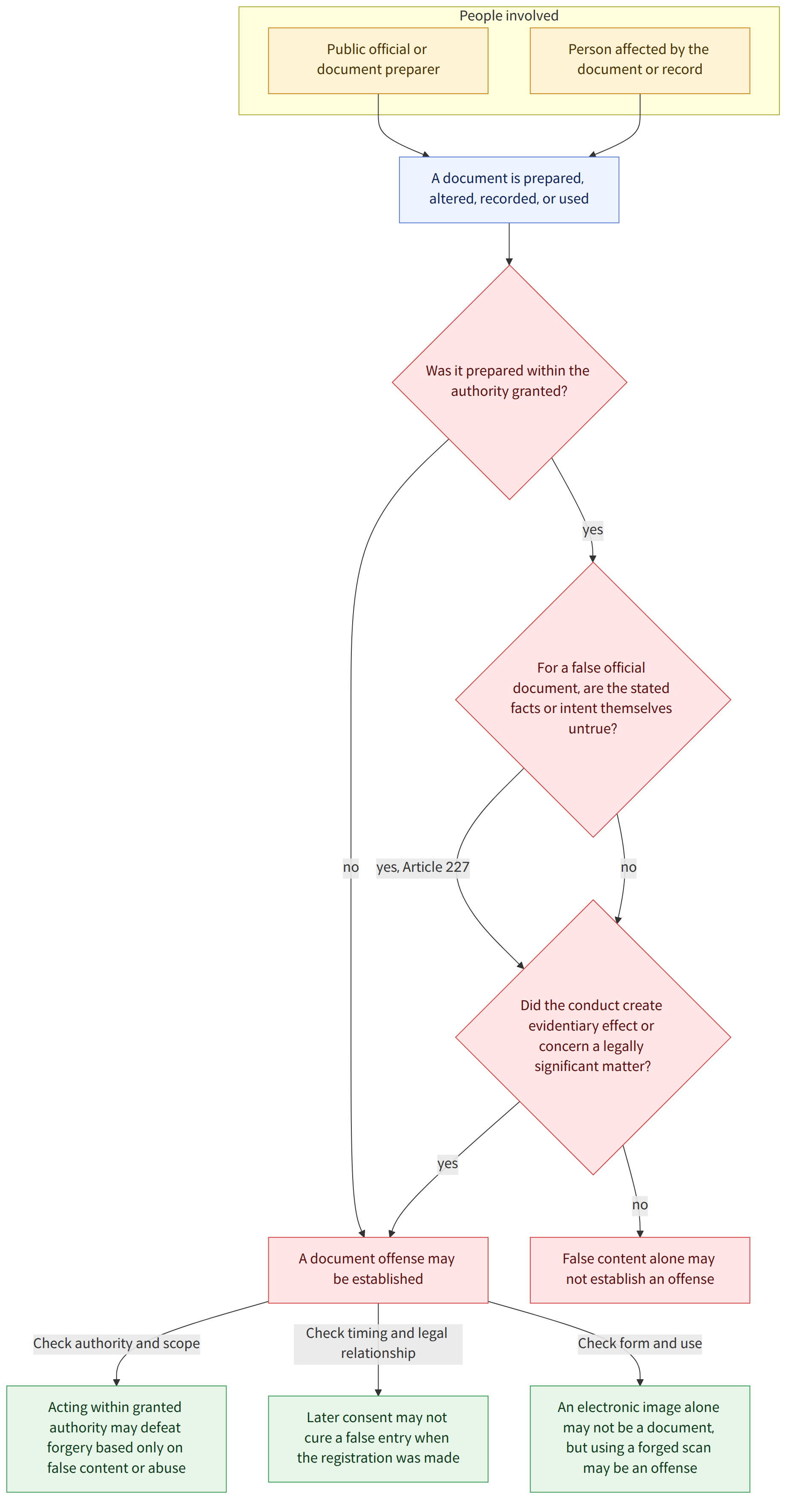
Whether a crime relating to documents has been committed is not determined solely by whether the content is untrue. It is necessary to consider together the authority to prepare the document and its form, the evidentiary effect created by the alteration, the legal significance of the recorded matter, and the circumstances at the time of the conduct.
At a glance
Key points
- The crime of preparing a false official document requires the contents of the official document to be untrue. Accordingly, even if a law or regulation was incorrectly applied, the crime may not be established if the facts or expression of intent stated in the document are not themselves false (Criminal Act, Article 227 (형법 제227조); Case 1).
- If a person with authority to prepare a document prepares it, the crime of document forgery is not established merely because its contents are false or the authority was abused (Cases 3 and 25).
- Preparing a document beyond the scope of the authority granted may constitute the crime of forging a private document. However, if the person is authorized to prepare it as an agent and acts within that authority to pursue an interest, the crime of preparing a private document under an assumed capacity may not be established (Criminal Act, Articles 231 and 232 (형법 제231조·제232조); Cases 3 and 22).
- If part of a document is altered so as to create new evidentiary effect, the crime of altering a document may be established even if the altered content accords with objective facts (Criminal Act, Articles 225 and 231 (형법 제225조·제231조); Cases 4, 19, and 21).
- If a registration did not reflect the substantive legal relationship when made, subsequent consent or ratification that corrects the relationship may not affect a crime of making a false entry in the original of an authentic deed that has already been established (Criminal Act, Article 228(1) (형법 제228조 제1항); Cases 2 and 10).
- Whether an entry in a public electronic record or the original of an authentic deed is “false” depends on the nature of the matter represented by the record. In some cases, the matters considered—such as a falsely reported transaction price or a photograph in a driver’s license register—were found not to fall within the scope of the relevant crime (Cases 8 and 23).
- The fact that a document file is stored electronically does not, by itself, make it a document under the Criminal Act. An image file displayed on a monitor may not be recognized as a document, but scanning and transmitting a forged document may constitute the crime of using a forged document (Criminal Act, Article 234 (형법 제234조); Cases 16 and 20).
- Even if a document has not been completed, the crime of forging another person’s signature may be established if the other person’s signature is written in a way that could be mistaken for a genuine signature (Criminal Act, Article 239(1) (형법 제239조 제1항); Case 17).
Frequently asked questions
Q. If a public official issues a permit by incorrectly applying the law, does that constitute the crime of preparing a false official document?
The crime of preparing a false official document is not automatically established merely because a law or regulation was incorrectly applied. It is necessary to distinguish whether the intent to grant permission expressed in the permit itself was untrue, or whether the requirements for permission were simply assessed incorrectly (Case 1).
Q. If a transaction price different from the actual price is reported and entered in the real estate register, does that constitute the crime of making a false entry in public electronic records?
In the case, the court found that the crime of making a false entry in public electronic records was not established because the transaction price entered in the register could not be regarded as an important matter concerning rights and obligations in relation to the real estate. The case explains, however, that administrative fines relating to the transaction report may be imposed (Case 8).
Q. If a registration was initially made without consent, can the offender avoid punishment if the owner later consents?
If a registration did not reflect the substantive legal relationship at the time it was made, the crime already established may remain unaffected even if consent or ratification is later given and the registration comes to reflect the actual legal relationship. As a rule, the relevant point in time is when the registration was made (Cases 2 and 10).
Q. Does falsely registering a marriage or staging a divorce to evade creditors constitute the same crime?
If a marriage is registered solely for another purpose, such as entering the country, without an intention to establish a genuine marital relationship, the marriage is void and the crime of making a false entry in the original of an authentic deed may be established. By contrast, the case explains that a sham divorce may not amount to making a false entry if there was an intention to divorce legally, even temporarily (Cases 7 and 9).
Q. If an image file of an official document is scanned and sent by email, does that constitute forgery or use of a forged official document?
One case found that merely creating an image file with different content from a genuine document does not constitute document forgery under the Criminal Act. However, if a paper document is first forged and then scanned and sent, forgery and use of a forged document may be established (Cases 16 and 20).
Q. Does presenting another person’s driver’s license to verify one’s identity constitute the crime of unlawful use of an official document?
In the case, the court found that a driver’s license serves not only as proof of qualification to drive but also to verify the holder’s identity. Accordingly, presenting another person’s driver’s license when asked to verify one’s identity may constitute the crime of unlawful use of an official document (Criminal Act, Article 230 (형법 제230조); Case 11).
Q. Can signing another person’s name before a document is completed constitute the crime of forging another person’s signature?
Even if a document has not been completed, the crime of forging another person’s signature may be established if the signature as written is sufficient to lead an ordinary person to believe it is the genuine signature of the person named. The form and appearance of the signature, the circumstances in which it was made, and the function of the document must all be considered (Criminal Act, Article 239(1) (형법 제239조 제1항); Case 17).
Q. What happens if I am authorized to complete a blank document as an agent but write in a higher amount?
If a person writes content contrary to the named person’s wishes by exceeding the amount authorized, the crime of forging a private document may be established. Conversely, if the person is authorized to prepare the document as an agent and writes an amount lower than the specified amount within the scope of that authority, the crime of preparing a private document under an assumed capacity may not be established, depending on the circumstances (Cases 3 and 22).
Relevant laws
- Criminal Act, Article 30 (형법 제30조)
- Criminal Act, Article 33 (형법 제33조)
- Criminal Act, Article 34(1) (형법 제34조 제1항)
- Criminal Act, Article 137 (형법 제137조)
- Criminal Act, Article 225 (형법 제225조)
- Criminal Act, Article 227 (형법 제227조)
- Criminal Act, Article 228(1) (형법 제228조 제1항)
- Criminal Act, Article 228(2) (형법 제228조 제2항)
- Criminal Act, Article 229 (형법 제229조)
- Criminal Act, Article 230 (형법 제230조)
- Criminal Act, Article 231 (형법 제231조)
- Criminal Act, Article 232 (형법 제232조)
- Criminal Act, Article 234 (형법 제234조)
- Criminal Act, Article 237-2 (형법 제237조의2)
- Criminal Act, Article 239(1) (형법 제239조 제1항)
Watch out for
- Do not conclude that forgery or the crime of preparing a false document has been established merely because the document’s content is untrue. Also check who had authority to prepare it and what evidentiary function the document serves.
- Even if a registration or document is later ratified, that may not extinguish a crime already established at the time of the conduct.
- When a file is transmitted, the assessment of document forgery and use of a forged document may differ depending on whether a new image file was created or the forged document itself was scanned and sent.
Related articles
Source cases
This guide was compiled by AI from the following Korea Legal Aid Corporation consultation cases (in Korean).
- 공무원이 건축법에 위반됨을 알면서도 건축허가서를 작성한 경우에 허위공문서작성죄 등의 성립 여부
- 공정증서원본불실기재죄 성립 후 실체적 권리관계 부합시 처벌여부
- 대리인이 매매계약서에 실제보다 낮은 금액 기재한 경우 자격모용사문서작성죄 해당 여부
- 권한없는 자가 임의로 인감증명서의 사용용도란의 기재를 고쳐 쓴 경우
- 작성권한자를 기망하는 경우 문서위조죄의 간접정범 성립여부
- 타인 주민등록증의 사진제거 후 자기사진을 붙여 사용한 경우
- 가장이혼신고가 공전자기록등불실기재죄에 해당되는지
- 부동산 거래가액을 허위로 신고한 경우, 공전자기록불실기재죄의 성립 여부
- 허위로 혼인신고를 한 경우에 공정증서원본불실기재죄의 성립 여부
- 추인으로 인해 실제와 일치된 경우 공정증서원본불실기재죄 성부
- 타인의 운전면허증을 자신의 것처럼 제시한 경우 처벌 여부
- 법무사를 기망하여 등기이전 시 공정증서원본불실기재죄 성부
- 사자(死者)명의의 문서를 작성한 경우 사문서위조죄가 되는지
- 규제 회피를 위하여 등기원인을 ‘증여’로 한 경우에 공정증서원본불실기재죄의 성립 여부
- 등록증불실기재죄의 대상에 사업자등록증이 포함되는지
- 형법상 문서의 의미와 이미지파일의 문서성
- 미완성 문서에도 사서명위조죄가 성립하는지 여부
- 무권대리인의 자격모용에 의한 사문서작성죄의 성립 여부
- 사서증서 인증서 중 사서증서 부분을 변조한 행위의 처벌 여부
- 컴퓨터 모니터 화면에 나타나는 이미지가 공문서위조죄에서의 문서에 해당하는지 여부
- 영수증에 관련 부동산을 특정을 위해 임의로 추가 기재한 경우 사문서변조죄 해당 여부
- 위임권한의 한계를 넘어서 문서를 작성한 경우 처벌 여부
- 운전면허증 교부신청서에 타인의 사진을 붙여 제출한 경우 공정증서원본불실기재죄의 성립여부
- 비공무원인 자의 허위공문서작성죄 공동정범 성립여부
- 주식회사 지배인의 권한을 남용한 허위 차용증 작성의 사문서 위조 해당 여부
This guide is general legal information about Korean law, not legal advice for your situation. For a specific case, consult a lawyer or the Korea Legal Aid Corporation (call 132 in Korea).