
Guide to the Admissibility of Evidence and Trial Procedure in Criminal Cases
Based on 127 consultation cases · Updated · Translated from the Korean original.
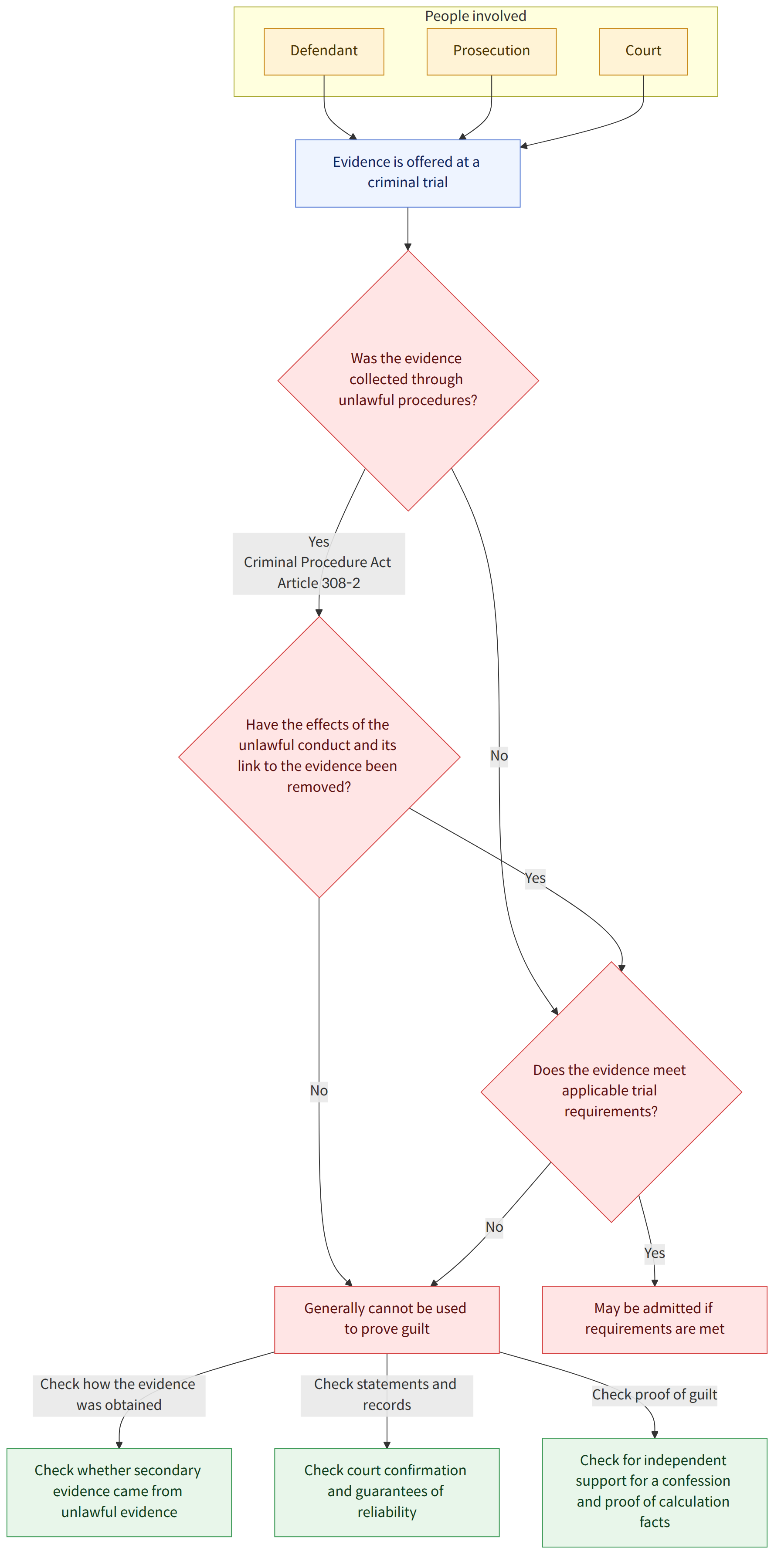
Whether evidence may be used in a criminal trial depends on how it was collected and prepared, and on whether there was an opportunity to challenge the statements and contents in court. As a general rule, unlawfully collected evidence cannot be used, while some evidence is admissible only if it is confirmed in court or meets strict requirements for an exception.
At a glance
Key points
- Evidence collected through unlawful procedures and secondary evidence obtained on the basis of that evidence generally cannot be used to prove guilt. However, the court may make an exceptional determination after considering all relevant circumstances, including whether the causal connection between the unlawful conduct and the collection of evidence has been severed (Criminal Procedure Act, Article 308-2 (형사소송법 제308조의2), Examples 5, 12, and 15).
- A breath test conducted while a person is under unlawful arrest cannot be used as evidence if the effects of the unlawful arrest have not been removed, even if the defendant later requested a blood draw or consented to the use of the evidence (Examples 12 and 15).
- Conversations recorded by a private individual are assessed differently depending on whether the person making the recording was a participant in the conversation or whether it was a conversation between other people. A secret recording of a private conversation between others must be distinguished from a recording made by a participant in the conversation (Protection of Communications Secrets Act, Articles 3, 4, and 14 (통신비밀보호법 제3조·제4조·제14조), Examples 7, 9, and 17).
- For a suspect interrogation statement prepared by a prosecutor, issues include whether the form and contents of the record accurately reflect the statement made in court and whether the statement was made under circumstances that provide particular guarantees of reliability. One example holds that a suspect interrogation statement prepared by the police may be used as evidence only if the defendant or defense counsel acknowledges its contents in court (Criminal Procedure Act, Article 312 (형사소송법 제312조), Examples 11 and 23).
- There is a precedent holding that a statement record is inadmissible if the defendant does not consent to its use as evidence when the prosecutor recalls a witness who has already testified at trial and obtains a statement retracting testimony favorable to the defendant.
- The fact that a witness is abroad does not, by itself, make a statement record admissible as an exception. It is necessary to establish, among other things, that sufficient steps were taken to secure the witness’s appearance in court and that the record was prepared under circumstances that provide particular guarantees of reliability (Criminal Procedure Act, Article 314 (형사소송법 제314조), Example 16).
- A defendant’s confession cannot be used to prove guilt if it is the only evidence. However, a document that continuously and mechanically records business transactions may serve as independent evidence rather than as a document confessing to the facts of a crime (Criminal Procedure Act, Article 310 (형사소송법 제310조), Example 25).
- To estimate the blood alcohol concentration at the time of drunk driving using the Widmark formula, the underlying facts—such as the amount consumed, the time of drinking, and the person’s weight—must be strictly proven, and the various individual factors affecting the calculation must also be considered (Example 1).
Frequently asked questions
Q. Can evidence collected unlawfully never be used in a trial?
As a general rule, evidence collected unlawfully and secondary evidence obtained on the basis of it cannot be used to prove guilt. However, the court may consider the nature and degree of the unlawful conduct, the causal connection with the collection of the evidence, and other relevant circumstances to determine whether the case is an exceptional one that does not undermine the substance of due process.
Q. If I requested a blood draw after being unlawfully arrested, can the results be used as evidence?
Even if you requested the blood draw yourself, it is difficult to find that the causal connection between the arrest and the collection of evidence was severed if there are no circumstances showing that the effects of the unlawful arrest had completely dissipated and that your freedom of decision-making was ensured. In that case, the blood test results cannot be used as evidence. There is a precedent holding that this does not change merely because you consented to the use of the evidence.
Q. If I take part in a conversation and secretly record a call with the other person, can I use it as evidence?
A distinction is made between a participant recording their own conversation and recording a private conversation between other people. Even if a participant’s recording is not, by itself, unlawfully obtained evidence, it must meet the requirements for admissibility, including that the recording accurately reflects what was actually said.
Q. If I deny in court what I said to the police, can the police statement be used as evidence?
Under Article 312(3) of the Criminal Procedure Act, as cited in the example, a suspect interrogation statement prepared by an investigative agency other than the prosecution may be used as evidence only if the defendant or defense counsel acknowledges its contents in court. The provision means that the statement is not admissible if its contents are not acknowledged.
Q. What happens if I signed a prosecutor’s record but dispute that it accurately reflects what I said?
The fact that you signed or affixed a seal to a record does not, by itself, establish that its contents match what you actually said. The example explains that if the defendant disputes the contents, whether the record is genuinely authentic in substance becomes an issue; it is also relevant whether a video recording or another objective method can prove that the record matches the statement.
Q. If a witness lives abroad, can their recorded statement be used in court instead of having them testify?
The fact that a witness lives abroad does not, by itself, make the statement record admissible as an exception. The court must consider whether all available means, such as confirming contact information and issuing a summons, were used to secure the witness’s appearance in court, and whether the record was prepared under circumstances that provide particular guarantees of reliability.
Q. Can I withdraw my consent if I change my mind during the trial after agreeing to the use of evidence?
According to the example, an expression of consent to the use of evidence may be revoked or withdrawn before the examination of the evidence is complete, but withdrawing consent after the examination is complete does not eliminate admissibility that has already been established. There is a precedent holding that consent cannot be withdrawn after the examination is complete even when consent was deemed to have been given because the defendant did not appear at trial.
Q. Can I be found guilty based only on a confession and a notebook I wrote?
A confession cannot be used to prove guilt if it is the only evidence. However, a document that records business expense details as they arise, irrespective of the facts of the crime, may be recognized as independent evidence rather than as a confession, according to a precedent.
Q. Can I be punished based only on a blood alcohol concentration calculated using the Widmark formula?
To estimate the blood alcohol concentration at the time of driving, the underlying facts for the calculation—such as the amount consumed, the time of drinking, and the person’s weight—must be strictly proven. Because individual factors affecting absorption and elimination in the body vary, whether the calculation alone is sufficient must be assessed in light of the specific circumstances.
Relevant laws
- Criminal Procedure Act, Article 308-2 (형사소송법 제308조의2)
- Criminal Procedure Act, Article 310 (형사소송법 제310조)
- Criminal Procedure Act, Article 312 (형사소송법 제312조)
- Criminal Procedure Act, Article 313 (형사소송법 제313조)
- Criminal Procedure Act, Article 314 (형사소송법 제314조)
- Criminal Procedure Act, Article 318 (형사소송법 제318조)
- Criminal Procedure Act, Article 215 (형사소송법 제215조)
- Criminal Procedure Act, Article 216(3) (형사소송법 제216조 제3항)
- Criminal Procedure Act, Article 146 (형사소송법 제146조)
- Criminal Procedure Act, Article 148 (형사소송법 제148조)
- Criminal Procedure Act, Article 149 (형사소송법 제149조)
- Criminal Procedure Act, Article 159 (형사소송법 제159조)
- Protection of Communications Secrets Act, Article 3 (통신비밀보호법 제3조)
- Protection of Communications Secrets Act, Article 4 (통신비밀보호법 제4조)
- Protection of Communications Secrets Act, Article 14 (통신비밀보호법 제14조)
Watch out for
- Whether evidence may be admitted and whether that evidence alone is sufficient to establish guilt are separate issues. The credibility and probative value of evidence are assessed separately.
- Consent to the use of evidence must be revoked or withdrawn before the examination of the evidence is complete. Reversing that decision after the examination is complete may not eliminate admissibility that has already been established.
- The underlying facts required to calculate the Widmark formula, such as the amount consumed, the time of drinking, and the person’s weight, must be strictly proven.
- A recording of a private conversation between other people may be treated differently from a recording made by a participant in the conversation, so the circumstances of the recording and the participants in the conversation must be distinguished.
Source cases
This guide was compiled by AI from the following Korea Legal Aid Corporation consultation cases (in Korean).
- 위드마크공식에 의한 운전시점의 혈중알코올농도 추정치의 증거능력
- 법정증언을 번복하는 내용으로 검사가 작성한 진술조서의 효력
- 국민참여재판이란 무엇인지
- 수소법원 이외의 판사에게 발부받은 영장의 적법
- 의식불명자에 대한 채혈과 영장주의
- 형사재판은 어떻게 진행되는지
- 개인이 타인간의 대화를 몰래 녹음한 테이프의 증거능력
- 즉심 받은 후 피해자가 사망한 경우 다시 처벌받게 되는지
- 고소인이 자기와 피고인과의 통화를 녹음한 테이프의 증거능력
- 경찰 대질신문 중 피고인의 자백을 들었다는 피해자 진술의 증거능력
- 경찰관이 작성한 조서와 검사가 작성한 조서의 효력이 다른지
- 위법한 강제연행 상태에서 피의자의 요구에 의하여 이루어진 혈액채취 방법에 의한 음주측정 결과의 증거능력
- 피고인이 자신에 대한 검사 작성의 피의자신문조서의 성립의 진정과 임의성을 인정하였다가 이를 번복한 경우, 그 피의자신문조서의 ...
- 범죄피의자가 타인의 성명을 모용(冒用)한 경우 그 효력
- 위법하게 체포된 상태에서 이루어진 음주측정요구에 의해 수집되었고, 피고인이 증거로 함에 동의한 증거의 증거능력
- 예외적인 증거능력 인정과 외국거주의 의미
- 자기와 제3자간 대화를 몰래 녹음한 테이프의 증거능력
- 공판기일에 원진술자가 증언거부권을 행사한 경우 증거능력에 대한 예외에 해당하여 원진술자에 대한 진술조서의 증거능력을 인정할 수...
- 유아도 증언능력이 인정될 수 있는지
- 피고인이 공시송달의 방법에 의한 공판기일 소환을 2회 이상 받고도 출석하지 않아 법원이 피고인의 출정 없이 증거조사를 하는 경...
- 심신상실로 무죄가 확정된 경우 치료감호청구 가능 여부
- 사인이 위법하게 수집한 증거의 증거능력
- 피고인이 검사 작성 피의자신문조서의 내용을 다투는 경우
- 거짓말탐지기 검사가 증거능력을 갖기 위한 요건 및 증거력
- 피고인이 범죄사실 등을 기재한 수첩이 보강증거가 될 수 있는지
This guide is general legal information about Korean law, not legal advice for your situation. For a specific case, consult a lawyer or the Korea Legal Aid Corporation (call 132 in Korea).