
Execution of Criminal Judgments: Guide to Fines, Sentence Terms, and Confiscation
Based on 39 consultation cases · Updated · Translated from the Korean original.
This guide summarizes the standards for dealing with key issues that arise after a judgment becomes final, such as paying fines in installments or substituting community service, suspension of sentence execution, and calculating sentence terms. Applications and objections are subject to deadlines and eligibility requirements, and separate remedies may be needed in some circumstances, such as the confiscation of property owned by a third party.
At a glance
Key points
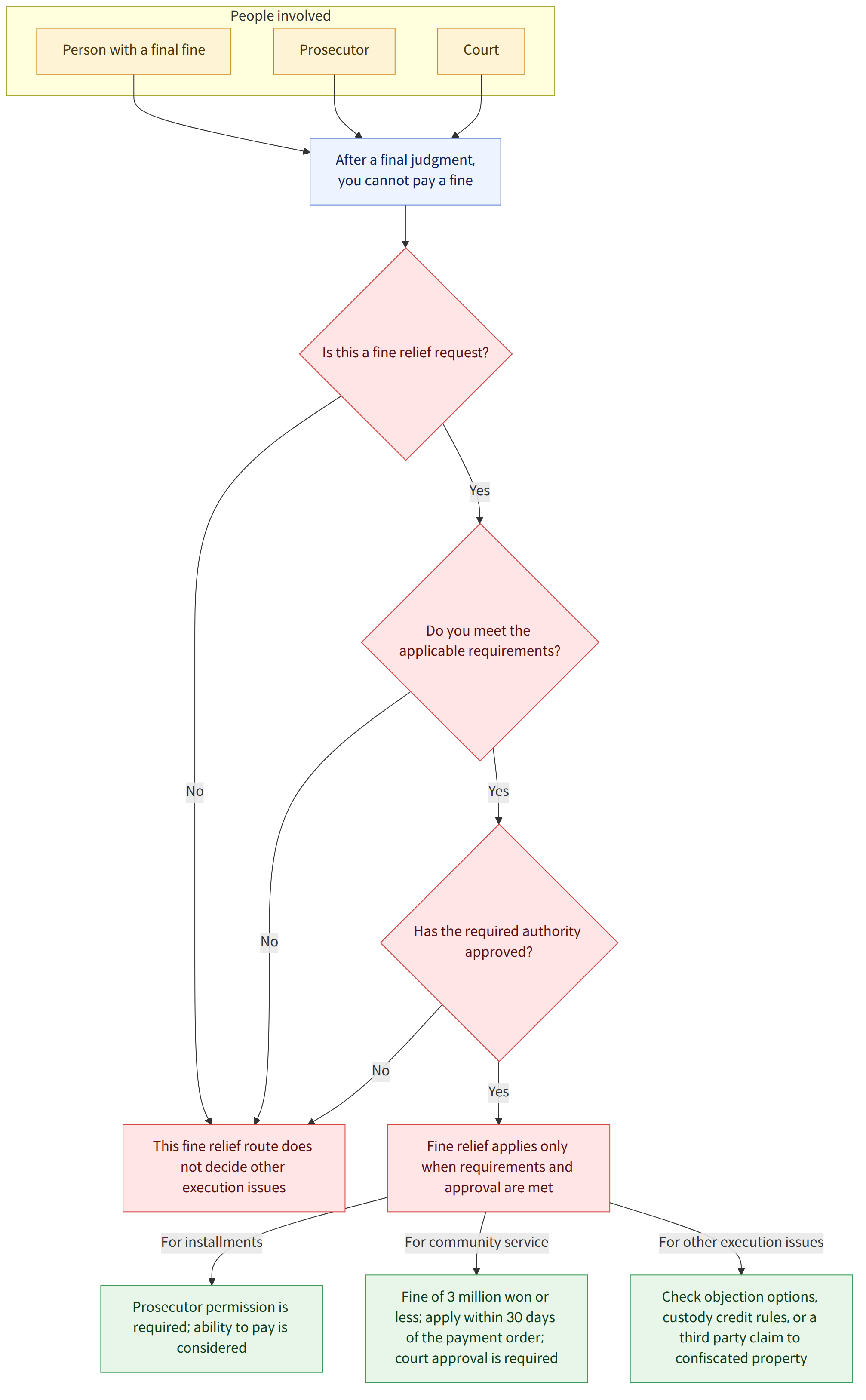
- A person who meets the prescribed requirements must obtain the prosecutor's permission to pay a fine in installments; permission is not granted merely by applying (Case 7).
- For fines within a specified range, a person who meets the requirements may apply to the prosecutors' office for community service, which may be substituted for payment of the fine only with the court's approval (Case 13).
- A prosecutor may suspend execution of a sentence if execution is expected to pose a serious risk to the person's health or life, among other circumstances, but family members do not have a formal right to apply (Criminal Procedure Act, Articles 470 and 471 (형사소송법 제470조·제471조); Case 11).
- A prosecutorial disposition concerning execution of a court judgment, including an order setting the sentence expiration date, may be challenged by filing an objection with the court that pronounced the judgment (Criminal Procedure Act, Article 489 (형사소송법 제489조); Case 6).
- All time spent in custody from the filing of an appeal until its withdrawal is credited toward the principal sentence (analogous application of Article 482(2) of the Criminal Procedure Act (형사소송법 제482조 제2항); Case 17).
- A period during which execution of another sentence overlaps with execution of an arrest warrant is time spent in custody pursuant to execution of the sentence and is therefore not credited toward the principal sentence (Case 8).
- As a general rule, a confiscation judgment concerning property owned by a third party does not have effect against an owner who is not the defendant in the criminal case. The owner may claim delivery within the prescribed period after execution of the confiscation (Criminal Procedure Act, Article 484(1) (형사소송법 제484조 제1항); Case 21).
- A statement waiving ownership or the right to claim return after seizure does not, by itself, extinguish the investigative agency's duty to return the property (Case 1).
Frequently asked questions
Q. If I am in financial difficulty, can I pay my fine in installments?
If you meet the requirements prescribed by the rules, such as being a recipient of National Basic Livelihood Security benefits, you may apply to pay the fine in installments. However, the prosecutor must grant permission after considering your financial capacity and ability to pay, among other factors; applying does not guarantee permission to pay in installments.
Q. If I cannot afford to pay the fine, can I substitute community service for it?
According to the standard described in the case, a person whose sentence of a fine of 3 million won or less has become final may apply to the prosecutor at the competent district prosecutors' office for community service within 30 days of the prosecutor's order to pay the fine. The person may substitute community service for payment of the fine only if they meet the application requirements and obtain the court's approval.
Q. If a sentenced person is ill, can their family apply to suspend execution of the sentence?
Suspension of execution of a sentence is a procedure under which the prosecutor decides whether to suspend execution in circumstances such as a serious risk to the person's health or life. According to the case, family members and relatives do not have a formal right to apply, but they may inform the prison warden of the circumstances and submit a petition asking the warden to make a recommendation to the prosecutor.
Q. How can I challenge what seems to be an incorrect sentence expiration date?
An order setting the sentence expiration date may constitute a prosecutorial disposition concerning execution of a court judgment. Under Article 489 of the Criminal Procedure Act (형사소송법 제489조), an objection may be filed with the court that pronounced the judgment. The case explains that setting the sentence expiration date is subject to an objection.
Q. Does the time I spent in custody after appealing and before withdrawing the appeal count toward my sentence?
According to the case, all days spent in custody from the filing of an appeal until its withdrawal are credited toward the principal sentence. A prosecutor's directive for execution of the sentence that does not credit that period may be challenged by filing an objection.
Q. Does time spent under arrest while serving a sentence in another case count toward a new sentence?
While execution of a sentence and execution of an arrest warrant overlap, the person is already in custody as a result of the sentence, regardless of whether they are also under arrest. According to the standard described in the case, that period is therefore not credited toward the principal sentence in the other case.
Q. My property was confiscated in someone else's criminal case. Can I get it back?
The case explains that, as a general rule, the effect of a confiscation judgment extends to the defendant in the criminal case, but not to an owner who is not the defendant. Within three months after execution of the confiscation, a person with a legitimate right may claim delivery of the property from the prosecutor and must submit evidence confirming ownership.
Q. If I signed a waiver of ownership when my property was seized, can I no longer get it back?
A statement waiving ownership or the right to claim return under the Criminal Procedure Act does not, by itself, extinguish the investigative agency's duty to return the property or the right to claim its return. The case explains that property no longer needed to remain in custody must be returned, except in circumstances covered by statutory exceptions.
Relevant laws
- Criminal Procedure Act, Article 85(1) and (3) (형사소송법 제85조 제1항·제3항)
- Criminal Procedure Act, Article 133(1) (형사소송법 제133조 제1항)
- Criminal Procedure Act, Articles 417 and 418 (형사소송법 제417조·제418조)
- Criminal Procedure Act, Article 460 (형사소송법 제460조)
- Criminal Procedure Act, Articles 470 and 471 (형사소송법 제470조·제471조)
- Criminal Procedure Act, Articles 473 and 475 (형사소송법 제473조·제475조)
- Criminal Procedure Act, Article 482 (형사소송법 제482조)
- Criminal Procedure Act, Article 484(1) (형사소송법 제484조 제1항)
- Criminal Procedure Act, Articles 488 and 489 (형사소송법 제488조·제489조)
- Criminal Procedure Act, Article 492 (형사소송법 제492조)
- Criminal Act, Article 57 (형법 제57조)
- Criminal Act, Article 69(2) (형법 제69조 제2항)
- Criminal Act, Articles 70 and 71 (형법 제70조·제71조)
- Criminal Act, Article 72(1) (형법 제72조 제1항)
- Criminal Act, Article 80 (형법 제80조)
Watch out for
- Even if you meet the requirements and apply to pay a fine in installments, the prosecutor's permission is required.
- The case states that an application for community service must be made within 30 days of the prosecutor's order to pay the fine, so you should confirm the date from which the period runs.
- A claim for delivery of confiscated property owned by a third party must be made within three months after execution of the confiscation. Delivery may be difficult if the property has been destroyed or is due to be disposed of.
- Dissatisfaction with the reasoning of a judgment must be distinguished from questions about how to interpret its operative part. An application for interpretation under Article 488 of the Criminal Procedure Act (형사소송법 제488조) is not a procedure for challenging contradictions or unfairness in the reasoning of a judgment.
Source cases
This guide was compiled by AI from the following Korea Legal Aid Corporation consultation cases (in Korean).
- 소유권 포기한 압수물에 몰수형이 선고되지 않은 경우 반환청구권
- 형사피고인이 출석하지 않아도 형(刑)이 선고될 수 있는지
- 피고인 이외 제3자 소유 물건에 대한 몰수선고판결의 효력
- 확정판결을 받은 후 과거의 범죄사실이 발각된 경우
- 노역장유치 집행을 위하여 구인하는 경우, 형집행장을 제시하여야 하는지 여부
- 검사의 형기종료일 지정처분이 이의신청의 대상이 되는지 여부
- 벌금도 분할납부가 가능한지 여부
- 형의 집행과 구속영장집행 경합 시 미결구금일수의 본형산입 여부
- 주식회사에 귀속된 불법 수수료에 해당하는 금품을 주식회사의 대표이사로부터 몰수·추징할 수 있는지
- 추징금 미납 사실만으로 출국금지처분을 하는 것이 적법한지 여부
- 복역 중 지병 악화를 이유로 한 형(刑)의 집행정지 가능한지
- 판결이 확정된 후 판결이유 부분의 부당함을 의의신청으로 다툴 수 있는지
- 벌금을 사회봉사로 대체할 수 있는지
- 사건과 무관한 물건을 압수당한 경우 압수물 환부 및 압수의 취소
- 수형자 아닌 제3자가 벌금 일부를 납부한 경우 형의 시효가 중단되는지 여부
- 2개의 징역형 선고 시 형(刑)의 집행순서 및 가석방의 적용 여부
- 상소제기 후 상소취하한 때까지의 구금일수의 본형 산입여부
- 무죄판결에 명시하여야 할 이유
- 선박의 실질적 소유자가 밀수한 경우 선박의 몰수 여부
- 형의 집행기간의 의미
- 선박임차인의 밀수로 선박몰수판결 시 선박소유자의 보호
- 벌금미납자에 대한 노역장유치 집행을 위하여 검사의 지휘를 받아 형집행장을 집행하는 경우, 벌금미납자 검거가 사법경찰관리의 직무...
- 피고인이 심신미약임을 진술한 경우, 유죄판결에 명시될 이유
- 피고사건에 토지관할이 존재하지 않는 경우
- 뇌물에 공할 금품이 특정되지 아니한 경우 가액을 추징할 수 있는지 여부
This guide is general legal information about Korean law, not legal advice for your situation. For a specific case, consult a lawyer or the Korea Legal Aid Corporation (call 132 in Korea).