
Guide to the Elements and Penalties for Offenses Involving Stolen Property
Based on 11 consultation cases · Updated · Translated from the Korean original.
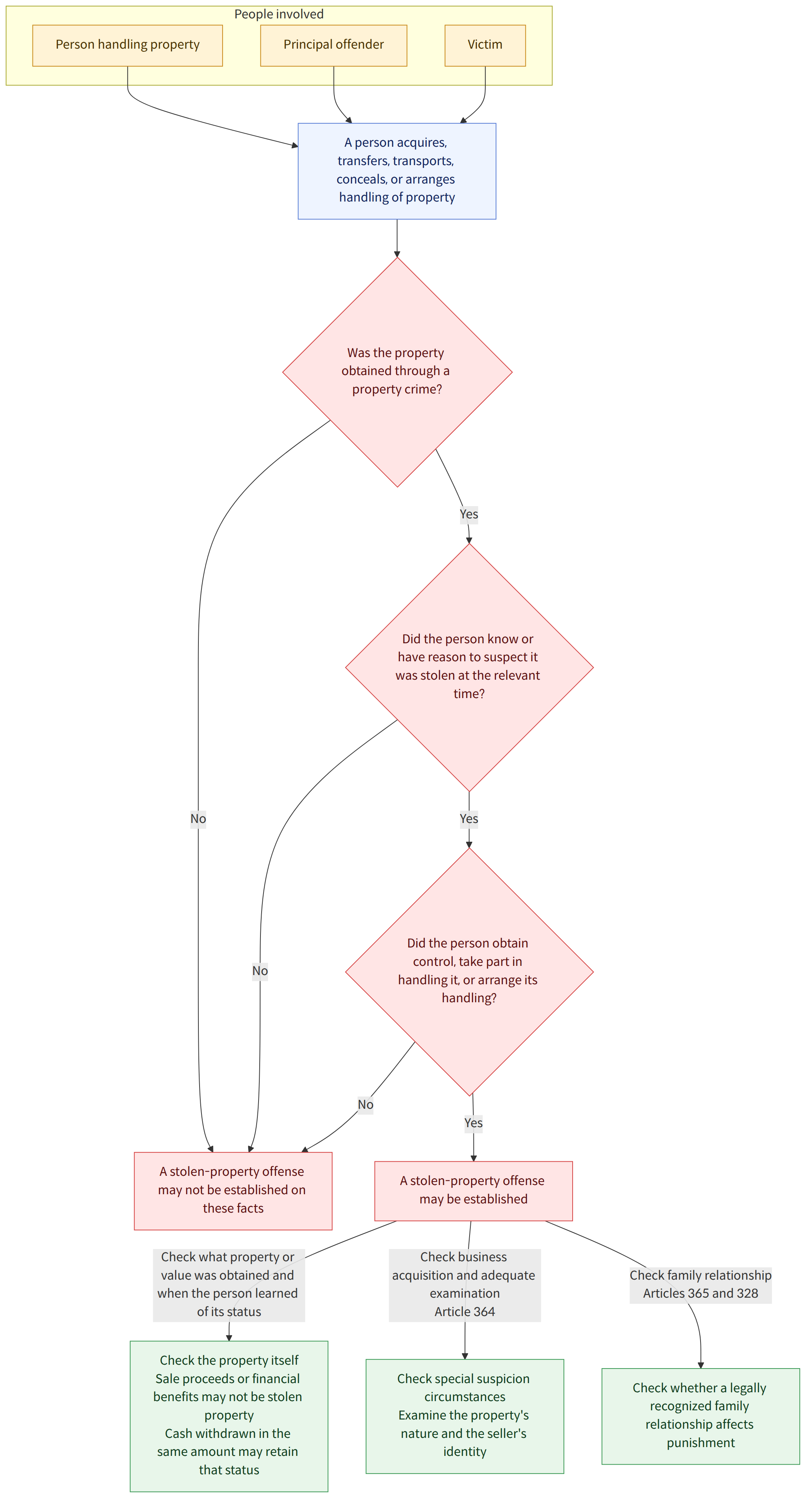
Offenses involving stolen property may arise when a person acquires, transfers, transports, or conceals property obtained through a property crime, or arranges for any of these acts. Whether and when the person knew the property was stolen, whether they actually obtained possession or the right to dispose of it, and whether they are related to the principal offender or the victim may affect whether an offense is established and the applicable punishment.
At a glance
Key points
- In principle, the subject of an offense involving stolen property is the property itself obtained through a property crime such as theft, fraud, or embezzlement. Money obtained by selling stolen property, or a financial benefit obtained through a crime, may not be considered stolen property.
- Acquiring stolen property means taking possession of it and obtaining the practical right to dispose of it. Merely riding as a passenger in a stolen vehicle driven by someone else is not considered participation in the act of transporting it.
- Knowledge that property is stolen need not be certain; awareness of the possibility that it is stolen may be sufficient. However, if a person did not know the property was stolen when acquiring it, the offense of receiving stolen property is not established merely because the person learned this afterward.
- The offense of receiving stolen property in the course of business may be established when there are special circumstances giving reason to suspect the property is stolen, but the person acquires it without adequately examining its nature or the seller’s identity (Criminal Act, Article 364 (형법 제364조)).
- When cash that is stolen property is deposited with a financial institution and then withdrawn as cash in the same amount, its status as stolen property may be recognized because its monetary value has been preserved. By contrast, if what was obtained through the crime was a deposit claim or other financial benefit, it cannot necessarily be concluded that cash withdrawn afterward is stolen property.
- A person who aided a theft or similar crime may separately be guilty of concealing stolen property if they later keep it. Unlike the principal offender, an accessory may not be treated as having committed an unpunishable subsequent act involving property obtained through their own crime.
- A special rule on punishment may apply if the person is related by a legally recognized family relationship to the principal offender or the victim. However, the cases explain that a court must determine whether the rule applies when a co-offender who is related to the principal offender was not involved in the offense involving stolen property (Criminal Act, Article 365 (형법 제365조); Criminal Act, Article 328 (형법 제328조)).
Frequently asked questions
Q. Can I be guilty of transporting stolen property just by riding in someone else’s car, even if I know the property is stolen?
As in the case described, merely riding as a passenger in the back seat on the way home was not considered sufficient to constitute participation in the act of transporting stolen property. However, the same conclusion cannot necessarily be drawn where the person jointly planned or participated in carrying out the transportation.
Q. Can I be punished for receiving stolen property if I find out after buying an item that it was stolen?
If you did not know the item was stolen when you acquired it, you do not commit the offense of receiving stolen property merely because you learned of this afterward. However, the offense may be established if you knew it was stolen when you actually took delivery, even if you did not know this when entering into the sale contract. Whether you suspected that the item might be stolen is also relevant.
Q. Can I be guilty of receiving stolen property even if I only suspected that it might be stolen?
It may be sufficient to have been aware of the possibility that the item was stolen, even without certain knowledge that it was. The determination takes into account various circumstances together, including the nature of the item, the price paid, and the identity of the person possessing it.
Q. Is it a crime to receive a share of money obtained from selling stolen property?
The case explains that the money obtained by selling a gold ring that was stolen property was not itself stolen property, so merely receiving that money was insufficient to constitute the offense of receiving stolen property. It notes, however, that civil liability to return the money may arise.
Q. Is cash still stolen property if it is deposited in a bank and then withdrawn?
When cash that is stolen property is deposited and then withdrawn as cash in the same amount, its status as stolen property may be recognized because its monetary value has been preserved, even though the physical banknotes are not the same. Accordingly, the person who kept the money for someone else may be guilty of concealing stolen property.
Q. Can I be guilty of receiving stolen property if I withdraw money from my account after fraud proceeds have been deposited into it?
The case explains that after the victim’s money was deposited into the account, the account holder’s withdrawal of it was merely an exercise of the right to claim repayment of the deposit, and did not involve receiving possession of the money from the principal offender or obtaining the right to dispose of it. Accordingly, the withdrawal alone was insufficient to constitute the offense of receiving stolen property.
Q. Can I be guilty of concealing stolen property even if I did not start keeping it knowing that it was stolen?
Even if you initially kept an item without knowing it was stolen, continuing to keep it after learning that it was stolen may constitute the offense of concealing stolen property. However, the case explains that the offense is not established where a person continues to possess an item under a right to do so until repair costs are paid.
Q. If I was punished for helping with a theft, can I be punished again for later keeping the stolen item?
The case finds that an accessory to theft may also separately be guilty of concealing stolen property for subsequently keeping the stolen item. It explains that the principle that a person cannot be punished for an unpunishable subsequent act involving property obtained through their own crime is limited to principal offenders and others in similar positions.
Q. Is land acquired through a double sale of real estate also considered stolen property?
The case explains that real estate involved in a double sale is not itself property obtained through a breach of trust, but property used in the commission of the crime; therefore, the person who acquired it cannot be charged with receiving stolen property. Whether the person was an accomplice to the breach of trust may be considered separately.
Relevant laws
- Criminal Act, Article 362 (형법 제362조)
- Criminal Act, Article 364 (형법 제364조)
- Criminal Act, Article 365 (형법 제365조)
- Criminal Act, Article 328(1) and (2) (형법 제328조 제1항·제2항)
- Civil Act, Article 320 (민법 제320조)
Watch out for
- Not only whether you knew that property was stolen but also when you knew it is important. You must distinguish between knowing it was stolen at the time of acquisition and continuing to conceal it after learning this later.
- In cases involving money, distinguish between depositing and withdrawing cash that is itself stolen property and withdrawing money that represents a deposit claim or other financial benefit obtained through a crime.
- Whether a sentence is reduced or waived because of a family relationship may depend on the type of relationship and the relationships among the person handling the stolen property, the principal offender, and the victim. The cases also explain that some issues require a court’s determination.
Source cases
This guide was compiled by AI from the following Korea Legal Aid Corporation consultation cases (in Korean).
- 타인이 절취, 운전하는 승용차의 뒷좌석에 편승한 경우 장물운반죄의 성립여부
- 장물범이 피해자 또는 본범과 친족관계에 있는 경우의 처벌
- 장물인 현금을 금융기관에 예치하였다가 현금으로 인출한 경우 인출한 현금의 장물성 유지 여부
- 물품 구입 후에서야 장물임을 알았을 경우 취득죄 성립 여부
- 방조범으로 가담한 자가 장물에 관한 죄를 범한 경우 불가벌적 사후행위에 해당하는지 여부
- 업무상과실장물취득죄의 성립요건
- 타인의 사기범행에 이용된 자기명의 예금계좌에서 피해자로부터 입금된 편취금을 인출한 경우 장물취득죄의 성립여부
- 이중매매 된 부동산의 취득자를 장물죄로 처벌할 수 있는지 여부
- 장물인 정을 모르고 보관했다가 후에 장물인 정을 알고도 계속 보관한 경우 장물보관죄의 성립여부
- 인터넷뱅킹으로 계좌이체 후 현금카드로 인출한 금원이 장물인지 여부
- 장물을 팔아서 얻은 돈임을 알면서 교부받은 경우 장물취득죄가 성립하는지 여부
This guide is general legal information about Korean law, not legal advice for your situation. For a specific case, consult a lawyer or the Korea Legal Aid Corporation (call 132 in Korea).