
When does negligence causing death or injury give rise to criminal liability?
Based on 10 consultation cases · Updated · Translated from the Korean original.
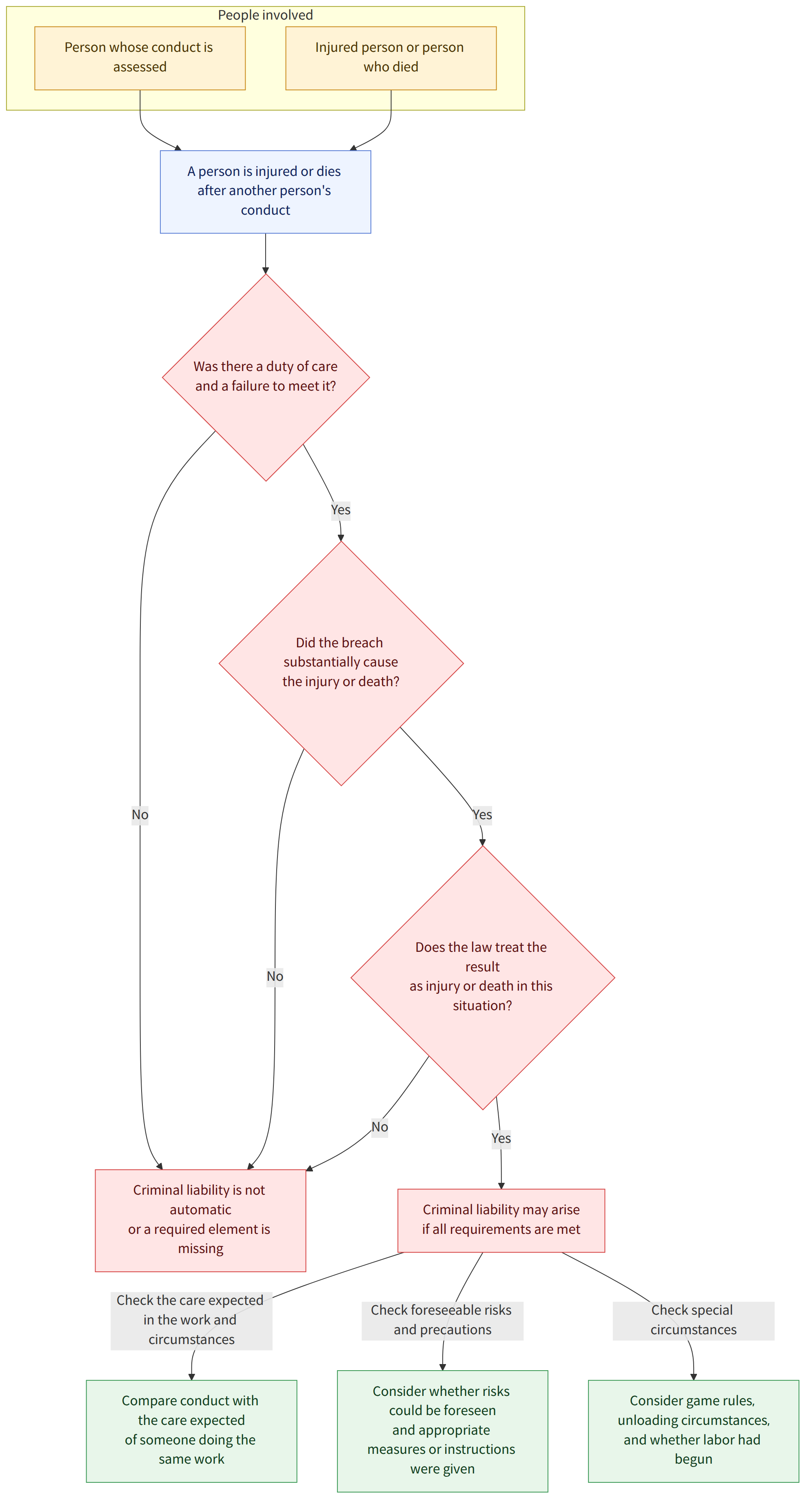
A person does not automatically incur criminal liability just because someone was injured or died as a result of negligence. The specific circumstances are examined to determine whether the person had a duty of care to foresee and prevent the outcome, and whether the breach of that duty caused the harm.
At a glance
Key points
- Negligence is assessed by examining whether the person failed to foresee an outcome that could have been foreseen, or failed to prevent an outcome that could have been prevented. Occupational negligence is measured against the degree of care expected of an ordinary person engaged in the same work, taking into account the medical standards, environment, and specific nature of the work at the time (Case 1, Supreme Court, April 14, 2011, Decision 2010Do10104).
- A breach of a duty of care alone is not enough; a substantial causal relationship between the breach and the injury or death must also be established. In the circumstances of the case, no causal relationship with the injury was found, even though no allergy reaction test had been conducted before the bee-venom acupuncture treatment or the explanation of side effects had been insufficient (Case 1).
- A person in charge at a worksite may have a duty to take necessary safety measures depending on their responsibilities and whether they knew of the risk of an accident. In one case, negligence was found on the part of the person in charge of overall safety and health at the site for failing to take measures to prevent a fall at a construction site where an opening cover had been removed (Case 3, Supreme Court, December 23, 2010, Decision 2010Do1448).
- If a person could have foreseen risks during the packaging, securing, or unloading of cargo but failed to take appropriate measures or provide instructions, they may also be found liable for occupational negligence causing death even if they merely arranged the transport (Case 2, Supreme Court, July 23, 2009, Decision 2009Do3219).
- Even if an object carried on a truck falls and injures someone, whether the accident occurred as a result of the vehicle’s operation is assessed separately. In one case involving an accident during unloading from a parked vehicle, the court found that it was not a traffic accident under the Act on Special Cases Concerning the Settlement of Traffic Accidents (교통사고처리 특례법) and held that the offense of occupational negligence causing bodily injury had been committed (Case 4, Supreme Court, July 9, 2009, Decision 2009Do2390).
- An injury sustained during sport may not constitute negligent infliction of bodily injury if the person followed the rules of the game or committed only a minor violation of the kind ordinarily foreseeable in the game, without going beyond what is socially acceptable. By contrast, the offense was found to have been committed in a case where a golf ball flew in an unforeseeable direction and injured a caddie behind the golfer (Case 6, Supreme Court, October 23, 2008, Decision 2008Do6940).
- Liability relating to a fetus’s death may be assessed differently depending on whether labor had begun at the time of death. One case held that the death of a fetus before labor began could not be treated as bodily injury to the mother; another held that a fetus during labor is a person and that occupational negligence causing death may be established (Case 7, Supreme Court, June 29, 2007, Decision 2005Do3832; Case 10, Supreme Court, October 12, 1982, Decision 81Do2621).
Frequently asked questions
Q. If a patient goes into shock after a bee-venom acupuncture treatment, will the Korean medicine doctor face criminal punishment?
The fact that shock occurred does not, by itself, establish the offense of occupational negligence causing bodily injury. In the case, the offense was not established because no adequate causal relationship was found between the injury and either the failure to conduct an allergy reaction test or the breach of the duty to explain beforehand.
Q. Could performing unnecessary surgery because of a misdiagnosis amount to occupational negligence causing bodily injury?
The offense of occupational negligence causing bodily injury may be established if a doctor makes a misdiagnosis without conducting the detailed tests needed for diagnosis and then fails to adequately explain what the patient needs to know, with the result that the patient’s consent to surgery is not validly obtained. In one case, removing a patient’s uterus was found to constitute bodily injury that impaired the integrity of her body, even though she was unable to become pregnant.
Q. Can a site manager also face criminal liability if an accident occurs at a construction site?
A site manager may be found negligent in the course of their work if they had overall responsibility for occupational safety and health, could have foreseen the risk of an accident, and failed to take the necessary safety measures, causing an accident. In one case, negligence was found on the part of the person in charge of overall safety and health at the site after a fall occurred because of inadequate safety facilities, including a removed opening cover.
Q. If a driver dies because cargo was not properly secured, is the person who arranged its transport also liable?
A person may be held liable if they could have known the cargo’s weight and shape and the risks associated with the restraints used, but secured it improperly and failed to communicate precautions for transporting it, resulting in a fatal accident. In a case involving the transport of steel plates, the person who arranged the transport was found guilty of occupational negligence causing death.
Q. If a pedestrian is injured while cargo is being unloaded from a parked truck, is it treated as a traffic accident?
Whether an accident occurred as a result of a vehicle’s operation is determined based on the specific circumstances. In one case, cargo fell and injured someone after a vehicle had been parked and unloading had begun, with a considerable amount of time having passed. The incident was not treated as a traffic accident under the Act on Special Cases Concerning the Settlement of Traffic Accidents (교통사고처리 특례법), and the offense of occupational negligence causing bodily injury was found to have been committed.
Q. Can accidentally injuring someone while playing golf or another sport amount to negligent infliction of bodily injury?
The offense of negligent infliction of bodily injury may not be established if the person followed the rules of the game or committed only a minor rule violation of the kind ordinarily foreseeable in the game, without going beyond what is socially acceptable. However, as in one case, the offense may be established if the person seriously breached their duty of care by hitting the ball in an unexpected direction and injuring someone behind them.
Q. If a fetus dies because of medical staff’s negligence, can negligent infliction of bodily injury against the mother be established?
In the cases described, a fetus was not treated as part of the mother’s body, nor was the fetus’s death itself treated as bodily injury to the mother. However, one precedent discussed in the guide states that if the fetus dies after labor has begun, the fetus is considered a person during labor, and the offense of occupational negligence causing death may be established.
Q. In an accident caused by faulty construction, is only the builder criminally liable?
In one case, it was held that negligence at different stages—construction, supervision, and maintenance of a bridge—could combine to cause its collapse and that, absent special circumstances, those involved would have difficulty avoiding joint responsibility. Actual liability is determined by examining each person’s role and negligence and how these relate to the collapse and resulting casualties.
Relevant laws
- Criminal Act (provisions concerning occupational negligence causing death or injury; article numbers not specified in the cases) (형법)
- Criminal Act, Article 251 (Infanticide) (형법 제251조)
- Act on Special Cases Concerning the Settlement of Traffic Accidents, Article 2, item 2 (교통사고처리 특례법 제2조 제2호)
- Guarantee of Automobile Accident Compensation Act, Article 2, item 2 (자동차손해배상 보장법 제2조 제2호)
Watch out for
- The mere fact that an accident occurred does not establish criminal negligence; the causal relationship between the breach of a duty of care and the outcome must also be considered.
- Even in the same type of accident, the conclusion may differ depending on the risks at the time, the person’s role and duty of care, and whether the outcome could have been foreseen and prevented.
- In medical treatment, inadequate explanation alone does not determine criminal liability; the issue is whether the breach of the duty to explain caused the injury.
- Case 9 explains that, where a collapse of a building or other structure results in a victim’s death or injury, the limitation period begins to run from that point. This rule cannot be generalized to all cases of negligent homicide or injury.
Source cases
This guide was compiled by AI from the following Korea Legal Aid Corporation consultation cases (in Korean).
- 한의사가 환자에게 봉침을 놓았는데, 환자가 쇼크반응이 일어난 경우 한의사의 형사상 책임
- 화물 운반 중에 발생한 인사사고와 형사책임
- 공사현장에서 사고가 발생한 경우 현장관리인의 형사책임
- 화물차에 적재되어 있던 화물이 추락하여, 지나가던 행인이 다친 경우 형사책임
- 의사가 오진으로 환자의 자궁을 적출한 경우의 형사책임
- 운동경기 중 타인에게 상해를 입힌 경우의 형사상 책임
- 산부인과 의사가 업무상 과실로 태아를 사망에 이르게 한 경우에, 산모에 대한 업무상과실 치상죄가 성립하는지 여부
- 골프 카트를 운전하다가 동승한 승객이 떨어져서 다친 경우의 형사책임
- 부실공사로 인하여 인명피해가 발생한 경우 형사상책임
- 분만 도중에 업무상 과실로 인하여 태아가 사망한 경우의 형사책임
This guide is general legal information about Korean law, not legal advice for your situation. For a specific case, consult a lawyer or the Korea Legal Aid Corporation (call 132 in Korea).