
Guide to Decisions Not to Prosecute in Criminal Proceedings and How to Challenge Them
Based on 33 consultation cases · Updated · Translated from the Korean original.
A decision not to prosecute is a disposition in which a prosecutor does not refer a case for trial. It includes several types, such as no suspicion, suspension of indictment, and no right to prosecute. The available methods of challenge, eligibility, and deadlines vary depending on whether the person is a complainant, accuser, victim, or suspect. Check the notice of disposition and the case records, and observe the applicable deadlines.
At a glance
Key points
- The types of dispositions not to prosecute include suspension of indictment, no suspicion, no crime, no right to prosecute, suspension of investigation, and deferment of prosecution. Each disposition has different grounds and effects (Examples 1, 23).
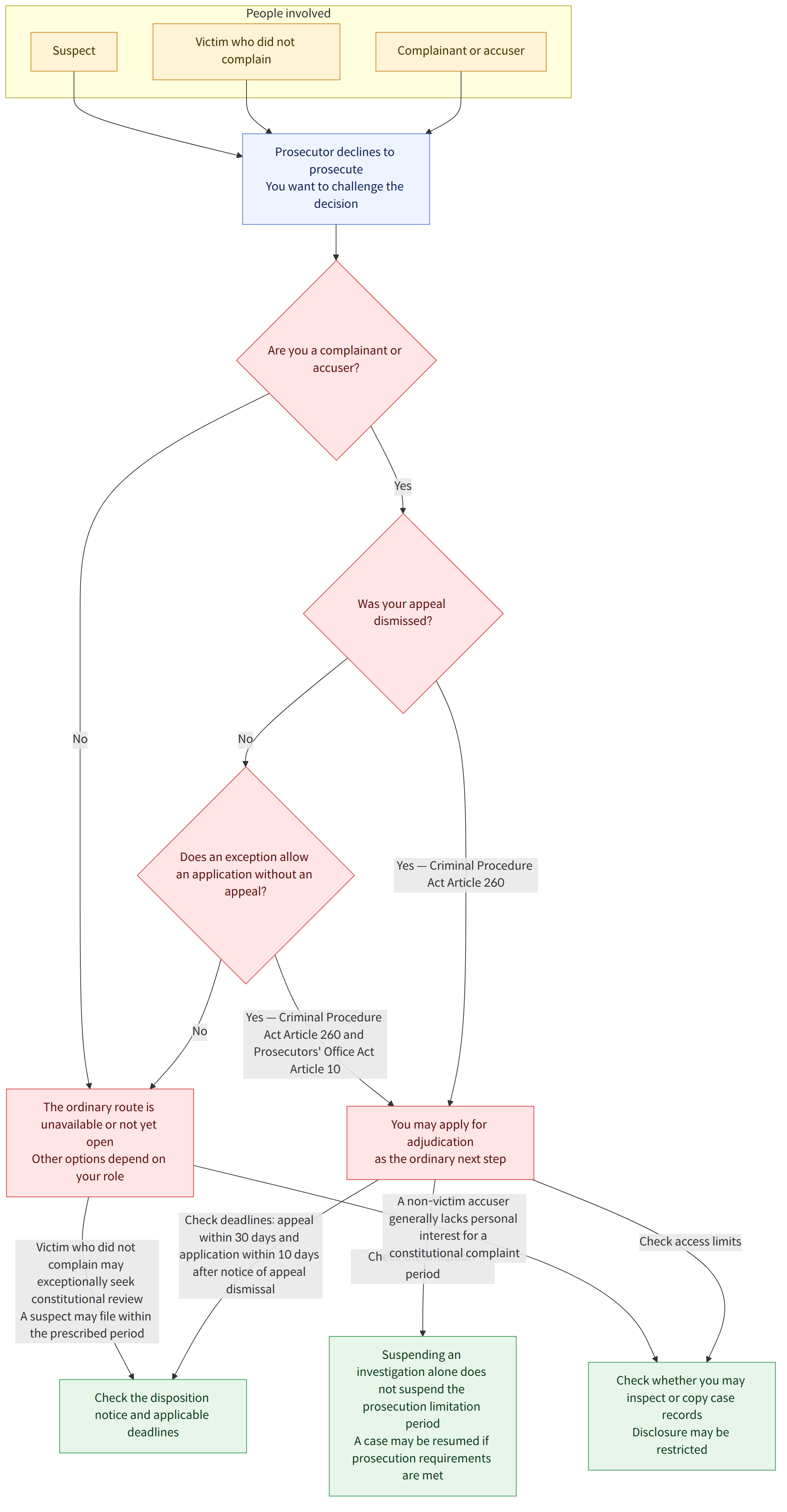
- A complainant or accuser may appeal a decision not to prosecute, and, as a rule, an application for adjudication must be preceded by an appeal. If a specified exceptional circumstance arises after the appeal, an application for adjudication may be filed without first appealing (Criminal Procedure Act, Article 260 (형사소송법 제260조); Prosecutors’ Office Act, Article 10 (검찰청법 제10조); Examples 6, 22).
- A victim who did not file a complaint cannot use the ordinary appeal or application-for-adjudication procedures. However, according to the examples, the victim may exceptionally file a constitutional complaint directly, seeking revocation of the decision not to prosecute (Constitutional Court, June 24, 2010, 2008Hun-Ma716; Examples 7, 17).
- As a rule, an accuser who was not a victim of the crime does not have the required personal interest to file a constitutional complaint against a decision not to prosecute (Constitutional Court, April 27, 2017, 2016Hun-Ma140; Example 15).
- The examples explain that there is no ordinary court procedure through which a suspect can directly challenge a suspension-of-indictment disposition. However, a suspect may file a constitutional complaint within the prescribed period (Constitutional Court Act, Article 69(1) (헌법재판소법 제69조 제1항); Examples 10, 21).
- Suspension of investigation halts the investigation; it is not a ground for suspending the statute of limitations for prosecution. However, it is necessary to separately consider whether a different statutory ground for suspension applies, such as the filing of charges or the filing of charges against an accomplice (Criminal Procedure Act, Article 253 (형사소송법 제253조); Examples 5, 13, 20).
- A decision not to prosecute does not have the same effect as a final judgment barring a second prosecution. The investigation may therefore be resumed or charges brought if the requirements for prosecution are met, including that the statute of limitations has not expired (Examples 19, 24).
- People involved in a case in which prosecution was declined may apply to inspect or copy the records within a specified scope, but access may be restricted where disclosure could cause harm (Prosecutors’ Office Preservation Rules, Articles 20-2 and 22 (검찰보존사무규칙 제20조의2, 제22조); Example 14).
Frequently asked questions
Q. What types of dispositions not to prosecute are there?
The examples include suspension of indictment, no suspicion, no crime, no right to prosecute, suspension of investigation, and deferment of prosecution. Suspension of indictment is a disposition not to bring charges after considering the circumstances, even where the alleged facts are acknowledged. No suspicion is a disposition made when, for example, no crime has been committed or the evidence is insufficient.
Q. How can I challenge a prosecutor’s decision not to prosecute?
As a rule, a complainant or accuser may file an application for adjudication after filing an appeal. According to the examples, an appeal must be filed within 30 days from the date notice is received that charges will not be brought, and an application for adjudication must be submitted within 10 days from the date notice of dismissal of the appeal is received. In certain cases, such as when no disposition has been made within three months after the appeal, an application for adjudication may be filed without first appealing.
Q. Can a victim who did not file a complaint challenge a decision not to prosecute?
They cannot use the ordinary appeal or application-for-adjudication procedures available to complainants and accusers. However, the examples explain that, in exceptional circumstances, a victim who did not file a complaint may directly file a constitutional complaint seeking revocation of the decision not to prosecute.
Q. Can someone who only reported a crime file a constitutional complaint against a decision not to prosecute?
If an accuser is not a victim whose rights or legal interests were directly infringed by a crime, as a rule, the accuser does not have the required personal interest to file a constitutional complaint against a decision not to prosecute. Accordingly, the fact that someone is an accuser alone does not make a constitutional complaint admissible.
Q. How can a suspect challenge a suspension-of-indictment disposition?
According to the examples, there is no ordinary court procedure through which a suspect can directly challenge a suspension-of-indictment disposition. However, if the suspect wishes to argue that the disposition infringes on their fundamental rights, they may file a constitutional complaint. The examples state that it must be filed within 90 days from the date the person became aware of the disposition and within one year from the date it was made. The person must also appoint an attorney as counsel.
Q. Does suspension of investigation also stop the statute of limitations for prosecution?
No. The examples describe suspension of investigation as a disposition that halts the investigation and state that, by itself, it does not suspend the statute of limitations for prosecution. It is necessary to separately check whether another statutory ground for suspension applies, such as being abroad for the purpose of evading prosecution or criminal punishment.
Q. Can a case be reinvestigated or prosecuted after a decision not to prosecute?
A disposition not to prosecute does not have the same effect as a final judgment barring a second prosecution. Accordingly, if the allegations are substantiated by new evidence, for example, and the requirements for prosecution are met, including that the statute of limitations has not expired, the investigation may be resumed or charges may be brought. The examples also explain that, for crimes requiring an accusation, an existing accusation may remain valid.
Q. If I submit an application for adjudication to the prison within the deadline, have I met the deadline?
According to the examples, the special rule allowing a convicted defendant in custody to submit a notice of appeal does not apply to an application for adjudication. Therefore, even if the application was submitted to prison staff within the filing period, it may not be considered duly filed unless it reaches the chief prosecutor of the relevant district prosecutors’ office or branch prosecutors’ office within the prescribed period.
Q. Can I apply to inspect or copy the records of a case in which prosecution was declined?
Within the scope described in the examples, a person who was a suspect, a complainant or accuser, a victim, or a witness who gave a statement may apply to inspect or copy the records. Access may be restricted if disclosure could harm the privacy or safety of people involved in the case or seriously interfere with an investigation or trial, among other concerns.
Relevant laws
- Criminal Procedure Act, Article 249 (형사소송법 제249조)
- Criminal Procedure Act, Article 252 (형사소송법 제252조)
- Criminal Procedure Act, Article 253 (형사소송법 제253조)
- Criminal Procedure Act, Article 257 (형사소송법 제257조)
- Criminal Procedure Act, Article 258 (형사소송법 제258조)
- Criminal Procedure Act, Article 259 (형사소송법 제259조)
- Criminal Procedure Act, Article 260 (형사소송법 제260조)
- Criminal Procedure Act, Article 261 (형사소송법 제261조)
- Criminal Procedure Act, Article 262 (형사소송법 제262조)
- Criminal Procedure Act, Article 344 (형사소송법 제344조)
- Criminal Procedure Act, Article 405 (형사소송법 제405조)
- Prosecutors’ Office Act, Article 10 (검찰청법 제10조)
- Constitutional Court Act, Article 25(3) (헌법재판소법 제25조 제3항)
- Constitutional Court Act, Article 69(1) (헌법재판소법 제69조 제1항)
- Constitutional Court Act, Article 70(1) (헌법재판소법 제70조 제1항)
Watch out for
- The deadlines for an appeal or an application for adjudication may be short. Check the date of notice of the disposition and the date of notice dismissing the appeal, and ensure that the documents reach the designated authority within the deadline.
- Whether a decision not to prosecute can be challenged depends on whether the person is a complainant, accuser, victim, or suspect. In particular, distinguish the procedures available to a victim who did not file a complaint from those available to an accuser who was not a victim of the crime.
- Suspension of investigation and a decision not to prosecute do not mean the same thing. Suspension of investigation halts the investigation and, by itself, does not suspend the statute of limitations for prosecution.
Source cases
This guide was compiled by AI from the following Korea Legal Aid Corporation consultation cases (in Korean).
- 불기소처분의 종류에는 어떤 것이 있는지
- 사기죄의 공소시효는 어느 정도 되는지
- 소송사기미수죄의 공소시효 기산점인 범죄행위의 종료시기
- 기소중지자도 출국할 수 있는지
- 공범이 받은 무죄확정판결의 진범에 대한 공소시효정지효력
- 검사의 불기소처분에 대한 고소인의 불복 방법
- 고소를 제기하지 않은 피해자의 불기소처분에 대한 불복방법
- 재소자의 재정신청서가 검사장에게 늦게 도착된 때 그 효력
- 무혐의불기소처분이 위법한 경우 재정신청 기각 가능 여부
- 기소유예 처분에 대한 피의자의 불복절차가 없는 것은 위헌 아닌지
- 소년보호처분이 결정된 사건에 대한 형사처벌가능여부
- 기소유예를 함이 상당한 사건일 때 재정신청을 기각할 수 있는지
- 기소중지처분이 공소시효를 정지시키는 효력이 있는지
- 불기소사건기록의 등사
- 불기소처분에 고발인의 헌법소원 청구가부
- 재소자가 재정신청 기각결정에 대한 재항고장을 제출할 경우의 법정기간 준수 여부의 판단기준
- 항고, 재항고 당사자 적격
- 공범에 대한 공소제기와 공소시효의 정지
- 고발을 요하는 범죄에서 불기소처분 후 나중에 공소를 제기할 경우 고발이 다시 있어야 하는지
- 고소한 사건이 기소중지되면 그 사건은 어떻게 되는지
- 기소유예 처분에 대한 피의자의 불복방법
- 항고를 거치지 않아도 재정신청이 가능한 사유
- 공소보류란 무엇인지
- 불기소처분의 일사부재리 효력 인정여부
- 재정신청에 대한 기각결정시 헌법소원 가부
This guide is general legal information about Korean law, not legal advice for your situation. For a specific case, consult a lawyer or the Korea Legal Aid Corporation (call 132 in Korea).