
Requirements for Criminal Liability and Standards for Punishment under the Criminal Act
Based on 79 consultation cases · Updated · Translated from the Korean original.
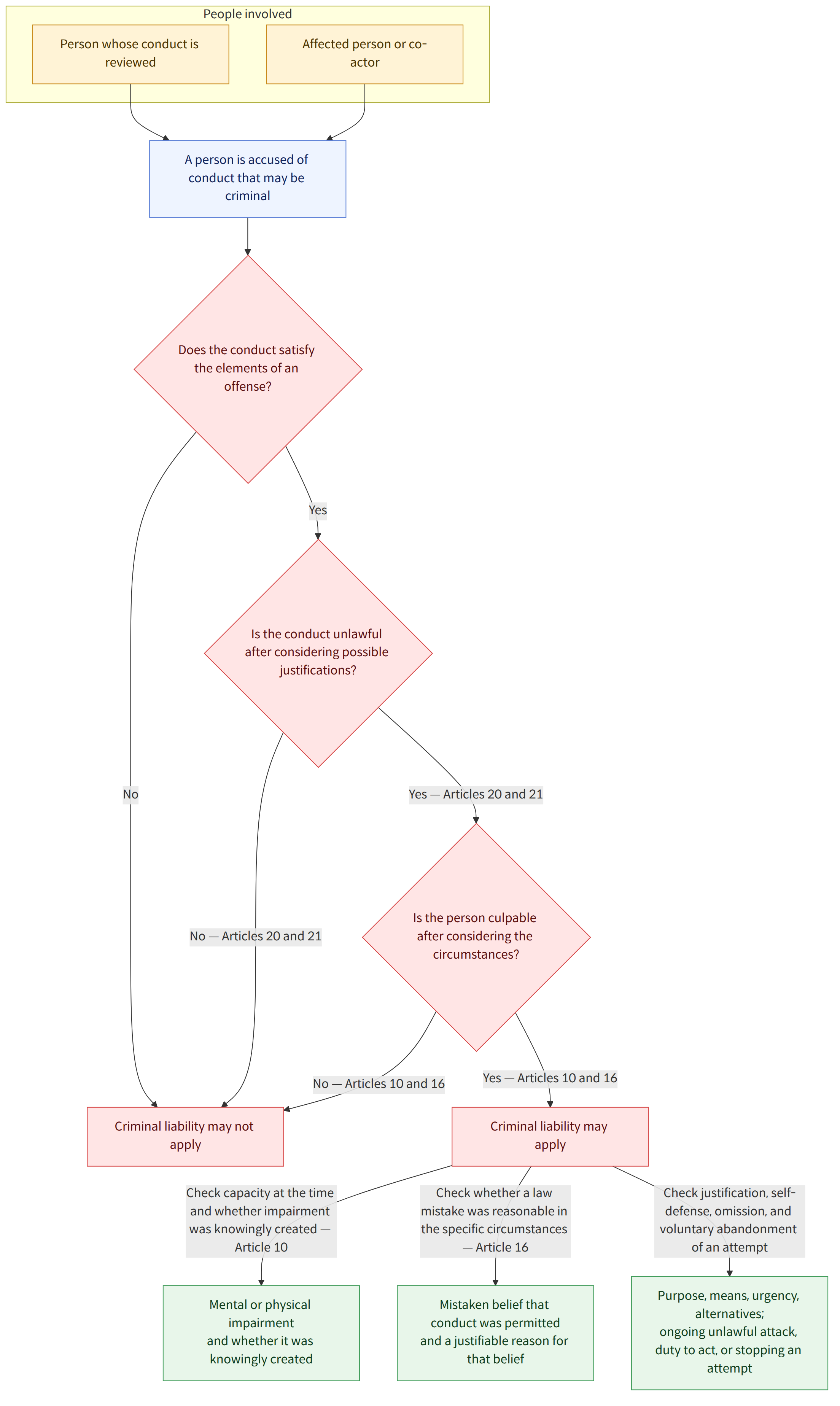
Whether a crime has been committed is determined by examining whether the conduct constitutes a crime under the law, whether its unlawfulness is precluded, and whether the person can be held responsible. The mere fact that a person had a mental disorder or was mistaken about the law does not exempt them from punishment; the specific circumstances at the time of the conduct and the statutory requirements must be considered.
At a glance
Key points
- The requirements for establishing a crime are examined under three headings: satisfaction of the elements of the offense, unlawfulness, and culpability (Case 13).
- Mental or physical impairment is not established merely by the existence of a mental disorder. What matters is whether, at the time of the offense, the person’s ability to distinguish right from wrong or control their actions was absent or diminished (Criminal Act, Article 10 (형법 제10조), Cases 1 and 19).
- If a person knowingly creates a state of mental or physical impairment despite foreseeing a risk, they may not be entitled to a reduced sentence or exemption from punishment on that basis (Criminal Act, Article 10, Paragraph 3 (형법 제10조 제3항), Case 18).
- As a general rule, not knowing the law does not excuse a person from punishment as a mistake of law. The person must have mistakenly believed that the law permitted the conduct in their particular circumstances and must have had a justifiable reason for that belief (Criminal Act, Article 16 (형법 제16조), Cases 2 and 24).
- Whether an act is justifiable is determined by considering not only the legitimacy of its purpose, but also the appropriateness of the means, the balance of interests, the urgency, and whether there was any alternative (Criminal Act, Article 20 (형법 제20조), Cases 3, 4, 5, and 9).
- Self-defense requires a reasonable defensive act against an ongoing, unlawful infringement. Conduct during a fight in which both parties intend to attack each other is generally unlikely to be recognized as self-defense (Criminal Act, Article 21 (형법 제21조), Case 6).
- If a person with a legal duty to act could have prevented a crime but failed to do so, thereby facilitating its commission, they may be guilty of a crime by omission or of aiding and abetting (Case 7).
- An attempted crime may be punishable. If a person voluntarily stops or prevents the result from occurring, the sentence may be reduced or the person may be exempted from punishment as a voluntary abandonment of an attempt. If the person fails actually to stop an accomplice’s offense, voluntary abandonment may not be recognized (Criminal Act, Articles 25 and 26 (형법 제25조·제26조), Case 14).
Frequently asked questions
Q. Will I avoid punishment for committing a crime if I have a mental illness?
The mere fact that a person has a mental illness does not exempt them from punishment. The issue is determined by considering all the specific circumstances, including whether, at the time of the offense, the person’s ability to distinguish right from wrong or control their actions was absent or diminished because of the disorder (Criminal Act, Article 10 (형법 제10조)).
Q. Will my sentence be reduced if I was drunk and cannot remember what happened?
A person’s intoxication alone does not reduce their sentence. If a person knowingly creates a state of mental or physical impairment, despite foreseeing a risk such as drunk driving, a reduction or exemption from punishment on that basis may not apply (Criminal Act, Article 10, Paragraph 3 (형법 제10조 제3항)).
Q. Can I avoid punishment if I did not know the law and did not realize my conduct was illegal?
It is difficult to avoid punishment merely by claiming not to have known the law or a regulation. Although the conduct is generally criminal, a mistake of law may be at issue if the person mistakenly believed that the law permitted it in their particular circumstances and had a justifiable reason for that belief (Criminal Act, Article 16 (형법 제16조)).
Q. Can breaking the law for a good purpose be recognized as a justifiable act?
An act is not justified merely because it was done for a good purpose. The purpose and method of the conduct, the interests protected and harmed, the urgency, and the availability of other means must all be considered (Criminal Act, Article 20 (형법 제20조)).
Q. If the other person hit me first, is hitting back self-defense?
The fact that the other person attacked first does not, by itself, establish self-defense. If both parties fought with the intent to attack each other, conduct during the mutual fight may not qualify as self-defense. Nor is an attack made in retaliation after the threat has passed likely to qualify as a defensive act (Criminal Act, Article 21 (형법 제21조)).
Q. Can I be punished for standing by while a crime is committed, even if I did not carry it out myself?
A person who is required by law or a duty of office to prevent a criminal result may be guilty of a crime by omission or of aiding and abetting if they could have prevented the result but failed to do so, and their failure made the principal’s offense easier to commit. Whether there was a duty to act and whether the person could have prevented the result are among the matters examined in light of the specific circumstances.
Q. Will I avoid punishment if I stop committing the offense on my own?
If, after beginning to commit an offense, a person voluntarily stops or prevents the result from occurring, the sentence may be reduced or the person may be exempted from punishment as a voluntary abandonment of an attempt. This is distinguished from cases where the offense is not completed because of an external obstacle. It is also important whether an accomplice actually stopped the crime from continuing (Criminal Act, Articles 25 and 26 (형법 제25조·제26조)).
Q. If I committed a crime abroad and was punished there, can I be punished again in Korea?
According to the cited case, when a foreign national commits a crime outside Korea against the Republic of Korea or a Korean national, Korean criminal law may apply under Article 6 of the Criminal Act. The case law described states that a foreign judgment does not have res judicata effect in Korea; however, having served a sentence abroad may be taken into account when determining the sentence in Korea.
Relevant laws
- Criminal Act, Article 5 (형법 제5조)
- Criminal Act, Article 6 (형법 제6조)
- Criminal Act, Article 7 (형법 제7조)
- Criminal Act, Article 9 (형법 제9조)
- Criminal Act, Article 10 (형법 제10조)
- Criminal Act, Article 12 (형법 제12조)
- Criminal Act, Article 13 (형법 제13조)
- Criminal Act, Article 16 (형법 제16조)
- Criminal Act, Article 20 (형법 제20조)
- Criminal Act, Article 21 (형법 제21조)
- Criminal Act, Article 22 (형법 제22조)
- Criminal Act, Article 25 (형법 제25조)
- Criminal Act, Article 26 (형법 제26조)
- Criminal Act, Article 155, Paragraph 4 (형법 제155조 제4항)
- Criminal Act, Article 297 (형법 제297조)
Watch out for
- Self-defense, justifiable acts, and necessity are assessed individually in light of the purpose and method of the specific conduct and the circumstances at the time.
- The existence of a mental disorder alone may not be enough to determine criminal responsibility; the person’s capacities at the time of the offense and the surrounding circumstances are important.
- Some parts of the cited cases refer to former law or provisions that have since been amended. The current laws applicable to an actual case should therefore be checked separately.
- This guide provides general explanations of the counseling cases presented. Whether punishment applies in an actual case may vary depending on the facts and evidence.
Related articles
Source cases
This guide was compiled by AI from the following Korea Legal Aid Corporation consultation cases (in Korean).
- 충동조절장애에 따른 범행을 심신장애로 인한 범행으로 볼 수 있는지
- 법령 오인으로 중개수수료를 초과하여 받은 경우에 법률의 착오인지
- 관리비가 체납된 경우 관리사무소의 단수조치가 정당행위인지
- 수지침시술행위가 무면허의료행위로서 처벌되는지
- 초·중등학교 교사의 체벌이 어느 정도까지 허용될 수 있는지
- 싸움 중에 행해진 가해행위가 정당방위에 해당할 수 있는지
- 부하직원의 배임행위를 발견하고도 방치한 경우 형사처벌 여부
- 운전면허가 취소된 줄 모르고 운전한 경우 무면허운전에 해당되는지
- 근로자의 쟁의행위가 형법상 정당행위가 되기 위한 요건
- 지압서비스가 의료법상의 의료행위에 해당되는지
- 위법한 강제연행 과정에서 음주측정 요구에 응하여야 하는지
- 스스로 범죄를 범한 자가 긴급피난을 할 수 있는지
- 초법규적 책임조각사유로서 기대불가능성
- 범죄행위 중 자의로 범행을 중단했을 경우에도 처벌하는지
- 경찰관이 행인의 소지품을 수색한 경우 그것이 정당한 것인지
- 노동조합원의 찬반투표 없이 한 쟁의행위의 형사처벌 여부
- 외국인이 국외에서 사문서를 위조한 경우, 형법이 적용되는지
- 만취 후 운전하여 교통사고를 낸 경우 심신장애로 인한 감경 여부
- 정신질환자의 범죄에 대한 형법 제10조의 적용 기준
- 피고인에게 불리한 판례변경과 소급금지원칙
- 낙선운동의 경우에도 공직선거법이 적용되는지
- 고속도로를 주행 하던 중 무단횡단하던 운행자를 미리 발견한 경우
- 민사소송에서의 증거 수집을 위한 실정법 위반행위의 효과
- 법률의 부지의 효과
- 외국에서 처벌받은 범죄행위에 대해 다시 국내에서 처벌받을 수 있는지 여부
This guide is general legal information about Korean law, not legal advice for your situation. For a specific case, consult a lawyer or the Korea Legal Aid Corporation (call 132 in Korea).