
Other Crimes under the Criminal Act: Elements and Points to Note
Based on 185 consultation cases · Updated · Translated from the Korean original.
Whether other crimes are established depends not only on the nature of the conduct but also on specific circumstances, such as its purpose, whether it was repeated, access privileges, and duties to protect or assist. Punishability is not determined solely by a content rating or the relationship between the parties; the statutory elements of each crime must be examined.
At a glance
Key points
- A rating of “Suitable for Ages 18 and Over” by the Korea Media Rating Board may be relevant to assessing obscenity, but it does not automatically rule out obscenity (Cases 1 and 18; Supreme Court Decision 2006Do3558, rendered March 13, 2008).
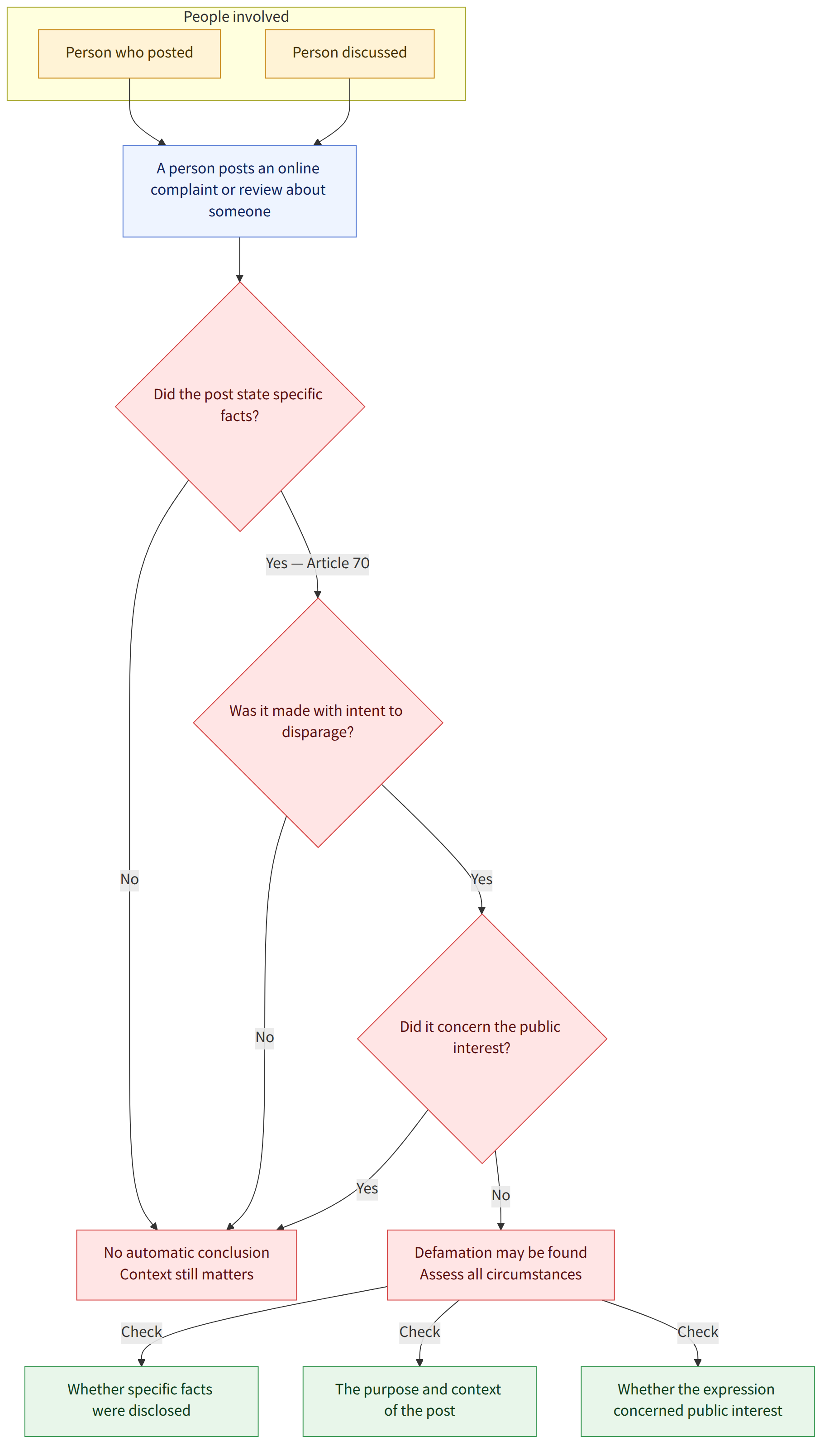
- Whether an online post constitutes defamation is determined by considering such factors as whether it stated specific facts, whether it was made with the intent to disparage, and whether it concerned the public interest (Act on Promotion of Information and Communications Network Utilization and Information Protection, Article 70 (정보통신망법 제70조); Cases 2 and 10).
- Even if a person knows someone else’s ID and password or was previously permitted to use them, whether that person currently has authorization to access the information and communications network is determined based on, among other things, the authorization granted by the service provider (Act on Promotion of Information and Communications Network Utilization and Information Protection, Article 48(1) (정보통신망법 제48조 제1항); Cases 8 and 9).
- Whether messages causing anxiety were sent repeatedly is not determined by the number of messages alone. The overall circumstances are examined—including proximity in time and place, similarity of method, and continuity of intent—to determine whether they formed a series of acts (Act on Promotion of Information and Communications Network Utilization and Information Protection, Article 44-7(1)(3) (정보통신망법 제44조의7 제1항 제3호); Case 12).
- The crime of abduction of a minor is not established merely because a parent moved with their child to another residence. The specific circumstances must be examined, including whether violence, threats, or unlawful de facto force was used (Criminal Act, Articles 287 and 288 (형법 제287조·제288조); Case 15).
- A person cannot be forcibly detained at a police station without a legal basis merely because they are subject to summary proceedings. Restrictions on personal liberty are not limited to cases involving physical barriers (Criminal Act, Article 124 (형법 제124조); Case 19).
- An operator of a bar or other drinking establishment may have a contractual duty to assist in protecting patrons’ lives and physical safety. Various circumstances are considered, including whether a patron was in a dangerous condition and whether the operator could have taken necessary measures (Criminal Act, Article 271 (형법 제271조); Case 20).
- The crime of evading compulsory execution requires conduct such as concealing property or transferring it fictitiously while there is a specific risk of compulsory execution. A genuine transfer of property is distinguished from a fictitious transfer, even if the purpose was to avoid execution (Criminal Act, Article 327 (형법 제327조); Case 23).
Frequently asked questions
Q. Can a video rated “Suitable for Ages 18 and Over” by the Korea Media Rating Board still be punished as obscene material?
Content ratings primarily classify viewing suitability based on the viewer’s age. A court determines whether material is obscene based on its overall content and other factors, so a rating of “Suitable for Ages 18 and Over” does not, by itself, rule out obscenity.
Q. Can a complaint or review posted online constitute defamation?
The overall circumstances are considered, including whether the post disclosed specific facts, whether the expression concerned the public interest, and whether it was made with the intent to disparage. Subjective evaluations or opinions may be distinguished from statements of specific facts, and the context of the expression and purpose of the post are also important.
Q. Can I be punished for accessing someone else’s email using their ID and password?
Knowing someone’s ID and password does not, by itself, establish that you had authorization to access the account. Whether there was unauthorized access to an information and communications network is determined by considering matters such as whether any past permission remained valid and whether the service provider allowed a third party to use the account.
Q. Is sending two aggressive text messages a violation of the Act on Promotion of Information and Communications Network Utilization and Information Protection?
Sending two messages does not, by itself, necessarily establish repeated conduct causing anxiety. The overall circumstances—including the content of the messages, the circumstances in which they were sent, the time interval, and the similarity of the method—are considered to determine whether they formed a series of repeated acts.
Q. Is perjury established if someone lies without having been informed of the right to refuse to testify?
The fact that a person was not informed of the right to refuse to testify does not always rule out perjury. The specific circumstances are considered as a whole, including whether the person knew of the grounds for refusing to testify and of that right, and whether the failure to provide notice actually impeded the exercise of the right.
Q. Is it the crime of abduction of a minor if a parent takes their child out of the home and goes abroad?
The crime of abduction is not automatically established merely because one parent moved with the child to another residence. It is necessary to consider whether violence, threats, or unlawful de facto force disrupted the existing state of protection and care, and whether the parent abused their rights to protect and care for the child in a way that harmed the child’s interests.
Q. Can the police force a person subject to summary proceedings to remain at a police station until the hearing the next day?
There is no legal basis for forcibly detaining someone merely because they are subject to summary proceedings. Refusing a legitimate request to go home and restricting the person’s liberty may raise the issue of unlawful confinement; if the person is injured during detention, separate enhanced penalties may also be at issue.
Q. Can criminal liability arise if a bar leaves a dangerously intoxicated patron unattended?
Depending on the circumstances, the crime of abandonment or abandonment resulting in death may be at issue. The overall circumstances are considered, including whether the bar operator had a contractual duty to assist, whether the operator knew of the patron’s condition and the danger, and whether the operator could have taken necessary measures, such as arranging transportation or contacting the patron’s acquaintance or the police.
Q. Is it the crime of evading compulsory execution to transfer a claim to someone else before it is due?
Under the standard applied in the case, the crime of evading compulsory execution is unlikely to be established if the claim is not yet due and there is no specific risk of compulsory execution. Even if there is a risk of execution, a genuine transfer is distinguished from a fictitious transfer; it is also necessary to consider whether there was a risk of harming the creditor’s rights.
Relevant laws
- Act on Promotion of Information and Communications Network Utilization and Information Protection, Article 24-2(2) (정보통신망 이용촉진 및 정보보호 등에 관한 법률 제24조의2 제2항)
- Act on Promotion of Information and Communications Network Utilization and Information Protection, Article 44-7(1)(1) and (3) (정보통신망 이용촉진 및 정보보호 등에 관한 법률 제44조의7 제1항 제1호·제3호)
- Act on Promotion of Information and Communications Network Utilization and Information Protection, Article 48(1) (정보통신망 이용촉진 및 정보보호 등에 관한 법률 제48조 제1항)
- Act on Promotion of Information and Communications Network Utilization and Information Protection, Article 49 (정보통신망 이용촉진 및 정보보호 등에 관한 법률 제49조)
- Act on Promotion of Information and Communications Network Utilization and Information Protection, Article 70(1) and (2) (정보통신망 이용촉진 및 정보보호 등에 관한 법률 제70조 제1항·제2항)
- Act on Promotion of Information and Communications Network Utilization and Information Protection, Article 71(1)(3), (9), and (11) (정보통신망 이용촉진 및 정보보호 등에 관한 법률 제71조 제1항 제3호·제9호·제11호)
- Act on Promotion of Information and Communications Network Utilization and Information Protection, Article 74(1)(2) and (3) (정보통신망 이용촉진 및 정보보호 등에 관한 법률 제74조 제1항 제2호·제3호)
- Criminal Procedure Act, Article 310-2 (형사소송법 제310조의2)
- Criminal Procedure Act, Article 312(4) (형사소송법 제312조 제4항)
- Act on Special Cases Concerning the Punishment, etc. of Sexual Crimes, Article 26 (성폭력범죄의 처벌 등에 관한 특례법 제26조)
- Act on Special Cases Concerning the Punishment, etc. of Sexual Crimes, Article 30(6) (성폭력범죄의 처벌 등에 관한 특례법 제30조 제6항)
- Act on Special Cases Concerning the Punishment, etc. of Sexual Crimes, Article 34 (성폭력범죄의 처벌 등에 관한 특례법 제34조)
- Food Sanitation Act, Article 2(1) (식품위생법 제2조 제1호)
- Food Sanitation Act, Article 39(3) (식품위생법 제39조 제3항)
- Food Sanitation Act, Article 97(1) (식품위생법 제97조 제1호)
Watch out for
- The conclusions in the cases are based on the laws in force at the time and the specific facts of each case. In an actual matter, the currently applicable laws and the specific evidence should be checked.
- Even when an expression is made in the public interest, other circumstances—such as whether the facts are true and the manner and scope of the expression—may be important. Do not assume that a public-interest purpose always exempts a person from liability.
- Reporting and licensing obligations may vary depending on how the business is actually operated and on statutory exceptions. It is prudent to check with the relevant authority before setting up facilities or starting business operations.
Related articles
Source cases
This guide was compiled by AI from the following Korea Legal Aid Corporation consultation cases (in Korean).
- 18세 관람가 비디오물을 그대로 인터넷에 제공한 경우
- 청와대 인터넷 신문고 사이트에 민원을 게재한 경우
- 성폭력범죄 피해자에 대한 영상녹화수사의 취지와 실익
- 영업양수 후 식품위생법상 영업자지위 승계신고 못한 경우
- 치과의사의 보톡스 시술이 의료법위반인지
- 공소권 없음으로 처리될 진범 대신 허위 진술한 경우 처벌 여부
- 회사 내 외부인의 출입이 금지된 공터에서 근로자 30명 정도가 사전 신고 없이 집회를 한 경우 집회 및 시위에 관한 법률로 처...
- 상관의 아이디와 비밀번호를 도용한 경우
- 이메일 출력물을 제3자에게 보여준 경우
- 주관적 평가를 주된 내용으로 하는 댓글을 게시한 경우
- 사냥개, 전파수신기, 수렵용 칼 등을 싣고 다닌 경우 야생생물 보호 및 관리에 관한 법률에 위반하여 처벌되는지
- 변제독촉을 받던 중 하루 간격으로 2번 문자메시지를 발송한 경우
- 체력단력장 내에 목욕 시설을 구비하면서도 신고를 하지 않는다면 공중위생관리법으로 처벌되는 것인지
- 형사소송에서의 증언거부권 불고지와 위증죄의 성립여부
- 외국 국적의 아내가 아이를 데리고 출국한 경우
- 성매매알선행위와 건물제공행위의 관계
- 돈을 빨리 갚지 않으면 상부에 보고하겠다고 경찰관이 전화한 경우
- 누드광고 사이트에서 전라의 여성 사진 등을 게시한 경우
- 즉결심판 피의자를 강제로 유치시킨 경우 불법감금 여부
- 주점의 손님이 저체온증으로 사망에 이르는 것을 방치한 경우
- 생활한복이 저작권법의 보호대상이 되는 저작물인지
- 자연식품도 식품위생법상 식품으로 보아야 하는지
- 변제기 전에 채권양도한 경우 강제집행면탈죄 성립 여부
- 청소년과 함께 온 성년자에게 주류 판매 시 청소년보호법 위반 여부
- 법정 취급자 외의 제3자로부터 개인정보를 제공받은 경우
This guide is general legal information about Korean law, not legal advice for your situation. For a specific case, consult a lawyer or the Korea Legal Aid Corporation (call 132 in Korea).