
Guide to Types of Criminal Punishment and Sentence Reduction and Enforcement
Based on 57 consultation cases · Updated · Translated from the Korean original.
Punishments include the death penalty, imprisonment with labor, imprisonment without labor, punishments affecting qualifications, and property-related punishments. The type and term of punishment, as well as how it is enforced, vary depending on the crime. Voluntary surrender, repeat offending, the limitation period and lapse of a sentence, confiscation, and collection of equivalent value each have different requirements and effects; it cannot be assumed that any of these circumstances automatically reduces a sentence or exempts a person from enforcement.
At a glance
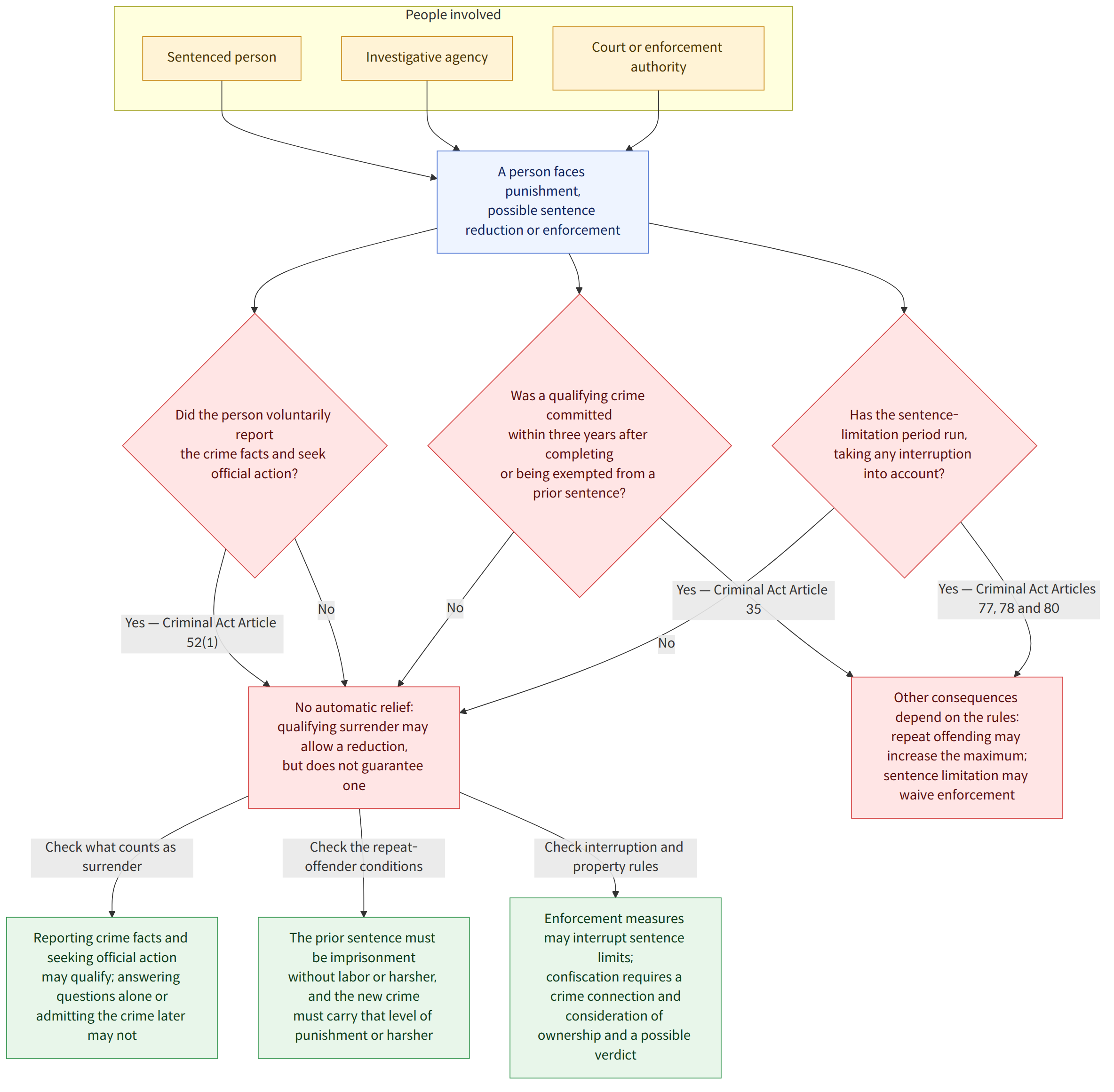
Key points
- The Criminal Act provides for nine types of punishment: the death penalty, imprisonment with labor, imprisonment without labor, deprivation of qualifications, suspension of qualifications, a fine, detention, a minor fine, and confiscation. The order of severity of punishments is also prescribed by law (Criminal Act, Articles 41 and 50 (형법 제41조, 제50조)).
- Imprisonment with labor involves confinement in a correctional facility and the performance of penal labor. Imprisonment without labor also involves confinement and restriction of liberty, but does not require the performance of penal labor (Criminal Act, Article 67 (형법 제67조)).
- The limitation period for a sentence is a system under which enforcement is waived if a prescribed period passes after the judgment becomes final without the sentence being enforced. The period may be interrupted when compulsory measures to enforce a fine, collection of equivalent value, or similar measures begin. The effect of an interruption that has already occurred may remain even if enforcement becomes impossible or an attachment is canceled (Criminal Act, Articles 77, 78, and 80 (형법 제77조·제78조·제80조); Examples 3 and 4).
- Voluntary surrender is an expression of intent by an offender to report the facts of the crime to an investigative agency and seek to be dealt with by the authorities. Merely answering questions from an investigative agency, or admitting the crime later after initially denying it, may not be treated as a voluntary surrender. Even when conduct qualifies as a voluntary surrender, a reduction or remission of the sentence is not guaranteed automatically (Criminal Act, Article 52(1) (형법 제52조 제1항); Examples 6, 12, and 21).
- A person who has been sentenced to imprisonment without labor or a more severe punishment may be punished as a repeat offender if, within three years after completing or being exempted from serving that sentence, they commit another crime punishable by imprisonment without labor or a more severe punishment. Under the general Criminal Act, the maximum term prescribed for the crime may be increased by up to two times for repeat offending (Criminal Act, Article 35 (형법 제35조); Example 8).
- A person who has not received a sentence of suspension of qualifications or a more severe punishment for a prescribed period after completing or being exempted from serving a sentence may apply to have the sentence lapse. In some cases, a sentence lapses without a separate application. However, the example explains that, unlike the register of sentenced persons and the list of sentenced persons, criminal history information in investigation data records is not deleted (Criminal Act, Article 81 (형법 제81조); Act on the Lapse of Criminal Sentences, Articles 7 and 8 (형의 실효 등에 관한 법률 제7조·제8조); Examples 9 and 11).
- Confiscation requires consideration of statutory requirements, including whether the item is connected to the crime for which the person was found guilty and who owns it. Property owned by an accomplice may also be confiscated if the requirements are met. However, under the legal framework described in the example, confiscation or collection of equivalent value is not available where the limitation period for prosecution has expired and a guilty verdict cannot be entered (Criminal Act, Articles 48 and 49 (형법 제48조·제49조); Examples 10, 13, and 15).
Frequently asked questions
Q. What types of punishment are there?
The Criminal Act provides for nine types of punishment: the death penalty, imprisonment with labor, imprisonment without labor, deprivation of qualifications, suspension of qualifications, a fine, detention, a minor fine, and confiscation. The order of severity of punishments is prescribed by the Criminal Act.
Q. What is the difference between imprisonment with labor and imprisonment without labor?
Both punishments involve confinement in a correctional facility and a restriction of liberty. Imprisonment with labor requires the prisoner to perform penal labor, while imprisonment without labor does not. The example explains that prisoners serving imprisonment without labor may also work if they apply to do so.
Q. Is a sentence always reduced if I voluntarily surrender?
No. Even if the conduct qualifies as voluntary surrender, the court may reduce or remit the sentence, but is not required to do so. Admitting the facts of a crime in response to questions or an investigation by an investigative agency may amount only to a confession, not a voluntary surrender.
Q. Does it count as a voluntary surrender if I appear voluntarily and admit the crime after a wanted notice has been issued?
According to the example, voluntarily appearing after a crime has been discovered or a wanted notice has been issued may also qualify as a voluntary surrender. Whether the effect of a voluntary surrender is recognized is determined based on the specific circumstances, including whether the person voluntarily reported the facts of the crime and expressed a wish to be dealt with by the authorities.
Q. When does repeat offending apply, and how much can the sentence be increased?
A person who has been sentenced to imprisonment without labor or a more severe punishment may be punished as a repeat offender if, within three years after completing or being exempted from serving that sentence, they commit another crime punishable by imprisonment without labor or a more severe punishment. Under the general Criminal Act, the maximum term prescribed for the crime may be increased by up to two times for repeat offending. Reoffending during a period of suspended execution or parole is not included among the repeat-offender requirements described in the example.
Q. If the limitation period for a fine has expired, do I no longer have to pay it?
Under the standard described in the example, the limitation period for a fine is three years, but the period may be interrupted if compulsory enforcement measures are initiated during that time. The interruption may be recognized even if enforcement ultimately proves impossible, provided compulsory measures have already begun. Therefore, the limitation period should not be assumed to have expired based solely on the date the judgment became final.
Q. Are all records of a fine removed over time?
The example explains that a fine is not recorded in the register of sentenced persons or the list of sentenced persons, while distinguishing this from criminal history information in the investigation data records managed by the National Police Agency, where the fact that a fine was imposed may remain. It also explains that criminal history checks and the provision of criminal history information are permitted only in limited circumstances.
Q. Can property held by an accomplice or money that has been seized be confiscated?
Property owned by an accomplice may also be subject to confiscation, but the statutory requirements must be met, including whether the item was used or intended to be used in the crime for which the person was found guilty. The example explains that an item intended for use in a future crime separate from the crime for which the person was found guilty cannot be confiscated.
Q. Can a sentence be increased simply because I deny the facts of the crime?
The example explains that simply denying the facts of a crime may be an exercise of the defendant’s right to defend themself, and that a sentence may not be increased solely on the ground that the defendant has shown no remorse. However, even where objective and clear evidence exists, actively obstructing the discovery of the truth or attempting to mislead the court may be taken into account in sentencing.
Relevant laws
- Criminal Act, Article 35 (형법 제35조)
- Criminal Act, Article 41 (형법 제41조)
- Criminal Act, Article 42 (형법 제42조)
- Criminal Act, Article 48 (형법 제48조)
- Criminal Act, Article 49 (형법 제49조)
- Criminal Act, Article 50 (형법 제50조)
- Criminal Act, Article 52(1) (형법 제52조 제1항)
- Criminal Act, Article 67 (형법 제67조)
- Criminal Act, Article 77 (형법 제77조)
- Criminal Act, Article 78 (형법 제78조)
- Criminal Act, Article 80 (형법 제80조)
- Criminal Act, Article 81 (형법 제81조)
- Act on the Lapse of Criminal Sentences, Article 2(7) (형의 실효 등에 관한 법률 제2조 제7호)
- Act on the Lapse of Criminal Sentences, Article 7 (형의 실효 등에 관한 법률 제7조)
- Act on the Lapse of Criminal Sentences, Article 8 (형의 실효 등에 관한 법률 제8조)
Watch out for
- Voluntary surrender should not be assumed to arise merely from appearing before an investigative agency or admitting the crime. It is necessary to consider whether the person voluntarily reported the crime and externally expressed a wish to be dealt with by the authorities.
- The limitation period for fines, collection of equivalent value, and similar measures may be interrupted when compulsory measures begin. The effect of an interruption may not be undone merely because enforcement proves impossible or an attachment is canceled.
- The lapse of a sentence and the deletion of criminal history information from investigation data records are not the same thing. The example explains that there is no provision for deleting criminal history information from investigation data records.
- This guide summarizes explanations from the consultation examples provided. For an actual case, the applicable laws and regulations and the specific facts should be checked separately.
Source cases
This guide was compiled by AI from the following Korea Legal Aid Corporation consultation cases (in Korean).
- 형벌의 종류 및 차이
- 심리기일 통지하지 않아 보조인 출석 없이 한 소년보호처분결정
- 집행개시 후 집행불능 된 경우 벌금형의 시효가 중단되는지
- 추징금에 기하여 유체동산 압류 후 취소된 경우 시효중단 여부
- 일정한 금원의 출연 또는 강연과 기고를 내용으로 하는 사회봉사명령이 허용되는지 여부
- 자수서를 소지하고 수사기관에 자발적으로 출석하였으나 자수서를 제출하지 아니하고 범행사실도 부인하였다면 자수의 효력이 인정되는지...
- 범행과 동일행위에 대해 무혐의 처리되었다면 법률의 착오인지
- 누범이란 무엇인지
- 형을 집행받은 후 오랜 기간이 지나도 전과가 말소되지 않는지
- 공범자의 소유물도 몰수의 대상이 되는지 여부
- 벌금형을 선고받은 사실이 전과기록에 해당되는지
- 수사를 받던 도중 범죄사실을 진술한 경우 자수감경이 되는지
- 몰수의 요건인 ‘범죄행위에 제공하려고 한 물건’의 의미
- 확정된 형을 집행함에 있어서 무죄로 확정된 다른 사건에서의 미결구금일수를 산입할 수 있는지 여부
- 공소시효가 완성된 경우 몰수를 할 수 있는지 여부
- 형사책임의 전속성
- 수사기관에 뇌물수수의 범죄사실을 자발적으로 신고하였으나 그 수뢰액을 실제보다 적게 신고함으로써 적용범조와 법정형이 달라지게 된...
- 범죄사실을 단순히 부인한다는 이유로 형을 가중할 수 있는지 여부
- 선고유예 판결을 하는 경우, 판결이유에서 선고형을 정해 놓아야 하는지 여부
- 성폭력범죄의 처벌 등에 관한 특례법상 등록대상 성범죄에 대하여 선고유예 판결이 있는 경우에도 등록대상자로서 신상정보 제출의무를...
- 수사기관에서 처음에는 범죄사실을 부인하다가 자백한 경우에도 형을 감면할 수 있는지 여부
- 벌금형에 대한 노역장유치기간이 선택형인 징역형의 장기보다 긴 경우, 노역장유치기간을 정함에 있어 위법이 있는지 여부
- 징벌적 추징이 가능한지 여부
- 지명수배된 후에도 자수하여 형을 감면받을 수 있는지 여부
- 수개의 범죄사실 중 일부에 대한 자수
This guide is general legal information about Korean law, not legal advice for your situation. For a specific case, consult a lawyer or the Korea Legal Aid Corporation (call 132 in Korea).