
Other Criminal Procedure: Victims’ Rights and Compensation
Based on 13 consultation cases · Updated · Translated from the Korean original.
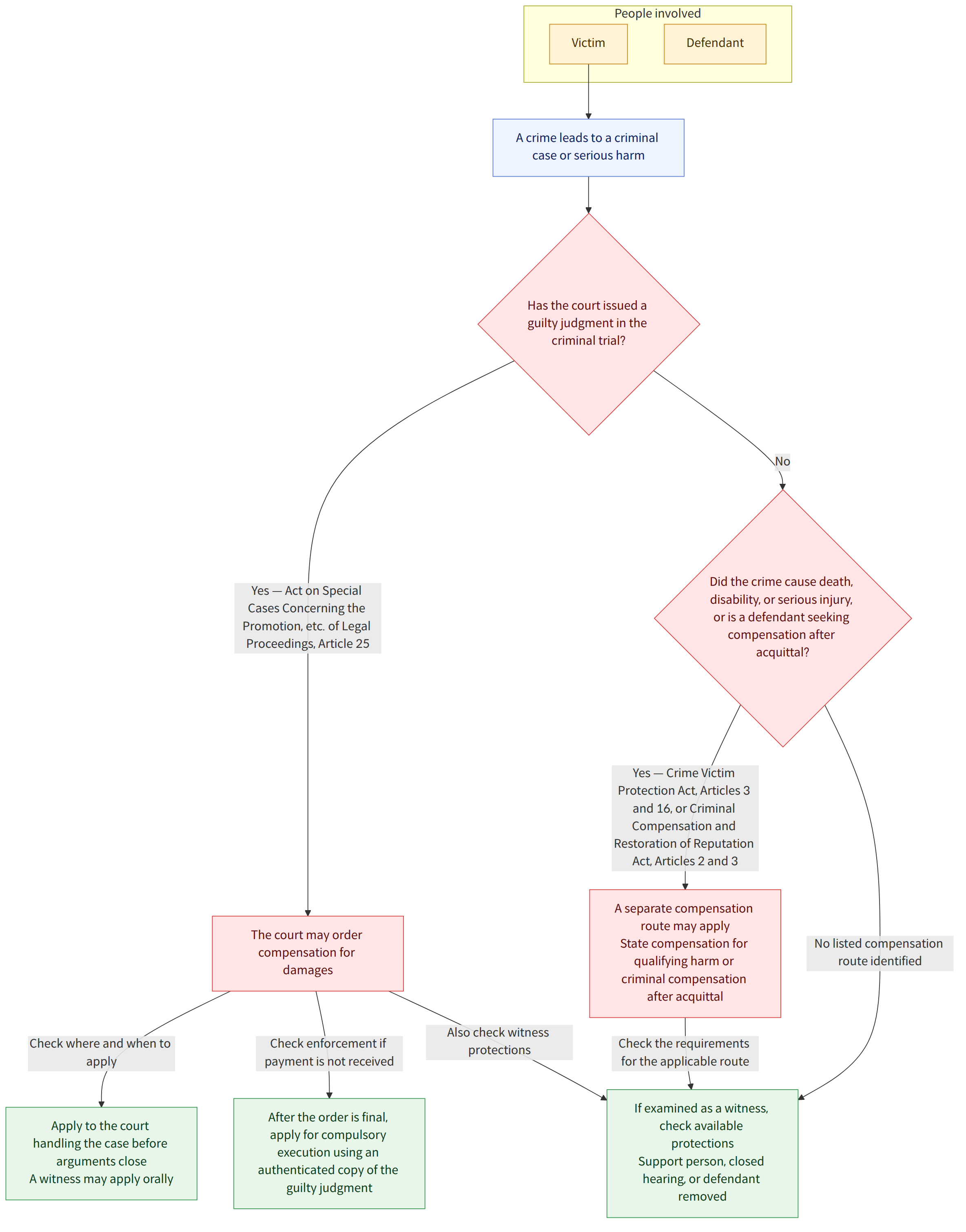
During a criminal trial, a victim may apply for a compensation order for direct losses, medical expenses, emotional distress, and other damages arising from certain crimes. A person who dies or sustains a disability or serious injury as a result of a crime may apply for crime victim compensation. After an acquittal or a decision not to prosecute, a claim for criminal compensation may be made subject to the applicable requirements. Victims may also request measures such as the presence of a support person or a closed hearing when they are examined as witnesses.
At a glance
Key points
- A compensation order is a system under which, when a guilty judgment is issued in a criminal trial, the court orders compensation for damages on its own initiative or upon an application by the victim or another person (Act on Special Cases Concerning the Promotion, etc. of Legal Proceedings, Article 25 (소송촉진등에관한특례법 제25조)).
- An application for a compensation order must be submitted to the court where the case is pending before the close of arguments at the trial hearing in the first or second instance. If the victim appears as a witness, an oral application may also be made (Act on Special Cases Concerning the Promotion, etc. of Legal Proceedings, Article 26 (소송촉진등에관한특례법 제26조)).
- If payment is not received even after a compensation order becomes final, an application for compulsory execution may be filed on the basis of an authenticated copy of the guilty judgment containing the order (Act on Special Cases Concerning the Promotion, etc. of Legal Proceedings, Article 34 (소송촉진등에관한특례법 제34조)).
- If a person dies or sustains a disability or serious injury as defined by law as a result of a crime against life or bodily integrity, the person may, subject to the applicable requirements, apply to the State for crime victim compensation (Crime Victim Protection Act, Articles 3 and 16 (범죄피해자보호법 제3조, 제16조)).
- A defendant whose acquittal has become final may, subject to the applicable requirements, claim criminal compensation for pretrial detention or execution of a sentence. If the defendant dies without filing a claim, an heir may file one (Criminal Compensation and Restoration of Reputation Act, Articles 2 and 3 (형사보상 및 명예회복에 관한 법률 제2조, 제3조)).
- Even if the judgment’s disposition does not state an acquittal, compensation may be claimed for pretrial detention necessary for the investigation or proceedings concerning a part found not guilty in the reasoning of the judgment. However, the court may dismiss all or part of the claim (Supreme Court Decision 2014Mo2521, March 11, 2016 (대법원 2016. 3. 11. 자 2014모2521 결정)).
- When a victim is examined as a witness, the victim may, subject to the applicable requirements, request the presence of a person with whom they have a relationship of trust, a closed hearing, or the defendant’s removal from the courtroom (Act on Special Cases Concerning the Punishment, etc. of Sexual Crimes, Article 34 (성폭력범죄의 처벌 등에 관한 특례법 제34조); Criminal Procedure Act, Articles 294-3 and 297 (형사소송법 제294조의3·제297조)).
- A legal assistant may attend the trial proceedings, and the victim’s identifying information and other personal details are protected under the applicable laws and regulations (Act on the Protection of Children and Juveniles from Sexual Abuse, Articles 18-6 and 19 (아동·청소년의 성보호에 관한 법률 제18조의6·제19조)).
Frequently asked questions
Q. Can I claim medical expenses or compensation for emotional distress in a criminal trial?
For certain crimes, you may apply for a compensation order during the criminal trial to seek compensation for direct property damage, medical expenses, and emotional distress. For other crimes as well, a compensation order may be issued if the defendant and the victim have agreed on the amount of damages.
Q. When and how do I apply for a compensation order?
Submit an application to the court where the case is pending before the close of arguments at the trial hearing in the first or second instance. If the victim appears in court as a witness, an oral application may also be made. The application must state what compensation is sought, the basis for it, and the amount claimed.
Q. What can I do if I have received a compensation order but the other party does not pay?
Once a compensation order becomes final or is declared provisionally enforceable, an authenticated copy of the guilty judgment containing the compensation order has the same effect, for purposes of civil execution, as an enforceable copy of a civil judgment. You may apply for compulsory execution on that basis.
Q. Can I apply for crime victim compensation even if the offender has not been arrested?
The case explains that you may apply to the State for crime victim compensation if someone dies as a result of a crime or sustains a disability or serious injury as defined by law. However, payment may be restricted for reasons such as a family relationship or fault on the part of the victim, and the amount may be adjusted to account for damages or other benefits received.
Q. When can I claim criminal compensation, and what is the time limit?
A defendant whose acquittal has become final may, subject to the applicable requirements, claim compensation for detention or execution of a sentence. According to the case, the claim must be filed within three years from the date the claimant learns that the acquittal has become final and within five years from the date it becomes final.
Q. Can I claim criminal compensation even if the acquittal appears only in the reasoning of the judgment?
This may be possible. You may claim compensation for pretrial detention that was necessary for the investigation or proceedings concerning the part found not guilty in the reasoning of the judgment. However, the court may dismiss all or part of the compensation claim.
Q. Can an heir file a claim on behalf of someone entitled to criminal compensation who has died?
If a person entitled to claim compensation dies without filing a claim, an heir may file one. The case explains that a sole heir may claim criminal compensation.
Q. Can I request someone’s presence or a closed hearing when the victim is examined as a witness?
When a victim of a sexual offense described in the case is examined as a witness, the victim may, subject to the applicable requirements, request the presence of a person with whom they have a relationship of trust. When a crime victim is examined as a witness, the victim may request a closed hearing if there is a recognized need. The presiding judge may also order the defendant to leave the courtroom if the judge finds that the victim would have difficulty giving a full statement in the defendant’s presence.
Q. Can the defendant learn the victim’s information by inspecting or copying the case records?
The case explains that disclosure by a legal assistant of the victim’s identifying information and other personal details should be permitted only to the extent the victim consents. The victim’s information is protected under the applicable laws prohibiting disclosure of confidential information, so it cannot be assumed that such information will be disclosed in every case.
Relevant laws
- Constitution, Article 27(5) (헌법 제27조제5항)
- Constitution, Article 28 (헌법 제28조)
- Act on Special Cases Concerning the Promotion, etc. of Legal Proceedings, Article 25 (소송촉진등에관한특례법 제25조)
- Act on Special Cases Concerning the Promotion, etc. of Legal Proceedings, Article 26 (소송촉진등에관한특례법 제26조)
- Act on Special Cases Concerning the Promotion, etc. of Legal Proceedings, Article 34 (소송촉진등에관한특례법 제34조)
- Civil Execution Act (민사집행법)
- Crime Victim Protection Act, Article 3 (범죄피해자보호법 제3조)
- Crime Victim Protection Act, Article 8 (범죄피해자보호법 제8조)
- Crime Victim Protection Act, Articles 16 through 32 (범죄피해자보호법 제16조부터 제32조까지)
- Crime Victim Protection Act, Article 19 (범죄피해자보호법 제19조)
- Crime Victim Protection Act, Article 20 (범죄피해자보호법 제20조)
- Crime Victim Protection Act, Article 21 (범죄피해자보호법 제21조)
- Crime Victim Protection Act, Article 22 (범죄피해자보호법 제22조)
- Criminal Compensation and Restoration of Reputation Act, Article 2 (형사보상 및 명예회복에 관한 법률 제2조)
- Criminal Compensation and Restoration of Reputation Act, Article 3 (형사보상 및 명예회복에 관한 법률 제3조)
Watch out for
- An application for a compensation order must be filed before the close of arguments at the trial hearing in the first or second instance.
- There is a time limit for filing a claim for criminal compensation, as described in the case. If you do not claim payment within two years after the compensation decision is served, you may lose your right to payment.
- Crime victim compensation may be denied or reduced due to a family relationship, fault on the part of the victim, or other reasons. It may also be adjusted if damages or other benefits have been received.
- An acquittal or compensation order does not always mean that compensation or damages in full are guaranteed. The court may dismiss all or part of a criminal compensation claim, and civil liability relating to a compensation order may later be disputed.
Source cases
This guide was compiled by AI from the following Korea Legal Aid Corporation consultation cases (in Korean).
- 형사재판절차에서 상해로 인한 치료비를 받을 수 있는지
- 범죄피해자 보호제도
- 구속피고인이 무죄확정판결을 받은 경우 형사보상 청구 여부
- 판결 이유에서 무죄로 판단된 경우 형사보상청구를 할 수 있는지 여부
- 배상명령을 받은 이후의 절차
- 형사보상청구권자가 사망하였을 경우 상속인이 청구할 수 있는지
- 공판절차에서 법률조력인이 출석할 수 있는지
- 피해자 증인신문시 신뢰관계있는 자의 동석요청 가능한지
- 피고인이 기록 열람·등사를 하여 피해자 정보 알게 되는지
- 피해자 증인신문시 피고인을 나가게 할 수 있는지
- 범죄피해구조금 제도는 무엇인지
- 피해자 증인신문시 심리비공개요청이 가능한지
- 법률조력인이 피해자 인적정보 등을 누설할 수 있는지
This guide is general legal information about Korean law, not legal advice for your situation. For a specific case, consult a lawyer or the Korea Legal Aid Corporation (call 132 in Korea).