
Guide to Criminal Retrials and Formal Trials Against Summary Orders
Based on 13 consultation cases · Updated · Translated from the Korean original.
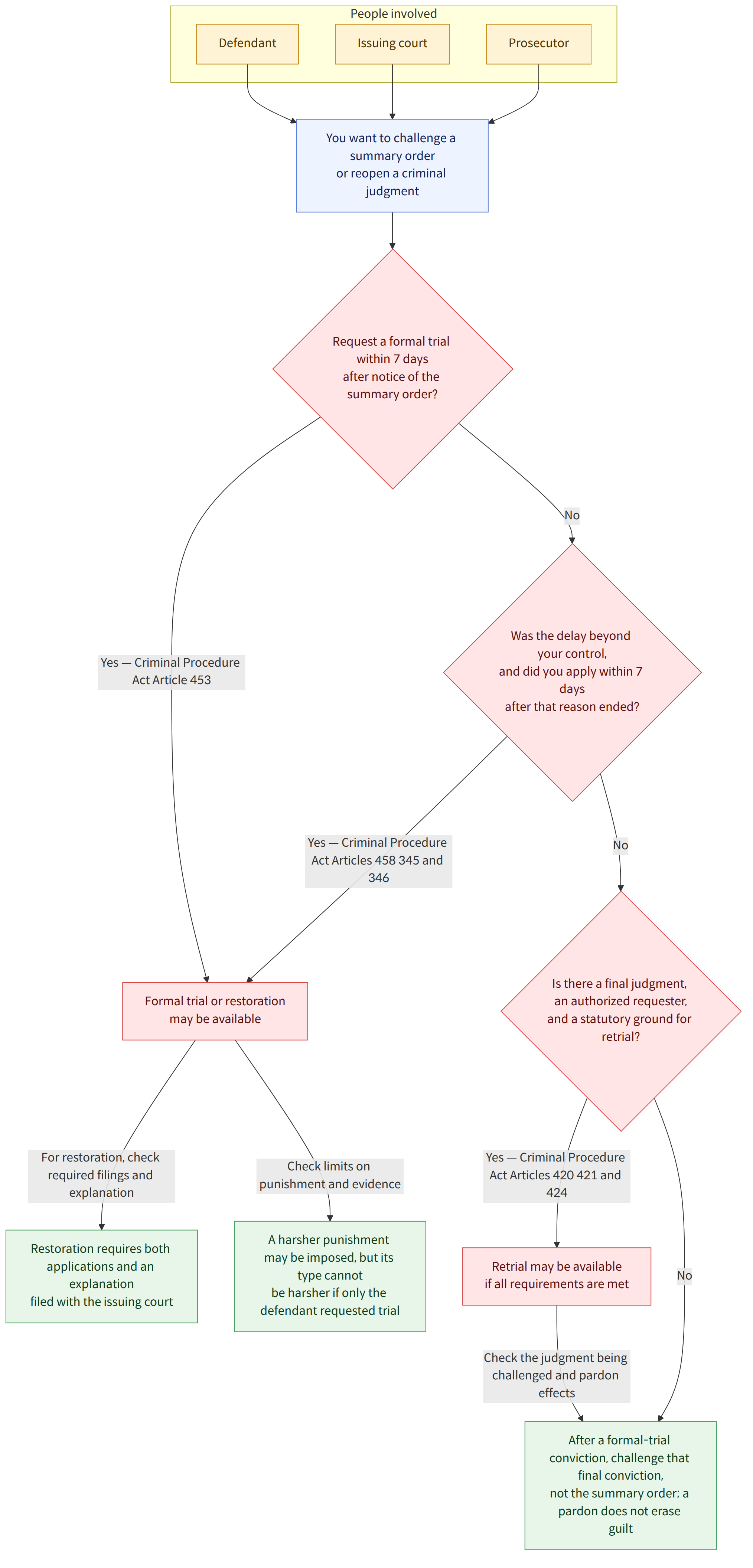
To challenge a summary order, you must generally request a formal trial within 7 days from the day you are notified of it. If you miss the deadline, you should consider whether the delay was due to a reason not attributable to you and the procedure for applying for restoration. A retrial must be requested against a final judgment by a person entitled to do so and on a ground prescribed by law. Whether a special pardon was granted or formal-trial proceedings took place may affect the subject and outcome of a retrial.
At a glance
Key points
- A summary order is a judicial decision imposing a fine, a minor fine, or confiscation following a written examination without trial proceedings. To challenge it, you must file a written request for a formal trial with the court that issued it within 7 days from the day you are notified of it (Criminal Procedure Act, Article 453 (형사소송법 제453조)).
- To obtain restoration of the right to request a formal trial, you must submit both an application for restoration and a request for a formal trial within 7 days from the day a reason not attributable to you ceased to exist, and explain that reason (Criminal Procedure Act, Article 458(1) (형사소송법 제458조 제1항), Article 345 (제345조), and Article 346 (제346조)).
- At a formal trial against a summary order, a punishment more severe than that in the summary order may be imposed, but if only the defendant requested the formal trial, the type of punishment may not be changed to a more severe one. Even if the case is heard together with a separately prosecuted case, a sentence that violates the prohibition on increasing the type of punishment is not permitted (Criminal Procedure Act, Article 457-2 (형사소송법 제457조의2)).
- If a defendant who requested a formal trial is absent from two hearing dates and evidence is examined without the defendant present, the defendant may be deemed to have consented to the evidence. Even if the defendant later appears and challenges the evidence on appeal, its lawfully established admissibility is not lost for that reason alone (Criminal Procedure Act, Article 318(2) (형사소송법 제318조 제2항), Article 458(2) (제458조 제2항), and Article 365 (제365조); Supreme Court Decision 2007Do5776, May 27, 2010).
- Even if a special pardon extinguishes the effect of the sentence, it does not eliminate the findings of fact or the determination of guilt in the conviction. Accordingly, a retrial may be requested if a statutory ground for retrial exists. Even if guilt is established at retrial, imposing a sentence again or upholding the original judgment may impair the legal status obtained through the special pardon (Criminal Procedure Act, Article 420 (형사소송법 제420조) and Article 439 (제439조); Supreme Court en banc Decision 2011Do1932, May 21, 2015; Supreme Court Decision 2012Do2938, October 29, 2015).
- A retrial of the judgment itself dismissing an appeal or final appeal is not available on every ground. One of the limited grounds specified in the Criminal Procedure Act, such as fabrication or alteration of evidence or false testimony, must exist (Criminal Procedure Act, Article 421(1) (형사소송법 제421조 제1항)).
- If a conviction becomes final in the formal-trial proceedings after a formal trial was requested against a summary order, the retrial must be requested against the final conviction, not the summary order that has ceased to have effect (Criminal Procedure Act, Article 456 (형사소송법 제456조); Supreme Court Decision 2011Do10626, April 11, 2013).
- The right to request a retrial is limited to persons specified by law, including a prosecutor, the person convicted, and that person's legal representative. If the person requesting a retrial dies after filing the request but before the decision becomes final, the proceedings end, and a spouse or relative cannot continue them (Criminal Procedure Act, Article 424 (형사소송법 제424조); Supreme Court Decision 2014Mo739, May 30, 2014).
Frequently asked questions
Q. I received a summary order and believe it is unfair. What should I do?
A summary order is a judicial decision imposing a fine, a minor fine, or confiscation following a written examination without trial proceedings. To challenge it, you must file a written request for a formal trial with the court that issued the summary order within 7 days from the day you were notified of it. If the request is legally valid, the case will be heard in trial proceedings.
Q. Can I still request a formal trial if I missed the deadline?
If you were unable to file the request within the time limit for a reason that was not attributable to you or your representative, you may apply for restoration of the right to request a formal trial. Within 7 days from the day that reason ceased to exist, you must submit both an application for restoration and a request for a formal trial to the court that issued the summary order, and explain the reason.
Q. Can I submit the application to restore my right to request a formal trial first and file the request for a formal trial later?
The example explains that you must request a formal trial at the same time as applying for restoration. If you submit only the application for restoration and omit the request for a formal trial, you may be considered not to have complied with the procedure prescribed by law, making it difficult to obtain permission for restoration.
Q. If I request a formal trial against a summary order, could my fine increase or could I be sentenced to imprisonment?
A fine greater than the one in the summary order may be imposed. However, when only the defendant requests a formal trial, the type of punishment may not be changed to a more severe one; therefore, the fine in the summary order cannot be replaced with imprisonment.
Q. Can I challenge the evidence again on appeal after missing two formal-trial hearings?
If the defendant is absent twice and evidence is examined without the defendant present, the defendant may be deemed to have consented to the evidence. Even if the defendant later appears at the appellate trial and seeks to withdraw that consent, the admissibility of evidence already lawfully established is not thereby lost.
Q. Can I request a retrial of a final conviction after receiving a special pardon?
Even if a special pardon extinguishes the effect of the sentence, it does not eliminate the findings of fact or the determination of guilt in the conviction. Accordingly, a retrial may be requested if a statutory ground for retrial exists. Even if guilt is again established at retrial, imposing a sentence again or upholding the original judgment may impair the legal status obtained through the special pardon.
Q. Can I request a retrial solely on the ground that the judgment dismissing my final appeal was unjust?
That reason alone is insufficient. A retrial of a judgment dismissing an appeal or final appeal is available only on the limited grounds prescribed by law; merely arguing that the lower court incorrectly assessed the facts or evidence does not qualify.
Q. If I requested a formal trial against a summary order and the conviction became final, which judgment should I seek to have retried?
A request for a formal trial renders the summary order ineffective. Therefore, if you wish to rely on a ground for retrial, you must request a retrial of the conviction that became final in the formal-trial proceedings, not of the summary order that has ceased to have effect.
Q. Can a parent request a retrial on behalf of an adult child? If the person requesting a retrial dies, can family members continue the case?
The right to request a retrial is limited to persons specified by law, so a parent cannot request one on a child's behalf merely because the adult child is overseas. However, the example distinguishes cases in which the adult child is recognized as having a mental or physical disorder. If the person requesting a retrial dies before the decision on the request becomes final, the proceedings end, and a spouse or relative cannot continue them.
Q. Can a defendant aged 70 or older who requests a formal trial against a summary trial judgment be appointed a public defender?
If a request for a formal trial against a summary trial judgment is legally valid, trial proceedings begin. If the defendant is 70 or older and has no attorney, the court may appoint an attorney on its own authority.
Relevant laws
- Criminal Procedure Act, Article 33(1)(3) (형사소송법 제33조 제1항 제3호)
- Criminal Procedure Act, Article 283 (형사소송법 제283조)
- Criminal Procedure Act, Article 318(1)–(2) (형사소송법 제318조 제1항·제2항)
- Criminal Procedure Act, Articles 340–342 (형사소송법 제340조부터 제342조까지)
- Criminal Procedure Act, Articles 344–352 (형사소송법 제344조부터 제352조까지)
- Criminal Procedure Act, Article 354 (형사소송법 제354조)
- Criminal Procedure Act, Article 345 (형사소송법 제345조)
- Criminal Procedure Act, Article 346(1), (3) (형사소송법 제346조 제1항·제3항)
- Criminal Procedure Act, Article 365 (형사소송법 제365조)
- Criminal Procedure Act, Article 420 (형사소송법 제420조)
- Criminal Procedure Act, Article 421(1) (형사소송법 제421조 제1항)
- Criminal Procedure Act, Article 424 (형사소송법 제424조)
- Criminal Procedure Act, Article 439 (형사소송법 제439조)
- Criminal Procedure Act, Article 453 (형사소송법 제453조)
- Criminal Procedure Act, Article 454 (형사소송법 제454조)
Watch out for
- The deadline to request a formal trial is 7 days from the day you are notified of the summary order. Take care not to miss the deadline when calculating the time limit or filing your request.
- When applying to restore your right to request a formal trial, submit the request for a formal trial together with the application for restoration; do not submit only the application for restoration.
- The fine may increase at a formal trial. The prohibition on increasing the type of punishment does not mean that the amount of the fine cannot increase.
- When requesting a retrial, separately confirm which judgment is the subject of the request, whether the applicant is legally entitled to request one, and whether the asserted ground for retrial is recognized.
Source cases
This guide was compiled by AI from the following Korea Legal Aid Corporation consultation cases (in Korean).
- 정식재판을 청구한 피고인이 2회 불출석 한 경우
- 재심사건에 불이익변경금지의 원칙이 적용되는지
- 약식명령에 대하여 불복할 경우 그 방법
- 상고기각 판결이 부당하다는 취지만으로 재심청구가 가능한지
- 정식재판을 청구한 사건과 공소가 제기된 사건을 병합 심리한 경우 불이익변경 여부의 판단기준
- 즉심에 대한 정식재판청구 시 국선변호인선정 가능 여부
- 정식재판 청구를 함께 하지 아니한 약식명령에 대한 정식재판청구권 회복청구가 적법한지
- 형 선고의 효력을 상실케 하는 특별사면에 대한 재심이 허용되는지 여부
- 약식명령에 정식재판을 청구한 경우 형이 가중될 수 있는지
- 약식명령에 대한 정식재판절차에서 유죄판결이 선고되어 확정된 경우 재심청구의 대상
- 재심청구인이 재심 청구를 한 후 청구에 대한 결정이 확정되기 전에 사망한 경우
- 재심청구권자
- 정식재판청구권회복청구
This guide is general legal information about Korean law, not legal advice for your situation. For a specific case, consult a lawyer or the Korea Legal Aid Corporation (call 132 in Korea).