
Criminal Offenses Against Sexual Morals: Standards for Obscene Conduct and Material
Based on 10 consultation cases · Updated · Translated from the Korean original.
Whether obscene material or bodily exposure is punishable depends on the content and manner of the expression, the scope of its exposure to the public, and the circumstances. In particular, obscenity, public accessibility, and distribution through an information and communications network are separate requirements and should be considered separately.
At a glance
Key points
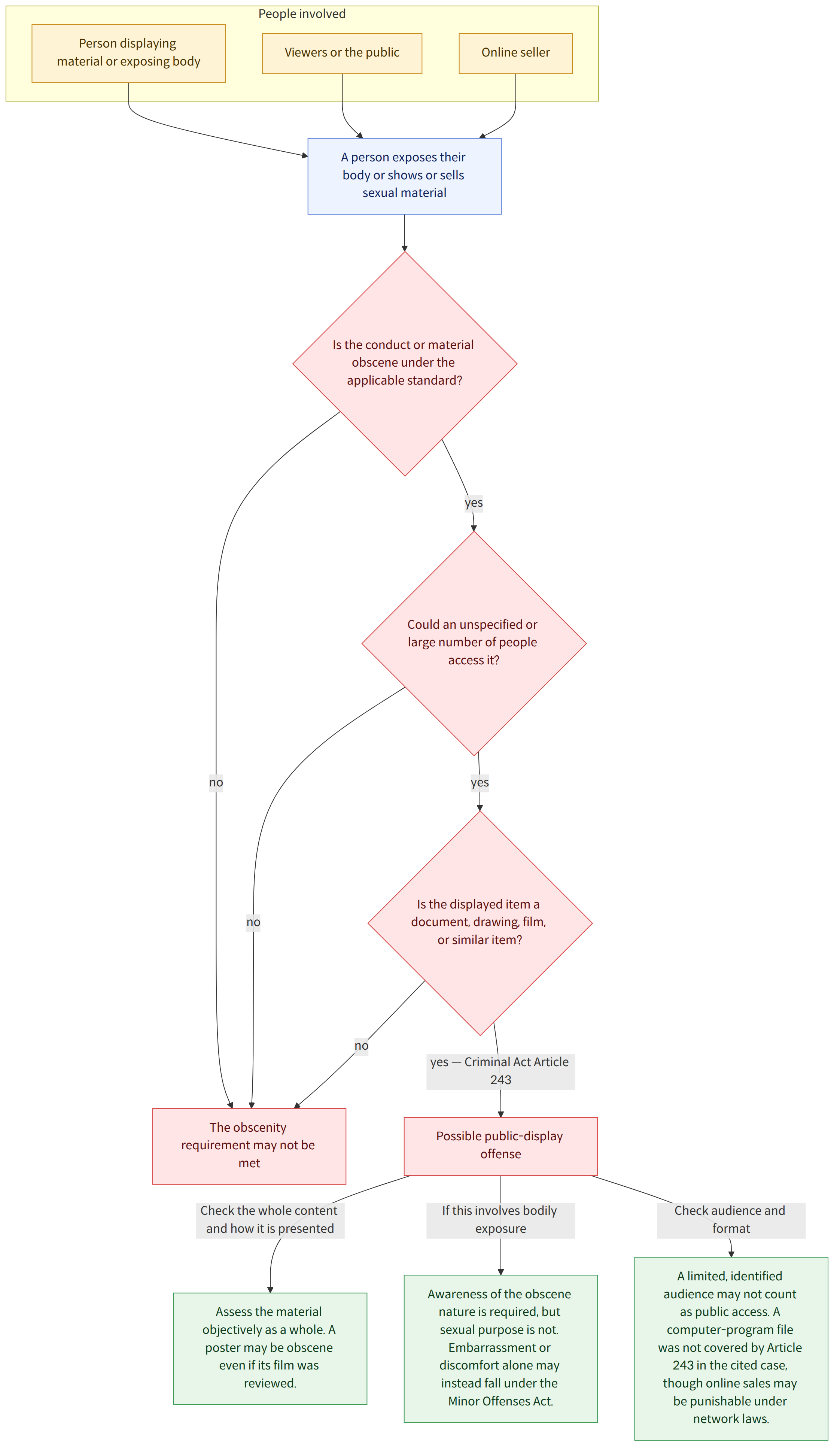
- An obscene act for purposes of the public-indecency offense is conduct that arouses the sexual desire of ordinary people, offends normal sexual modesty, and contravenes sexual morality. A sexual purpose is not essential, but awareness of the obscene nature of the conduct is required (Criminal Act, Article 245; Supreme Court Decision 2000Do4372).
- Even if a person exposes their body, where the specific circumstances show that the conduct causes only embarrassment or discomfort, it may be punishable under the Minor Offenses Act rather than as public indecency (Minor Offenses Act, Article 1(41); Supreme Court Decision 2003Do6514).
- To publicly display or screen an obscene document, drawing, film, or similar item, it must be accessible to an unspecified or large number of people. Public accessibility may not be established if the item was shown only to a limited, identified group (Criminal Act, Article 243; Supreme Court Decision 73Do409).
- Case law has held that an obscene computer-program file is not a document, drawing, film, or other object within the meaning of Article 243 of the Criminal Act. The case explains, however, that selling obscene material over a communications network may be punishable under laws relating to information and communications networks (Supreme Court Decision 98Do3140).
- Whether material is obscene is assessed objectively and as a whole, including how explicitly it depicts sexual parts. Adult products that are crudely made or depict only certain characteristics in simplified form may not be considered obscene (Supreme Court Decision 2006Do3558).
- Even if the film itself has undergone review, its promotional poster may constitute obscene material if it excessively emphasizes sexually suggestive aspects and harms sexual sensibilities (Criminal Act, Article 243; Supreme Court Decision 90Do1485).
- The fact that a person in a video looks somewhat young does not, by itself, establish that the material is child or juvenile pornography. The assessment considers various information, including the person’s appearance and physical development and the source of the video, to determine whether they would objectively and unmistakably be recognized as a child or juvenile (Act on the Protection of Children and Juveniles from Sexual Abuse, Article 2(5); Supreme Court Decision 2013Do4503).
- The possibility of a retrial following the decision that the adultery offense was unconstitutional is not determined solely by when the offense occurred. The case explains that a retrial may be sought where the conviction became final after an earlier decision upholding the law’s constitutionality (Constitutional Court Act, Article 47(3) and (4); Supreme Court Decision 2015Mo1475).
Frequently asked questions
Q. Can an act constitute public indecency even if there was no sexual purpose?
It may be possible. According to the cases, sexual arousal or gratification is not an essential requirement; what matters is whether the person was aware of the obscene nature of the conduct.
Q. Does exposing one’s buttocks in front of people always constitute public indecency?
Not necessarily. Whether conduct is obscene and offensive to sexual modesty is determined by considering the body part exposed, the manner and extent of the exposure, the place, and the motive. If it causes only embarrassment or discomfort, it may instead constitute a violation of the Minor Offenses Act.
Q. Does showing an obscene video to a few friends at home constitute publicly displaying obscene material?
If only a limited, identified group could see it, the conduct may not amount to publicly displaying or screening an item under Article 243 of the Criminal Act. In one case, showing something to two friends was found not to satisfy the public-accessibility requirement.
Q. If I sell an obscene video file online, can I be punished under Article 243 of the Criminal Act?
The case cited found that a computer-program file did not qualify as a document, drawing, film, or other object under Article 243 of the Criminal Act. However, it explains that selling such material over a communications network may be punishable as a violation of laws relating to information and communications networks.
Q. Can a poster for a film rated for adults only also be considered obscene material?
It can. Even if a film has been reviewed, its poster may be considered obscene if it excessively emphasizes the film’s sexually provocative aspects, arouses sexual desire, and harms normal sexual sensibilities.
Q. Can making or displaying adult products or penis-enlargement devices constitute an offense involving obscene material?
An object is not automatically considered obscene solely because of its intended use. Adult products are assessed by considering the specificity of their depiction and other factors as a whole. In one case, a penis-enlargement device was found not to be obscene in itself.
Q. If someone in a video looks young, does that make it child or juvenile pornography?
A person’s youthful appearance alone is not conclusive. The assessment considers their appearance and physical development, as well as information about the source of the video and its cast, to determine whether they would objectively and unmistakably be recognized as a child or juvenile.
Q. I received a final conviction for adultery. Can I seek a retrial after the law was declared unconstitutional?
The case explains that a retrial may be sought if a conviction for adultery became final after an earlier decision upholding the law’s constitutionality, even if the offense occurred before that decision. Whether this applies in a particular case depends on the specific circumstances, including the relevant dates.
Relevant laws
- Criminal Act, Article 241 (형법 제241조)
- Criminal Act, Article 243 (형법 제243조)
- Criminal Act, Article 244 (형법 제244조)
- Criminal Act, Article 245 (형법 제245조)
- Constitutional Court Act, Article 47(3) and (4) (헌법재판소법 제47조 제3항·제4항)
- Former Framework Act on Telecommunications, Article 48-2 (구 전기통신기본법 제48조의2)
- Act on Promotion of Information and Communications Network Utilization and Information Protection, Article 42-2 (정보통신망 이용촉진 및 정보보호 등에 관한 법률 제42조의2)
- Act on Promotion of Information and Communications Network Utilization and Information Protection, Article 73(3) (정보통신망 이용촉진 및 정보보호 등에 관한 법률 제73조 제3호)
- Act on Promotion of Information and Communications Network Utilization and Information Protection, Article 74(1)(2) (정보통신망 이용촉진 및 정보보호 등에 관한 법률 제74조 제1항 제2호)
- Minor Offenses Act, Article 1(41) (경범죄처벌법 제1조 제41호)
- Act on the Protection of Children and Juveniles from Sexual Abuse, Article 2(4) and (5) (아동·청소년의 성보호에 관한 법률 제2조 제4호·제5호)
Watch out for
- Obscenity is not established merely because there was exposure or expression. The specific circumstances, including the place, manner, extent, and audience, must also be considered.
- Provisions of laws relating to information and communications networks and the Minor Offenses Act cited in the cases are explained with reference to the laws in force at the time. The laws and provisions currently in force should be checked separately.
- Whether a retrial is available for an adultery conviction should not be determined solely by when the offense occurred. The relationship between the earlier decision upholding the law’s constitutionality and the date the conviction became final must be checked.
Source cases
This guide was compiled by AI from the following Korea Legal Aid Corporation consultation cases (in Korean).
This guide is general legal information about Korean law, not legal advice for your situation. For a specific case, consult a lawyer or the Korea Legal Aid Corporation (call 132 in Korea).