
Requirements for Trespass to a Residence and Key Cases
Based on 19 consultation cases · Updated · Translated from the Korean original.
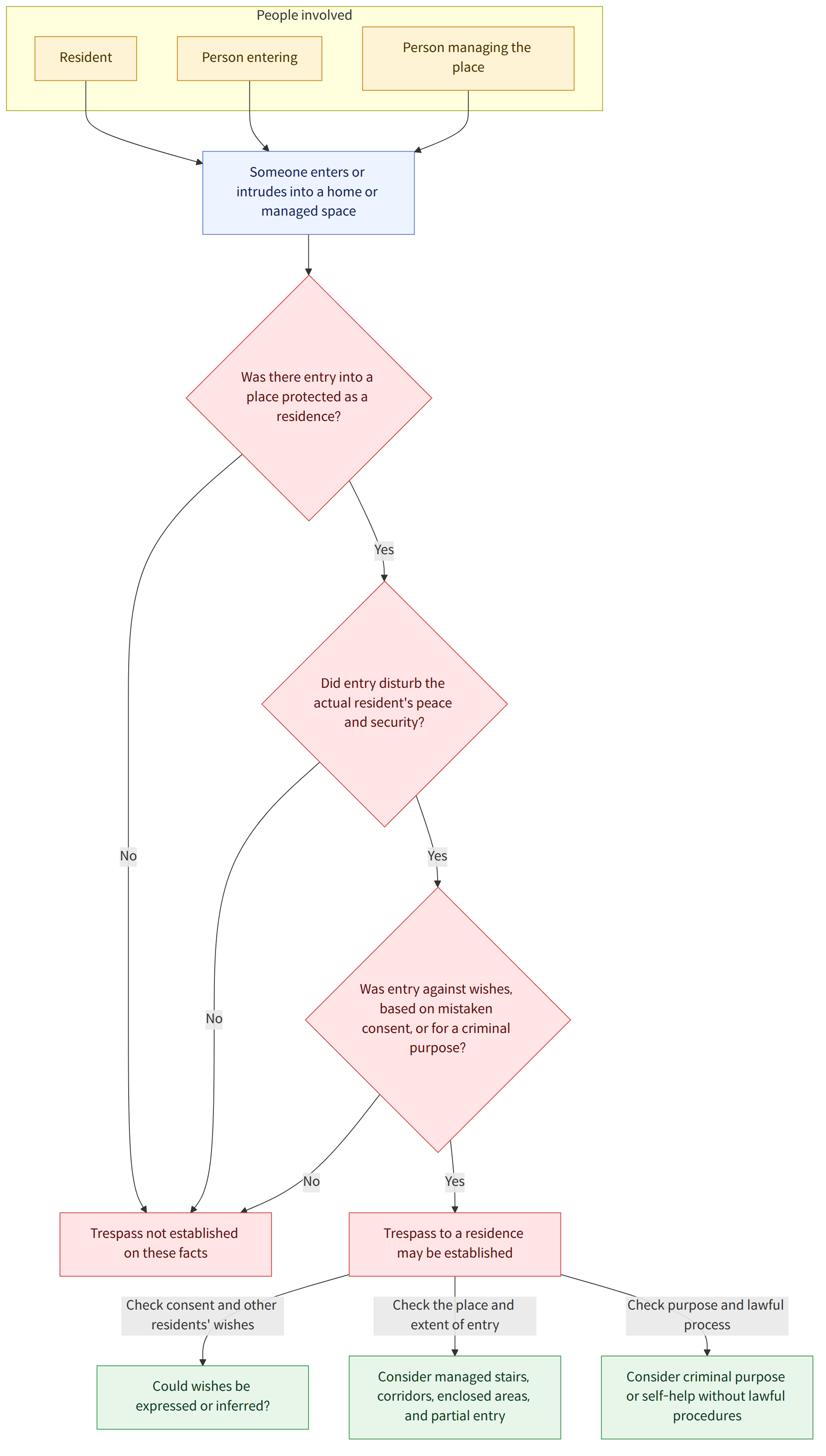
Whether the crime of trespass to a residence is established depends primarily on whether the peace and security enjoyed by the actual resident have been disturbed, rather than on whether the person in possession has a legal right to occupy the residence. Even where consent to enter was given, the crime may be established depending on the true meaning of that consent, the purpose of entry, and how the place is managed.
At a glance
Key points
- The crime of trespass to a residence protects the peace and security of a residence as a matter of fact; whether the person in possession has a valid legal right does not determine whether the crime is established (Cases 1, 7, and 14).
- Even if one person living in the home gives consent, the crime of trespass to a residence may be established if entry is contrary to another resident’s express or inferred wishes (Case 1).
- It cannot readily be concluded that consent was given where a resident permitted entry by mistake, or where the circumstances show that the resident would not have consented had they known the criminal purpose (Case 4).
- The crime of trespass to a residence may be established even if the person’s entire body did not enter, provided that part of the person entered the residence and the entry was sufficient to disturb the peace and security of the home as a matter of fact (Cases 1 and 6).
- A residence is not limited to the interior of a home. Depending on how they are managed and on the specific circumstances, common-use stairs and corridors in a multi-unit residence or the enclosed area around a residence may be the subject of the crime of trespass to a residence (Cases 11, 13, and 16).
- Even a restaurant open to the public may be the subject of the crime of trespass to a residence if someone enters for a criminal purpose or otherwise against the express or inferred wishes of the person operating it (Cases 1 and 10).
- Entering a residence during the day with the intent to steal may constitute the crime of trespass to a residence even before the person begins committing theft. At night, the person may begin committing nighttime housebreaking and larceny upon entering the residence (Cases 2 and 5).
- Even when a rights-holder is seeking to exercise their rights, entering a residence in another person’s possession or recovering possession by self-help without following lawful procedures may constitute the crime of trespass to a residence (Cases 7 and 14).
Frequently asked questions
Q. If one person I live with gives me permission, may I enter the home of another resident?
Not always. If one resident’s consent is contrary to another resident’s wishes, and those wishes are explicit or can be inferred from the circumstances, the crime of trespass to a residence may be established.
Q. Can putting just my head through a window constitute trespass to a residence?
Yes. It is not necessary for the person’s entire body to enter. The crime of trespass to a residence may be established if part of the person enters and the intrusion is sufficient to disturb the resident’s peace and security in the home.
Q. Can entering a place open to everyone, such as a restaurant, for the purpose of committing a crime constitute trespass to a residence?
Even in a place open to the public, entering against the express or inferred wishes of the person operating it may constitute the crime of trespass to a residence. In a case where someone entered a restaurant disguised as a customer to install a listening device, the court found that the conduct could constitute this crime.
Q. Can a landlord or property owner commit trespass to a residence by entering a home they own?
Yes. While a tenant is actually in possession of the property, even its owner may disturb the tenant’s peace and security in the home by entering at will without following the procedures prescribed by law.
Q. Do the stairs of a multi-unit residence or the passageway inside a home’s gate count as part of the residence?
Common-use stairs and corridors in a multi-unit residence serve the daily lives of the occupants of each unit and are intended to be subject to the residents’ supervision and management. Accordingly, absent special circumstances, they may be the subject of the crime of trespass to a residence. Entry into the enclosed area inside a gate may also raise an issue if it is carried out in a manner that disturbs the peace and security of the home.
Q. Can I be punished for entering a home during the day to steal something even if I do not manage to steal anything?
Entering a home during the day with the intent to steal may itself constitute the crime of trespass to a residence. However, there is a case holding that the person cannot be considered to have begun committing theft if they had not yet started searching for items to steal.
Q. May I break the lock and enter a building occupied by someone else to recover what I consider to be my rights?
Cases have held that even an owner or rights-holder may commit the crime of trespass to a residence by forcibly entering a building in another person’s possession as a means of self-help. Rights must be exercised through lawful procedures.
Q. Does refusing a demand to leave the workplace after an unlawful lockout constitute the crime of refusing to leave?
If a lockout is not recognized as a legitimate labor dispute action, entering a workplace that the person was ordinarily allowed to enter may not constitute the crime of trespass to a residence. An employee who has occupied a workplace as part of a lawful labor dispute may not commit the crime of refusing to leave by refusing a demand to leave following an unlawful lockout.
Q. Does leaving household belongings behind after moving out constitute the crime of refusing to leave?
In a case, the court held that a person had left the residence—and therefore had not committed the crime of refusing to leave—after returning the house key and leaving with their family, even though they had left household belongings behind. The court explained that leaving means the person’s body departing from the residence.
Relevant laws
- Criminal Act, Article 319(1) and (2) (형법 제319조 제1항·제2항)
- Criminal Act, Article 329 (형법 제329조)
- Criminal Act, Article 330 (형법 제330조)
- Criminal Act, Article 331(1) (형법 제331조 제1항)
- Criminal Act, Article 331-2 (형법 제331조의2)
- Criminal Act, Article 332 (형법 제332조)
- Criminal Act, Article 342 (형법 제342조)
- Criminal Act, Article 297 (형법 제297조)
- Act on Special Cases Concerning the Punishment, etc. of Sexual Crimes, Article 3(1) (성폭력범죄의 처벌 등에 관한 특례법 제3조 제1항)
- Act on Special Cases Concerning the Punishment, etc. of Sexual Crimes, Article 8(1) (성폭력범죄의 처벌 등에 관한 특례법 제8조 제1항)
Watch out for
- Do not assume that you may enter a residence in another person’s possession at will merely because you are the owner or can claim a right to it.
- Consider not only whether permission to enter was given, but also who gave it and whether that person would have granted permission had they known the purpose of entry.
- There are cases in which merely entering the grounds of a construction site was not considered an intrusion into a site office or an unfinished building. Distinguish the structure and management of the place entered, as well as the specific circumstances.
Source cases
This guide was compiled by AI from the following Korea Legal Aid Corporation consultation cases (in Korean).
- 처가 집안에서 간통한 때 그 상대 남자의 주거침입죄 여부
- 상습으로 다른 사람의 집에 들어가 재물을 훔친 경우 주거침입죄 성립 여부
- 공사현장의 타워크레인에 올라가 이를 점거한 경우 주거침입죄 성립 여부
- 착오로 주거에 들어오도록 승낙을 한 경우 주거침입죄가 성립되는지
- 물건 훔치려고 주거침입 후 곧 도망친 경우 처벌 여부
- 신체의 일부만 들어간 경우에도 주거침입죄에 해당하는지
- 권리자가 자신의 권리를 행사하기 위해 주거에 들어간 경우 주거침입죄가 성립하는지 여부
- 주거에 침입하여 강간하면서 상해를 입힌 경우 형사책임
- 야간에 퇴직회사에 들어가 자필서류를 가져온 경우 처벌 여부
- 대중의 출입허가장소에 범죄목적으로 출입을 한 경우 주거침입죄의 성부
- 실제 빌라의 객실에 들어가지 않고 계단에 들어가기만 하여도 주거침입죄가 성립되는지
- 부당한 직장폐쇄와 주거침입죄의 성립여부
- 위요지도 주거침입죄에 객체에 해당하는지
- 자력구제로 침입한 것도 주거침입 성립하는지
- 직장폐쇄와 주거침입
- 대문 안의 마당이나 통로가 주거에 해당하는지
- 퇴거요구를 받고 건물에서 나가면서 가재도구 등을 남겨둔 경우 퇴거불응죄 성립 여부
- 외도 현장을 촬영할 목적으로 침입하는 것도 죄인지
- 주거침입죄의 죄수
This guide is general legal information about Korean law, not legal advice for your situation. For a specific case, consult a lawyer or the Korea Legal Aid Corporation (call 132 in Korea).