
Guide to Types of Debt Assumption and Creditor Claims
Based on 15 consultation cases · Updated · Translated from the Korean original.
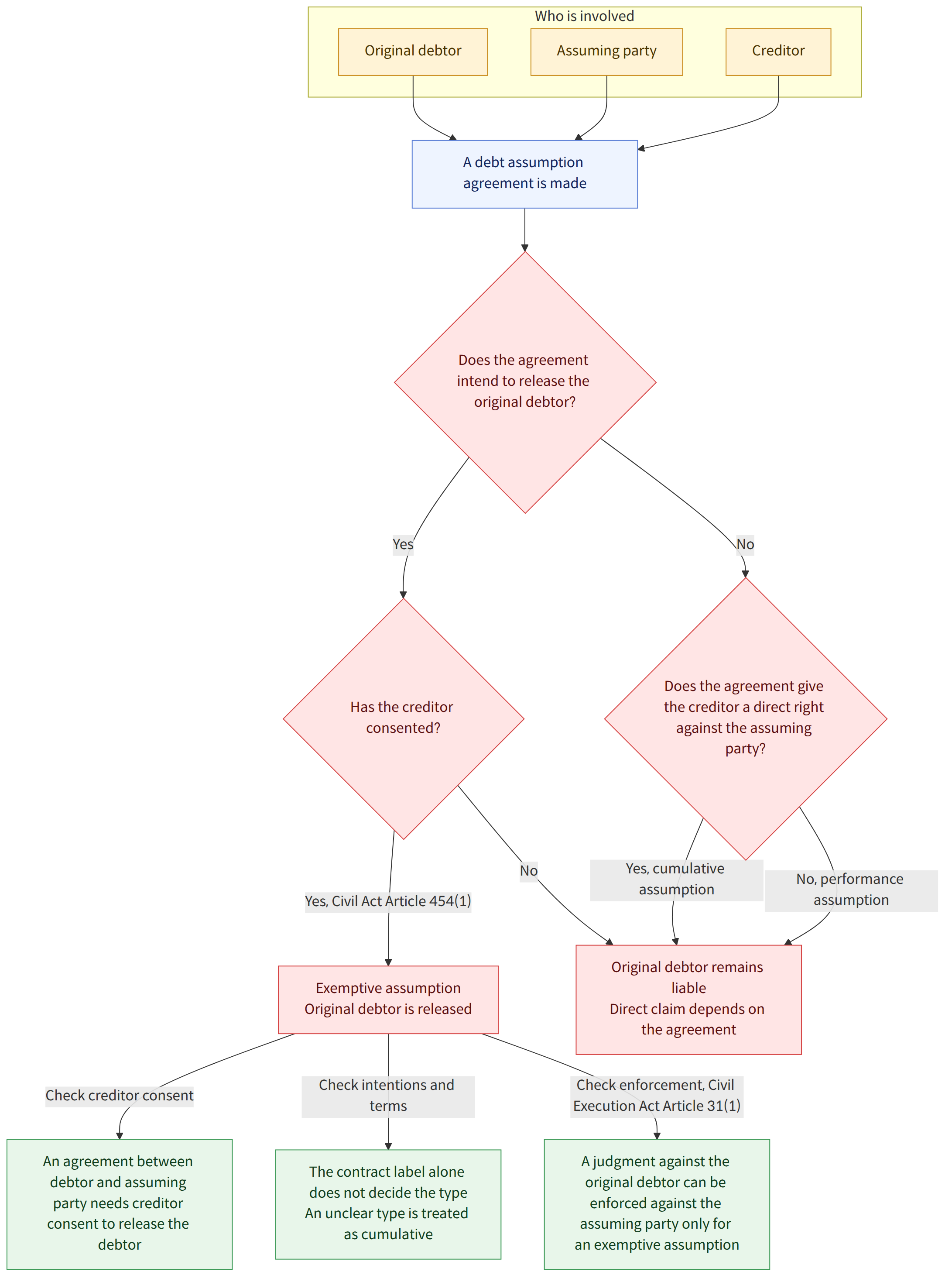
Debt assumption is divided into an exemptive assumption, in which the original debtor is released from the debt; a cumulative assumption, in which the original debtor and the assuming party are both liable; and a performance assumption, in which the assuming party promises to perform only in relation to the debtor. The type is not determined by the label used in the contract alone. Depending on the parties’ intentions and the terms of the agreement, the person against whom the creditor may claim can differ.
At a glance
Key points
- An exemptive assumption of debt is a form in which the assuming party succeeds to the debtor’s position and the original debtor is released. If it is made by an agreement between the debtor and the assuming party, it takes effect only with the creditor’s consent (Civil Act, Article 454(1) (민법 제454조 제1항)).
- A cumulative assumption of debt is a form in which the original debtor remains liable and the assuming party also becomes directly liable to the creditor. The creditor’s consent is not a requirement for it to take effect, and the creditor may demand performance directly from the assuming party (Case 12, Supreme Court Decision 98Da33765, rendered Nov. 24, 1998).
- If it is unclear whether an assumption of debt is exemptive or cumulative, it is treated as cumulative. The specific type is determined, however, by interpreting the parties’ intentions as expressed in the agreement (Case 13, Supreme Court Decision 2002Da36228, rendered Sept. 24, 2002).
- A performance assumption is an arrangement in which the assuming party promises the debtor to perform the debtor’s obligation to the creditor. Absent special circumstances, the creditor cannot demand payment directly from the assuming party (Case 14, Supreme Court Decision 2008Da75072, rendered June 11, 2009).
- Even if a purchaser of real estate assumes secured debts or other obligations and receives a corresponding deduction from the purchase price, that fact alone does not make the assumption exemptive. Whether the creditor may claim directly depends on a comprehensive assessment of matters including whether the parties intended to give a third party a direct right (Case 2, Supreme Court Decision 97Da28698, rendered Oct. 24, 1997).
- A cumulative assumption of debt may be treated as a contract for the benefit of a third party. The creditor may acquire the right to claim directly against the assuming party by indicating an intention to accept the benefit, such as by demanding performance from that party. However, if the creditor states that it does not consent to an exemptive assumption without knowing that the assumption is cumulative, that statement may not be treated as a rejection of the benefit (Case 5, Supreme Court Decision 2011Da56033, rendered Sept. 13, 2013).
- If an exemptive assumption of debt is recognized, a succession execution clause may be obtained to enforce against the assuming party a judgment against the original debtor. A cumulative assumption, by contrast, creates a separate obligation from that of the original debtor, so the enforceability of the original judgment cannot be extended to the assuming party (Civil Execution Act, Article 31(1) (민사집행법 제31조 제1항)).
- Even if a business transferee does not use the transferor’s trade name, notifying a creditor individually that it will assume the transferor’s debt may make the transferee liable to that creditor for payment (Commercial Act, Article 44 (상법 제44조), Case 7).
Frequently asked questions
Q. We entered into a debt assumption agreement. Does the original debtor no longer have to pay?
That depends on whether it is an exemptive assumption or a cumulative assumption. In an exemptive assumption, the original debtor is released from the debt relationship; in a cumulative assumption, the original debtor remains liable. If the type is unclear, it may be treated as a cumulative assumption.
Q. Can an assumption of debt be valid without the creditor’s consent?
An exemptive assumption of debt under an agreement between the debtor and the assuming party takes effect only with the creditor’s consent. A cumulative assumption of debt, by contrast, may take effect without the creditor’s consent.
Q. If the assuming party under a performance assumption does not pay, can the creditor claim directly against that person?
As a rule, the creditor cannot claim directly against the assuming party. The assuming party under a performance assumption is obligated to perform the debt in relation to the debtor, but does not itself owe the debt directly to the creditor.
Q. How is the type of debt assumption determined if it is not clearly stated in the contract?
This is determined by interpreting the parties’ intentions and the terms of the agreement. If it is unclear whether the assumption is exemptive or cumulative, it is treated as cumulative. Accordingly, not only the wording of the contract but also the parties’ agreement is important.
Q. In a cumulative assumption of debt, must the creditor consent in order to claim directly against the assuming party?
The creditor’s consent is not a requirement for a cumulative assumption of debt to take effect. However, if the agreement between the debtor and the assuming party constitutes a contract for the benefit of a third party, the creditor may acquire the right to claim directly against the assuming party by indicating an intention to accept the benefit, such as by demanding performance from that party.
Q. If an exemptive assumption of debt is recognized, can the creditor immediately enforce the original judgment against the assuming party?
If the assuming party succeeds to the original debtor’s position through an exemptive assumption of debt, enforcement may proceed upon obtaining a succession execution clause. In a cumulative assumption, the enforceability of the original judgment cannot be extended to the assuming party, and a separate claim against that party may be necessary.
Q. If a tenant paid rent to the new landlord without objecting, did the tenant agree to the assumption of the obligation to return the deposit?
Such conduct may be regarded as implied consent, but that conclusion cannot be drawn from the conduct alone. The specific circumstances must be examined, including whether there was doubt about the possibility of recovering the deposit; the fact that the tenant later demanded its return from the former landlord may also be taken into account.
Q. Could the transferee still have to pay for goods even if the business transfer agreement excluded the debt for their price?
Even if the transferee does not continue using the transferor’s trade name, it may be held liable to a creditor for payment if it separately notified that creditor that it would assume the transferor’s debt. The transferee’s liability is not negated merely because the transfer agreement excluded that debt from the liabilities being assumed.
Q. If the party assuming the debt paid interest, was the statute of limitations also interrupted?
Even if the assuming party under a performance assumption acknowledged the debtor’s debt or paid interest, this does not, absent special circumstances, interrupt the statute of limitations through acknowledgment of the debt. This is because the assuming party is not directly liable to the creditor.
Relevant laws
- Civil Act, Article 454(1) (민법 제454조 제1항)
- Civil Execution Act, Article 31(1) (민사집행법 제31조 제1항)
- Installation and Utilization of Sports Facilities Act, Article 27(1) (체육시설의 설치·이용에 관한 법률 제27조 제1항)
- Commercial Act, Article 44 (상법 제44조)
- Income Tax Act, Article 88(1) (소득세법 제88조 제1항)
Watch out for
- Even if a contract states that a party “assumes the debt,” this does not immediately establish that the assumption is exemptive. Both whether the debtor is to be released and whether the parties intended to give the creditor a direct right must be considered.
- Whether implied consent to an exemptive assumption of debt is recognized depends on the circumstances. The fact that the creditor did not object or paid rent to the assuming party does not, by itself, establish consent.
- The limitation period may vary depending on the nature of the debt. The case discussed explains that, even after an exemptive assumption, the existing commercial limitation period continues to apply to a commercial debt; this should not be applied to all debts without distinction.
- A business transferee’s liability for payment and a transferee’s succession to the obligations of a sports facility business may depend on the applicable laws and specific circumstances, so these situations should be distinguished from the general principles of debt assumption.
Source cases
This guide was compiled by AI from the following Korea Legal Aid Corporation consultation cases (in Korean).
- 면책적채무인수와 승계집행문부여
- 병존적 채무인수와 이행인수의 구별
- 면책적 채무인수에 대한 묵시적 승낙
- 면책적 채무인수와 소멸시효기간
- 면책적 채무인수를 승낙하지 아니한다는 의사표시를 한 채권자가 다시 중첩적 수익의 의사표시를 하여 인수인에 대한 채권을 취득할 ...
- 채무자와의 계약에 의한 채무인수의 성질
- 영업양도와 채무인수
- 부담부증여와 양도취득세
- 이행인수인이 채권자에 대하여 채무자의 채무를 승인한 경우, 시효중단 사유가 되는 채무승인의 효력이 발생하는지 여부
- 제3자의 보증적 채무인수가 있는 때의 이행최고의 상대방
- 채무자의 의사에 반하는 채무인수
- 중첩적 채무인수에서의 채권자의 승낙
- 채무인수가 면책적인 것인지 병존적인 것인지 불분명할 경우
- 이행인수인에 대한 채무 이행 청구
- 채무인수의 방법
This guide is general legal information about Korean law, not legal advice for your situation. For a specific case, consult a lawyer or the Korea Legal Aid Corporation (call 132 in Korea).