
Guide to Extinguishing Claims: Deposits for Performance, Setoff, and Subrogation
Based on 91 consultation cases · Updated · Translated from the Korean original.
A debt may be extinguished through a lawful deposit for performance or setoff, among other means, but the grounds and amount of the deposit and the requirements for setoff must be satisfied. Care is required when collecting deposited funds: failing to reserve an objection or making an improper payment on a garnished claim may lead to issues involving additional claims or double payment.
At a glance
Key points
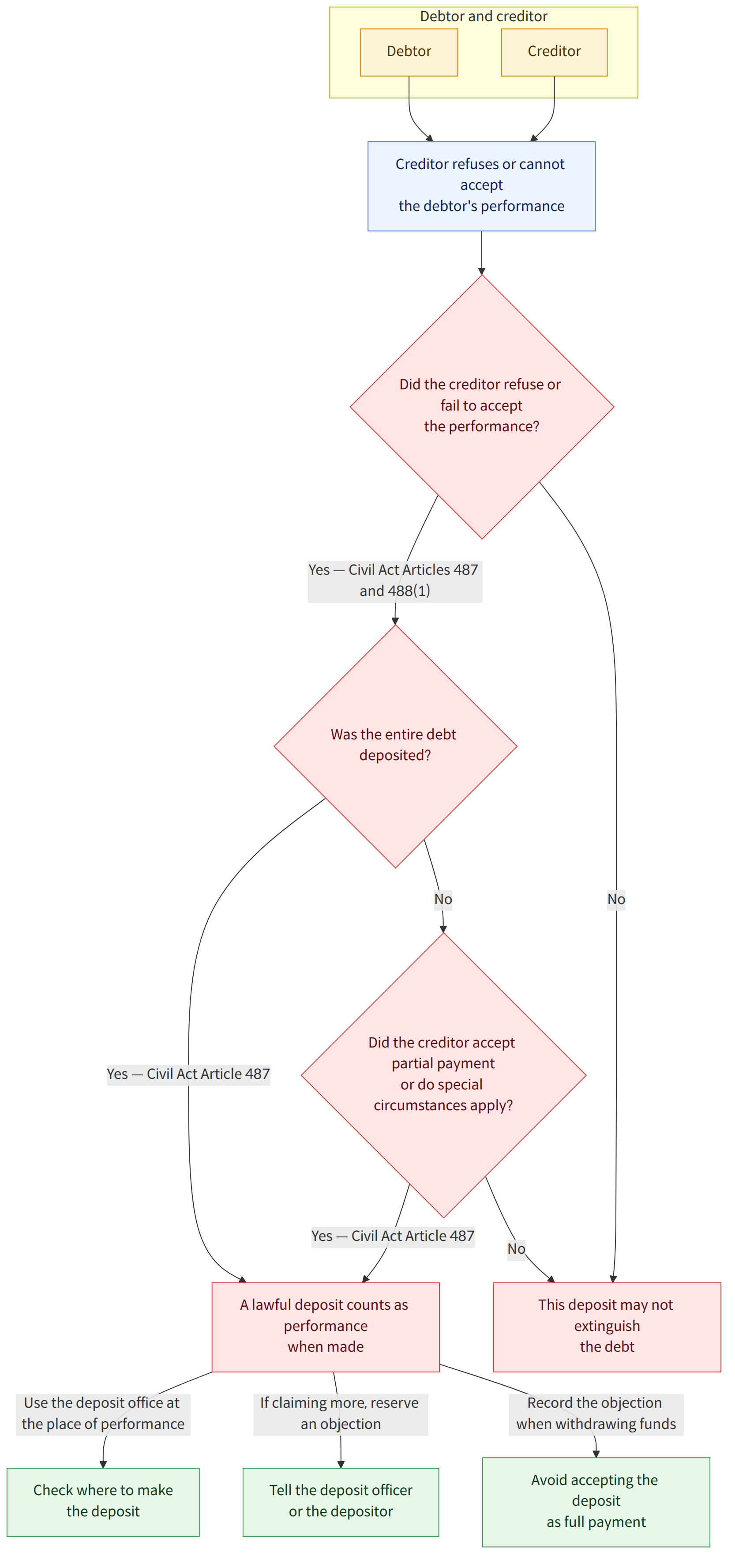
- If the creditor refuses or is unable to accept performance, the debtor may make a deposit for performance for the creditor; a lawful deposit takes effect as performance when made (Civil Act, Articles 487 and 488(1) (민법 제487조, 제488조 제1항)).
- As a general rule, the entire amount of the debt must be deposited. A partial deposit may not take effect as performance unless the creditor accepts it or special circumstances warrant treating partial performance as effective (Civil Act, Article 487 (민법 제487조); Supreme Court Decision 2008Da10051, July 10, 2008).
- If you intend to make an additional claim after collecting deposited funds, it is important to reserve an objection stating that you accept the funds as partial payment. The objection may be made to the deposit officer or the depositor (Cases 10 and 21).
- Setoff requires, among other things, that the debts be of the same kind and that both be due. A declaration of intent to set off is required; a claim barred by the statute of limitations may also be set off if it could have been set off before the limitation period expired (Civil Act, Articles 492(1), 493, and 495 (민법 제492조 제1항, 제493조, 제495조)).
- As a general rule, it is difficult to assert a setoff against a garnishing creditor using a claim acquired after the claim was garnished. However, claims whose basis existed before the garnishment and that are concurrently performable with the claim subject to garnishment may be treated differently (Civil Act, Article 498 (민법 제498조); Case 22).
- A guarantor or other person with a legitimate interest in performing the obligation may be subrogated to the creditor upon payment, but the rights that may be exercised are limited to the scope of the right of recourse (Civil Act, Articles 481 and 482 (민법 제481조, 제482조)).
- If the creditor intentionally or negligently causes security to be lost or diminished, a person subrogated by operation of law may be discharged to the extent that they cannot obtain reimbursement. However, this rule does not apply to security that was already extinguished before the guarantee or other basis for subrogation by operation of law was established (Civil Act, Article 485 (민법 제485조); Cases 23 and 25).
- As a general rule, when a claim and an obligation become vested in the same person, the claim is extinguished by merger. An exception may apply where there is a legitimate reason for preserving the claim, such as the rights of a third party (Civil Act, Article 507 (민법 제507조); Case 14).
Frequently asked questions
Q. What should I do if the creditor refuses to accept payment?
If the creditor refuses or is unable to accept performance, the debtor may make a deposit for performance with the deposit office at the place of performance. If the deposit is lawful, it takes effect as performance when made, regardless of whether the creditor has collected the deposited funds (Case 2).
Q. Will my debt be extinguished if I deposit less than the full amount owed?
As a general rule, the entire amount of the debt must be deposited. A partial deposit may not extinguish the debt unless the creditor accepts it or special circumstances warrant treating partial performance as effective (Cases 2 and 10).
Q. If I accept deposited damages, can I no longer claim the remaining damages?
If the deposit was made on the basis that it constituted full payment of the debt, accepting it without reserving an objection may be treated as acceptance in accordance with the stated purpose of the deposit. If you intend to make an additional claim, it is advisable to reserve an objection stating that you accept the deposited funds as partial compensation for damages, and to note this on the application to withdraw the deposited funds (Cases 10 and 21).
Q. If we each owe money to the other, are the debts automatically set off?
Setoff does not occur automatically. The debts must be of the same kind and, among other requirements, must be due; a declaration of intent to set off is also required (Cases 5, 7, and 18).
Q. Can rent barred by the statute of limitations still be deducted from the lease deposit?
The issue is whether the rent claim and the obligation to return the lease deposit were capable of being set off against each other before the limitation period for the rent claim expired. The Civil Act provides that a claim may be set off if it could have been set off before the limitation period expired. The specific dates on which the claims arose and when the obligations became due must therefore be checked (Case 7).
Q. Can I set off a claim against a garnished claim using a claim that arose after the garnishment?
As a general rule, it is difficult to assert a setoff against a garnishing creditor using a claim acquired after a garnishment order was issued. However, exceptions may apply to claims whose basis existed before the garnishment and that are concurrently performable with the claim subject to garnishment. The basis on which the claim arose and whether the obligations are concurrently performable must therefore be examined (Case 22).
Q. If a guarantor pays on the debtor’s behalf, can they also exercise the original creditor’s security rights?
A guarantor or other person with a legitimate interest in performing the obligation may be subrogated to the creditor upon payment, and may exercise rights relating to the claim and its security to the extent of the right of recourse. However, without a right of recourse, the person cannot exercise the creditor’s rights by subrogation; for a person who makes only partial payment, the amount paid and the scope of the right of recourse may limit those rights (Cases 8, 9, and 13).
Q. Is it safe to pay a person who received an assignment order for a claim subject to competing garnishments?
An assignment order concerning a claim subject to competing garnishments may be ineffective, so paying the person who received the assignment order immediately is risky. The third-party debtor may consider making a deposit to satisfy the enforcement obligation. Even if payment is made to a person who received an invalid assignment order, its effect may depend on whether the payer acted in good faith and without negligence (Case 19).
Q. If the debtor and creditor become the same person through inheritance, is the claim extinguished?
As a general rule, when a claim and an obligation become vested in the same person, the claim is extinguished by merger. However, it may remain in existence if there is a legitimate reason for preserving it; the specific circumstances, including the exercise of rights against third parties, must be considered (Case 14).
Relevant laws
- Civil Act, Article 378 (민법 제378조)
- Civil Act, Article 470 (민법 제470조)
- Civil Act, Article 476 (민법 제476조)
- Civil Act, Article 477 (민법 제477조)
- Civil Act, Article 479 (민법 제479조)
- Civil Act, Article 481 (민법 제481조)
- Civil Act, Article 482 (민법 제482조)
- Civil Act, Article 485 (민법 제485조)
- Civil Act, Article 487 (민법 제487조)
- Civil Act, Article 488(1) (민법 제488조 제1항)
- Civil Act, Article 490 (민법 제490조)
- Civil Act, Article 492(1) (민법 제492조 제1항)
- Civil Act, Article 493 (민법 제493조)
- Civil Act, Article 495 (민법 제495조)
- Civil Act, Article 498 (민법 제498조)
Watch out for
- Before making a deposit, confirm that the grounds for the deposit and the amount are correct. A partial deposit may not extinguish the debt.
- If you intend to make an additional claim after collecting deposited funds, it is safer to clearly reserve an objection stating that you accept the funds as partial payment.
- For claims subject to garnishment, provisional attachment, or an assignment order, first confirm to whom and by what method payment should be made. An incorrect payment may mean that you have to pay again.
- The effect of a payer’s subrogation and discharge due to the loss of security may depend on whether a right of recourse exists, as well as when and why the security was lost.
Related articles
Source cases
This guide was compiled by AI from the following Korea Legal Aid Corporation consultation cases (in Korean).
- 제권판결 선고로 사고신고담보금을 지급한 후 제권판결 취소된 때 은행책임
- 채권자가 변제받기를 거부할 경우 채무자의 변제공탁방법
- 훔친 통장과 도장 등으로 예금이 인출된 경우 은행의 책임여부
- 약관조항이 무효인 경우 손해배상예정액으로 감액할 수 있는지
- 판결로 확정된 채권을 자동채권으로 상계항변 할 수 있는지
- 계약당사자 일방에게 불리한 약관도 효력이 있는지
- 임대차 존속 중 차임채권의 소멸시효가 완성된 후 임대인이 소멸시효가 완성된 차임채권을 자동채권으로 삼아 임대차보증금 반환채무와...
- 물상보증인이 채무를 변제하였으나 다른 사정에 의하여 채무자에 대하여 구상권이 없는 경우, 물상보증인이 채권자를 대위하여 채권자...
- 형식상 주채무자가 보증채무를 이행한 연대보증인에 대한 구상의무 범위
- 형사사건의 가해자가 합의금조로 공탁한 돈을 찾을 경우 그 효력
- 가맹점계약상 ‘판매지역권’을 부당하게 침해하는 조항도 효력이 있는지
- 보증채무와 주채무가 변제이익에 있어 우열이 있는지 여부
- 일부 대위변제자의 채무자에 대한 구상채권에 대하여 보증한 자가 자신의 보증채무를 변제함으로써 일부 대위변제자를 다시 대위하는 ...
- 자동차 운행 중 사고로 인한 손해배상채권과 채무가 상속으로 동일인에게 귀속하는 경우 피해자의 운행자에 대한 손해배상청구권이 상...
- 채권자의 잘못으로 배당받지 못한 금액에 대한 연대보증인의 면책 여부
- 지방자치단체의 택지공급계약서가 약관규제법상의 약관에 해당되는지
- 근로복지공단이 유족급여를 지급하고 유족급여수급자를 대위하여 행사하는 보험사업자등 제3자에 대한 손해배상채권에 대하여, 구 자동...
- 송금의뢰인이 수취인의 계좌 착오로 송금한 경우, 수취은행이 수취인에 대한 대출채권을 자동채권으로 하여 상계하는 것이 유효한지 ...
- 무효인 전부명령권자에 대한 제3채무자의 변제가 효력이 있는지
- 국내통화로 외화채권에 변제충당할 경우 그 환산기준시점은 언제인지
- 공탁금수령에 관한 이의유보의 의사표시는 누구에게 하여야 하는지
- 수동채권과 동시이행관계인 자동채권이 압류 후 발생하여도 상계 가능한지
- 채권자의 고의·과실로 담보상실 된 경우 법정대위권자의 면책범위
- 은행이 공동명의예금자 중 1인에 대한 채권으로 예금채권과 상계가 가능한지
- 법정대위의 전제가 되는 보증 등의 시점 이전에 이미 소멸한 채권자의 담보에 대해서 민법 제485조가 적용되는지 여부
This guide is general legal information about Korean law, not legal advice for your situation. For a specific case, consult a lawyer or the Korea Legal Aid Corporation (call 132 in Korea).