
Crimes Against Reputation: A Guide to Defamation and Criminal Insult
Based on 28 consultation cases · Updated · Translated from the Korean original.
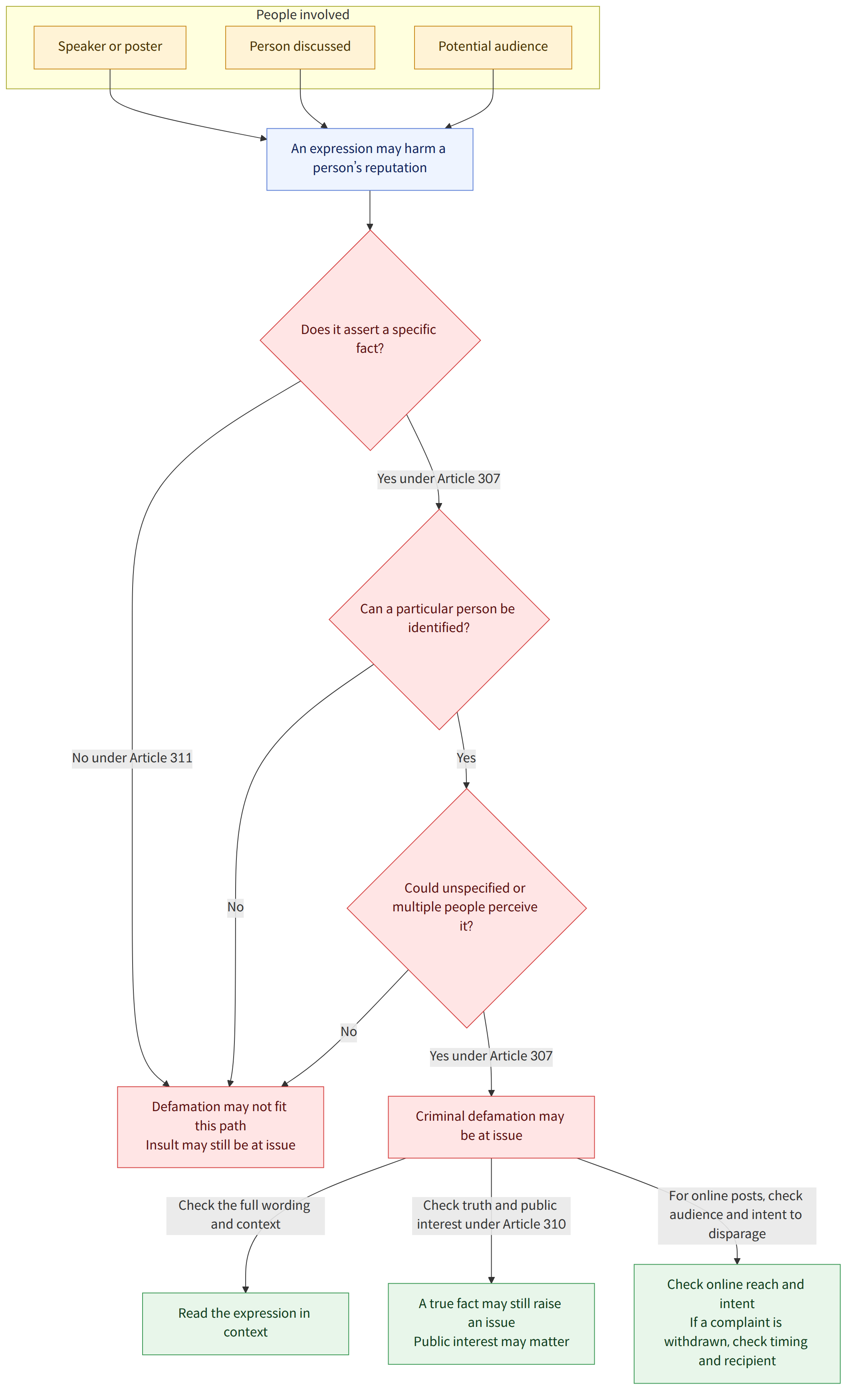
The key issue in criminal defamation is whether specific facts that could lower a particular person’s social standing were disclosed publicly; in criminal insult, it is whether contemptuous language was used without asserting a fact. The content and context of the expression, the scope of its audience, the likelihood of dissemination, and the public interest must all be considered, so it is difficult to decide uniformly based only on the words spoken or posted.
At a glance
Key points
- For criminal defamation, an assertion of fact must be a statement concerning a specific past or present state of affairs. An indirect expression may also qualify if it implies a particular fact and is specific enough to lower social standing (Criminal Act, Article 307 (형법 제307조); Cases 3, 5, and 12).
- The victim must be identifiable, but the person’s real name need not be disclosed. Even an ID or collective expression may identify the victim if the person it refers to can be recognized from the surrounding circumstances (Cases 4 and 14).
- Publicity means a state in which an unspecified or multiple number of people can perceive the expression. Even if something was said to only one person, issues may arise as to whether the speaker was aware of the likelihood of dissemination and accepted that risk (Cases 5, 10, 15, 21, and 25).
- An assertion of a true fact may still raise an issue of defamation. However, an act under Article 307(1) of the Criminal Act (형법 제307조 제1항) is not punishable if it concerns a true fact and is solely in the public interest (Article 310 of the Criminal Act (형법 제310조); Cases 7 and 13).
- Defamation by publication and similar means requires an intent to disparage. An expression concerning the public interest may, absent special circumstances, negate such intent. Article 310 of the Criminal Act (형법 제310조) does not apply to this offense (Articles 309 and 310 of the Criminal Act (형법 제309조·제310조); Cases 2 and 6).
- Criminal insult may be at issue where, without asserting a specific fact, a person expresses an abstract judgment or contemptuous feeling that could lower social standing. Even rude or vulgar language may not constitute an insult that lowers a person’s standing if the context does not support that conclusion (Article 311 of the Criminal Act (형법 제311조); Cases 5, 8, 20, and 23).
- For online posts, it is necessary to consider whether multiple users can view them, whether they assert facts, and whether there was an intent to disparage. Consumer reviews and criticism concerning matters of public interest are also assessed with consideration for the public interest and the purpose of the expression (Article 70 of the Act on Promotion of Information and Communications Network Utilization and Information Protection, Etc. (정보통신망 이용촉진 및 정보보호 등에 관한 법률 제70조); Cases 1, 3, and 11).
- In defamation and insult cases, the timing and recipient of a withdrawal of a complaint or similar action are important. A complaint may be withdrawn before the first-instance judgment is pronounced; after prosecution has been initiated, the withdrawal must be made to the court hearing the case (Articles 232 and 327 of the Criminal Procedure Act (형사소송법 제232조·제327조); Case 22).
Frequently asked questions
Q. Will I be guilty of criminal defamation if I post a negative review online?
A review does not automatically constitute criminal defamation. It is necessary to consider together whether it concerns a service you personally experienced, whether it was expressed in the public interest, whether there was an intent to disparage, and the scope of the posting and the manner of expression. An intent to disparage is also an issue in defamation through an information and communications network.
Q. Can it be defamation if I imply or indirectly suggest something that is not true?
Even if you do not state a fact directly, your words may amount to an assertion of fact if, taken as a whole, they imply the existence of a specific fact and could lower a particular person’s social standing. Whether an expression is merely an opinion or evaluation, or conveys a specific fact, is determined by examining the words used, their context, and other circumstances.
Q. Can publicity be established even if I spoke to only one person?
Publicity may be found even where something was said to only one person if it was likely to be spread to unspecified or multiple people. However, likelihood of dissemination alone does not always establish publicity; the specific circumstances must be considered, including whether the speaker was aware of that likelihood and accepted the risk. There may also be circumstances indicating that dissemination was unlikely, such as speaking in a whisper to the other person.
Q. Can the victim be identified even if I used an online ID or group name instead of a real name?
It is not necessary to use a person’s real name. A victim may be identified if the person can be recognized by considering the expression and surrounding circumstances together. Conversely, if it is difficult to tell who someone is from an online ID alone and there are no other clues, the victim may not be considered identifiable. Whether a collective expression identifies a victim also depends on whether a particular person within the group is clearly identifiable.
Q. Will I avoid punishment if I disclosed a true fact in the public interest?
Article 310 of the Criminal Act (형법 제310조) provides that an act under Article 307(1) of the Criminal Act (형법 제307조 제1항) is not punishable if it concerns a true fact and is solely in the public interest. The public interest may include the interests and concerns of a particular social group or all of its members. The content and scope of the expression, its purpose and manner, and the extent of harm to reputation are considered together. This provision does not apply to defamation by publication and similar means.
Q. Are all swear words or insulting comments about someone’s appearance criminal insults?
The standard for criminal insult is whether a person expressed an abstract judgment or contemptuous feeling, without asserting a fact, that could lower another person’s social standing. Even if an expression is rude or vulgar, criminal insult may not be established if, considering the circumstances in which it was said and the context as a whole, it does not lower the social standing of the other person’s personal worth.
Q. Can a post criticizing a public official or local government also be defamation?
Criticism concerning a public official’s public activities or a matter of public concern is assessed with consideration for freedom of expression and the public interest. However, even an expression concerning a public matter may be restricted if it is a malicious attack based on a clearly false statement that goes beyond permissible exaggeration or is manifestly unreasonable. There are also cases holding that the State or a local government itself cannot be a victim of criminal defamation or criminal insult under the Criminal Act.
Q. Does signing a settlement agreement automatically end a defamation or insult trial?
It does not end automatically. According to the cases, withdrawal of a complaint or withdrawal of an expressed wish not to have the person punished must take place before the first-instance judgment is pronounced. After prosecution has been initiated, the withdrawal must be submitted to the court hearing the case. If it has not been submitted to the court before the first-instance judgment is pronounced, the court may not be able to issue a judgment dismissing the prosecution.
Relevant laws
- Criminal Act, Article 20 (형법 제20조)
- Criminal Act, Article 307(1) and (2) (형법 제307조 제1항·제2항)
- Criminal Act, Article 309(1) and (2) (형법 제309조 제1항·제2항)
- Criminal Act, Article 310 (형법 제310조)
- Criminal Act, Article 311 (형법 제311조)
- Act on Promotion of Information and Communications Network Utilization and Information Protection, Etc., Article 70(1) and (2) (정보통신망 이용촉진 및 정보보호 등에 관한 법률 제70조 제1항·제2항)
- Constitution of the Republic of Korea, Article 124 (헌법 제124조)
- Framework Act on Consumers, Article 4 (소비자기본법 제4조)
- Criminal Procedure Act, Article 232(1) and (3) (형사소송법 제232조 제1항·제3항)
- Criminal Procedure Act, Article 327(5) and (6) (형사소송법 제327조 제5호·제6호)
Watch out for
- Publicity is not determined solely by whether several people actually heard the statement. Even a statement made to one person may raise issues concerning the likelihood of dissemination and whether the speaker was aware of and accepted that risk.
- Whether an expression is fact or opinion, whether the victim is identifiable, and whether the expression is specific enough to lower social standing depend not only on the wording but also on the context as a whole and the surrounding circumstances.
- The exclusion from punishment in the public interest under Article 310 of the Criminal Act (형법 제310조) concerns cases under Article 307(1) of the Criminal Act (형법 제307조 제1항). The cases explain that it does not apply to defamation by publication and similar means.
- A complaint must be withdrawn, or the wish to have the person punished withdrawn, before the first-instance judgment is pronounced. After prosecution has been initiated, the withdrawal must be made to the court hearing the case, not to an investigative agency.
Source cases
This guide was compiled by AI from the following Korea Legal Aid Corporation consultation cases (in Korean).
- 소비자가 인터넷에 이용 후기를 게시한 경우 명예훼손죄의 성립 여부
- 공공의 이익을 위한 경우 출판물 등에 의한 명예훼손죄 여부
- 인터넷에 악성댓글을 게재한 경우 명예훼손죄의 성립 여부
- 인터넷에 허위사실을 게시한 경우 명예훼손죄 성립 여부
- 말다툼 중 사기꾼이라고 한 경우 명예훼손죄 성립 여부
- 인쇄물 몇 장을 배포한 경우 출판물 등에 의한 명예훼손 성립 여부
- 형법 제310조의 위법성조각사유인 ‘오로지 공공의 이익에 관한 때’의 의미와 판단 기준
- 신고를 받고 출동한 경찰에게 욕설을 한 경우 모욕죄의 성립 여부
- 인터넷에 타인에 대한 의견을 게시한 경우 명예훼손죄의 성립 여부
- 남편친구에게 남편명예를 훼손할 서신을 보낸 경우 처벌 여부
- 대통령에 대한 정책비판 등에 관한 동영상 게재가 명예훼손에 해당하는지
- 명예훼손죄 성립에 필요한 ‘사실의 적시’ 정도
- 형법 제310조의 위법성조각사유인 ‘공공의 이익’의 의미
- 피해자를 집합적 명사로 표현한 경우 명예훼손죄 성립 여부
- 명예훼손죄에서 ‘공연성’의 의미
- 기자회견이 허위사실 적시에 의한 명예훼손이 되기 위한 요건
- 다른 종교의 신앙 대상을 우스꽝스럽게 묘사하는 것 등이 허용되는지
- 국가나 지방자치단체가 명예훼손죄의 피해자가 될 수 있는지
- 명예훼손죄가 성립하기 위한 '사실의 적시'와 그 정도
- 모욕죄에서 말하는 ‘모욕’의 의미 및 위법성조각사유
- 명예훼손죄에 있어서 ‘공연성’의 의미
- 친고죄에서 고소취소 시기 및 그 상대방
- 모욕죄에서 말하는 ‘모욕’의 의미
- 인터넷 게임 채팅창에 외모 비하 발언을 한 경우 명예훼손죄의 성립 여부
- 명예훼손죄에 있어서 ‘공연성’의 의미
This guide is general legal information about Korean law, not legal advice for your situation. For a specific case, consult a lawyer or the Korea Legal Aid Corporation (call 132 in Korea).